AMD Zen Deep Neural Network (ZenDNN)

Overview
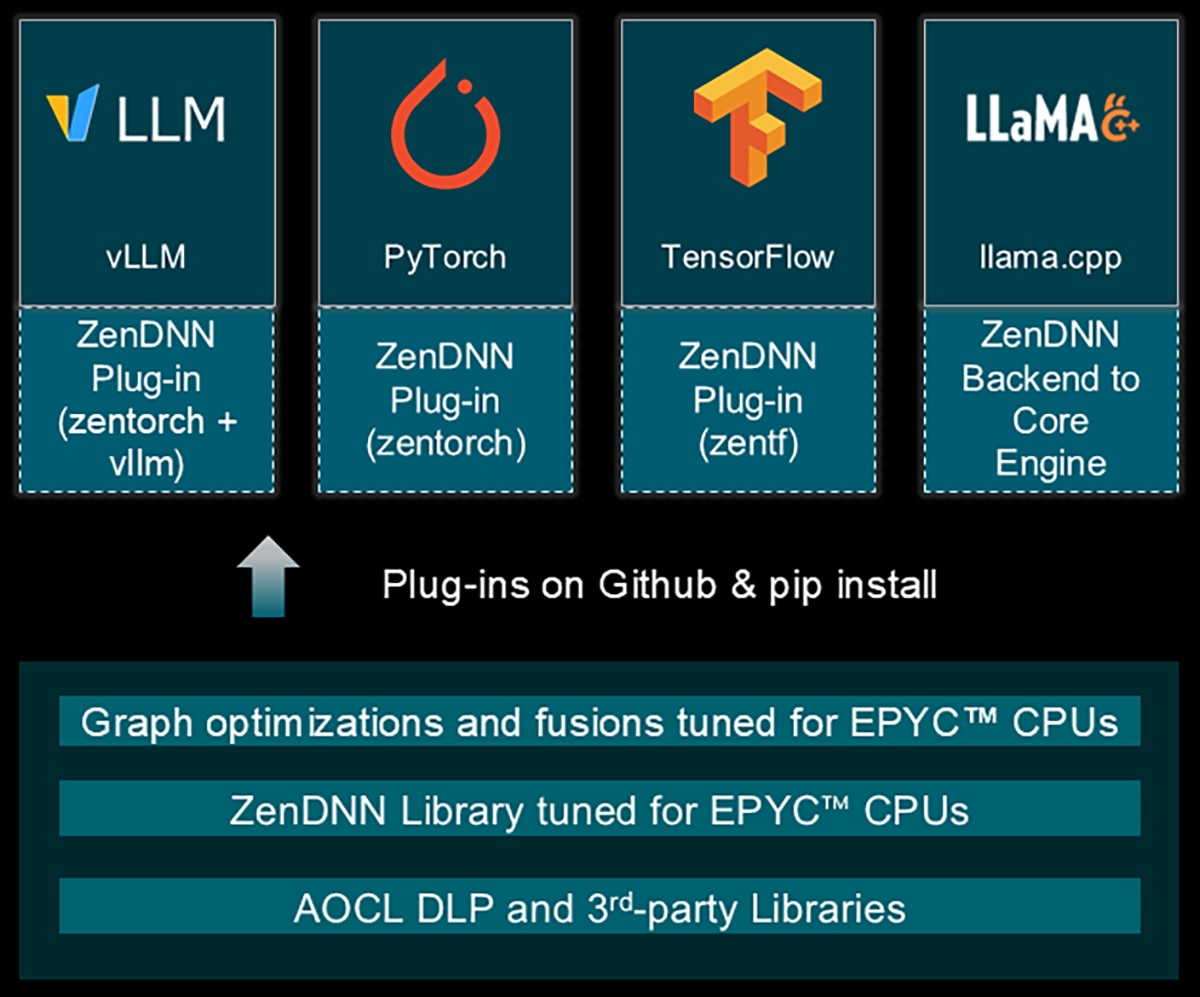
ZenDNN is a deep neural network acceleration inference library optimized for AMD “Zen” CPU architecture. ZenDNN library comprises of a set of fundamental building blocks and APIs designed to enhance performance for AI inference applications primarily targeting AMD EPYC™ server CPUs. ZenDNN plugs into mainstream AI frameworks offering developers seamless experience in developing cutting edge AI applications. This library continues to redefine deep learning performance on AMD EPYC™ CPUs, combining relentless optimization, innovative features, and leading-edge support for modern workloads.
ZenDNN at a Glance
- Delivers high performance over diverse AI workloads such as LLMs, NLP, Vision, and Recommendation Systems without significant engineering efforts offering ease of integration into existing x86 DL environment.
- Provides freedom of vendor choice by building upon open-source projects such as oneDNN. ZenDNN offers zero to minimal code modifications for existing x86 applications and at the same time supports additional APIs designed to deliver higher performance.
- ZenDNN is optimized to benefit from higher core counts and large L3 caches on AMD EPYC CPUs helping users derive TCO advantages.
ZenDNN Provides:
- Efficient multi-threading on large number of CPU cores
- Enhanced microkernels for efficient low level math operations
- Optimized Mempools
- Comprehensive graph optimizations and kernel fusions
- Broad framework supports: PyTorch, TensorFlow and integrated ONNX runtime
- Opensource code
Getting Started
Below is a comprehensive ZenDNN User Guide that covers the release highlights and installation instructions for PyTorch and TensorFlow. For the performance tuning enthusiasts, learn about extra tips and tricks under the Performance Tuning chapter. To read more about current and previous releases, check out the ZenDNN Release Blog tab.
Documentation
ZenDNN Library: https://github.com/amd/ZenDNN
ZenDNN Plugin for PyTorch: https://github.com/amd/ZenDNN-pytorch-plugin
ZenDNN Plugin for TensorFlow: https://github.com/amd/ZenDNN-tensorflow-plugin
Blogs and Media
AMD ZenDNN Explained: AI Inferencing Power You Didn't Know You Had

ZenDNN Blogs
Get started with ZenDNN to enhance AI performance on AMD EPYC™ server CPUs.
To read more about current and previous releases, see the AMD Technical Articles and Blogs.
What’s New
- 6.0
- 5.2.1
- 5.2
- 5.1
- 5.0.2
- 5.0.1
- 5.0
6.0 Release Highlights
ZenDNN 6.0.0 is a major release building on the 5.2.1 runtime architecture. It deepens the Low Overhead API (LowOHA) as the primary inference path, expands MoE group GEMM and FP16 operator coverage, and adds production-grade post-op and weight caching, with corresponding extensions to BenchDNN, gtests, and operator documentation.
Highlights at a Glance
- MoE / Group MatMul
- Regime-aware AUTO routing (decode vs. prompt)
- F16 group matmul support
- Group Dynamic Quant API
- N-tile DQ-INT8 and M-tile vertical-fusion custom kernels
- Gated-activation enhancements
- New runtime knob: ZENDNNL_GRP_MATMUL_ALGO
- FP16 Expansion
- FP16 coverage now includes SDPA, normalization, quant reorder, quant embedding, and softmax, extending the F16 matmul paths already present in 5.2.1 (AOCL DLP and OneDNN)
- Caching
- Post-op metadata cache
(ZENDNNL_ENABLE_POSTOP_CACHE) - In-place weight caching
(ZENDNNL_MATMUL_WEIGHT_CACHE=2) - Weight-reorder and ZP-compensation caches are now enabled by default
- Post-op metadata cache
- Quantization
- Vectorized per-group dynamic quant kernel
- BenchDNN dynamic-quantization workloads
- AutoTuner
- The ZENDNNL_MATMUL_AUTO_ALGO_CANDIDATES environment variable customizes the algorithm evaluation sequence
- BenchDNN
- SDPA and normalization workloads
- MoE fused inputs
- Group-matmul hardware perf-counter infrastructure
- Activations
- MISH activation support
- Float conversion paths in reorder (FP32 <-> FP16/BF16)
- Build & Compatibility
- CMake minimum raised to 3.26
ZenDNN Plugin for PyTorch (zentorch)
Overview
This is a major zentorch release that significantly expands framework support, introduces groundbreaking optimizations for Mixture of Experts (MoE) architectures, and enhances quantization capabilities for Large Language Models and Recommender Systems on AMD EPYC™ CPUs. This release transitions to PyTorch-aligned versioning, adds vLLM support up to version 0.23.0, introduces limited FP16 support for select operations, AOTI (Ahead of Time Inductor) integration, and delivers substantial performance improvements through Fused MoE operations and optimized group matmul kernels.
Improvements
1. Framework and Version Support
- PyTorch 2.12.0 Support: Full compatibility with PyTorch 2.12.0 in addition to PyTorch 2.11.0
- New plugin versioning scheme: Changed from independent ZenDNN versioning (6.0.0) to PyTorch-aligned format (v2.12.0.2, v2.11.0.2)
- Format:
{PYTORCH_MAJOR}.{PYTORCH_MINOR}.{PYTORCH_PATCH}.{ZENTORCH_PLUGIN_PATCH} - Enables clearer compatibility and smoother upgrade paths
- Format:
- vLLM 0.20.0–0.23.0 Support: Extended vLLM compatibility across major releases
- Out-of-tree plugin runtime support starts at vLLM 0.20.0
- Dropped support for vLLM 0.15.0–0.19.1
- Zen optimizations and features are upstreamed and available via the in-tree ZenCpuPlatform on vLLM for AMD EPYC CPUs with AVX512 ISA support
- TorchAO 0.17.0 Support: Enhanced quantization framework compatibility
- TorchAO 0.17.0 for vLLM 0.20.0–0.23.0 and PyTorch 2.11.0
2. Mixture of Experts (MoE) Optimizations
- Group Matmul: Parallel group matrix multiplication operator (zentorch_group_matmul) for batched expert computation with gated activation post-ops (SiLU, GELU, SwigluOAI), MoE weighted-reduce fusion, INT8 quantization support, and ZenDNN LowOHA backend
- Fused MoE: End-to-end MoE FFN block optimization (zentorch_fused_moe) integrating gate+up → activation → down → weighted reduce workflow with active-set narrowing, buffer aliasing, persistent scratchpads, and vLLM integration
- Quantized MoE: TorchAO INT8 quantized MoE model support with DA8W8 (dynamic INT8 activation, INT8 weights) integration
- MoE Model Support: Phi-4 Vision, and GatedDeltaNet (GDN) architecture enablement
3. Quantization Enhancements
- LLM-Compressor Integration: Support for externally quantized models
- W8A8 (INT8 weights and activations) and W4A16 (INT4 weights, BF16 activations) quantization schemes
- Compatible with vLLM v0.22.0+ for LLM-Compressor quantized models
- llm-compressor 0.10.0.2 for model quantization
- Pre-quantized models on Hugging Face supported out-of-the-box
- MoE Model Support: LLM-Compressor quantized MoE models are not supported in this release of zentorch
- Quantization Improvements:
- Improved WOQ fusions with better pattern matching
- Accuracy improvements across quantized LLM models
4. FP16 (Float16) Support — Limited
- Limited FP16 Operations: Native float16 inference for select operations
- Linear operations and all linear fusions (linear-unary, linear-binary, linear-unary-binary)
- Matrix multiplication (mm, bmm, addmm, baddbmm) with FP16 tensors
- Embedding and EmbeddingBag operations
- SDPA (Scaled Dot-Product Attention) FP16 support
- Weight prepacking for FP16
- Hardware Requirements: AVX512-FP16 ISA support required
- Known Limitations: FP16 not supported for quantized operations (WOQ, qlinear), convolution in this release
5. Performance Optimizations
- SDPA Integration: ZenDNN Scaled Dot-Product Attention kernels
- Optimized attention computation for LLM inference
- FP16 and BF16 SDPA support
- RMS Norm Optimization:
- Integrated ZenDNN RMS Norm operations
- Fused Add+RMS Norm for reduced memory bandwidth
- vLLM RMSNorm.forward patching for CPU acceleration
- Hardware Compatibility:
- AVX512 detection with graceful fallback to native PyTorch on unsupported hardware
6. vLLM Plugin Enhancements
- Plugin Architecture: Comprehensive restructuring for improved stability
- Cleaner separation between platform and general plugin entry points
- GEMM dispatch optimization and oneDNN bypass for zentorch kernels
- Fused RMS Norm integration in vLLM plugin
- TorchAO 0.17.0 patch support for vLLM 0.20.0–0.23.0
7. AOTI Integration
- Shim wrappers and lowerings: cpp_wrapper support for zentorch backend in torch.compile path
- QLinear, Linear and WoQ AOTI shim support along with their fused variants
- QuantEmbeddingBag AOTI shim for quantized embedding operations
- Enhanced performance for DLRMv2 model
Breaking Changes
- Dropped PyTorch 2.10.0 Support: PyTorch 2.10.0 is no longer supported; use PyTorch 2.11.0 or 2.12.0
- Dropped vLLM 0.15.0–0.19.1 Support: Minimum supported vLLM version is now 0.20.0 for out-of-tree plugin
- orchAO Version Requirements:
- vLLM 0.20.0–0.23.0 requires TorchAO 0.17.0 for execution
- AMD Quark Deprecation: AMD Quark is no longer required for quantization; TorchAO is now the standard quantization framework for zentorch
Known Issues
- GLIBCXX version conflicts may require setting LD_PRELOAD (see README)
- Experimental Python versions (3.13T, 3.14, 3.14T) are not supported
- FP16 support limited to core operations (linear, mm variants, embedding, SDPA); not available for quantized operations, convolution
- AVX512 instruction set required for optimal performance; fallback to native PyTorch on non-AVX512 system
ZenDNN Plugin for TensorFlow (zentf)
Improvements
1. Framework and Version Support
- TensorFlow 2.21.0 Support: Full compatibility with TensorFlow 2.21.0 through TensorFlow 2.16.1
- New plugin versioning scheme: Changed from independent ZenDNN versioning (6.0.0) to TensorFlow-aligned format (v2.21.0.0)
- Format:
{TENSORFLOW_MAJOR}.{TENSORFLOW_MINOR}.{TENSORFLOW_PATCH}.{ZENTF_PLUGIN_PATCH}
- Format:
2. Features Support
- Einsum Operator Support
- Supports ij,jk->ik (2D matmul) and abc,bcd->abd (batched matmul for MoE)
- FP32 and BF16 support
- ZenGroupEmbedding Fusion
- Fuses GatherV2 + SafeCast + ConcatV2 into a single op
- Multi-table embedding support with strided gather
- Eliminates concat overhead
- ZenSafeEmbeddingLookupSparse Fusion
- Fuses SparseFillEmptyRows → SparseSegment → SelectV2 subgraph
3. Build Info Enhancements
- Added zentf.__version__ and zentf.__config__ attributes
- Runtime version / config introspection
4. TF-Java Support
- TF-Java interface ported to TF 2.21.0
Binaries Download Links:
| ZenDNN Plug-in for PyTorch (Built with PyTorch 2.11.0) |
Description | MD5SUM |
| ZENTORCH_v2.11.0.2_Python_v3.10.zip | This zip file contains the zentorch wheel file and the necessary scripts to set up the environment variables. Compatible with Python version 3.10 | 750cda740b8070bfa267da18411be038 |
| ZENTORCH_v2.11.0.2_Python_v3.11.zip | This zip file contains the zentorch wheel file and the necessary scripts to set up the environment variables. Compatible with Python version 3.11 | a0c7bbe3fa24d50f8a89ff68735c7954 |
| ZENTORCH_v2.11.0.2_Python_v3.12.zip | This zip file contains the zentorch wheel file and the necessary scripts to set up the environment variables. Compatible with Python version 3.12 | 57767d3f26599b3dd1da5c7134025070 |
| ZENTORCH_v2.11.0.2_Python_v3.13.zip | This zip file contains the zentorch wheel file and the necessary scripts to set up the environment variables. Compatible with Python version 3.13 | aa382ee0ef1709113d2324a8c7bfde82 |
| Note: Above packages can be used for LLM executions with vLLM and non LLM executions | ||
| ZenDNN Plug-in for PyTorch (Built with PyTorch 2.12.0) |
Description | |
| ZENTORCH_v2.12.0.2_Python_v3.10.zip | This zip file contains the zentorch wheel file and the necessary scripts to set up the environment variables. Compatible with Python version 3.10 | 4b6d35592bd5b5419a55928cde966869 |
| ZENTORCH_v2.12.0.2_Python_v3.11.zip | This zip file contains the zentorch wheel file and the necessary scripts to set up the environment variables. Compatible with Python version 3.11 | 9e93d8f624b3cb802c9b21d7fcfc36bb |
| ZENTORCH_v2.12.0.2_Python_v3.12.zip | This zip file contains the zentorch wheel file and the necessary scripts to set up the environment variables. Compatible with Python version 3.12 | 1927836762eeab1292eb26cd50c267fb |
| ZENTORCH_v2.12.0.2_Python_v3.13.zip | This zip file contains the zentorch wheel file and the necessary scripts to set up the environment variables. Compatible with Python version 3.13 | ac4eedaa1cf7b399b595274e23bd54bf |
| Note: Above packages can be used for non LLM executions | ||
| ZenDNN Plug-in for TensorFlow (Built with TensorFlow 2.20.0) | Description | MD5SUM |
| ZENTF_v2.20.0.0_Python_v3.10.zip | This zip file contains the zentf wheel file and the necessary scripts to set up the environment variables. Compatible with Python 3.10 | c9ebcb6f9118cc63b2ab07f432b0ce66 |
| ZENTF_v2.20.0.0_Python_v3.11.zip | This zip file contains the zentf wheel file and the necessary scripts to set up the environment variables. Compatible with Python 3.11 | 5a1df463d835d524d2a39b6944f4c051 |
| ZENTF_v2.20.0.0_Python_v3.12.zip | This zip file contains the zentf wheel file and the necessary scripts to set up the environment variables. Compatible with Python 3.12 | 8b311adc4bbf861a383f71c903e8309e |
| ZENTF_v2.20.0.0_Python_v3.13.zip | This zip file contains the zentf wheel file and the necessary scripts to set up the environment variables. Compatible with Python 3.13 | 4f24c62880c8d26f1c1750ac6f015915 |
| ZENTF_v2.20.0.0_Python_v3.9.zip | This zip file contains the zentf wheel file and the necessary scripts to set up the environment variables. Compatible with Python 3.9 | dd41a569a60574b0a13d1cba07cea2da |
| ZENTF_v2.20.0.0_C++_API.zip | This zip file contains the ZenDNN TensorFlow Plug-in with C++ APIs | 971b56eca3f3e4f0d27c0b3e375a5419 |
| ZenDNN Plug-in for TensorFlow (Built with TensorFlow 2.21.0) | Description | MD5SUM |
| ZENTF_v2.21.0.0_Python_v3.10.zip | This zip file contains the zentf wheel file and the necessary scripts to set up the environment variables. Compatible with Python 3.10 | 1871470ff213c4752ce8f7cf96ab2e5b |
| ZENTF_v2.21.0.0_Python_v3.11.zip | This zip file contains the zentf wheel file and the necessary scripts to set up the environment variables. Compatible with Python 3.11 | 6baa1424427917a73eb42d957ad456e4 |
| ZENTF_v2.21.0.0_Python_v3.12.zip | This zip file contains the zentf wheel file and the necessary scripts to set up the environment variables. Compatible with Python 3.12 | b61edbc61846ecf58227a09d071d4115 |
| ZENTF_v2.21.0.0_Python_v3.13.zip | This zip file contains the zentf wheel file and the necessary scripts to set up the environment variables. Compatible with Python 3.13 | 5028124b8b4cfa8b7d330b5f4cb9aafa |
| ZENTF_v2.21.0.0_C++_API.zip | This zip file contains the ZenDNN TensorFlow Plug-in with C++ APIs | 6cc3bb693491e7b090d243afec320a08 |
5.2.1 Release Highlights
ZenDNN 5.2.1 is an incremental update built on the ZenDNN 5.2 runtime architecture, focusing on expanded LOWOHA (Low Overhead APIs) and advanced quantization capabilities, along with performance improvements for matmul and GEMV workloads across multiple backends.
This release strengthens production readiness through reduced reorder overhead, enhanced profiling and regression benchmarking, and richer BenchDNN test coverage.
Key enhancements include expanded WOQ/U4 quantization with new DLP (Deep Learning Primitives) APIs, deeper integration of dynamic and static quantization into matmul and reorder flows, optimized LOWOHA normalization with fused add + RMS norm and AVX 512 kernels, ISA dependent FP16 matmul enablement via AOCL DLP and oneDNN, LIBXSMM BF16 BRGEMM improvements, and AutoTuner enhancements for improved kernel selection.
The underlying ZenDNN 5.2 platform remains unchanged, retaining its modular multi backend architecture, AutoTuner driven dispatch, unified caching, improved threading for key primitives, and low overhead APIs for small GEMM and fused BF16/FP32/INT8 workloads.
ZenDNN Plugin for PyTorch (zentorch)
Overview
- Incremental release built on the zentorch 5.2.0 foundation.
- Adds PyTorch 2.11.0 support, extends vLLM compatibility (0.15.0–0.18.0), and strengthens asymmetric WOQ and INT8 dynamic quantization capabilities.
Key Improvements
- Framework Support
- Support for PyTorch 2.11.0 (in addition to 2.10.0).
- Extended vLLM compatibility: 0.16.0, 0.17.0, 0.17.1, and 0.18.0.
- Performance & Quantization Enhancements
- Optimized vLLM RMSNorm using C++ CPU kernels.
- Asymmetric WOQ support via TorchAO:
- Int4 weight only quantization (Int4WeightOnlyOpaqueTensorConfig).
- Bias support for asymmetric quantized ops.
- Int4OpaqueTensor support using zentorch.
- Fusion support for quantized linear operators.
- NT8 dynamic quantization:
- Integrated dynamic qlinear operator in zentorch backend.
- Enabled execution of dynamically quantized models via vLLM with zentorch.
- Improved WOQ linear operator performance.
- Infrastructure, Testing & Tooling
- Expanded Hypothesis based testing for qlinear and BMM operations.
- Accuracy benchmarking using the LM Eval framework.
- New zentorch weekly PyPI package for development builds.
- Recommended jemalloc via LD_PRELOAD for DLRMv2 quantized model execution.
- Bug Fixes & Accuracy
- Fixed unit tests for qlinear_mul_add, fused WOQ linear, and BMM hypothesis tests.
Compatibility & Known Issues
- Validated only with torchao==0.16.0 for quantized models.
- No breaking changes; fully backward compatible with zentorch 5.2.0.
- Known issues:
- Possible GLIBCXX conflicts (may require LD_PRELOAD).
- Experimental Python versions (3.13T, 3.14, 3.14T) are not supported.
ZenDNN Plugin for TensorFlow (zentf)
Overview
- Minor incremental release on top of zentf 5.2.0..
- Continues focus on inference performance for Recommender Systems and Large Language Models on AMD EPYC™ CPUs.
TensorFlow & Python Support
- TensorFlow 2.21.0 as the primary supported version with optimal performance.
- Distributed via PyPI (Python wheel) and as a C++ package.
- TensorFlow Java main (75402bef) supported via source build only.
- Python 3.10–3.13 fully supported (Python 3.9 dropped).
Key Improvements
- TF 2.21 Integration
- Built for and validated against TensorFlow v2.21.0.
- Upgraded build system from Bazel 7.4.1 to 7.7.0.
- Aligned Python support with TensorFlow (3.10–3.13).
- TensorFlow Java supported via main branch due to lack of official 2.21 release.
- Backward Build Compatibility (TF 2.16–2.21)
- Single unified codebase supports TensorFlow 2.16.0 through 2.21.0.
- ./configure automatically detects TensorFlow version and applies the correct build setup.
- Version specific configs maintained under version_configs/ (TF 2.19–2.21); TF 2.16–2.18 reuse TF 2.19 settings.
- Bazel and third party dependencies (protobuf, abseil, rules_cc) auto adjust per TensorFlow version.
- Standard build workflow remains unchanged and fully transparent to users.
5.2 Release Highlights
ZenDNN Extension for PyTorch (zentorch):
PyTorch Version Support
- PyTorch 2.10.0: Primary support with optimal performance (available via PyPI)
- Python 3.10 - 3.13: Full compatibility with the supported Python versions of PyTorch
Improvements
1. vLLM Integration
- vLLM-ZenTorch Plugin: Zero-code-changes Plug-and-play automatic acceleration for vLLM V1 inference engine
- vLLM Version Support: vLLM 0.12.0 to 0.15.1
2. Quantized Inference Support
LLM Quantization (Weight-Only Quantization) (Experimental):INT4 quantized inference functional support
RecSys Quantization (DLRM-v2):
- Embedding tables: UINT4 asymmetric per-channel weight-only quantization
- Linear layers: W8A8 quantization (INT8 symmetric per-channel for weights, UINT8 asymmetric per-tensor for activations)
- PyTorch 2 Export (PT2E) quantization framework with performance optimizations
- Custom EmbeddingBagUInt4Quantizer for embedding quantization
- X86InductorQuantizer for linear layer quantization
3. Performance Optimizations
- Improved bfloat16 Performance: AMD EPYC™ specific enhancements for bfloat16 operations
- Enhanced Operations with LOA: Low Overhead API optimizations for improved performance
- Optimized Embedding Kernels: Enhanced embedding bag operations with group op support
- Graph Optimizations: Advanced pattern identification and replacement, concat operation folding support
4. Infrastructure and Testing
- Hypothesis Testing Framework: Expanded test coverage with property-based testing
- NumPy 2.x Compatibility: Updated scripts for NumPy 2.x support
- TORCH_COMPILE_DEBUG Support: Full compatibility with PyTorch debugging tools
- Integrated with New ZenDNN Library: Updated to new ZenDNN library with self-managed dependency building
5. Documentation
- Updated README: Comprehensive documentation updates including:
- vLLM plugin usage instructions
- Weight-only quantization guide
- Profiler output interpretation
- Updated examples and usage patterns
- Example Scripts: Added DLRM-v2 quantization example scripts
ZenDNN Extension for TensorFlow (zentf):
TensorFlow Version Support
- TensorFlow 2.20.0: Primary support with optimal performance (available via PyPI and CPP package)
- TensorFlow-Java main(75402bef): Java User interface - Fully supported (available via source build only)
- Python 3.9 - 3.13: Full compatibility with the supported Python versions of TensorFlow
Improvements
1. TensorFlow 2.20.0 Integration
- zentf 5.2.0 is built for and validated against TensorFlow v2.20.0.
- Bazel 7.4.1: Upgraded from Bazel 5.3-6.5 range to a single supported version (7.4.1).
- Python 3.9 - 3.13: Extended Python version support to include Python 3.13.
- As TF JAVA is not released with 2.20.0 version, zentf is supported with main(75402bef) branch from TensorFlow-Java through source build only.
2. Migrate from legacy ZenDNN library to ZenDNNL
- CMake-based ZenDNNL integration using rules_foreign_cc.
- All operator kernels (MatMul, Conv2D, BatchMatMul, Softmax, Pooling) have been rewritten to use the ZenDNNL Low Overhead API (LOA), replacing the legacy ZenDNN primitives.
- Old third-party dependencies on zen_dnn and amd_blis (BLIS) have been removed, replaced by ZenDNNL with integrated AOCL-DLP.
3. Removed Legacy Components
- Mempool optimization has been completely removed and equivalent performance has been achieved using jemalloc as the memory allocator instead.
- INT8 support has been removed.
- Removal of non-performant ops: ZenTranspose, ZenReshape, Binary ops.
4. Performance Optimizations
- Enhanced Operations with LOA: Low Overhead API optimizations for improved performance
Note: For further details on this release, please consult the User Guide.
5.1 Release Highlights
Framework Compatibility
- PyTorch & TensorFlow: We've added full compatibility with PyTorch 2.7 and TensorFlow 2.19, ensuring seamless integration with the latest versions of these leading AI frameworks.
- vLLM + zentorch Plugin: The new zentorch plugin for vLLM delivers a significant performance uplift of up to 21% on a variety of models compared to vLLM-IPEX.
- Java® Integration: We've enabled support for PluggableDevice in TensorFlow-Java, a feature essential for zentf functionality. This feature has been officially contributed and upstreamed to the TensorFlow-Java repository, strengthening its core capabilities. For more details, please see the TensorFlow-Java integration Blog.
Performance Optimizations
- Recommender Systems: We've introduced several key optimizations to boost the performance of recommender models, such as DLRMv2.
- EmbeddingBag Improvements: New "out" variants of EmbeddingBag and related operators now write directly to a shared output buffer, eliminating the need for a separate concatenation operation and improving efficiency.
- Concat Optimization: We've introduced a new optimization that fuses the concatenation operation after Bottom MLP and EmbeddingBag, for the DLRMv2 model.
- New Operator Fusions: We've added new operator fusions to accelerate common computational patterns, resulting in a 25% performance uplift for the DIEN BF16 model.
- MatMul + BiasAdd + Tanh
- MatMul + BiasAdd + Sigmoid
- Kernel Optimizations:
- BF16/FP32 MatMul: A new kernel for BF16/FP32 matrix multiplication has been introduced that eliminates overheads in less compute-intensive GEMM operations, leading to improved performance of the DIEN model.
- Ahead of Time (AOT) Reorder: We now support AOT reordering for MatMul kernels across INT8, BF16, and FP32 data types.
- ZenDNN Enhancements: Added support for MatMul(+fused) Low Overhead API (LOA) to improve performance of small matrix shapes, further improving performance and efficiency.
Ecosystem Contribution
- We are actively contributing our optimization work directly to the core PyTorch codebase, as well as the PluggableDevice feature to the TensorFlow-Java repository. These regular upstream contributions strengthen the native performance and capabilities of both frameworks, benefiting the entire community.
5.0.2 Release Highlights
- Framework Compatibility: Fully compatible with PyTorch 2.6 and TensorFlow 2.18.
- Java® Integration: Introduces a Java interface to the TensorFlow plugin (zentf) via TensorFlow Java.
- Optimized Quantized Model Support: Enhanced performance for INT8/INT4-quantized DLRM models.
5.0.1 Release Highlights
- Compatible with deep-learning frameworks: Aligned closely with PyTorch 2.5 and TensorFlow 2.18, helping ensure smooth upgrades and interoperability.
- Efficient Model Execution: Added support for INT8/INT4-quantized DLRM models in zentorch, unlocking faster inference with lower memory usage compared to BF16-precision. This release supports the MLPerf® version of DLRMv2; support for generic models are planned for the next release.
5.0 Release Highlights
- Support for 5th Gen AMD EPYC™ processors, formerly codenamed “Turin”
- Framework Support: PyTorch 2.4.0, TensorFlow 2.17 and ONNXRT 1.19.2
- New APIs in the ZenDNN Plugin for PyTorch (zentorch), such as zentorch.llm.optimize() and zentorch.load_woq_model(), for enhanced LLM performance
- Enhanced matmul operators and fusions and a new BF16 auto-tuning algorithm targeted for generative LLMs.
- An optimized Scalar Dot Product Attention operator including-KV cache performance optimizations tailored to AMD EPYC™ cache architectures
- Support for INT4 Weight-Only-Quantization (WOQ)
- Improved Model Support: Llama3.1 and 3.2, Phi3, ChatGLM3, Qwen2, GPT-J
- And more!
Please consult each plugin’s Release Highlight section in the ZenDNN User Guide for a comprehensive list of updates.
Release Blog

Get Assistance for Current Projects
If you need technical support on ZenDNN, please file an issue ticket on the respective Github page:
- ZenDNN Library: https://github.com/amd/ZenDNN
- ZenDNN Plugin for PyTorch: https://github.com/amd/ZenDNN-pytorch-plugin
- ZenDNN Plugin for TensorFlow: https://github.com/amd/ZenDNN-tensorflow-plugin
- [Up to version 5.0]: ONNX Runtime with ZenDNN integrated: https://github.com/amd/ZenDNN-onnxruntime
Binaries are available on the PyPI repository as well and below are the links:
ZenTF: https://pypi.org/project/zentf/
ZenTorch : https://pypi.org/project/zentorch/
Refer to the user guide for more details.
Archive Access: For those requiring versions up to ZenDNN 5.1, our archives provide easy access to previous releases, ensuring you have the tools and resources you need for any project.
Sign Up for ZenDNN News
Keep up-to-date on the latest product releases, news, and tips.