Modernize Your Fleet with AI PCs - Built for Enterprise by AMD and Microsoft
Dec 17, 2025
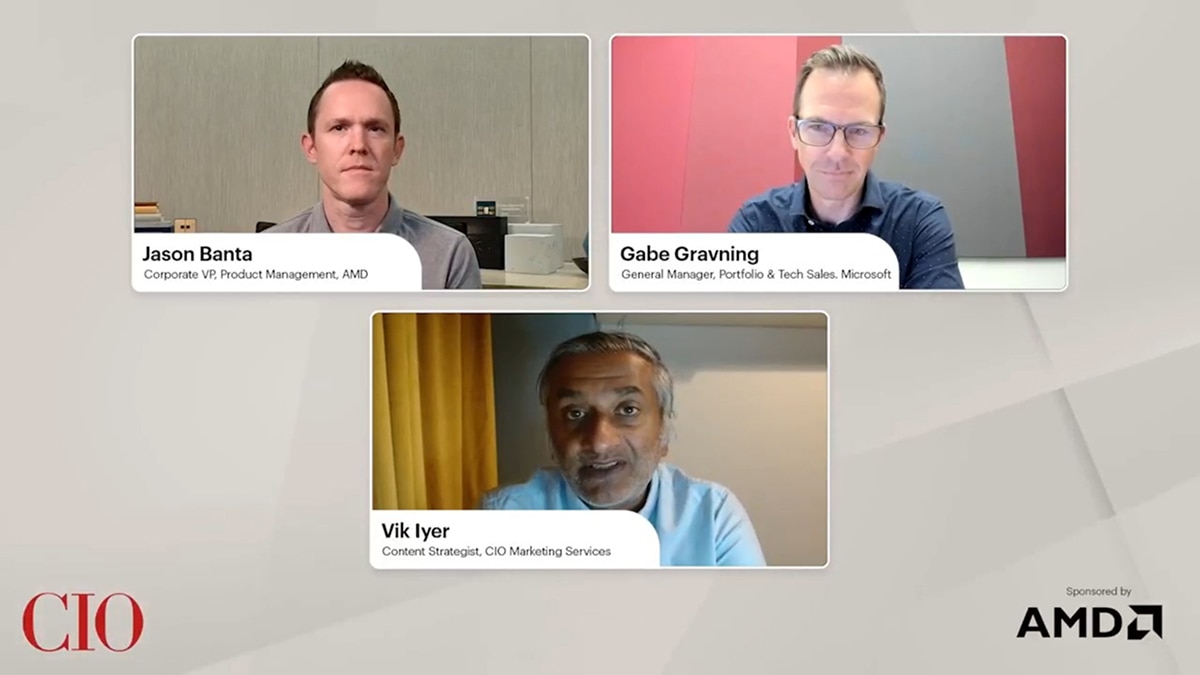
Recently, I had the opportunity to join Gabe Gravning, General Manager of Portfolio and Tech Sales at Microsoft, in a CIO.com-hosted webinar focused on how enterprises can embrace AI confidently and effectively. The discussion highlighted how collaboration between Microsoft and AMD spans the entire gamut of computing, from data centers to edge devices, empowering IT leaders to securely modernize while unlocking performance and productivity gains.
In this blog, I’d like to expand on some of those key themes from the webinar: how AMD and Microsoft are partnering to enable enterprise AI today, and how organizations can prepare for what’s next in intelligent computing.
A Partnership Built for the AI Era
AMD and Microsoft have worked together for years across the data center, cloud, and PC ecosystem. This collaboration extends through AMD EPYC™ server CPUs, AMD Instinct™ GPUs, and AMD Ryzen™ AI solutions, each of which is optimized for Microsoft platforms like Azure and Windows.
Our teams work together to deliver a unified AI platform, from microarchitectural design through silicon-level floor plans and software support. This integration between the operating system and the processors that run it enables new levels of efficiency, responsiveness, and a better user experience. These are critical factors to any CIO planning for scalable AI adoption, and our co-design ensures we deliver a superior holistic solution rather than isolated technologies.
From architecture through silicon and software, our teams co-engineer deeply to deliver a unified AI platform, not isolated technologies. That integration between the operating system and the silicon enables new levels of efficiency, responsiveness, and user experience—critical for CIOs planning for scalable AI adoption.
Copilot+ PCs: Bringing AI into Everyday Workflows
A key focus of the webinar was the rise of Copilot+ PCs, which bring secure, local AI directly into daily work. Advanced by AMD Ryzen™ AI processors, Windows Copilot+ PCs are designed to make tasks faster and smarter through features like semantic search, Recall, and Click-to-Do—all running on the Ryzen AI NPU.
Because these AI workloads run locally, they stay private, fast, and power-efficient—delivering meaningful productivity benefits without compromising user trust or performance. It’s a major step toward embedding AI seamlessly into applications rather than treating it as a separate app or add-on.
Modern, Safe, and Future-Ready
Now that Windows 10 has reached end-of-support the move to Windows 11 offers more than an operating system update—it’s a chance to strengthen endpoint security and streamline management. AMD Ryzen™ PRO platforms, combined with technologies such as the Microsoft Pluton Security Processor (GD 202) and AMD Memory Guard (GD 206) and AMD Shadow Stack (which enables Windows 11’s kernel-mode hardware-enforced stack protection), deliver chip-to-cloud protection designed for today’s hybrid workforce. GD 202.
We also ensure that modernization is manageable. Ryzen PRO solutions integrate seamlessly with Microsoft Intune and Windows Autopilot, enabling IT leaders to deploy, refresh, and manage devices efficiently while maintaining the highest security standards.
Empowering Developers to Build AI Experiences
The AI transformation depends on developers as much as devices. Microsoft’s Windows AI Foundry and Windows ML frameworks help developers bring new AI experiences to the PC. At AMD, we support this ecosystem with our ROCm™ software stack and Vitis™ AI suite, providing compatibility, performance, and flexibility across AI workloads.
The result is an open ecosystem development environment, where innovation can scale from Azure to the endpoint seamlessly.
A Moment of Opportunity for CIOs
As I shared during the webinar, the end of Windows 10 support is an opportunity to prepare for the next decade of intelligent computing. Adopting Copilot+ PCs built with AMD Ryzen AI processors provides organizations with a platform that’s built to evolve.
My advice to CIOs is to pair your Windows 11 migration with an AI PC strategy. This combination not only enhances security and manageability but also positions your workforce to take advantage of emerging AI capabilities that will define the modern enterprise experience.
In the future, enterprise computing will leverage artificial intelligence to help secure systems, provide business insights, and improve collaboration between teams. Together, AMD and Microsoft power innovation from cloud to client, helping organizations stride confidently into the AI era.
Learn more