The Vitis Software Platform Development Environment

The AMD Vitis™ software platform is a development environment for designs targeting FPGA fabric, Arm® processors, and AI Engines, working alongside the AMD Vivado™ Design Suite to provide a higher level of abstraction.

Vitis Software includes Vitis Embedded for C/C++ application development on Arm processors; AI Engine compilers and simulators; Vitis HLS for C/C++-based FPGA IP; Vitis Model Composer for model-based design in Simulink®; and performance-optimized libraries such as DSP, Vision, Solver, Ultrasound, and BLAS for FPGA or AI Engine deployment.

Design and Simulation Flows

Adam Taylor Presents: Step-by-Step System Design with Vitis Unified Platform

Learn to create an embedded system solution using the Vitis Unified heterogeneous system flow.

Vitis Embedded Software Development Flow

(Traditionally called Embedded SDK for previous FPGA families)

Export hardware from Vivado as a platform file
Arrow
Develop application code
 
Arrow
Debug and generate boot image

Designers who are developing C/C++ code for the Arm® embedded processor subsystem in AMD adaptive SoCs will typically use this flow.

  • Hardware engineers design programmable logic and export the hardware as a Xilinx Support Archive (XSA) file using AMD Vivado™ Design Suite. 
  • Software engineers incorporate this hardware design information in their target platform and use the Vitis Embedded software to develop their application code.

Developers can perform all system-level verification within the Vitis Embedded software and generate boot images to launch the application. 

Learn more in the Vitis Tools for Embedded Software Development section in UG1400 >

Vitis System Design Flow

(Hardware and Software)

Vitis System Design Flow Chart

System designers who are integrating both the software and hardware portions of their design in AMD adaptive SoCs will typically use this flow.

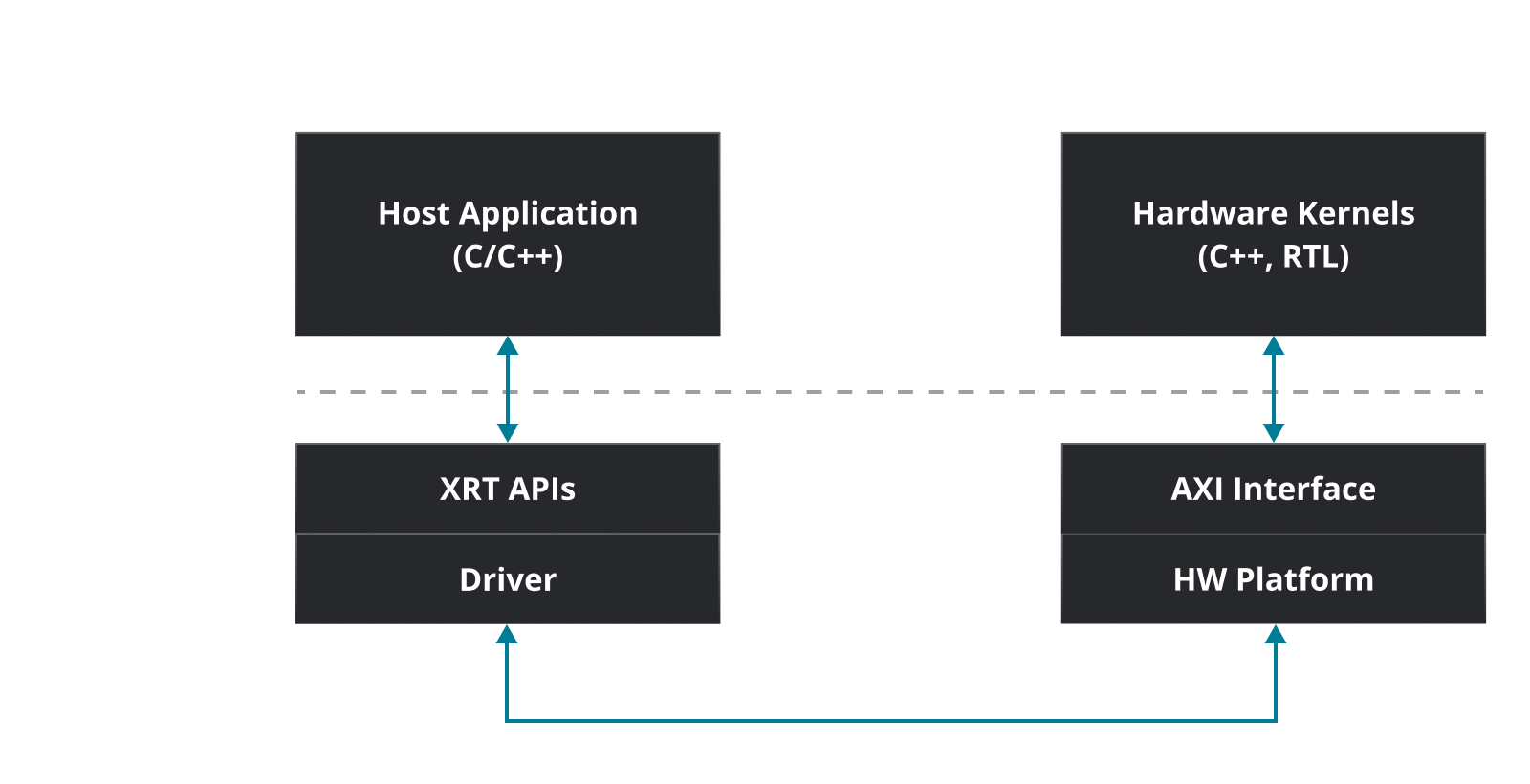
This flow is used to develop heterogeneous embedded system designs comprising of software applications running on Arm® embedded processors and compute kernels running on programmable logic (PL) and/or Versal™ AI Engine arrays.

This flow comprises:

  • A software host application written in C/C++ and typically run on the embedded Arm processor subsystem. It uses the native API implemented by the AMD Vitis Runtime Library to interact with hardware kernels within the AMD device. 
  • Hardware kernels that can be generated from C++ using the AMD Vitis™ HLS tool or described directly in RTL using AMD Vivado™ Design Suite.

Learn more in the Vitis Tools for Heterogeneous System Design section in UG1393 >

AMD Alveo™ Data Center accelerator cards employ the same system design flow—the software program runs on an x86 host, and the kernels run in the FPGA on a PCIe®-attached acceleration card.

Learn more in Vitis tools for Data Center Acceleration section in UG1393 >

Vitis Heterogeneous Simulation Flow

Simulate in Your Preferred Tools
 • Use existing MATLAB®, Python™, C++, or HDL testbenches
 • Avoid rewriting testbenches or learning new workflows
 • Accelerate algorithm-to-hardware iteration

Unified AI Engine + PL Simulation (Vitis Subsystem)
 • Simulate AI Engine and PL together
 • Replace fragmented flows with one consistent methodology
 • Detect integration issues early

Hardware-in-the-Loop (HIL) Validation
 • Shorten system-level validation time
 • Stream real I/O through silicon for faster debugging
 • Verify end-to-end throughput before final hardware

Tools and Libraries

Vitis Embedded

Vitis Embedded

Vitis™ Embedded is a standalone embedded software development package for developing host applications running on embedded Arm processors.

Vitis AI Engine DSP Design Tools: Compilers and Simulators

Vitis AI Engine DSP Design Tools: Compilers and Simulators

AMD Versal™ adaptive SoCs feature AI Engine arrays that enable the implementation of high-performance DSP functions to optimize power and resource efficiency.  Use of AI Engines in conjunction with the FPGA fabric resources can enable very efficient implementation of high-performance DSP applications.

Vitis HLS

Vitis HLS

The Vitis HLS tool allows users to easily create complex FPGA algorithms by synthesizing a C/C++ function into RTL.

The Vitis HLS tool is tightly integrated with both Vivado Design Suite for synthesis and place & route and the Vitis unified software platform for heterogeneous system designs and applications.

Vitis HLS

Vitis Model Composer

Vitis Model Composer is a model-based design tool that enables rapid design exploration within the MathWorks Simulink® environment.

The tool also allows you to model and simulate a design with a mix of AI Engine and programmable logic (HDL/HLS) blocks.

Vitis Libraries

Vitis Libraries

Open-source, performance-optimized libraries that offer out-of-the-box acceleration with minimal to zero code changes to your existing applications, written in C and C++.

Leverage the domain-specific accelerated libraries as is, modify to suit your requirements, or use as algorithmic building blocks in your custom accelerators.

What’s New in 2025.2

Enhanced Design Flow with AMD Versal™ AI Engines
  • AI Engine API enhancements
  • New and enhanced data types
  • Programming model updates and optimizations
  • New and enhanced DSP library functions
  • Improved AI Engine mapper and router 
Easier Verification of Versal AI Engine Designs
Enhancements to Vitis Model Composer for AIE DSP Designs
Updates for Vitis IDE for Embedded Development
  • Vitis Embedded now enables integration of third-party AI code assistants
  • Allows the use of VS Code Editor based on Eclipse Theia
  • Support for Zephyr (RTOS)
  • Enhanced debug capabilities with PS trace
  • Learn more about Vitis IDE

Resources