Cloud AI Costs Are Growing: How Hybrid AI Can Help
Aug 25, 2026

The economics of enterprise AI are changing as new frontier models and agentic AI expand what artificial intelligence can accomplish for businesses. Organizations that don't start building a hybrid deployment strategy today, however, might wind up paying significantly more for AI over the next few years.
If you’ve been expanding AI usage across your organization over the last 18 months, you may have already noticed certain trends. Wider AI access, more AI use, and agentic AI can all hit cost scaling hard. You buy more seats and encourage usage. Then token consumption climbs, the monthly bill leaps, and suddenly finance has some pointed questions about ROI.
Companies are increasingly looking for ways to address this problem, and the AMD Tokenomics Calculator is here to help you compare cloud, local, and hybrid AI deployment costs.
You’re Paying Cloud Rates for What Should Be Local Work
The Numbers: What the AMD Tokenomics Calculator Shows
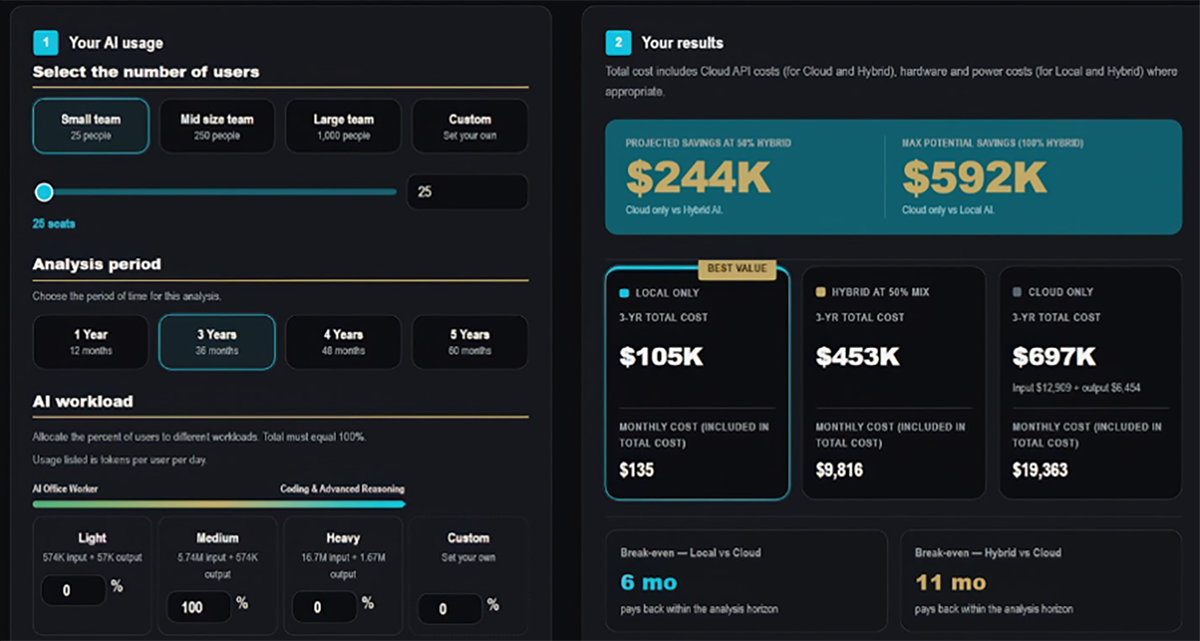
The tool models three deployment scenarios -- Cloud Only, Local (AMD), and Hybrid -- across fleet sizes and workload profiles, and computes:
- TCO: Total cost of ownership over 1, 3, 4, or 5 years
- Monthly Cost: Average monthly run rate under each deployment model
- Break-even: The month at which AMD hardware investment pays back versus cloud-only spend
- Hardware recommendation: Auto-sized AMD device configuration based on team size and workload tier
At a medium workload tier -- roughly 5.7M input tokens and 574K output tokens per user per day, meant to be representative of a knowledge worker actively using an agent harness like Claude Code, Codex, or Hermes. A fleet of 500 AMD AI PCs deployed in a hybrid configuration (50% local, 50% cloud) can deliver projected three-year savings of 40-60% versus cloud-only, depending on the cloud model in use. Full local deployment pushes that figure higher, with break-even typically achieved in under 24 months.
Image Zoom
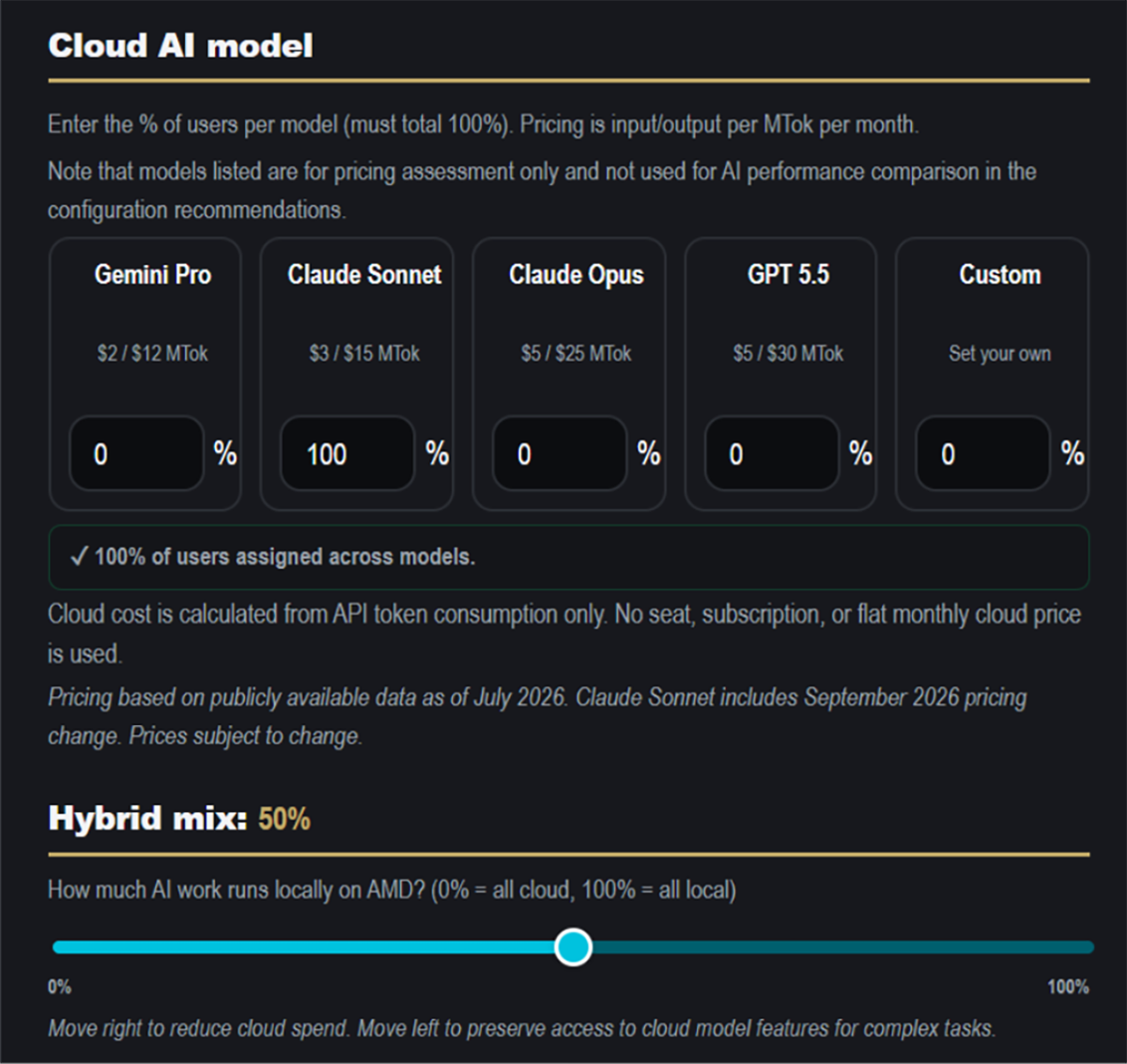
The Tokenomics Calculator's Hybrid Mix slider lets you model exactly what percentage of token volume runs locally versus cloud, so you can find the optimal split for your organization before you commit to any hardware investment. It can also export custom inputs to a PDF alongside results, a break-even analysis, and hardware recommendations you can bring to a business case review.
You’re Paying Cloud Rates for What Should Be Local Work
Knowledge workers using AI tend to follow a predictable pattern. Prompts are initially drafted, tested, and tweaked to best effect. The final execution generally happens after a back-and-forth conversation that may consume a significant portion of a task’s total token volume. That initial discussion doesn’t need frontier model performance to be effective. It does need to respond quickly, be readily available, and add no additional cost to the bottom line.
When all of that iterative work runs through a cloud API, you're paying frontier model pricing for what is functionally a rough-draft scratchpad. Every rephrased prompt, “make it shorter,” or “could you try a different tone?” hits your API bill one way or another.
A hybrid model that relies on both local and cloud AI services lets you use the right amount of compute for the right task without reducing employee access to valuable cloud tools. You can continue to use cloud services for final prompt execution and complex reasoning at a fraction of the cost you might pay for cloud-only service over the long term.
When Seats Run Out, Work Stops
There's an implicit opportunity cost when only some members of a team are allowed to use AI. It won’t show up directly on an invoice or financial statement, but employees who can’t learn from or experiment with the same AI services their peers use will likely be slower to adopt AI or to realize its benefits.
Enterprise cloud AI contracts are typically seat-based. When all licensed seats are occupied, employees who aren't on the license simply can't access AI functionality -- they wait, they find workarounds, or they go without. At a time when AI productivity gains are driving competitive differentiation, that forced exclusion is a real business cost.
Image Zoom
Moving workloads to local execution across AMD Ryzen™ AI and AMD Radeon™ products provides a parallel access path. Employees who would otherwise be locked out of cloud AI seats can use local inference for their workloads -- drafting, summarizing, analyzing, generating test code -- without consuming a single licensed seat or adding a single token to the cloud bill. For organizations with broad employee populations who want to benefit from AI but can't justify a seat license for everyone, local inference is one of the best ways to access without extending cost.
What Hybrid AI Means for IT and Finance Leaders
The conversation around AI in 2026 has moved from capability to sustainability. ITDMs want the benefits AI can deliver at scale, but they need those benefits to be reasonably affordable. For IT leaders, that means building an AI approach that doesn’t punch through cost ceilings or limit access to protect quarterly spend. Local inference’s ability to remove the per-token tax on initial conversation and prompt tightening addresses one of the most token-intensive parts of real-world AI use.
What this means, more broadly, is that advances in hardware and local models have made local AI both practical and useful. Tooling exists to deploy it and the hardware required to execute it is commercially available today.
Conclusion
So, take the AMD Tokenomics Calculator for a spin and compare your cloud, local, and hybrid AI costs. Run the numbers, see where your break-even falls, and decide how much of your AI spending belongs in the cloud. You’ll always have the option to spend your tokens there – but you might get better value if you deployed AI on your employees’ desks.
Try the AMD Tokenomics Calculator
All calculator outputs are estimates based on publicly available pricing and configurable hardware assumptions. Results will vary based on actual workload, hardware configuration, electricity costs, and negotiated pricing. AMD makes no warranty regarding the accuracy of third-party pricing data used in the tool.

Related Blogs
-
NeuroSpark Expands AI Compute Choice with AMD
NeuroSpark uses AMD Instinct GPUs and ROCm software on OCI to deliver flexible, cost-effective AI training and inference
October 23, 2026
-
Sovereign AI for European Customer Conversations
LeadDesk, QuTwo, and AMD Silo AI collaborate on a sovereign AI stack that brings near-frontier, open-weight models to European customer conversations.
October 22, 2026
-
AMD and Advantech - Architecting the Next Generation of Regulated Casino Games
Discover how Advantech and AMD are redefining regulated casino gaming with Ryzen Embedded 8000 Series processors, integrated RDNA 3 graphics, XDNA AI acceleration, and purpose-built DPX platforms. The solution enables immersive multi-screen experiences, predictive maintenance, stronger security, lower power consumption, simplified designs, and long-term platform availability for gaming OEMs worldwide.
October 21, 2026
-
Micro-World 2: Streaming Real-time Interactive World Model — ROCm Blogs
This blog demonstrates how Micro-World 2 combines precisely annotated action data, four-step diffusion distillation, and ROCm-optimized inference to deliver controllable, long-horizon, real-time world generation on a single AMD Instinct GPU through a fully open-source pipeline.
October 20, 2026
-
MoE Training Optimization with Primus — ROCm Blogs
Learn how to speed up MoE training on AMD Instinct GPUs with Primus: a fused MoE megakernel, FP8/MXFP8 expert GEMMs, and training-at-scale tuning.
October 20, 2026
-
Optimizing World Action Models on AMD GPUs — ROCm Blogs
Speed up World Action Models on AMD GPUs with GEAK kernels, fewer denoising steps, and latent actions, cutting FastWAM latency 25× at about 97 percent success.
October 20, 2026
-
Bringing Ultra-Fast, Interactive LLM Inference to AMD Instinct™ MI355X GPUs — ROCm Blogs
Accelerate single-request LLM inference on AMD Instinct MI355X with megakernels, speculative decoding, and MXFP4 for 1.9-3.3x faster decode.
October 19, 2026
-
hipCIM 26.06: GPU-Accelerated Whole-Slide Image I/O on AMD Instinct™ GPUs — ROCm Blogs
In this blog you will see how hipCIM 26.06 reads whole-slide images on AMD Instinct™ GPUs, and how fast and faithfully it decodes them.
October 19, 2026