Create, Connect, Control: AMD at IBC 2026
Sep 11, 2026
Introduction
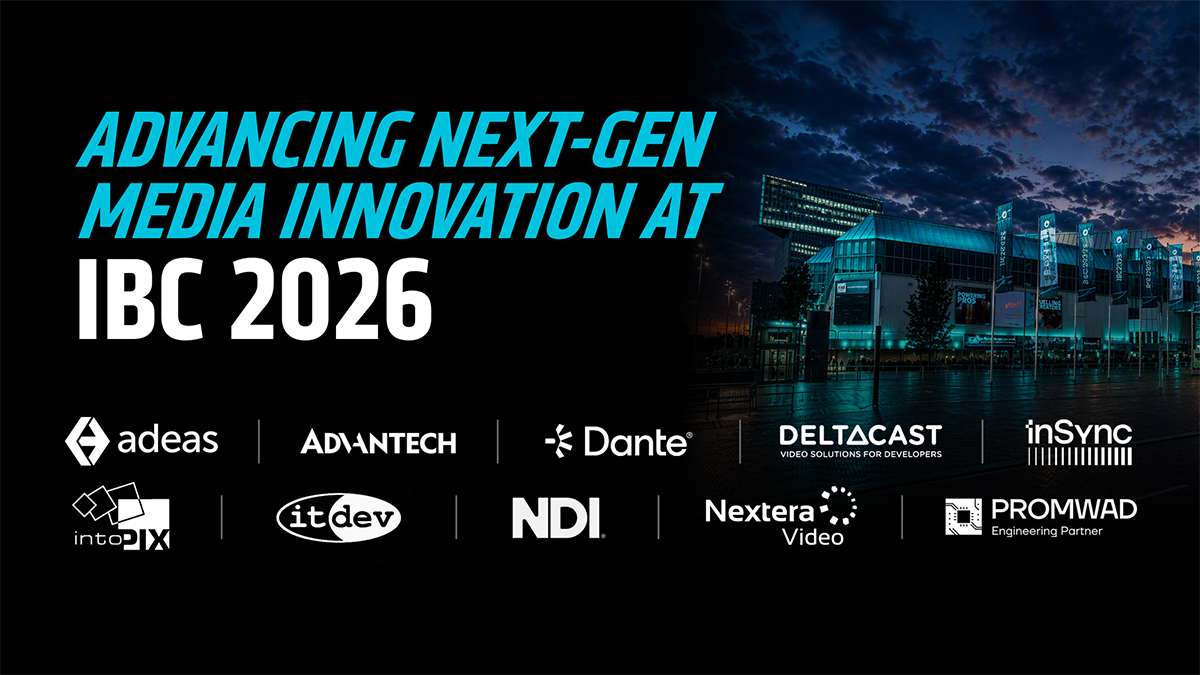
This year, the International Broadcasting Convention (IBC) will run at RAI Amsterdam from September 11 through September 14, 2026. The show focuses on companies that operate at any stage of the broadcast pipeline, from creation and post-production to transmission and distribution.
In my 2025 IBC blog, I wrote that AI implementations at the show had become more focused and pragmatic, with more attention paid to how the technology could be used in production. This remains true in 2026, even as AI agents — semi-autonomous AI systems that can plan and take action without requiring explicit human approval at every step — have become a much-discussed topic within the industry.
Practical problem-solving is also the premise of IBC’s unique Accelerator programme which runs alongside the show’s exhibitions, speaker sessions, and meetings. The Accelerator programme unites research organizations, technical partners, and industry leaders to develop proofs of concept that address real-world problems across content creation, management, and connectivity. By connecting groups that might not otherwise find each other, IBC hopes to move new concepts towards production-ready implementations.
IBC may fall in September, but work on the projects presented at the show begins much earlier. At Kickstart Day in February, teams of champions (broadcasters, studios, and research organizations) and participants (technology companies providing hardware, cloud compute, software, and engineering expertise) pitch problems they hope to solve. IBC selected nine projects for its 2026 Accelerator programme, with teams spending the following six months building proofs of concept for the fall show.
AMD and HP return as joint Associate Sponsors of the IBC Accelerator Media Innovation Programme this year (AMD, for the fifth year running), and provided hardware to all of the accelerator projects. Our direct project work and my own area of focus centered on FRAMES (Federated Retrieval, Agentic Media Environment and Software (Defined Workflows)), which explores how a common semantic model and knowledge graph can connect scripts, production data, archival material, newly captured content, creative teams, and AI agents. The project uses the MovieLabs Ontology for Media Creation to give production information consistent and machine-readable meaning. Locally running agents can retrieve and enhance media with creators remaining in control.
FRAMES begins with a script and uses that structured production context to tag and retrieve relevant archive material. Local AI agents can then perform tasks such as upscaling, noise removal, audio cleanup, or generative extension. The proof of concept will also simulate a late script change that requires a new capture, testing whether the shared production model can identify the affected work and notify the appropriate departments. Zero Trust controls govern access across the federated production environment. IBC will present the FRAMES proof of concept on September 11 from 11:30 a.m. to 12:30 p.m. on the Future Tech Stage.
Pluxbox: Disparate Pathways, Unified Command
Pluxbox is back at IBC this year, with new features to discuss. In 2025, the company demonstrated its no-code platform for connecting disparate media services and capabilities through a common interface. For 2026, Pluxbox has expanded that approach with CoreOC, a vendor-agnostic control platform that works across existing customer infrastructure, software, cloud services, and production environments.
CoreOC adds a more explicit orchestration layer to what Pluxbox demonstrated in 2025. It combines Networked Media Open Specifications (NMOS), an open standard for controlling interoperable IP-based media infrastructure, with Model Context Protocol (MCP), which provides a standard method for AI systems to interact with external tools, services, data, and other aspects of the production environment.
This year, Pluxbox will demonstrate radio co-host, vodcast, messaging and phone systems, as well as a social production platform built on CoreOC. The company sees AMD compute as a foundation for moving more AI processing into the media environment itself rather than treating AI as a separate cloud service.
"CoreOC is designed to simplify modern media operations, giving teams the flexibility to build and adapt their own workflows. With AI moving closer to the edge, we see an opportunity to make broadcast operations not only smarter, but also more responsive and efficient," said Dennis Laupman, CCO of Pluxbox. "AMD gives us the compute foundation to bring that intelligence directly into the media environment, where real-time performance, reliability and control matter."
This IBC demonstration distributes different parts of the workload across AMD hardware, with local AI and content-understanding tasks running on systems featuring AMD Ryzen™ AI Max PRO and Radeon™ AI PRO GPUs. AMD Threadripper™ PRO processors handle orchestration and control workloads, while AMD Alveo™ MA35D accelerators support high-density video processing and delivery.
17K Footage Requires a Serious Workstation
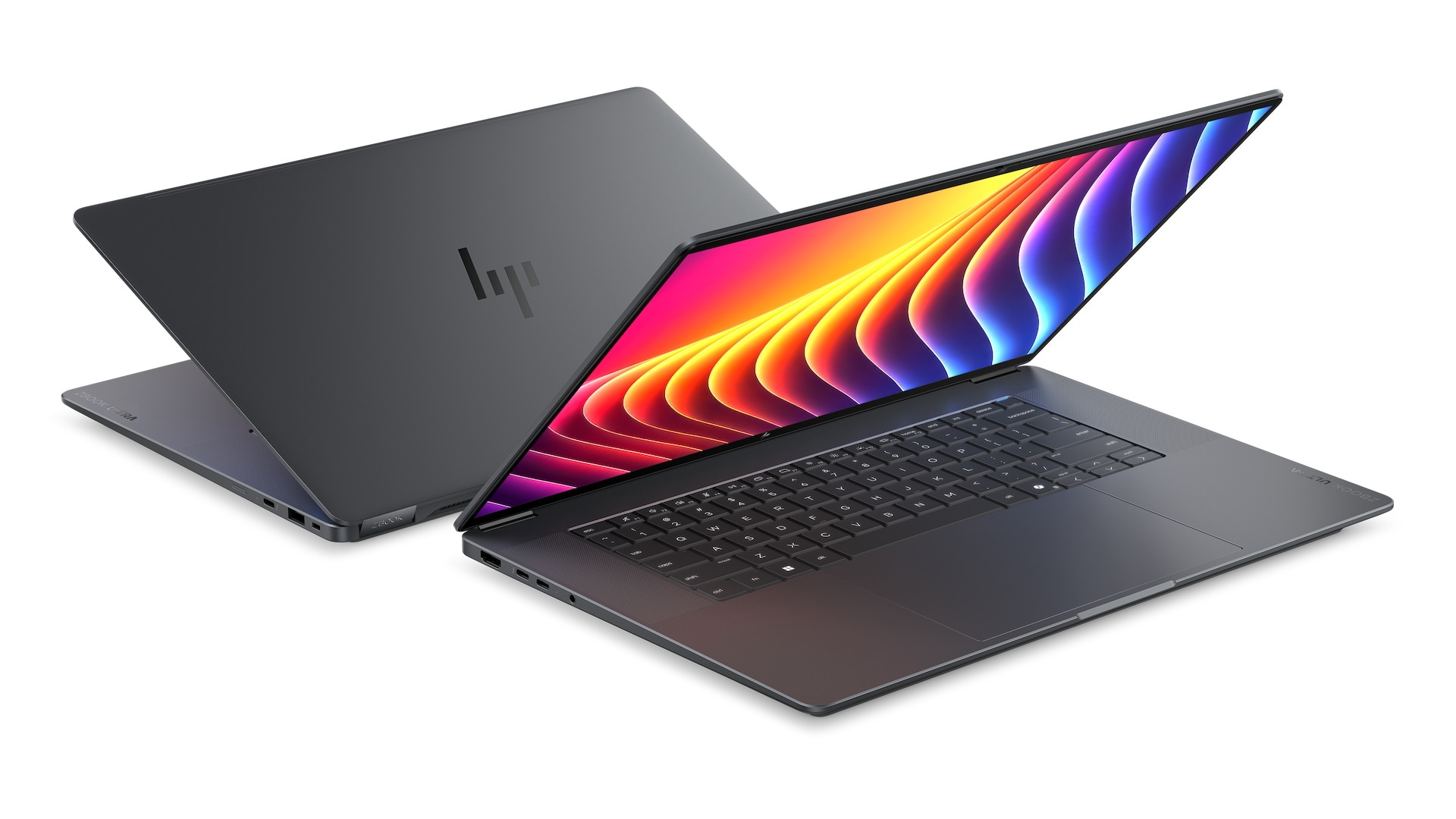
At the HP booth, Apollyon Films will take an expansive look at the workloads modern media systems have to handle. An HP Z6 G5 A workstation with a 96-core AMD Ryzen™ Threadripper PRO processor will run both an AMD Radeon AI PRO R9700 GPU and an NVIDIA RTX PRO Blackwell GPU. Some of the partner software used in the workflow has been tuned for AMD ROCm™ software, while other components are optimized for CUDA, so the system carries both.
The workstation will run DaVinci Resolve workflows including Magic Mask, color correction, effects, and speech-to-text subtitle generation. It will also work with 17K RAW footage captured using Blackmagic Design’s URSA Cine 17K 65 (shown shooting eclipse footage above), whose 65mm sensor records at resolutions up to 17,520 x 8,040. The high-resolution footage provides a substantially heavier processing workload than conventional 4K or 6K material – enough to stretch the capabilities of even a 96-core Threadripper PRO processor.
Omnisearch will add content retrieval to the same demonstration. Rather than depending only on filenames and manually entered metadata, Omnisearch indexes information inside video, including spoken dialogue, people, on-screen text, visual elements, and contextual information. Search results can then feed material into the post-production workflow running on the Threadripper PRO processor-based system.
Security in the Time of Agents
But compute is only one aspect of modern media production. AMD participates in (and I sit on the board of) the Global Creative & Security Community (GC-SC), a nonprofit industry group focused on developing and sharing practices around content creation, security, governance, and emerging technologies. At IBC, GC-SC will use its September 12 security workshop to launch Collective Defense for Media & Entertainment, a threat- and intelligence-sharing program developed with the Global Resilience Federation. The goal is to give media and entertainment companies a way to share information about threats across an industry where studios, broadcasters, production companies, and technology providers increasingly depend on one another’s systems. The workshop will also cover security-focused workplace use of AI, continuous monitoring and remediation, and AI-driven threats.
See You in Amsterdam
IBC has always been useful because media production forces new technologies into contact with real-world operational constraints. AI systems have to work with existing production tools. Search has to operate against actual media libraries. High-resolution footage has to move through the workstation fast enough to edit. Automation has to coexist with established control infrastructure, and increased connectivity creates security problems that individual companies cannot always solve alone.
Those are the kinds of problems AMD and its partners will be focused on in Amsterdam this year. If you will be at IBC from September 11 through September 14, I hope you will stop by the Accelerator Zone, visit our partners across the show floor, and see the work for yourself.

Related Blogs
-
MoRI UMBP Empowers AMD Instinct GPUs
See how UMBP, MoRI and SGLang optimize KV cache reuse to boost AMD Instinct™ MI355X GPU agentic AI performance and cost efficiency
October 01, 2026
-
Automating Performance Bottleneck Identification with the TraceLens Agent — ROCm Blogs
TraceLens Agent is an agentic workflow that examines GPU traces to deliver a prioritized optimization report, detailing root causes and fixes.
September 29, 2026
-
AIM: Unified User Experience from Profile Discovery to Deployment — ROCm Blogs
Learn how AIMs offer a unified user experience as you explore and deploy them across AMD Instinct, Radeon PRO, and EPYC.
September 29, 2026
-
MORI CCO
MORI CCO enables compute-communication overlap on AMD Instinct™ GPUs. Build faster distributed inference and training kernels with device-side communication.
September 29, 2026
-
Unlocking Sim2Real for a Robotic Arm with RL Accelerated by AMD Instinct GPUs — ROCm Blogs
Train an XArm-6 pick-and-lift policy with PPO in MuJoCo Warp on AMD Instinct GPUs, then transfer it to the real robot.
September 28, 2026
-
How AMD Ryzen AI Max PRO 400 Series Processors Bring Local Agentic AI to Business Customers
See how AMD Ryzen AI Max PRO 400 Series processors bring local agentic AI to business with more memory, flexible deployment, and lower costs.
September 28, 2026
-
Verl 0.9.0 on ROCm™ 10.0: Next-Generation RL Post-Training on AMD Instinct™ GPUs — ROCm Blogs
Enable Verl 0.9.0 on ROCm™ 10. Native AMD platform support, vLLM 0.27 and SGLang in one image, and updated async GRPO/DAPO recipes on AMD Instinct™ GPUs.
September 27, 2026
-
UltraQuant on AMD Instinct: More Efficient Agentic Serving for Qwen3.8-MXFP4 — ROCm Blogs
A native 4-bit MXFP4 KV cache that speeds up Qwen3.8 decode over 8-bit KV on AMD Instinct MI355X, with no accuracy loss.
September 24, 2026