The Importance of Open Ecosystems for Agentic AI Deployment
Jul 30, 2026

For many companies, enterprise AI has moved beyond isolated pilots and proofs of concept into a more demanding phase of evaluation. Artificial intelligence’s ability to summarize a document, draft an email, or answer questions is now table stakes. Companies increasingly want AI tools that operate across core business activities rather than being confined to a single application.
The arrival of agents -- defined as bots that can take independent action across multiple applications or services to accomplish a goal -- has raised customer expectations and challenged businesses to consider how agentic AI will interact with existing software and already-defined workflows. AI agents rely on large language models just as chatbots do, but agentic systems are designed to use software tools and data sources that generative AI chatbots often cannot reach. Those resources can include customer records, internal libraries, ticketing systems, code repositories, and business applications.
Agentic AI Requires an Open Ecosystem
Agents need this access as well as broad software interoperability to carry out their tasks, but companies attempting to scale from generative to agentic AI may find themselves stymied by vendor lock-in and proprietary software solutions that only work well with a handful of other applications. The same vertical integration that can make initial deployment easier can become a liability when a company expands its AI usage and the suite of tools it supports.
A recent article in the Wall Street Journal discusses the value of open AI ecosystems and the benefits of solutions that give businesses room to experiment. Currently, many agents may work well within specific software frameworks but can struggle when asked to interface with other applications. Maribel Lopez, principal analyst at Lopez Research, told the publication that deployment flexibility is a critical component of successful AI rollouts over the long term.
"There’s probably never been a tech stack we’ve dealt with in our lifetime that has required innovation this rapidly," Lopez told the WSJ. "AI is not a set-it-and-forget-it technology—you always have to be building on it. There can be a lot of value in having access to that new, fresh, constantly evolving tool set that the open-source community offers."
AMD’s Open Approach to Enterprise AI
AMD supports the industry's need for rapid, continuous innovation with a comprehensive suite of end-to-end AI solutions that spans embedded FPGAs, AMD EPYC™ server CPUs, mobile workstations, and AMD Instinct™ accelerators. This breadth gives customers more room to match AI workloads to the power and cooling limits of the environments where these workloads will run. AMD ROCm™ and HIP support industry-standard frameworks like PyTorch and TensorFlow, as well as the ONNX runtime, allowing models to be evaluated, ported, and deployed across environments without retraining or reformatting. This flexibility can help organizations respond swiftly to conditions today, without foreclosing strategic options whose importance may only become apparent months or years down the line.
Additionally, AMD provides containerized services, such as AMD Inference Microservices (AIMs), to manage AI inference workloads on AMD Instinct GPUs. AIMs provide Enterprises with an “easy” button for inference, taking away all the complexity while providing service-level assurance when deployed on specific AMD hardware configurations. These microservices are part of the open-sourced AMD Enterprise Reference Stack and are designed to interface with a company's existing environments and toolsets through open and closed source platform partners such as Red Hat, SUSE, Canonical, VMware, and Nutanix. Our goal is to enable agents and data connector functionality across structured and unstructured databases, spreadsheets, and SaaS products. Achieving this requires an architecture that does not restrict access to disparate data sources or associated applications.
Flexibility and freedom of choice will only become more important as agentic AI matures. Early agent tests may automate a narrow task inside a single application, but the advantages of full production deployment will require agents to access multiple data sources, launch appropriate tools, and return results in formats other software can use. Companies that prioritize agents capable of connecting to existing employee workflows and systems will be in the best position to realize the benefits agentic AI provides. The open ecosystem approach championed by AMD gives enterprises a path for scaling AI throughout their organizations without limiting available software options or forcing every future decision through a single vendor software stack.
Click here to explore how AMD’s open, end-to-end portfolio can help your organization deploy and scale AI from the data center to the endpoint.
Legal Endnotes:
DISCLAIMER: The information contained herein is for informational purposes only and is subject to change without notice. While every precaution has been taken in the preparation of this document, it may contain technical inaccuracies, omissions and typographical errors, and AMD is under no obligation to update or otherwise correct this information. Advanced Micro Devices, Inc. makes no representations or warranties with respect to the accuracy or completeness of the contents of this document, and assumes no liability of any kind, including the implied warranties of noninfringement, merchantability or fitness for particular purposes, with respect to the operation or use of AMD hardware, software or other products described herein. No license, including implied or arising by estoppel, to any intellectual property rights is granted by this document. Terms and limitations applicable to the purchase or use of AMD products are as set forth in a signed agreement between the parties or in AMD's Standard Terms and Conditions of Sale. GD-18u.
Links to third party sites are provided for convenience and unless explicitly stated, AMD is not responsible for the contents of such linked sites and no endorsement is implied. GD-97
© 2026 Advanced Micro Devices, Inc. All rights reserved. AMD, the AMD Arrow logo, Ryzen, and combinations thereof are trademarks of Advanced Micro Devices, Inc. Certain AMD technologies may require third-party enablement or activation. Supported features may vary by operating system. Please confirm with the system manufacturer for specific features. No technology or product can be completely secure.


Related Blogs
-
Absci Accelerates AI Antibody Design on AMD Instinct™ GPUs
AMD and Absci achieved a 3x speedup in AI antibody design by running the AbsciBind co-folding model on Instinct™ GPUs with optimized Triton kernels.
October 18, 2026
-
FP16 GEMM Optimization on AMD RDNA™ 3 and RDNA™ 4 Architectures — ROCm Blogs
Learn how to build an FP16 GEMM kernel with WMMA on AMD RDNA 3 and RDNA 4, one optimization at a time, and approach hipBLASLt performance.
October 15, 2026
-
Day 0 Support for Muse Spark Open on AMD
AMD is excited to announce Day-0 support for Meta’s latest Muse Spark Open model family on AMD Instinct™ MI350X and MI355X GPUs
October 15, 2026
-
Introducing FastFlow SDK
Explore AMD FastFlow-SDK for local AI development on AMD Ryzen™ AI NPUs, from running models to customizing inference and optimizing operators with FastFlow, IRON, and HRX.
October 15, 2026
-
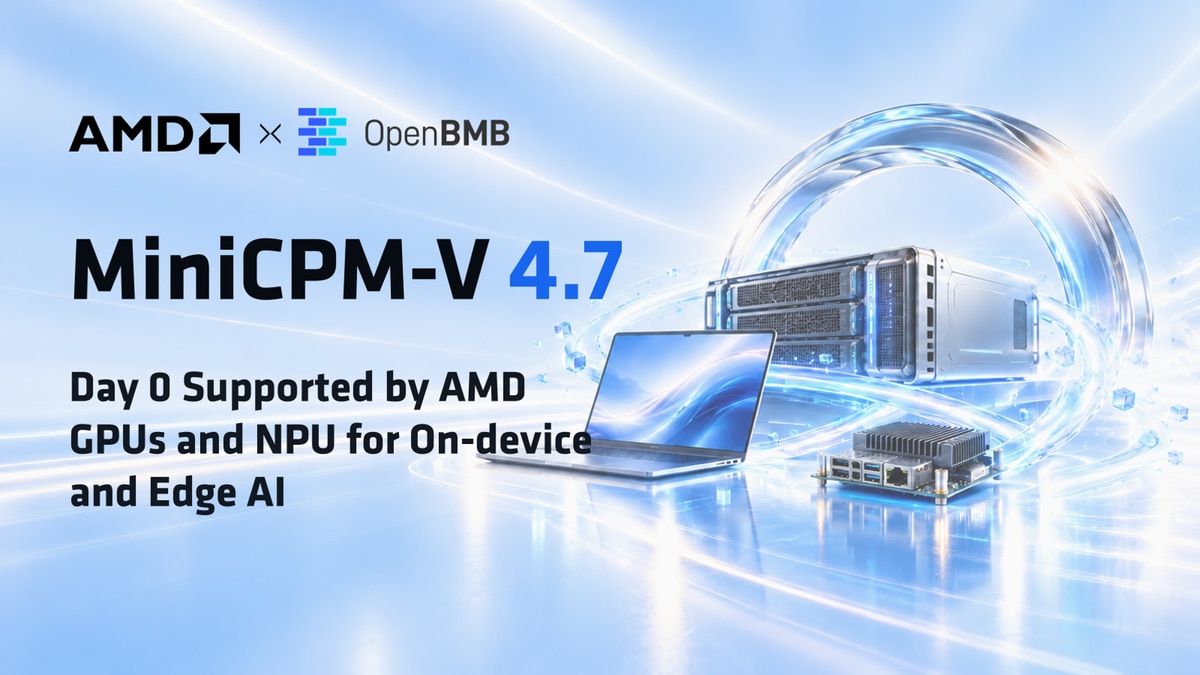
MiniCPM Day 0 Support Across AMD Hardware
Explore Day 0 support for MiniCPM-V 4.7 on AMD Radeon™ GPUs, Ryzen™ AI Max processors, and Ryzen™ AI NPUs for on-device AI inference.
October 14, 2026
-
Long Context, One Node: Serving GLM-5.3-FP8 on MI300X with DP8+EP8 — ROCm Blogs
Learn how to serve GLM-5.3-FP8 on one AMD Instinct™ MI300X node with DP8+EP8 and vLLM v0.28 for long-context workloads, and compare it with TP=8.
October 13, 2026
-
Meet the Next AMD Ryzen™ AI Halo
Meet the next AMD Ryzen™ AI Halo developer platform, powered by the AMD Ryzen™ AI Max+ PRO 495 processor. Run larger local LLMs, up to 300B parameters, thanks to the 192GB of unified memory that comes on the new platform.
October 12, 2026
-