AMD Instinct MI355X GPU Sets a New Bar for DeepSeek Inference
Jun 10, 2026
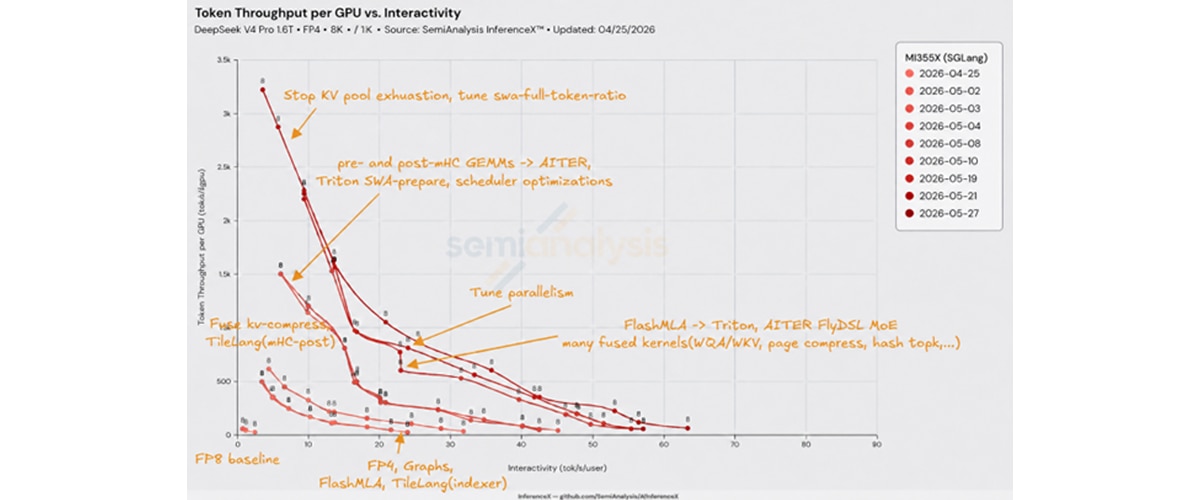
DeepSeek V4 was one of the most demanding open-model inference launches to date, stressing every part of the serving stack: sparse attention, MoE execution, quantization, multi-token prediction, scheduling, graph capture, and distributed inference. In less than a month, AMD Instinct™ MI355X GPU performance improved by more than 100x on the same silicon through systematic kernel and framework engineering (Figure 1). Today, MI355X GPU delivers leading per-GPU throughput and strong cost-per-token economics on DeepSeek models.
Image Zoom
Production Serving Performance
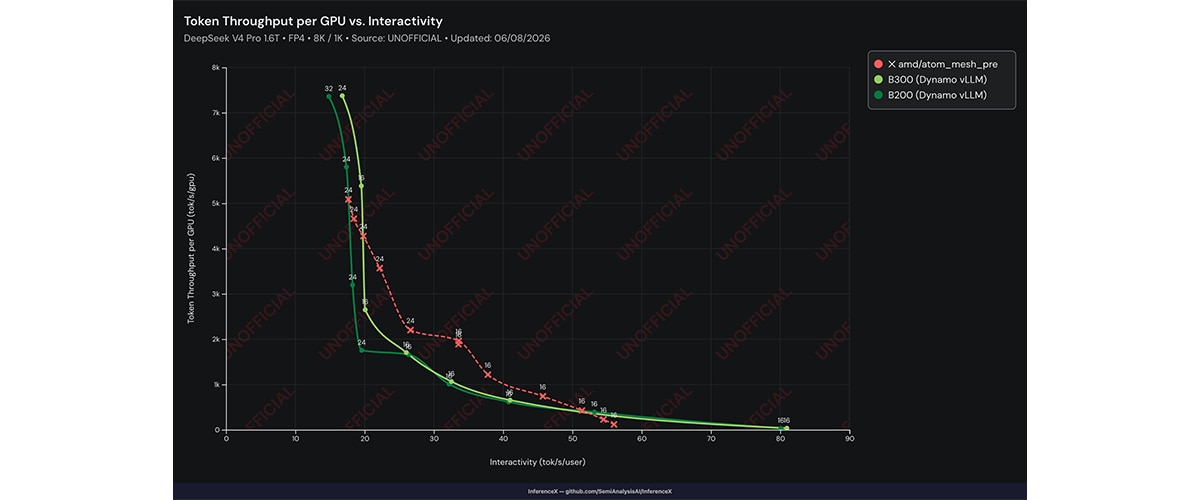
For production inference, the important question is not peak tokens per second alone. It is the throughput a system can deliver while maintaining the interactivity users expect. On DeepSeek V4 Pro, MI355X GPU with ATOM matches or exceeds B200 and B300 with Dynamo vLLM on per-GPU throughput across most of the interactivity range (Figure 2). Results are based on a PR submitted to InferenceX, not yet merged upstream.
Image Zoom
Cost per Token and Fleet Economics
Cost per token is where infrastructure decisions become business decisions. The right evaluation uses a transparent ownership model at the interactivity target each application requires.
Starting with DeepSeek R1 0528 (FP4, 8K/1K, MTP enabled), MI355X GPU (with MoRI + SGLang + MTP) delivers equivalent or lower cost per million output tokens compared to GB300, GB200, B200, and B300 (running Dynamo + TRT + MTP) at production interactivity levels under a hyperscaler ownership cost model (Figure 3).
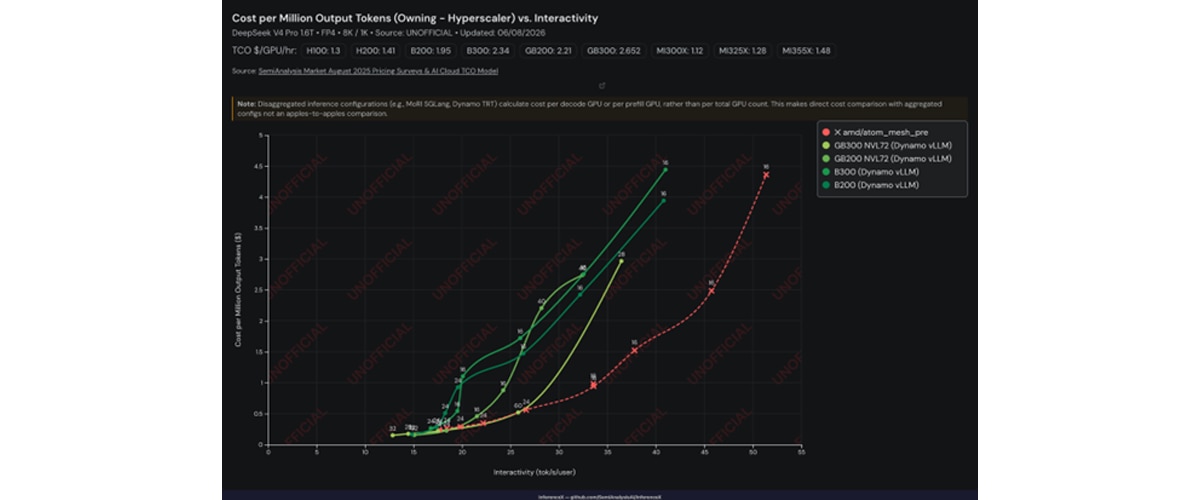
On DeepSeek V4 Pro (FP4, 8K/1K), MI355X GPU (with ATOM) delivers equivalent or lower cost per million output tokens compared to GB300, GB200, B200, and B300 (running Dynamo + vLLM) at production interactivity levels under a hyperscaler ownership cost model (Figure 4). Results are based on a PR submitted to InferenceX, not yet merged upstream.
Image Zoom
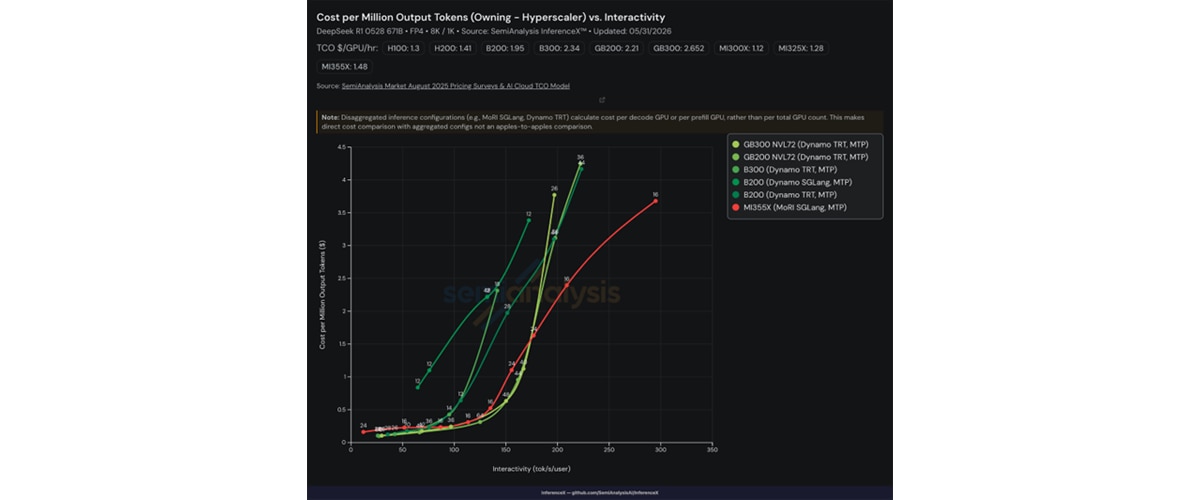
Image Zoom
The Path Forward
The MI355X GPU improvement curve showed that the software stack can move fast when kernel engineering, framework integration, and benchmark feedback loops are aligned. vLLM and SGLang are top priorities for AMD Instinct GPUs. ATOM, which is open source, gives us a speed-of-light path for experimentation and optimization before upstreaming improvements to vLLM and SGLang.
Day 0 is one day. Production is every day after that. MI355X GPU wins where it matters.

Related Blogs
-
Kimi K3 on AMD Instinct GPUs with TokenSpeed
TokenSpeed delivers fast, agentic LLM inference on AMD Instinct™ MI355X GPUs, with optimized kernels and leading Kimi K3 performance.
October 09, 2026
-
MangoBoost Delivers Open AI Models Powered by AMD
Mango Inference a serverless inference service providing production-ready access to open models powered by AMD Instinct™ GPUs and AMD ROCm™ software
October 09, 2026
-
Pre-Training Hybrid LLMs from Scratch in Primus on AMD Instinct™ GPUs — ROCm Blogs
Pre-train hybrid LLMs mixing MLA attention with Gated DeltaNet, Kimi Delta Attention and Mamba2 mixers on AMD Instinct MI355X GPUs, with open recipes.
October 07, 2026
-
DI Series: Serving Kimi-K3 MXFP4 Wide-EP Disaggregated on AMD Instinct MI300X and MI325X — ROCm Blogs
Learn how to serve a 1.4 TiB Kimi-K3 MXFP4 mixture-of-experts model disaggregated across AMD Instinct MI300X and MI325X GPUs.
October 07, 2026
-
AMD Instinct MI455X vs MI355X: A Technical Look at the Advancing AI 2026 Inference Numbers — ROCm Blogs
Explore the MI455X vs MI355X inference numbers from Advancing AI 2026, and learn how each benchmark was measured and what it really means.
October 07, 2026
-
How Agentic AI Is Expanding the Role of the DPU
As agentic AI drives more stateful workloads, DPUs are becoming critical for networking, storage, KV-cache management, and infrastructure efficiency.
October 05, 2026
-
MoRI UMBP Empowers AMD Instinct GPUs
See how UMBP, MoRI and SGLang optimize KV cache reuse to boost AMD Instinct™ MI355X GPU agentic AI performance and cost efficiency
October 01, 2026
-
Automating Performance Bottleneck Identification with the TraceLens Agent — ROCm Blogs
TraceLens Agent is an agentic workflow that examines GPU traces to deliver a prioritized optimization report, detailing root causes and fixes.
September 29, 2026