AMD Launches Helios™: The Highest Performing Rackscale AI Infrastructure Solution
Jul 23, 2026
Why the AI Factory Needs a New Architecture
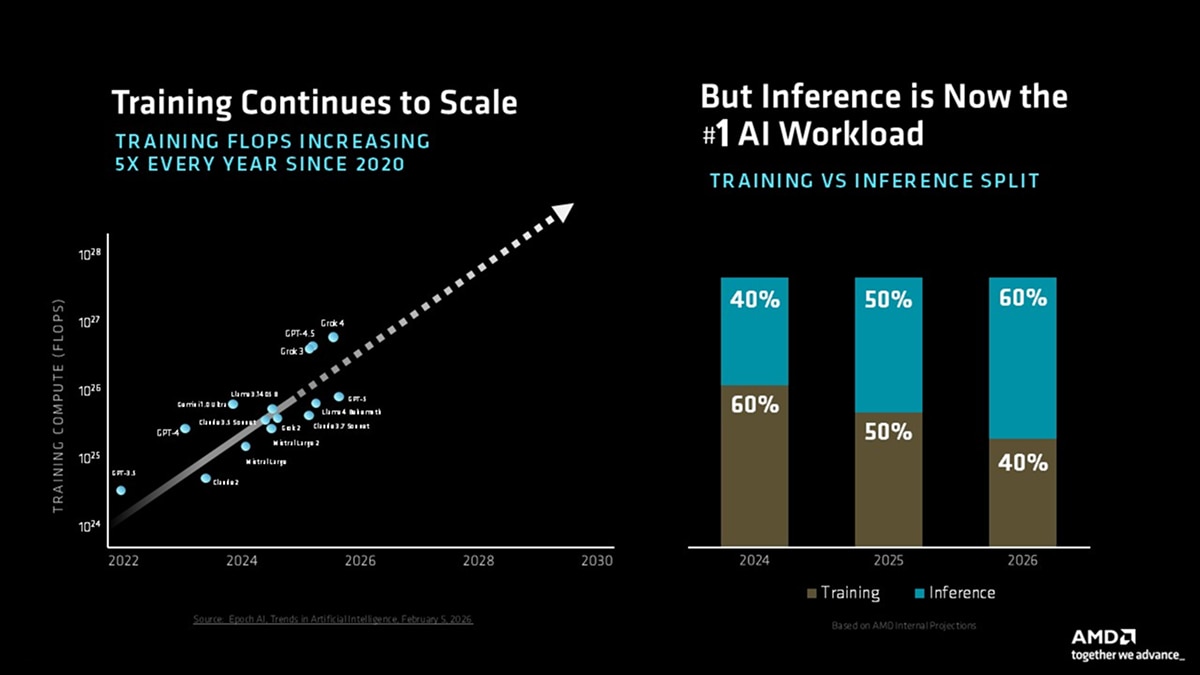
Monthly token consumption has increased 158X in two years as AI moves from experimentation into products and services. Training compute has continued to grow, increasing 5X per year since 2020. Inference is becoming the largest AI workload as models serve billions of interactions.
Agentic AI increases that demand further. A single request can trigger multiple reasoning steps, sub-agents, retrieval operations and tool calls, along with CPU-driven routing, scheduling and memory management. The demand is therefore not only for more tokens; every useful result requires more inference, orchestration and data movement, placing additional pressure on compute, memory capacity, networking, latency and cost per token.
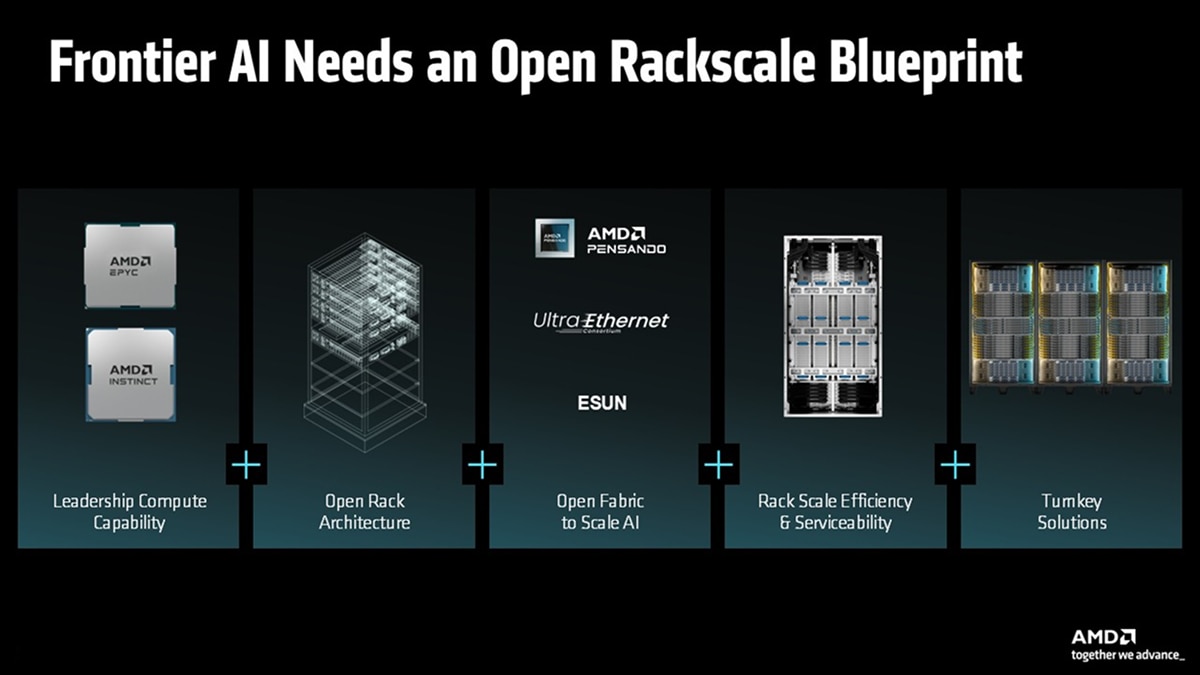
AI requires a new infrastructure blueprint. Leadership compute is essential, but compute alone is not enough. Customers also need open rack architecture, high-bandwidth scale-up and scale-out fabrics, efficient power and cooling, serviceability, and turnkey solutions that can be deployed rapidly. AMD set out to design these capabilities together as one system.
AMD Instinct™ MI455X GPU is the Engine. AMD Helios is the System.
At the heart of AMD Helios, the AMD Instinct™ MI455X GPU delivers a generational leap in AI compute, HBM4 capacity and memory bandwidth.
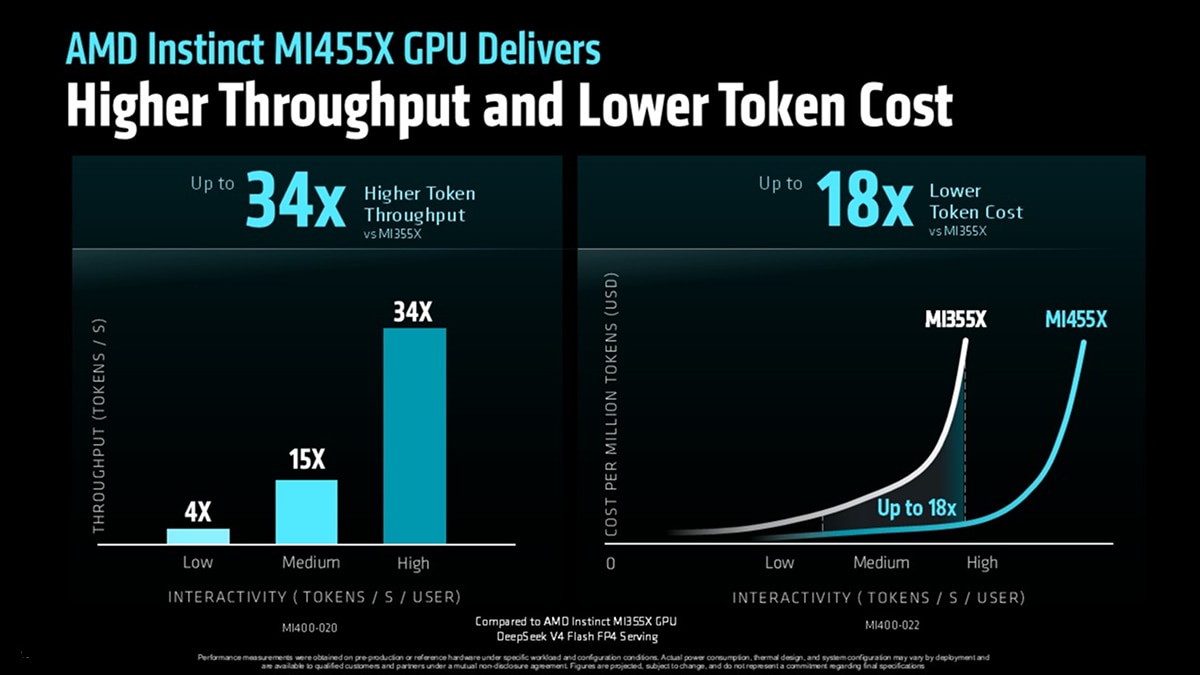
On DeepSeek-V4-Flash, one of the leading open-weight models in its class, AMD Instinct™ MI455X GPUs deliver up to 34X higher token throughput at high interactivity and up to 18X lower token cost compared with AMD Instinct™ MI355X GPUs. The results connect the architectural gains to the performance and economics required for production inference.
Inside AMD Helios: One Rack, One Co-Designed System
AMD Helios is designed around the path an AI workload takes through the rack. Work enters through the host layer, moves into the GPU domain, accesses model and active data in HBM4 and communicates across the rack through the scale-up fabric.
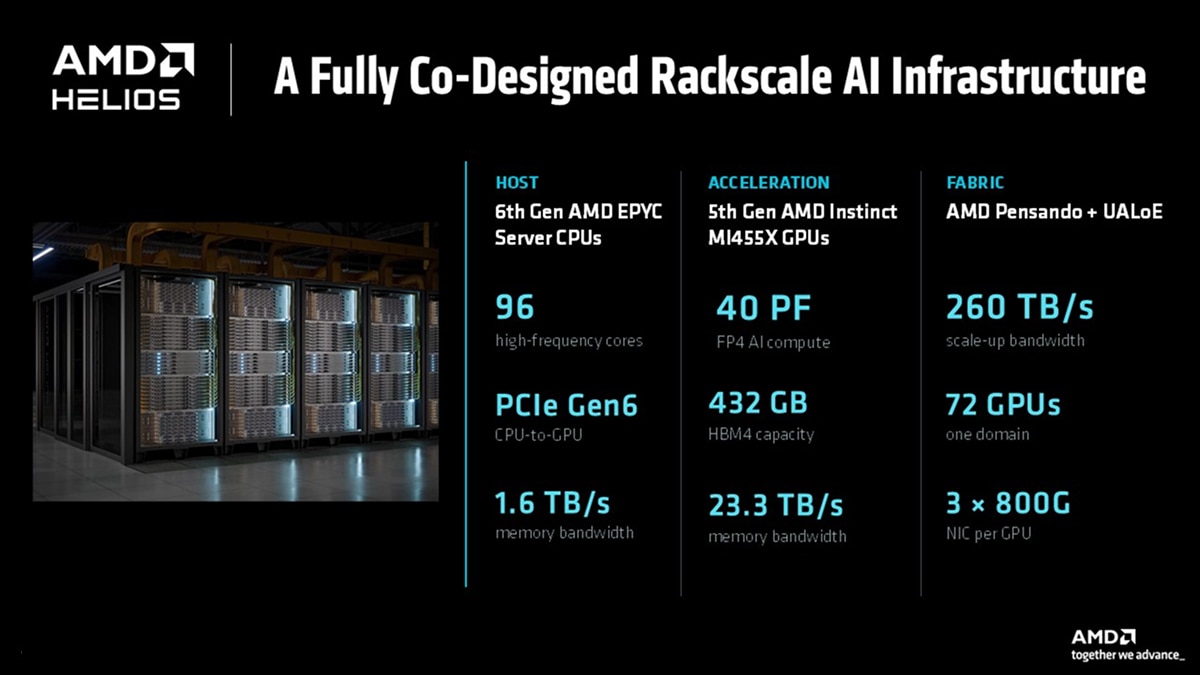
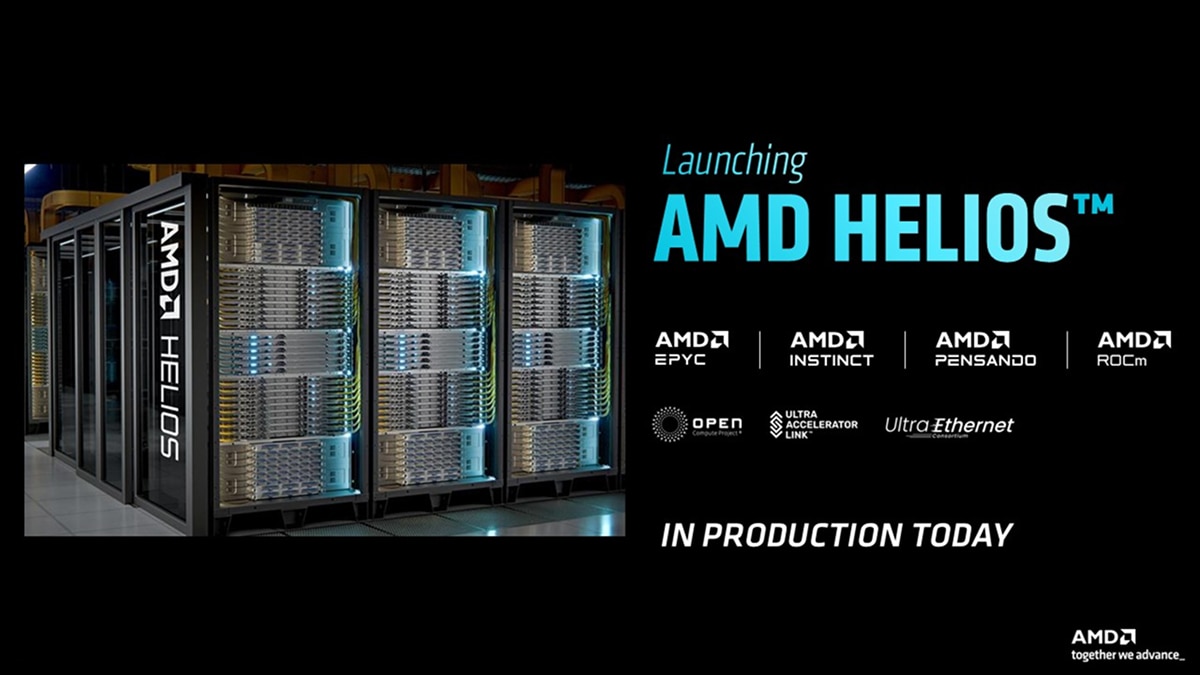
The AMD Helios rackscale solution combines 6th Gen AMD EPYC™ “Venice” 9006 Series Server CPUs, 5th Gen AMD Instinct™ MI455X GPUs and AMD Pensando™ networking with UALoE fabric in a fully co-designed platform. Together, these components connect 72 GPUs in one scale-up domain with 260 TB/s of scale-up bandwidth for frontier AI inference and training.
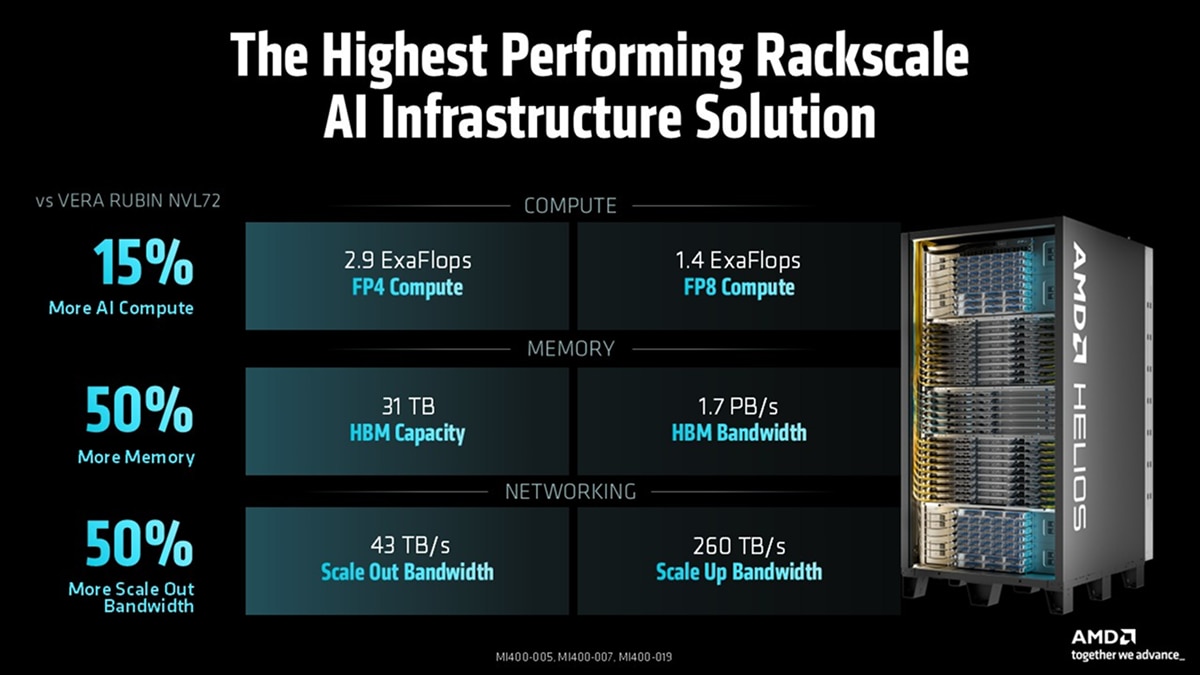
That rack-scale design sets a new competitive bar. Compared with an NVIDIA Vera Rubin NVL72 rack, AMD Helios is designed to deliver up to 15% more AI compute, 50% more HBM capacity and 50% more scale-out bandwidth. AMD Helios combines those advantages with 2.9 exaflops of dense FP4 compute, 1.4 exaflops of FP8 compute, 31 TB of HBM4, 1.7 PB/s of aggregate HBM bandwidth, 260 TB/s of scale-up bandwidth and 43 TB/s of scale-out bandwidth.
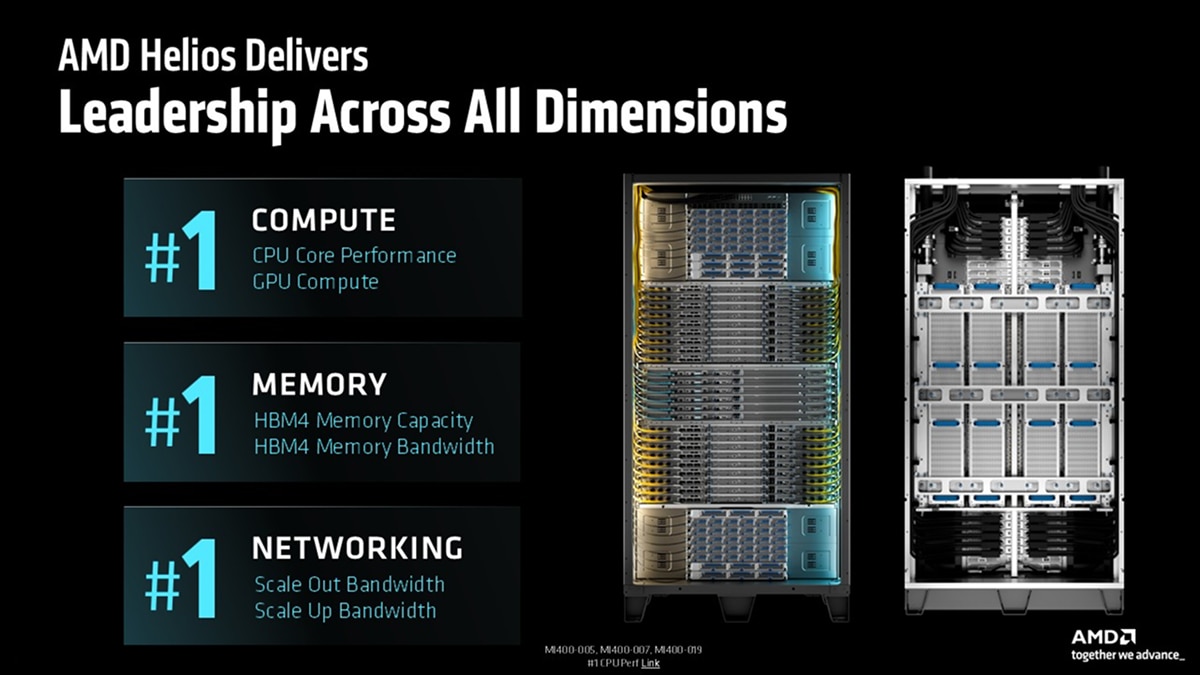
More compute and HBM capacity give large models and active workloads additional room within the rack. Higher HBM bandwidth helps keep the GPU domain supplied with data, and greater scale-out bandwidth provides more capacity for expanding beyond a single rack. AMD Helios brings those capabilities together as one rack-scale platform rather than treating compute, memory and networking as separate infrastructure decisions.
Performance and Economics at AI Factory Scale
Peak specifications establish the scale of AMD Helios. In production, the practical measures are throughput at the required level of interactivity, tokens per dollar and the number of active workloads a rack can support.
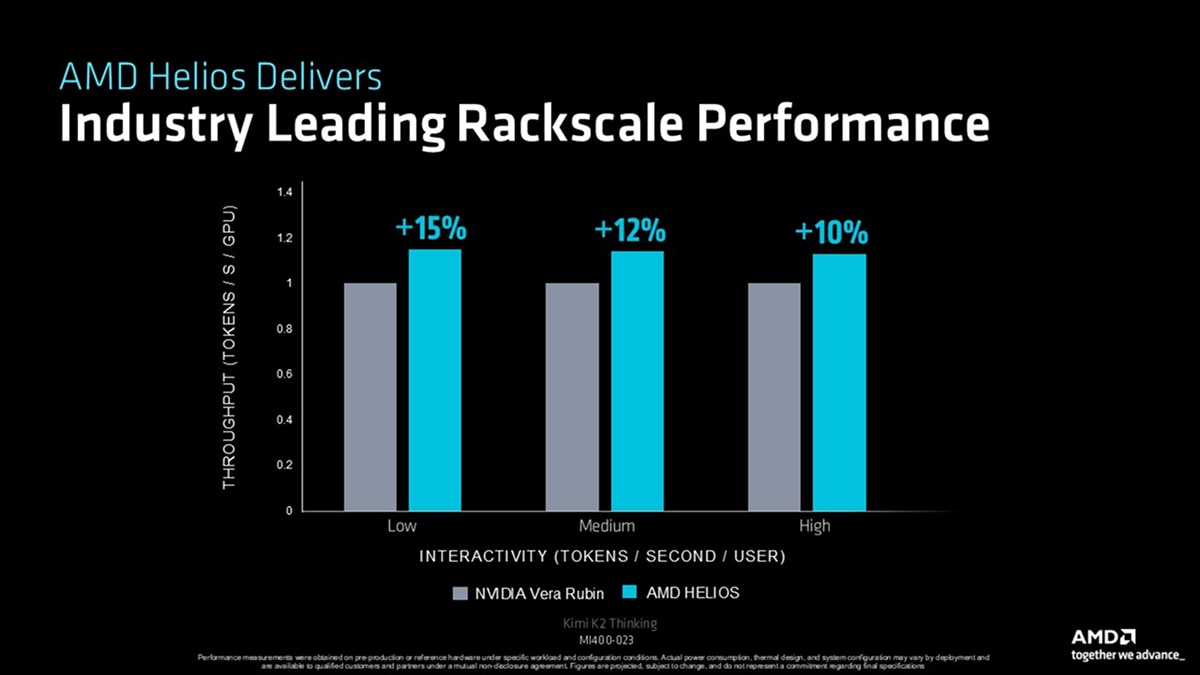
On Kimi K2 Thinking with a 32K input and 8K output sequence, modeled AMD Helios throughput per GPU is up to 15% higher at low interactivity, 12% higher at medium interactivity and 10% higher at high interactivity than modeled NVIDIA Vera Rubin NVL72 rack performance. The comparison shows how the rack’s compute, memory and fabric design supports throughput across different token-delivery targets.
Open at Every Layer, From Rack to Software
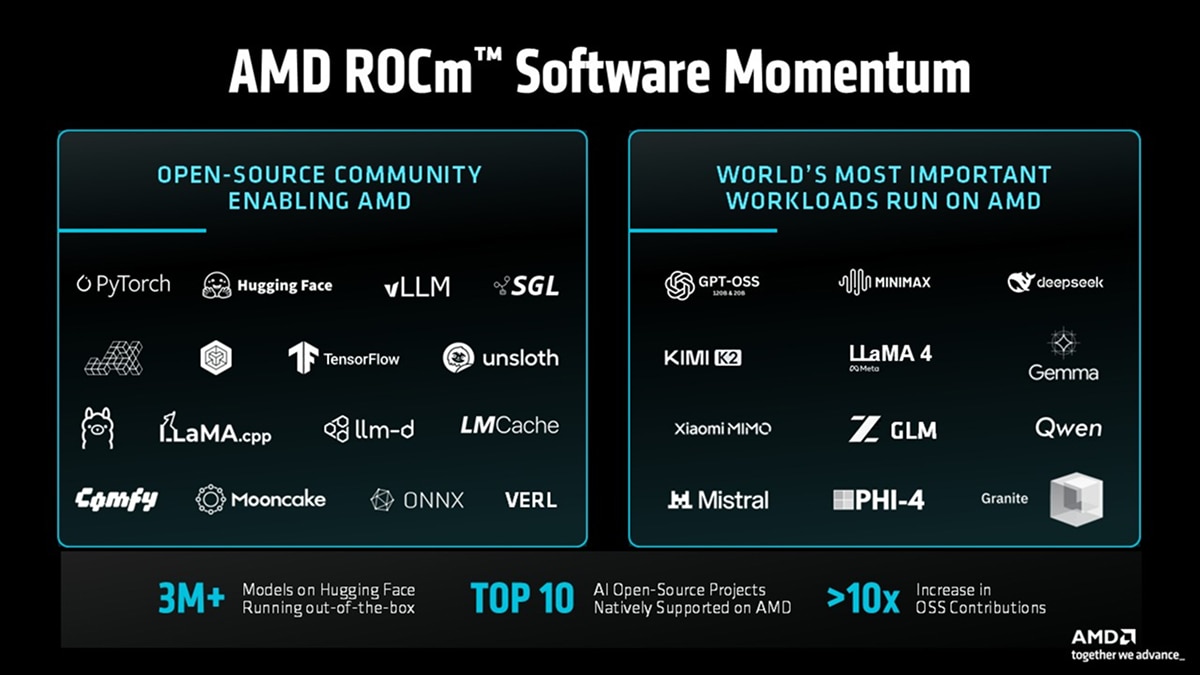
AMD ROCm™ software connects the rack-scale architecture of AMD Helios to production AI workloads. Native support for leading frameworks, including PyTorch, TensorFlow and JAX, lets developers use familiar tools for high-throughput inference and distributed training.
Optimized libraries and open standards help applications take advantage of AMD Instinct™ GPU compute, memory and fabric capabilities across the rack. AMD ROCm software also provides tools for deployment, observability and lifecycle management, giving infrastructure teams a consistent software foundation for operating AMD Helios at scale.
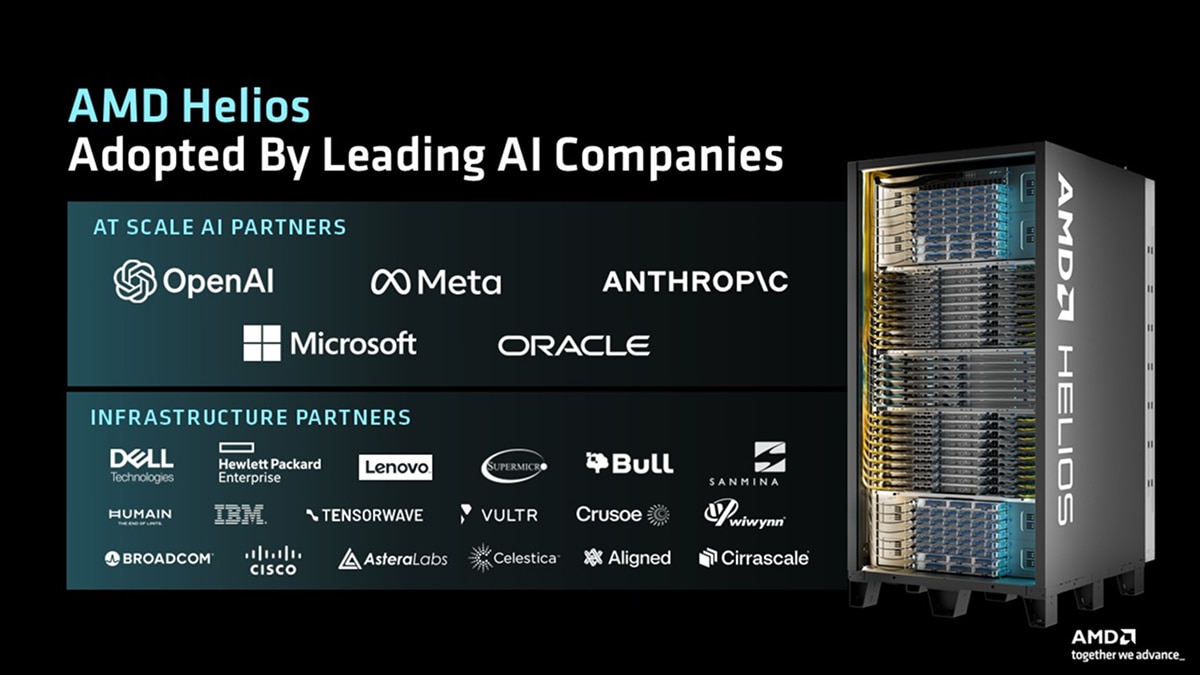
AMD Helios is being adopted across AI leaders, cloud partners and infrastructure partners. That breadth matters because rack-scale infrastructure reaches production through a connected supply chain, from model developers and cloud operators to the companies building and servicing the physical systems.
Final Takeaway
AMD Instinct™ MI455X GPUs bring a major increase in compute, memory bandwidth and HBM capacity. AMD Helios scales that engine into a complete rack-scale platform, connecting 72 GPUs with AMD EPYC™ “Venice” server CPUs, AMD Pensando™ networking, AMD ROCm™ software and an open system architecture.
AMD Helios also marks a broader shift in how AMD advances AI infrastructure. Annual execution now connects successive AMD Instinct GPU generations with progress in memory, interconnect and GPU scale-up. The result is an open, multi-generation compute cadence for rack-scale AI.
With AMD Helios, the rack is no longer simply where the AI system is installed. The rack is the AI system, and AMD is delivering an open platform for the AI factory era.
Footnotes
- Exponential View, The State of the AI Economy, June 25, 2026. The 158X increase in monthly inference token volume is derived from the source data across the two-year period presented. For additional information, visit: https://intelligence.exponentialview.co/assets/ev-state-of-ai-economy-2026.pdf
- Epoch AI, Trends in Artificial Intelligence, updated February 5, 2026. Training compute for frontier language models grew at an estimated rate of 5X per year from 2020 through the period presented. For additional information, visit: https://epoch.ai/trends.
- AMD internal projections as of July 2026. The workload mix presented projects training and inference at 60% and 40%, respectively, in 2024; 50% and 50% in 2025; and 40% and 60% in 2026. Projections are subject to change.
- Artificial Analysis, DeepSeek V4 Flash (Reasoning, Max Effort): Intelligence, Performance and Price Analysis, accessed July 2026. Artificial Analysis places DeepSeek-V4-Flash among the leading open-weight models in intelligence when compared with models of similar size. DeepSeek identifies DeepSeek-V4-Flash as an open-weight Mixture-of-Experts language model with a one-million-token context window. Model rankings may change as models and evaluations are updated. For additional information, visit: https://artificialanalysis.ai/models/deepseek-v4-flash and https://fe-static.deepseek.com/chat/transparency/deepseek-V4-model-card-EN.pdf
- MI400-006 - Based on AMD Performance Labs calculations in June 2026 using peak theoretical precision performance of the AMD Instinct™ MI455X GPU compared with published specifications for the AMD Instinct™ MI355X GPU. Results may vary by system configuration and data type. MI400-006.
- MI400-008 - Calculations by AMD Performance Labs in June 2026 based on the memory capacity and memory bandwidth specifications of the AMD Instinct™ MI455X GPU compared with the published memory capacity and memory bandwidth specifications of the AMD Instinct™ MI355X GPU, respectively. System manufacturers may vary configurations, yielding different results. MI400-008.
- MI400-020 - Based on measurements and calculations by AMD Performance Labs in July 2026 using the AMD Instinct™ MI455X GPU to determine measured token throughput at high, medium, and low interactivity points with DeepSeek-V4-Flash FP4 serving, compared with the AMD Instinct™ MI355X GPU. System manufacturers may vary configurations, yielding different results. MI400-020.
- MI400-022 - Based on calculations by AMD Performance Labs in July 2026 using the AMD Instinct™ MI455X GPU to determine cost per one million tokens at high, medium, and low interactivity using projected hourly cloud pricing and tokens per second, compared with the AMD Instinct™ MI355X GPU running DeepSeek-V4-Flash FP4 serving. System manufacturers and hourly cloud pricing may vary, yielding different results. MI400-022.
- MI400-005 - Based on calculations by AMD Performance Labs in June 2026 to determine the peak theoretical precision performance of the AMD Helios Rackscale Solution using peak matrix FP16, BF16, INT8, Open Compute Project MXFP6, MXFP8, FP8, and MXFP4 data types, compared with the NVIDIA Vera Rubin NVL72 rack using dense NVFP4 and FP8/FP6 data types. System manufacturers may vary configurations, yielding different results. MI400-005.
- MI400-007 - Calculations by AMD Performance Labs in June 2026 based on the published memory capacity and memory bandwidth specifications of the AMD Helios Rackscale Solution compared with the published memory capacity and memory bandwidth specifications of the NVIDIA Vera Rubin NVL72 rack. System manufacturers may vary configurations, yielding different results. MI400-007.
- MI400-019 - Calculations by AMD Performance Labs in July 2026 based on the published scale-out bandwidth specifications of the AMD Helios Rackscale Solution compared with the published scale-out bandwidth specifications of the NVIDIA Vera Rubin NVL72 rack. System manufacturers may vary configurations, yielding different results. MI400-019.
- MI400-023 - Based on calculations by AMD Performance Labs in July 2026 using the AMD Helios Rackscale Solution to determine token throughput per GPU at high, medium, and low interactivity points with Kimi K2 Thinking using a 32K input sequence length and an 8K output sequence length, compared with published specifications for the NVIDIA Vera Rubin NVL72 rack. System manufacturers may vary configurations, yielding different results. MI400-023.
- MI400-025 - Based on AMD Performance Labs estimates as of July 2026, tokens-per-dollar performance was calculated using the Kimi K2 Thinking workload with a 32K input sequence length and an 8K output sequence length on the AMD Helios Rackscale Solution compared with the NVIDIA Vera Rubin NVL72 rack. Results reflect estimated aggregate throughput across low, medium, and high interactivity operating points and projected hourly pricing for the system GPUs. System configurations and pricing may vary, yielding different results. MI400-025.
- Performance measurements were obtained on pre-production or reference hardware under specific workload and configuration conditions. Actual power consumption, thermal design, and system configuration may vary by deployment and are available to qualified customers and partners under a mutual non-disclosure agreement. Figures are projected, subject to change, and do not represent a commitment regarding final specifications.
GENERAL DISCLAIMER
The information contained herein is for informational purposes only and is subject to change without notice. While every precaution has been taken in the preparation of this document, it may contain technical inaccuracies, omissions and typographical errors, and AMD is under no obligation to update or otherwise correct this information. Advanced Micro Devices, Inc. makes no representations or warranties with respect to the accuracy or completeness of the contents of this document, and assumes no liability of any kind, including the implied warranties of noninfringement, merchantability or fitness for particular purposes, with respect to the operation or use of AMD hardware, software or other products described herein. No license, including implied or arising by estoppel, to any intellectual property rights is granted by this document. Terms and limitations applicable to the purchase or use of AMD products are as set forth in a signed agreement between the parties or in AMD's Standard Terms and Conditions of Sale. GD-18u.
© 2026 Advanced Micro Devices, Inc. All rights reserved. AMD, the AMD Arrow logo, AMD Instinct, and combinations thereof are trademarks of Advanced Micro Devices, Inc. Other product names used in this publication are for identification purposes only and may be trademarks of their respective owners. Certain AMD technologies may require third-party enablement or activation. Supported features may vary by operating system. Please confirm with the system manufacturer for specific features. No technology or product can be completely secure.
Cautionary Statement
This blog may contain forward-looking statements concerning Advanced Micro Devices, Inc. (AMD), which are made pursuant to the Safe Harbor provisions of the Private Securities Litigation Reform Act of 1995. Forward-looking statements are commonly identified by words such as "would," "may," "expects," "believes," "plans," "intends," "projects" and other terms with similar meaning. Investors are cautioned that any forward-looking statements in this blog are based on current beliefs, assumptions and expectations, speak only as of the date of this blog and involve risks and uncertainties that could cause actual results to differ materially from current expectations. Such statements are subject to certain known and unknown risks and uncertainties, many of which are difficult to predict and generally beyond AMD's control, that could cause actual results and other future events to differ materially from those expressed in, or implied or projected by, the forward-looking information and statements. Investors are urged to review in detail the risks and uncertainties in AMD’s Securities and Exchange Commission filings, including but not limited to AMD’s most recent reports on Forms 10-K and 10-Q.
AMD does not assume, and hereby disclaims, any obligation to update forward-looking statements made in this blog, except as may be required by law.
Footnotes
- Exponential View, The State of the AI Economy, June 25, 2026. The 158X increase in monthly inference token volume is derived from the source data across the two-year period presented. For additional information, visit: https://intelligence.exponentialview.co/assets/ev-state-of-ai-economy-2026.pdf
- Epoch AI, Trends in Artificial Intelligence, updated February 5, 2026. Training compute for frontier language models grew at an estimated rate of 5X per year from 2020 through the period presented. For additional information, visit: https://epoch.ai/trends.
- AMD internal projections as of July 2026. The workload mix presented projects training and inference at 60% and 40%, respectively, in 2024; 50% and 50% in 2025; and 40% and 60% in 2026. Projections are subject to change.
- Artificial Analysis, DeepSeek V4 Flash (Reasoning, Max Effort): Intelligence, Performance and Price Analysis, accessed July 2026. Artificial Analysis places DeepSeek-V4-Flash among the leading open-weight models in intelligence when compared with models of similar size. DeepSeek identifies DeepSeek-V4-Flash as an open-weight Mixture-of-Experts language model with a one-million-token context window. Model rankings may change as models and evaluations are updated. For additional information, visit: https://artificialanalysis.ai/models/deepseek-v4-flash and https://fe-static.deepseek.com/chat/transparency/deepseek-V4-model-card-EN.pdf
- MI400-006 - Based on AMD Performance Labs calculations in June 2026 using peak theoretical precision performance of the AMD Instinct™ MI455X GPU compared with published specifications for the AMD Instinct™ MI355X GPU. Results may vary by system configuration and data type. MI400-006.
- MI400-008 - Calculations by AMD Performance Labs in June 2026 based on the memory capacity and memory bandwidth specifications of the AMD Instinct™ MI455X GPU compared with the published memory capacity and memory bandwidth specifications of the AMD Instinct™ MI355X GPU, respectively. System manufacturers may vary configurations, yielding different results. MI400-008.
- MI400-020 - Based on measurements and calculations by AMD Performance Labs in July 2026 using the AMD Instinct™ MI455X GPU to determine measured token throughput at high, medium, and low interactivity points with DeepSeek-V4-Flash FP4 serving, compared with the AMD Instinct™ MI355X GPU. System manufacturers may vary configurations, yielding different results. MI400-020.
- MI400-022 - Based on calculations by AMD Performance Labs in July 2026 using the AMD Instinct™ MI455X GPU to determine cost per one million tokens at high, medium, and low interactivity using projected hourly cloud pricing and tokens per second, compared with the AMD Instinct™ MI355X GPU running DeepSeek-V4-Flash FP4 serving. System manufacturers and hourly cloud pricing may vary, yielding different results. MI400-022.
- MI400-005 - Based on calculations by AMD Performance Labs in June 2026 to determine the peak theoretical precision performance of the AMD Helios Rackscale Solution using peak matrix FP16, BF16, INT8, Open Compute Project MXFP6, MXFP8, FP8, and MXFP4 data types, compared with the NVIDIA Vera Rubin NVL72 rack using dense NVFP4 and FP8/FP6 data types. System manufacturers may vary configurations, yielding different results. MI400-005.
- MI400-007 - Calculations by AMD Performance Labs in June 2026 based on the published memory capacity and memory bandwidth specifications of the AMD Helios Rackscale Solution compared with the published memory capacity and memory bandwidth specifications of the NVIDIA Vera Rubin NVL72 rack. System manufacturers may vary configurations, yielding different results. MI400-007.
- MI400-019 - Calculations by AMD Performance Labs in July 2026 based on the published scale-out bandwidth specifications of the AMD Helios Rackscale Solution compared with the published scale-out bandwidth specifications of the NVIDIA Vera Rubin NVL72 rack. System manufacturers may vary configurations, yielding different results. MI400-019.
- MI400-023 - Based on calculations by AMD Performance Labs in July 2026 using the AMD Helios Rackscale Solution to determine token throughput per GPU at high, medium, and low interactivity points with Kimi K2 Thinking using a 32K input sequence length and an 8K output sequence length, compared with published specifications for the NVIDIA Vera Rubin NVL72 rack. System manufacturers may vary configurations, yielding different results. MI400-023.
- MI400-025 - Based on AMD Performance Labs estimates as of July 2026, tokens-per-dollar performance was calculated using the Kimi K2 Thinking workload with a 32K input sequence length and an 8K output sequence length on the AMD Helios Rackscale Solution compared with the NVIDIA Vera Rubin NVL72 rack. Results reflect estimated aggregate throughput across low, medium, and high interactivity operating points and projected hourly pricing for the system GPUs. System configurations and pricing may vary, yielding different results. MI400-025.
- Performance measurements were obtained on pre-production or reference hardware under specific workload and configuration conditions. Actual power consumption, thermal design, and system configuration may vary by deployment and are available to qualified customers and partners under a mutual non-disclosure agreement. Figures are projected, subject to change, and do not represent a commitment regarding final specifications.
GENERAL DISCLAIMER
The information contained herein is for informational purposes only and is subject to change without notice. While every precaution has been taken in the preparation of this document, it may contain technical inaccuracies, omissions and typographical errors, and AMD is under no obligation to update or otherwise correct this information. Advanced Micro Devices, Inc. makes no representations or warranties with respect to the accuracy or completeness of the contents of this document, and assumes no liability of any kind, including the implied warranties of noninfringement, merchantability or fitness for particular purposes, with respect to the operation or use of AMD hardware, software or other products described herein. No license, including implied or arising by estoppel, to any intellectual property rights is granted by this document. Terms and limitations applicable to the purchase or use of AMD products are as set forth in a signed agreement between the parties or in AMD's Standard Terms and Conditions of Sale. GD-18u.
© 2026 Advanced Micro Devices, Inc. All rights reserved. AMD, the AMD Arrow logo, AMD Instinct, and combinations thereof are trademarks of Advanced Micro Devices, Inc. Other product names used in this publication are for identification purposes only and may be trademarks of their respective owners. Certain AMD technologies may require third-party enablement or activation. Supported features may vary by operating system. Please confirm with the system manufacturer for specific features. No technology or product can be completely secure.
Cautionary Statement
This blog may contain forward-looking statements concerning Advanced Micro Devices, Inc. (AMD), which are made pursuant to the Safe Harbor provisions of the Private Securities Litigation Reform Act of 1995. Forward-looking statements are commonly identified by words such as "would," "may," "expects," "believes," "plans," "intends," "projects" and other terms with similar meaning. Investors are cautioned that any forward-looking statements in this blog are based on current beliefs, assumptions and expectations, speak only as of the date of this blog and involve risks and uncertainties that could cause actual results to differ materially from current expectations. Such statements are subject to certain known and unknown risks and uncertainties, many of which are difficult to predict and generally beyond AMD's control, that could cause actual results and other future events to differ materially from those expressed in, or implied or projected by, the forward-looking information and statements. Investors are urged to review in detail the risks and uncertainties in AMD’s Securities and Exchange Commission filings, including but not limited to AMD’s most recent reports on Forms 10-K and 10-Q.
AMD does not assume, and hereby disclaims, any obligation to update forward-looking statements made in this blog, except as may be required by law.

Related Blogs
-
Meet the Next AMD Ryzen™ AI Halo
Meet the next AMD Ryzen™ AI Halo developer platform, powered by the AMD Ryzen™ AI Max+ PRO 495 processor. Run larger local LLMs, up to 300B parameters, thanks to the 192GB of unified memory that comes on the new platform.
October 12, 2026
-
AMD AI NIC™ Technology Driving AI-Ready Ethernet
Learn how AMD AI NIC™ technology helps organizations build AI-ready Ethernet networks with open standards, programmability, and transport innovation.
October 11, 2026
-
Kimi K3 on AMD Instinct GPUs with TokenSpeed
TokenSpeed delivers fast, agentic LLM inference on AMD Instinct™ MI355X GPUs, with optimized kernels and leading Kimi K3 performance.
October 09, 2026
-
MangoBoost Delivers Open AI Models Powered by AMD
Mango Inference a serverless inference service providing production-ready access to open models powered by AMD Instinct™ GPUs and AMD ROCm™ software
October 09, 2026
-
MoRI UMBP Empowers AMD Instinct GPUs
See how UMBP, MoRI and SGLang optimize KV cache reuse to boost AMD Instinct™ MI355X GPU agentic AI performance and cost efficiency
October 09, 2026
-
Pre-Training Hybrid LLMs from Scratch in Primus on AMD Instinct™ GPUs — ROCm Blogs
Pre-train hybrid LLMs mixing MLA attention with Gated DeltaNet, Kimi Delta Attention and Mamba2 mixers on AMD Instinct MI355X GPUs, with open recipes.
October 07, 2026
-
DI Series: Serving Kimi-K3 MXFP4 Wide-EP Disaggregated on AMD Instinct MI300X and MI325X — ROCm Blogs
Learn how to serve a 1.4 TiB Kimi-K3 MXFP4 mixture-of-experts model disaggregated across AMD Instinct MI300X and MI325X GPUs.
October 07, 2026
-
AMD Instinct MI455X vs MI355X: A Technical Look at the Advancing AI 2026 Inference Numbers — ROCm Blogs
Explore the MI455X vs MI355X inference numbers from Advancing AI 2026, and learn how each benchmark was measured and what it really means.
October 07, 2026