Advancing AI 2026: From Gigawatt Data Centers to Agentic PCs
Sep 16, 2026
Introduction
Advancing AI 2026 put two very different versions of AI scale under the same roof. At one end was AMD Helios™, our first rack-scale AI solution, built for frontier AI and headed for gigawatt-scale deployments. I work on the client and graphics side, so what caught my attention in San Francisco was how quickly serious AI capability is scaling, both in data centers and on the desk in front of you.
At AAI Day, developers showcased hybrid multi-agent systems that split work between AMD Ryzen™ AI agentic PCs and AMD Instinct™ infrastructure. AMD and Cisco discussed how enterprises could govern and manage local agents. ROCm.AI introduced a more consistent software path across AMD Ryzen, Radeon™, and Instinct hardware, allowing developers to carry familiar tools and workflows from local systems into much larger deployments.
For me, that’s where agentic AI gets especially interesting. An agentic PC can become part of a broader enterprise AI deployment strategy by running models locally. This can boost security when there are restrictions or concerns about sharing data with a cloud service. Frontier cloud models still remain available when less-sensitive but more complicated workloads justify the cost of using it. As AI moves from assistants that answer questions to agents that take action, the compute sitting in front of the user is increasingly important.
From Assistant to Actor
Generative AI has already proven that giving a model the right context can make it substantially more useful. Feed it a meeting transcript and it can extract key details. Give it a collection of emails and it can summarize what changed while you were away. Provide the right documents and it can help draft a report based on information scattered across them.
Agentic AI carries the same idea further because context can now lead to action. An agent can read a support ticket, determine what the customer needs, consult the tools and information available to it, and decide what to do next. Instead of returning a single answer, the agent carries out the task itself. The difference may look small – just a few more steps taken on your behalf – but the potential impact on both productivity and IT budgets could be significant.
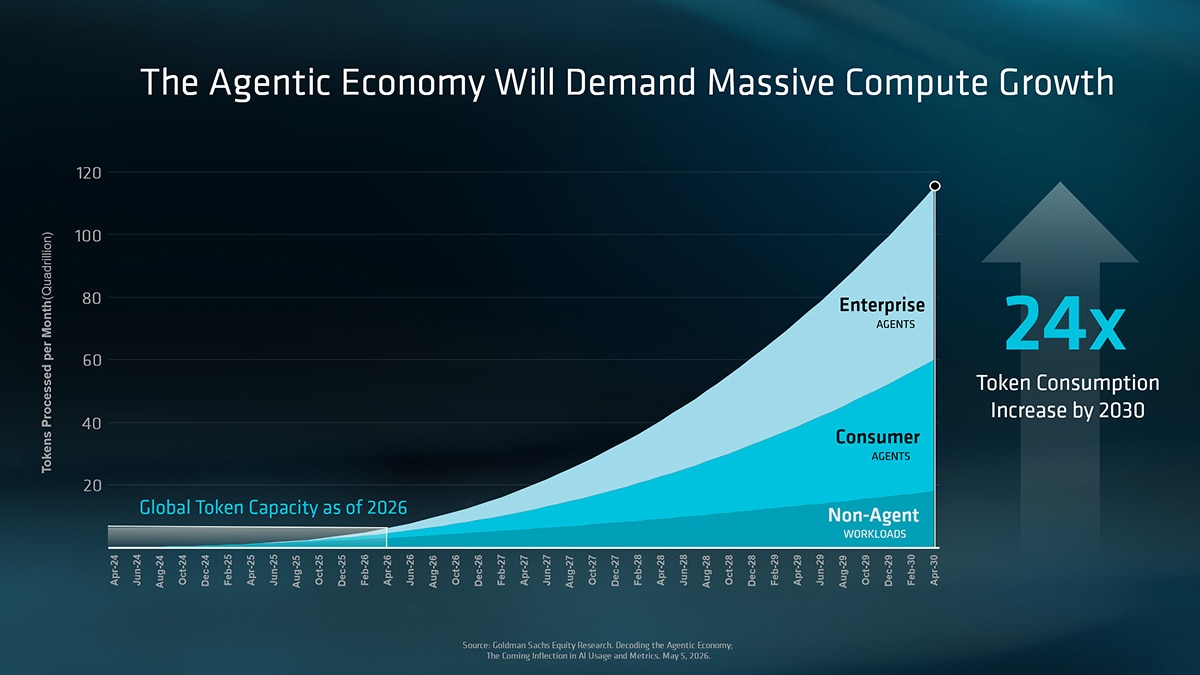
As remarkable as agents are, equipping every employee with a corresponding cloud service can quickly become expensive. Every task a cloud-based agent executes converts part of a human workflow into metered tokens, and costs can vary significantly depending on model choice and how an agent chooses to complete an assignment. Goldman Sachs expects token consumption from consumer and enterprise agents to dwarf non-agentic workloads in the long term:
There have already been multiple stories this year about companies that deployed cloud agents widely, only to backpedal once costs rose far faster than expected.
The way out of this problem is to match AI workloads to the models and systems best suited to the job. Local models have improved rapidly; some can now handle workloads that required frontier models 3-4 years ago. Work once reserved for a data center can now run on the PC sitting on your desk.
But bringing the full benefits of AI to local environments isn’t as simple as spinning up a model. A chatbot that summarizes a document needs access to the document. An agent tasked with resolving a problem may also need access to applications, credentials, customer records, communication tools, and other systems required to complete the job. The more useful the agent becomes, the more consequential its permissions become as well. A mistake can escalate far beyond a single bad answer if the AI agent isn’t paired with appropriate guardrails.
At AAI Day, I demoed a customer-support workload in which tickets arrived continuously and AI agents handled them as they appeared. Claude Code provided the agentic layer by triaging each ticket, reasoning through what it required, calling appropriate tools, and either resolving the issue or escalating it. Some routine queries could be handled automatically, but other tickets included sensitive information, abusive content, and prompt-injection attacks.
Our demo provided AI with the context and authority it needed to take appropriate action and the type of guardrails mentioned above.
Policy Guard handled admission. It evaluated commands and tool calls against declared rules and could either block violations or monitor and record them. AXIS governed execution itself through a kernel-level sandbox built on Landlock, seccomp, and network namespaces. Policy Guard could therefore decide that a request was admissible while AXIS still constrained where and how the resulting action could execute. When a request attempted to reach AWS credentials, Policy Guard could stop it at admission or AXIS could prevent its execution if Policy Guard was running in monitoring mode.
This defense in depth is critical precisely because useful agents will be run in situations their designers did not anticipate. Enterprise policies can identify known boundaries, but an autonomous system is valuable partly because it can respond to changing inputs without having every action scripted in advance. Containing execution gives IT another boundary when the agent encounters something outside the rulebook.
The same architecture also let us address the question of local vs. cloud execution. Lemonade served models locally on the Ryzen AI system and made a routing decision for individual requests. Routine work remained local, while requests judged to need more reasoning could be sent to a frontier cloud model. Across the demo, 69% of the token processing workload was handled locally, with just 31% offloaded to the cloud.
Evading the Tokenomics Trap
Our demo showed how local and cloud inference can coexist inside the same agentic workflow. Requests that fit a capable local model do not need to generate cloud API charges simply because another part of the workflow requires frontier reasoning. The appropriate split will vary by application, but the placement decision can happen at the level of the individual request instead of forcing the entire workload into one environment.
Local execution can also change where enterprise context travels. When a model and its data sources remain on-device, proprietary inputs and context can remain there as well. Local inference avoids the network round trip for those requests and can continue operating without an internet connection. Cloud inference remains available when a larger model or different resource is the better choice. Hybrid AI, which combines local and cloud resources, allows those requirements to coexist.
Silicon for the Agentic Era
Keeping meaningful agentic work local requires sufficient compute and memory. Agentic PCs featuring AMD Ryzen™ AI PRO 400 Series processors deliver up to 60 TOPS of NPU performance for everyday AI workloads. Larger local models and persistent agents can require substantially more memory, which is where higher-performance Agent Computer configurations enter the picture.
The Ryzen AI Max PRO platform gives developers a large unified memory pool for demanding local AI work, with up to 192GB of RAM in total, 160GB of which can be dedicated to the GPU. This is sufficient to run local models with up to 300B parameters and far exceeds the capabilities of laptops or desktops equipped with 32-64GB of RAM. Together these solutions help keep the right work local and reserve cloud inference for when it’s necessary.
We’re also applying agentic AI to AI development itself. ROCm.ai includes new AMD Skills that connect to Claude, Codex, Cursor, and Gemini so the guidance those agents give is tailored to AMD hardware. AMD ROCm™ Hyperloom, an end-to-end inference optimizer for host code and GPU kernels, can detect a bottleneck, apply a fix, and validate its own improvement, reducing engineering time spent chasing performance by hand. These build on the Ryzen AI PRO 400 support and broader Windows and Linux compatibility we introduced in ROCm 7.2. Developers can start with open models on AMD Ryzen AI Max PRO systems and carry familiar tools forward to AMD Radeon workstations or AMD Instinct GPUs as a project grows.
Conclusion
I build on the endpoint, so my conviction that AI’s greatest impact will be felt at a desk is the view from where I work — but the infrastructure behind a capability is rarely where people meet it. The cloud and the local sides of AI are both essential, which is why AMD has built a compute portfolio that spans the whole market. The work we do in data centers today improves what runs on your PC tomorrow; ROCm software and ROCm.ai optimizations rise to Helios and waterfall down to our work in robotics and physical AI.
At AAI we showed one Ryzen AI endpoint running agents on its own, cost-aware and contained by design. Now picture ten thousand of them across an enterprise, each a trusted machine, each contributing to the overall enterprise AI strategy. That’s the future we’re working towards – one where local devices and cloud capabilities are managed together, with intelligent workload routing that ensure both can work to best effect.

Related Blogs
-
NeuroSpark Expands AI Compute Choice with AMD
NeuroSpark uses AMD Instinct GPUs and ROCm software on OCI to deliver flexible, cost-effective AI training and inference
October 23, 2026
-
Sovereign AI for European Customer Conversations
LeadDesk, QuTwo, and AMD Silo AI collaborate on a sovereign AI stack that brings near-frontier, open-weight models to European customer conversations.
October 22, 2026
-
Scaling 3D Gaussian Splatting with Distributed Compute: Why One GPU Is Never Enough — ROCm Blogs
Learn how to scale 3D Gaussian splatting across GPUs with distributed training, RCCL, and real-world optimization tips for AMD Instinct GPUs
October 22, 2026
-
FP8 GEMM Optimization on AMD RDNA™ 4 Architecture — ROCm Blogs
Learn how to port an FP16 GEMM kernel to FP8 on AMD RDNA 4 and use the smaller element size to unlock larger tiles and deeper K slices.
October 22, 2026
-
AMD and Advantech - Architecting the Next Generation of Regulated Casino Games
Discover how Advantech and AMD are redefining regulated casino gaming with Ryzen Embedded 8000 Series processors, integrated RDNA 3 graphics, XDNA AI acceleration, and purpose-built DPX platforms. The solution enables immersive multi-screen experiences, predictive maintenance, stronger security, lower power consumption, simplified designs, and long-term platform availability for gaming OEMs worldwide.
October 21, 2026
-
Micro-World 2: Streaming Real-time Interactive World Model — ROCm Blogs
This blog demonstrates how Micro-World 2 combines precisely annotated action data, four-step diffusion distillation, and ROCm-optimized inference to deliver controllable, long-horizon, real-time world generation on a single AMD Instinct GPU through a fully open-source pipeline.
October 20, 2026
-
MoE Training Optimization with Primus — ROCm Blogs
Learn how to speed up MoE training on AMD Instinct GPUs with Primus: a fused MoE megakernel, FP8/MXFP8 expert GEMMs, and training-at-scale tuning.
October 20, 2026
-
Optimizing World Action Models on AMD GPUs — ROCm Blogs
Speed up World Action Models on AMD GPUs with GEAK kernels, fewer denoising steps, and latent actions, cutting FastWAM latency 25× at about 97 percent success.
October 20, 2026