ROCm.AI: The AI-Native Developer Experience for Building on AMD
Jul 23, 2026
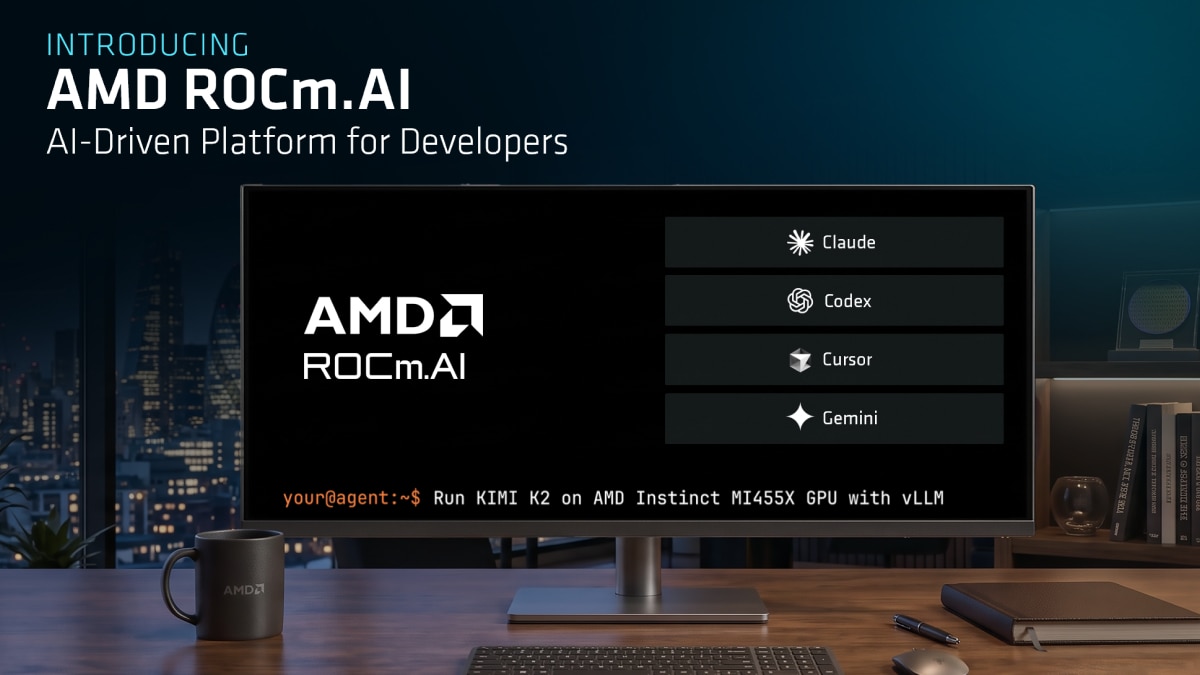
From Intent to Optimized Workloads: ROCm.AI Helps Make AI on AMD Faster to Build and Easier to Adopt
AI development on AMD now spans cloud infrastructure, enterprise clusters, workstations, desktops, and AI PCs. The real question is how quickly developers can turn AMD hardware into optimized AI services.
Across the AMD AI ecosystem, AMD ROCm™ software continues to accelerate software release velocity, broaden open-source engagement, expand framework support, strengthen model enablement, grow developer access and increase validation across the AI stack. That momentum spans the full AMD AI footprint from AMD Instinct™ GPUs in cloud and data center infrastructure to AMD Radeon™ workstations, Radeon desktop GPUs and Ryzen systems. This gives developers a more consistent software path wherever AI workloads run. AMD software is moving fast, scaling customer needs and becoming easier to adopt.
ROCm.AI is the next step: making that software momentum easier to access.
ROCm.AI is an AI-native developer experience for AI development across AMD platforms. Announced at Advancing AI 2026, ROCm.AI brings together AI-assisted development, intelligent deployment and AI-powered software optimization into a unified experience.
Build ROCm Faster
By applying AI and agentic workflows to ROCm development, ROCm.AI helps deliver a better software experience for developers reducing setup friction, making issues easier to diagnose and helping teams get to working AI workloads faster.
Make AI on AMD Easier to Use
ROCm.AI reduces the friction between AMD hardware and a working AI workload. Developers can install the stack, check the environment, serve models, diagnose issues and follow AMD-validated workflows instead of piecing together commands manually.
Boost Performance
ROCm.AI aids performance with ROCm Hyperloom, an autonomous agentic system that optimizes end-to-end inference workloads by identifying bottlenecks, applying targeted optimizations and validating correctness.
Built-in AI Assistance for the AMD AI Software Stack
ROCm.AI brings together complementary capabilities:
Image Zoom
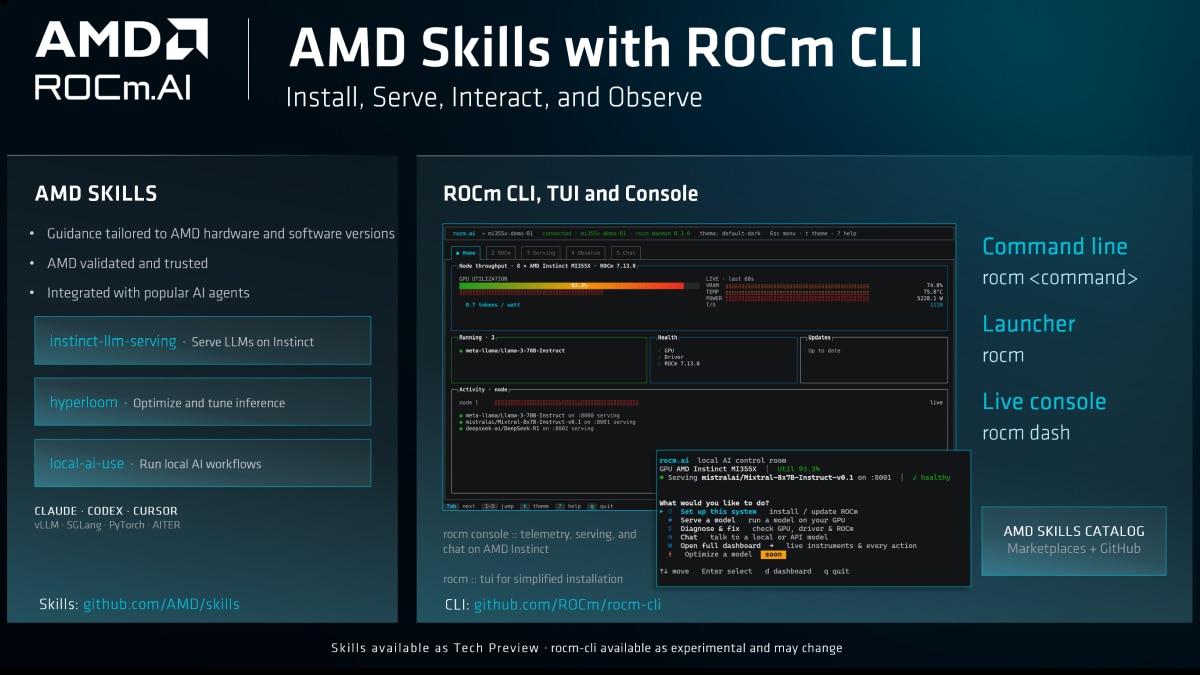
AMD Skills: Your Agent’s Way Into ROCm.AI
AMD Skills is the primary way in which ROCm.AI interfaces with the agents developers already use. They bring AMD-validated ROCm knowledge directly into Claude, Cursor, Codex and other leading assistants, so guidance is tailored to AMD hardware, ROCm versions and supported software paths.
Rather than searching documentation, stitching commands together, or relying on generic examples, developers can state their intent and let the agent draw on AMD Skills to guide the workflow.
AMD Skills are available today through official integrations with coding assistants. Developers can install them from the Codex Plugins catalog, the AMD page in the Cursor Marketplace, or by searching for amd-skills in Claude Plugins.
Sample AMD Skills
- serving-llms-on-instinct - Deploy production LLM endpoints on AMD Instinct GPUs with vLLM on ROCm.
- tracelens - Turn PyTorch profiler traces into actionable performance reports for faster inference and training.
- local-ai-use - Route image, speech, and text-to-speech to a local server on AMD client hardware, private and cloud-cost-free.
- local-ai-app-integration - Embed on-device AI into your own apps across NPU, iGPU, and dGPU.
ROCm CLI : Execution Layer
It gives users a trusted command-line path to install ROCm software, examine the environment and serve models, update components, and generate diagnostics. It is designed for developers, platform engineers, enterprise admins, CI/CD teams and secure environments that need repeatable execution. The CLI is deterministic and scriptable. A developer can run it directly. A script can call it in CI. A coding agent can invoke it with permission. ROCm Console can surface its state.
rocm install
rocm doctor
rocm serve qwen3
rocm update
ROCm Console: Telemetry and Diagnostics
ROCm Console provides visibility into system and workload state. It surfaces telemetry, logs, runtime status, and diagnostic context so users can understand what is happening on the machine. That visibility matters when teams are working with sensitive workloads, clusters, or performance data that should remain inside their environment
ROCm Hyperloom: Workload Optimization
ROCm™ Hyperloom helps developers boost performance with an autonomous agentic system designed to optimize end-to-end inference workloads on AMD GPUs, targeting both host code and GPU kernels by using AI agents and profiling tools to analyze a workload, identify bottlenecks, apply targeted optimizations and validate both performance and correctness. It brings together low-level GPU profiling, trace collection, trace analysis and iterative kernel and code optimization to reduce the manual effort traditionally required for GPU tuning.
Hyperloom helps developers move from a running workload to a better-optimized deployment by profiling the workload, identifying and planning around bottlenecks, exploring optimization options, benchmarking changes and generating a report with proposed improvements and expected performance gains.
ROCm.AI in Action
ROCm.AI is designed to meet developers where they are.
On an AMD Strix Halo System
“Set up this machine for local AI.”
ROCm.AI can guide the user through hardware detection, setup, model serving and local AI workflows.
On AMD Instinct infrastructure
“Serve Qwen 3.6 27B on my AMD Instinct GPU.”
ROCm.AI helps check the hardware and software environment, select the right serving path, launch the model endpoint and confirm that it is running.
For Optimization
“Optimize inference performance on this running model.”
ROCm Hyperloom profiles the workload, identifies bottlenecks across host code and GPU kernels, applies targeted optimizations and validates performance and correctness.
ROCm.AI helps developers move from model selection to running endpoint to optimization through a more guided AMD software experience.1
Why this matters for developers and platform teams
AI development is becoming increasingly agent-driven, and the hardware surface is also becoming more diverse. Developers are building AI PCs, Radeon desktops, workstations and AMD Instinct clusters.
ROCm.AI gives more consistent software experience that can guide setup, validate the environment, serve models, expose local telemetry and help tune workloads. For local developers, ROCm.AI shortens the path from a fresh AMD system to a working local AI workload. For platform and MLOps teams, it makes workflows more repeatable across users and environments. For enterprise operators, it supports local visibility and control. For AI companies, cloud providers and NeoClouds evaluating AMD infrastructure, it helps customers move from instance access to validated workloads faster.
The future of AI infrastructure will not be defined by hardware alone. It will be shaped by platforms that make powerful hardware easier to use, easier to optimize and easier to trust. With ROCm.AI, AMD is making AI on AMD simpler to build, operate and tune to help developers move faster and help decision makers adopt AMD AI infrastructure with greater confidence.
Coming soon:
The AMD Skills catalog will expand with additional workflows across local systems, developer workstations and data-center infrastructure, including:
- HIP Runtime Replay Analysis - Records and replays HIP calls, kernel launches, and memory operations to reproduce GPU failures and guide root-cause analysis on AMD Instinct and Radeon hardware.
- ROCm Doctor - Diagnoses common ROCm, PyTorch and llama.cpp failures by checking the environment against known configuration and compatibility issues.
- Hyperloom Kernel Optimizer - Uses agentic optimization workflows to identify GPU bottlenecks, evaluate code changes and improve inference and kernel performance.
- APU Memory Tuner - Analyzes and tunes shared and dedicated memory allocation on supported AMD APUs to improve model fit and local AI performance.
The AMD Skills catalog is currently a Tech Preview and is being developed in the open, so skill names, scope and availability may evolve as new workflows are validated.
ROCm.AI – Agentic AI Workflows, Simplified.
Get started with AMD-authored Skills and ROCm CLI to install, inspect, serve, migrate and optimize AI workloads on AMD platforms.
Contributors

Related Blogs
-
Meet the Next AMD Ryzen™ AI Halo
Meet the next AMD Ryzen™ AI Halo developer platform, powered by the AMD Ryzen™ AI Max+ PRO 495 processor. Run larger local LLMs, up to 300B parameters, thanks to the 192GB of unified memory that comes on the new platform.
October 12, 2026
-
Kimi K3 on AMD Instinct GPUs with TokenSpeed
TokenSpeed delivers fast, agentic LLM inference on AMD Instinct™ MI355X GPUs, with optimized kernels and leading Kimi K3 performance.
October 09, 2026
-
MangoBoost Delivers Open AI Models Powered by AMD
Mango Inference a serverless inference service providing production-ready access to open models powered by AMD Instinct™ GPUs and AMD ROCm™ software
October 09, 2026
-
MoRI UMBP Empowers AMD Instinct GPUs
See how UMBP, MoRI and SGLang optimize KV cache reuse to boost AMD Instinct™ MI355X GPU agentic AI performance and cost efficiency
October 09, 2026
-
Pre-Training Hybrid LLMs from Scratch in Primus on AMD Instinct™ GPUs — ROCm Blogs
Pre-train hybrid LLMs mixing MLA attention with Gated DeltaNet, Kimi Delta Attention and Mamba2 mixers on AMD Instinct MI355X GPUs, with open recipes.
October 07, 2026
-
DI Series: Serving Kimi-K3 MXFP4 Wide-EP Disaggregated on AMD Instinct MI300X and MI325X — ROCm Blogs
Learn how to serve a 1.4 TiB Kimi-K3 MXFP4 mixture-of-experts model disaggregated across AMD Instinct MI300X and MI325X GPUs.
October 07, 2026
-
AMD Instinct MI455X vs MI355X: A Technical Look at the Advancing AI 2026 Inference Numbers — ROCm Blogs
Explore the MI455X vs MI355X inference numbers from Advancing AI 2026, and learn how each benchmark was measured and what it really means.
October 07, 2026
-
How Agentic AI Is Expanding the Role of the DPU
As agentic AI drives more stateful workloads, DPUs are becoming critical for networking, storage, KV-cache management, and infrastructure efficiency.
October 05, 2026







Footnotes
- AMD Hyperloom performance improvements vary by workload and starting performance baseline. Results may also vary based on model architecture, hardware configuration, software environment, and optimization opportunities identified.
Footnotes
- AMD Hyperloom performance improvements vary by workload and starting performance baseline. Results may also vary based on model architecture, hardware configuration, software environment, and optimization opportunities identified.