From Prompt to Playback: Nunchux Turns AMD Instinct™ GPU Performance into Responsive Video AI
Oct 19, 2026

Real-Time Video Generation on AMD Instinct™ MI355X GPUs
Video is one of the most demanding workloads in multimodal inference. A single request can involve hundreds of frames, complex motion, high-resolution output and synchronized audio. The challenge is not simply getting the model to run. It is delivering the result quickly enough to support a responsive application experience.
In a proof of concept supported by AMD, the Nunchux AI team optimized MiniMax-H3 on AMD Instinct™ MI355X GPUs. On a single server with eight GPUs, the solution reported 1.33 seconds of generation latency for a five-second video and 5.39 seconds for a 15-second video. With 4 or 8 AMD Instinct MI355X GPUs, every tested clip length completed faster than it plays.
The same prompt was run through the Nunchux-optimized stack and the SGLang baseline on the same 8 AMD Instinct MI355X GPUs. The comparison gives readers a direct view of the generated outputs while making the difference in generation latency tangible. Together, the results demonstrate how AMD Instinct GPUs, and AMD ROCm™ software and workload-specific optimization can move generative video from a submit-and-wait process toward a more responsive experience.
The AMD Ecosystem Behind Deployable AI Services
AMD works with an expanding ecosystem of independent software vendors and inference service providers that help developers and enterprises turn accelerator performance into deployable AI applications. For organizations building generative image and video experiences, these providers can reduce the work required to optimize models, manage GPU infrastructure and serve results through application programming interfaces or dedicated environments.
Nunchux is one example within this ecosystem. The company develops multimodal inference software and services for application developers, creative and media platforms, commerce applications and enterprises deploying proprietary image, video and world models.
Why AMD Instinct MI355X
Diffusion-based video models place substantial demands on compute and memory capacity. Attention cost grows rapidly as token count increases, and longer clips contain more tokens, so headroom in raw throughput and memory capacity both matter.
AMD Instinct MI355X GPUs were selected for this proof of concept for three reasons:
- Large high-bandwidth memory keeps long-sequence video attention resident on-device, reducing the memory pressure that dominates this class of workload.
- Low-precision datatype support (including FP4/MXFP-class formats), combined with high compute throughput, made AMD Instinct MI355X GPUs a particularly compelling platform for Nunchux to optimize and accelerate video inference. In particular, MXFP6 offers approximately twice the theoretical peak matrix throughput of MXFP8.
- An open ROCm™ software stack gave the team full control to build custom kernels and profile down to the metal, which is essential for a team that co-designs algorithm and runtime together.
What Was Optimized on the AMD Stack
These results are not a drop-in port. Working on AMD ROCm software, Nunchux optimized the model and runtime together, including custom kernels, memory movement and execution strategy.
Nunchux develops its Model Optimizer and Inference Engine as one system, adapting both the model and runtime to the target hardware. One example is its custom MXFP6 kernel, which Nunchux reports runs approximately 13× faster than the rocm-libraries MXFP6 baseline in its testing. That kernel contributes to the end-to-end results alongside the rest of the optimized inference stack.
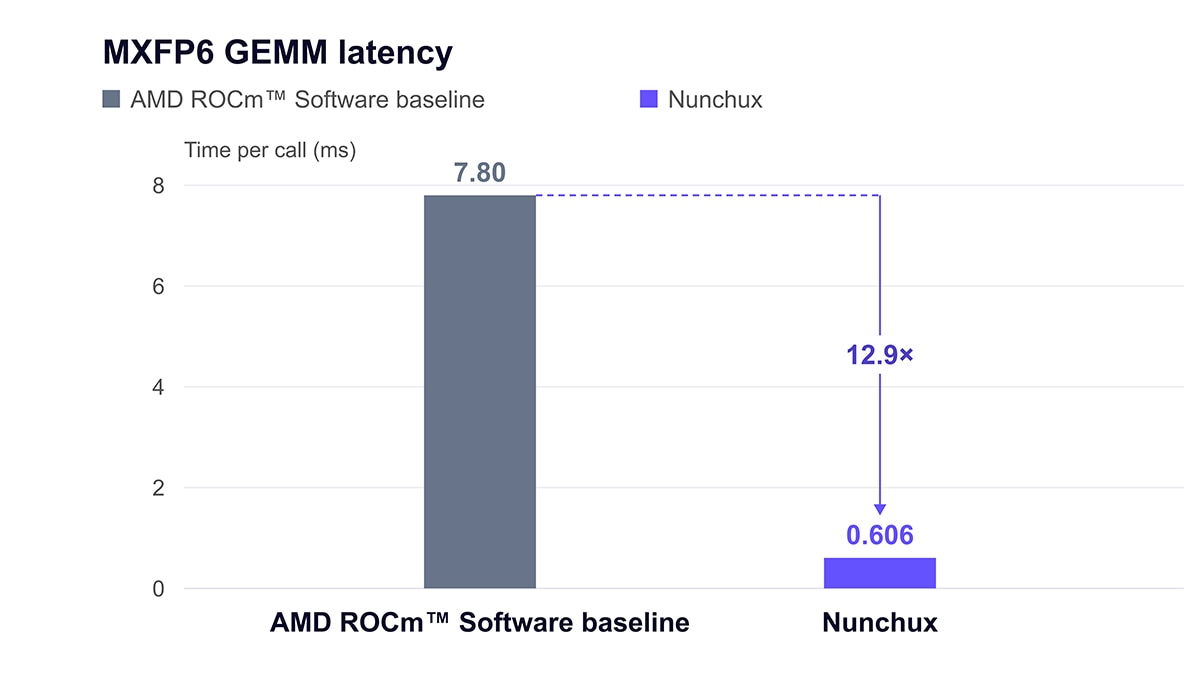
The broader AMD value is the level of access the ROCm software stack gives customers. Teams can identify where time is being spent, develop workload-specific optimizations and translate more of the underlying accelerator capability into useful application performance.
Turning Full-Stack Optimization into End-to-End Performance
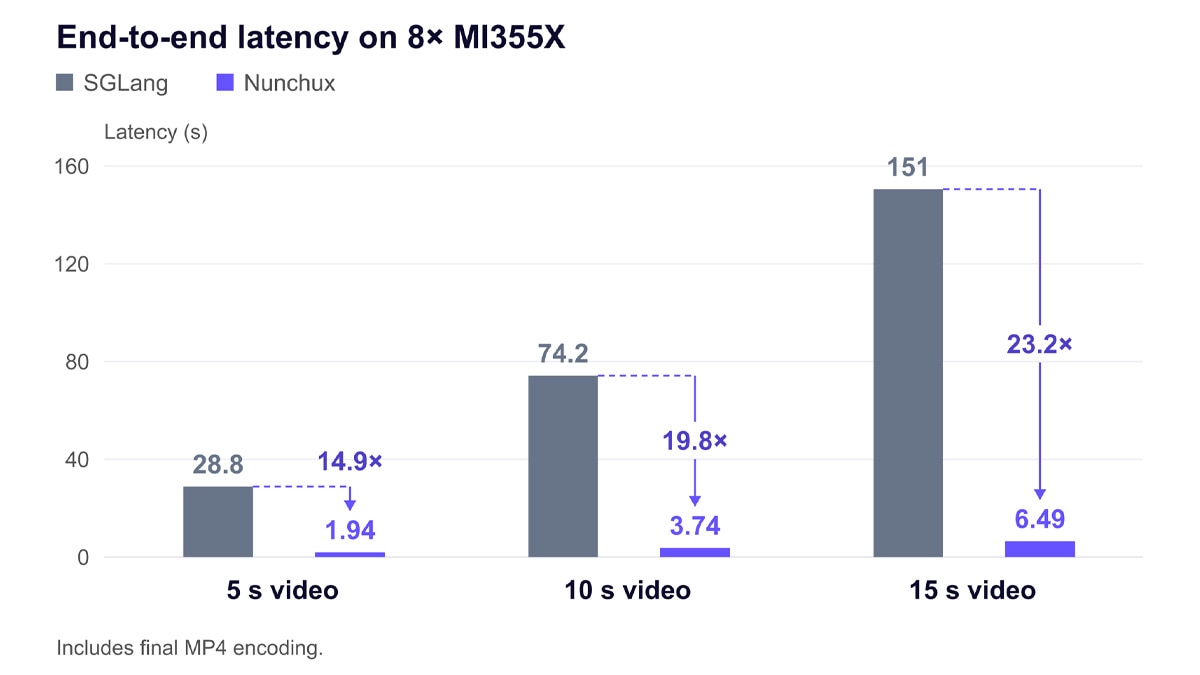
The headline generation-latency results show that the optimized solution can generate video faster than playback. A separate end-to-end measurement examined the complete application path, from the initial request to a finished MP4, including video encoding, providing a closer view of the wait an application user experiences.
On the same eight AMD Instinct™ MI355X GPUs, the Nunchux stack reduced the time required to produce a finished 15-second MP4 from 150.5 seconds with the SGLang baseline to 6.49 seconds, a reported 23.2× speedup.
Across the measured clip lengths, the improvement increased from 14.9× for a five-second clip to 23.2× for a 15-second clip. The hardware remained constant. What changed was how efficiently the optimized model and inference stack used it.
Where the Time Goes: The Denoise Loop
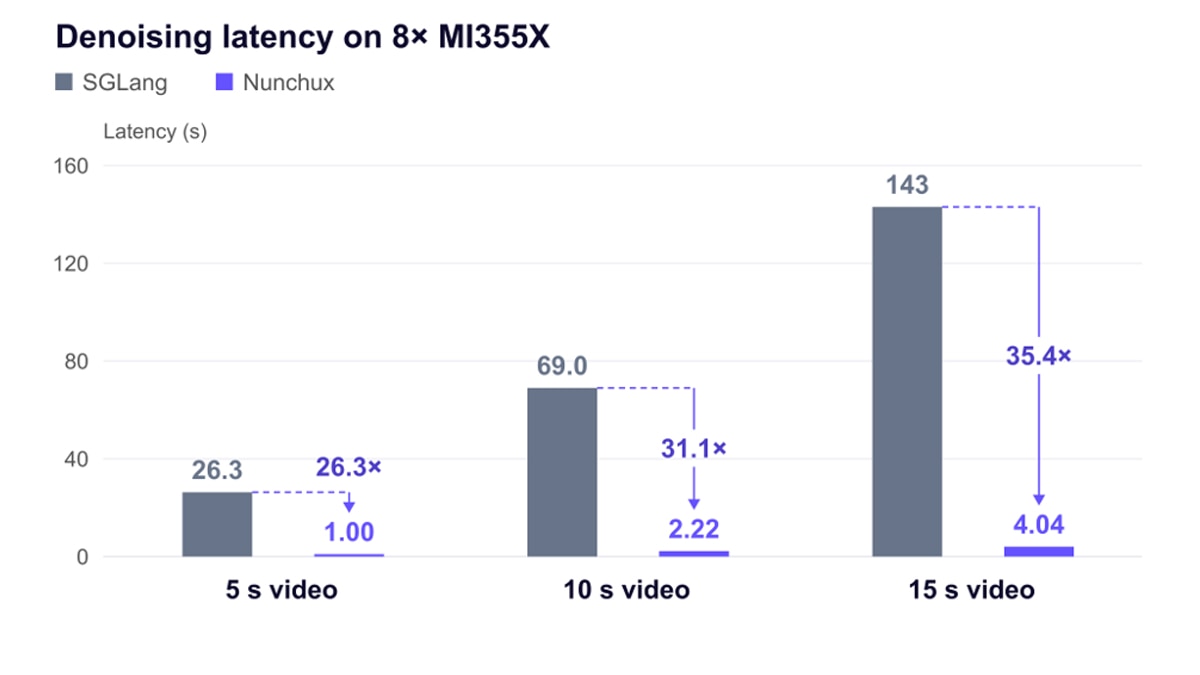
The stage-level breakdown helps explain the end-to-end improvement. In the SGLang baseline, more than 90% of total latency was concentrated in the denoising sampling loop, making it the largest opportunity for optimization.
On the same eight AMD Instinct MI355X GPUs, the Nunchux stack reduced denoising latency by 26.3× to 35.4× across the measured clip lengths. For the 15-second clip, denoising time decreased from 143.1 seconds to 4.04 seconds.
By reducing the stage that dominated the original runtime, the optimized stack shortened the full path from request to finished video. This connects the model, kernel and runtime work enabled by AMD ROCm™ software to the application-level latency improvement.
Real-Time Video Generation
Because every clip is finished faster than it plays, video generation on the AMD Instinct MI355X GPU can run in real time: the viewer waits once, at the start, and from then on the video stays ahead of the playhead. The lead never shrinks, so a single MI355X server can keep generating for as long as anyone is watching.
Competitive Performance in Real-Time Video Generation
Against NVIDIA Research’s separately published Sol-H3 results on eight NVIDIA B300 GPUs, Nunchux AI’s solution on eight AMD Instinct™ MI355X GPUs reported lower MiniMax-H3 generation times across the 5-, 10- and 15-second output lengths.
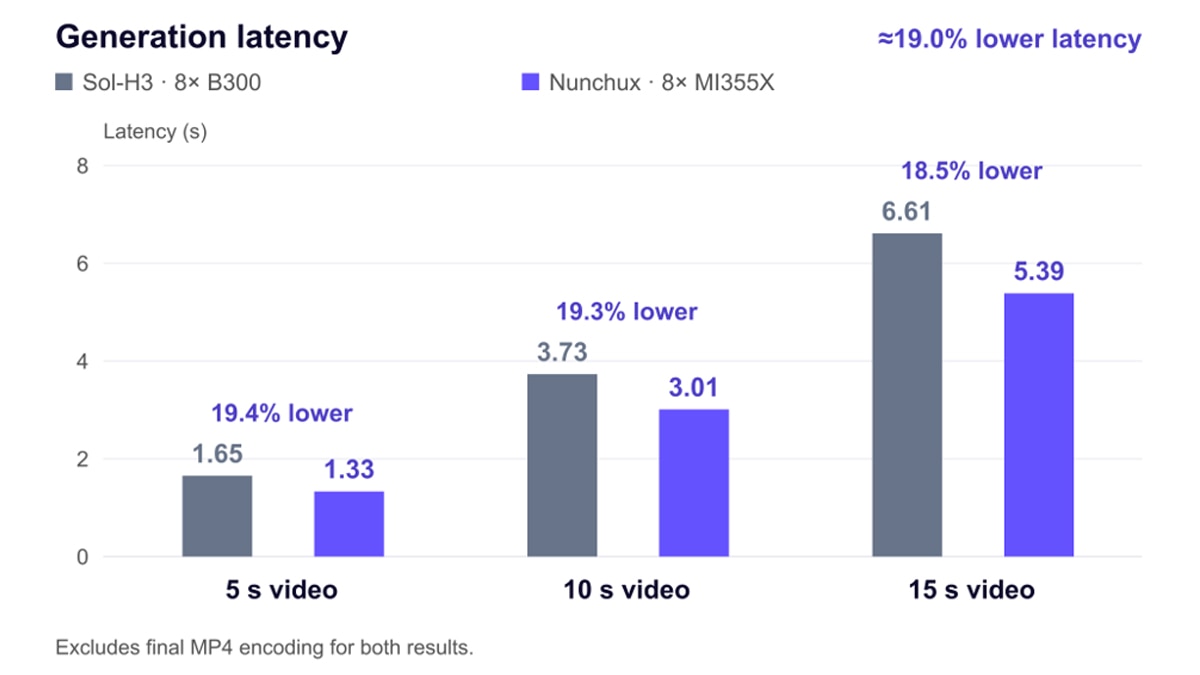
Across the three output lengths, the solution running on AMD Instinct MI355X GPU reported 18.5% to 19.4% lower generation latency than NVIDIA Sol-H3 on B300. The published results cover 1344×768 video at 24 frames per second, use eight GPUs and include text encoding, Diffusion Transformer denoising, and video and audio Variational Autoencoder decoding. Final MP4 encoding is excluded from both sets of results to align the timing scope.
These results demonstrate the competitive performance AMD Instinct MI355X GPU can deliver for demanding multimodal inference when paired with the AMD ROCm™ software stack and Nunchux AI’s Model Optimizer and Inference Engine. For more details, read the Nunchux AI technical blog.
What This Demonstrates for AMD Customers
These results come from co-design, not a one-size-fits-all stack. Accelerators differ in compute throughput, memory bandwidth, memory capacity and interconnect. Making effective use of those capabilities requires the model and runtime to be adapted to the target platform.
On AMD Instinct MI355X GPU, that work sat close to the AMD GPU architecture and the ROCm software stack. Model optimization, numerical formats, custom kernels, multi-GPU execution and decoding were treated as parts of the same inference path.
Nunchux AI is one customer example of the broader AMD platform story. AMD Instinct MI355X GPUs provide the compute and memory foundation. AMD ROCm software gives customers the flexibility to optimize deeply for their workloads. Customers can then translate those capabilities into applications, hosted services or dedicated deployments.
For AMD, this engagement demonstrates that the AMD Instinct MI355X GPU and AMD ROCm software combination can support demanding multimodal inference at competitive latency. More importantly, it shows how an AMD customer can turn infrastructure performance into a more responsive experience for developers and end users.
Get Started
Explore the ROCm™ software documentation, browse ROCm software container images, and read more engineering deep-dives on the ROCm software blogs. To evaluate Instinct™ hardware for your own workloads, contact your AMD account team.
Contributors



Related Blogs
-
From AI That Answers to AI That Acts
Why physical AI requires a new definition of performance – one built around the whole system, not peak compute.
October 19, 2026
-
Absci Accelerates AI Antibody Design on AMD Instinct™ GPUs
AMD and Absci achieved a 3x speedup in AI antibody design by running the AbsciBind co-folding model on Instinct™ GPUs with optimized Triton kernels.
October 18, 2026
-
Day 0 Support for Muse Spark Open on AMD
AMD is excited to announce Day-0 support for Meta’s latest Muse Spark Open model family on AMD Instinct™ MI350X and MI355X GPUs
October 15, 2026
-
Introducing FastFlow SDK
Explore AMD FastFlow-SDK for local AI development on AMD Ryzen™ AI NPUs, from running models to customizing inference and optimizing operators with FastFlow, IRON, and HRX.
October 15, 2026
-
Long Context, One Node: Serving GLM-5.3-FP8 on MI300X with DP8+EP8 — ROCm Blogs
Learn how to serve GLM-5.3-FP8 on one AMD Instinct™ MI300X node with DP8+EP8 and vLLM v0.28 for long-context workloads, and compare it with TP=8.
October 13, 2026
-
Meet the Next AMD Ryzen™ AI Halo
Meet the next AMD Ryzen™ AI Halo developer platform, powered by the AMD Ryzen™ AI Max+ PRO 495 processor. Run larger local LLMs, up to 300B parameters, thanks to the 192GB of unified memory that comes on the new platform.
October 12, 2026
-
AMD AI NIC™ Technology Driving AI-Ready Ethernet
Learn how AMD AI NIC™ technology helps organizations build AI-ready Ethernet networks with open standards, programmability, and transport innovation.
October 11, 2026
-
Kimi K3 on AMD Instinct GPUs with TokenSpeed
TokenSpeed delivers fast, agentic LLM inference on AMD Instinct™ MI355X GPUs, with optimized kernels and leading Kimi K3 performance.
October 09, 2026





Footnotes
- Nunchux testing. Testing was performed by Nunchux during an AMD-supported proof of concept on 8× AMD Instinct™ MI355X GPUs at 1344×768 and 24 fps. Generation latency excludes final MP4 encoding. Request-to-finished-MP4 results include final MP4 encoding. Results were measured by Nunchux and were not independently reproduced by AMD.
- NVIDIA comparison. NVIDIA Sol-H3 results were published by NVIDIA Research for 8× NVIDIA B300 GPUs at 1344×768 and 24 fps. Nunchux and NVIDIA testing was performed separately using their respective complete software and hardware configurations. Results were not independently reproduced by AMD.
- MI350-006: Calculations by AMD Performance Labs in May 2025, based on the published memory capacity specifications of AMD Instinct™ MI350X / MI355X OAM GPU. Server manufacturers may vary configurations, yielding different results. MI350-006.
- MI350-009A: Based on calculations by AMD Performance Labs in May 2025 to determine peak theoretical precision performance for AMD Instinct™ MI350X / MI355X GPUs across supported datatypes. Server manufacturers may vary configurations, yielding different results. MI350-009A
- GD-181a: All performance and/or cost savings claims are provided by the 3rd party organization featured herein and have not been independently verified by AMD. Performance and cost benefits are impacted by a variety of variables. Results herein are specific to such 3rd party organization and may not be typical. GD-181a.
GENERAL DISCLAIMER
The information contained herein is for informational purposes only and is subject to change without notice. While every precaution has been taken in the preparation of this document, it may contain technical inaccuracies, omissions and typographical errors, and AMD is under no obligation to update or otherwise correct this information. Advanced Micro Devices, Inc. makes no representations or warranties with respect to the accuracy or completeness of the contents of this document, and assumes no liability of any kind, including the implied warranties of noninfringement, merchantability or fitness for particular purposes, with respect to the operation or use of AMD hardware, software or other products described herein. No license, including implied or arising by estoppel, to any intellectual property rights is granted by this document. Terms and limitations applicable to the purchase or use of AMD products are as set forth in a signed agreement between the parties or in AMD's Standard Terms and Conditions of Sale. GD-18u.
© 2026 Advanced Micro Devices, Inc. All rights reserved. AMD, the AMD Arrow logo, AMD Instinct, and combinations thereof are trademarks of Advanced Micro Devices, Inc. All rights reserved. Unauthorized use is strictly prohibited. Other product names used in this publication are for identification purposes only and may be trademarks of their respective owners. Certain AMD technologies may require third-party enablement or activation. Supported features may vary by operating system. Please confirm with the system manufacturer for specific features. No technology or product can be completely secure.