Introducing AMD Instinct™ Coder 355: A Turnkey AI Assisted Coding Platform for the Enterprise
Nov 09, 2026
Enterprise AI coding powered by AMD, Dell, and Spectro Cloud - delivering up to 75% lower TCO1
AI is becoming part of everyday software development—from generating code and modernizing applications to automating tests and reviewing pull requests. As usage expands, enterprises face a practical question: how do they extend these productivity gains across their engineering teams while controlling costs and protecting proprietary code?
Frontier models offer powerful capabilities, but relying on them for every task can make costs difficult to predict. Longer context windows, repeated agent interactions, and growing adoption increase token consumption. Organizations also need clear policies governing when source code, prompts, and other sensitive information can be sent to external services.
Moving more inference on premises offers a way forward. Yet assembling servers, GPUs, inference software, models, and operational controls can be challenging and time consuming.
AMD Instinct Coder 355 brings together AMD, Dell Technologies, and Spectro Cloud to address all of these challenges with a turnkey enterprise AI assisted coding platform. The solution enables everyday coding workloads to run on premises and allows frontier services only when justified and is within enterprise data policies.
A complete platform for on premises AI coding
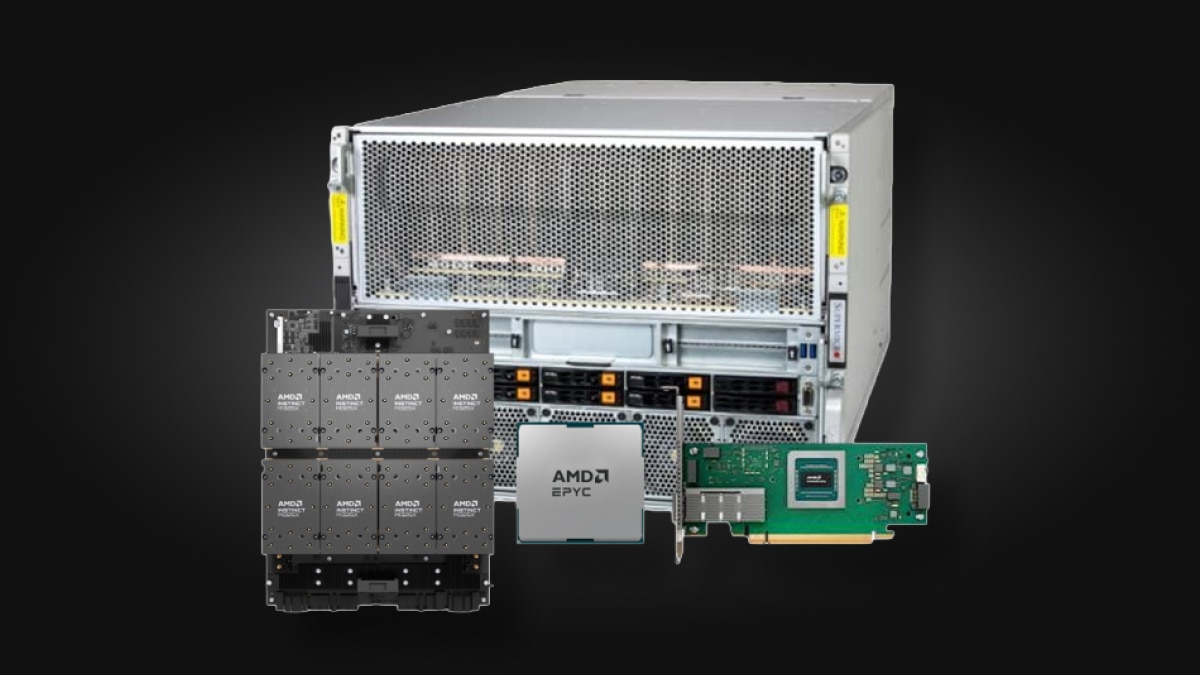
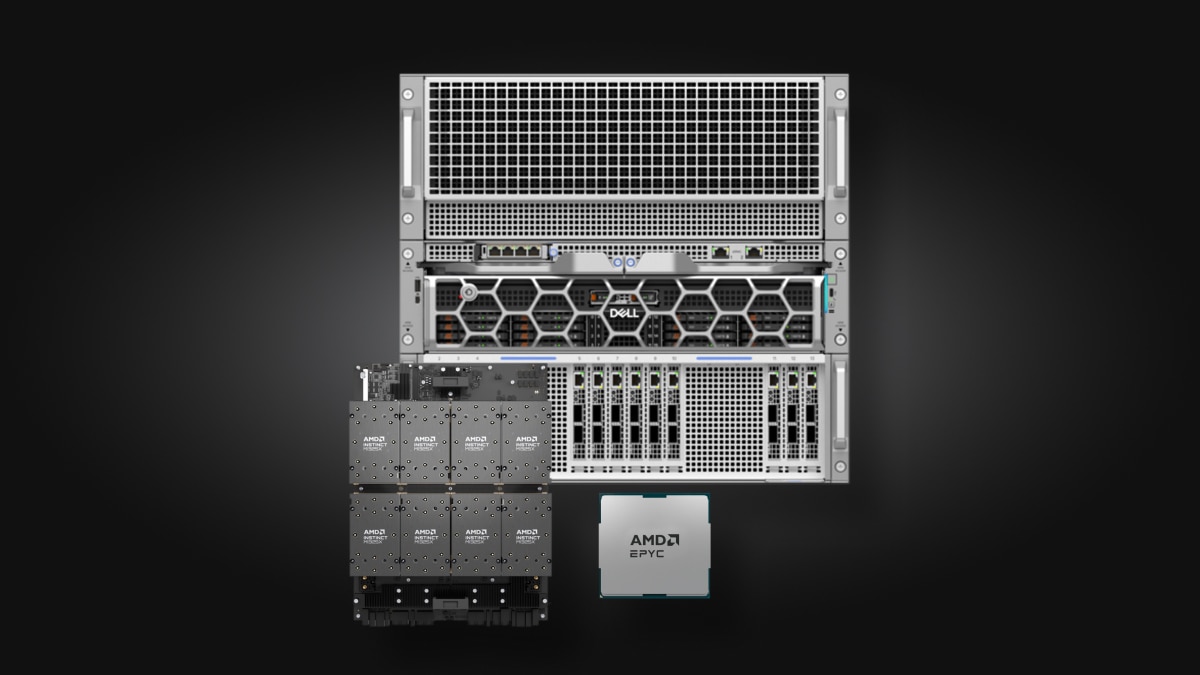
The solution combines Dell PowerEdge® servers powered by AMD EPYC™ processors and AMD Instinct™ MI355X GPUs, and features the GLM 5.3 model, and Spectro Cloud PaletteAI Inference Launchpad software.
AMD provides the compute foundation for local inference. Dell brings enterprise server infrastructure and hardware support options. Spectro Cloud integrates deployment, operations, and governance to help IT teams deliver AI coding as an internal service.
Together, these capabilities provide a turnkey inference stack, giving engineering teams access to AI assistance while helping IT retain control over infrastructure, usage, cost, and data.
Run local by default, use frontier only when justified
Every coding request does not require a frontier model. Code generation, test creation, documentation, and routine code review can be candidates for local inference, based on the selected model and the organization’s quality requirements.
PaletteAI Inference Launchpad provides intelligent routing that directs requests to local models by default and permits approved frontier services when task requirements justify them and IT policy allows. Platform teams define the routing policies, including which workloads are eligible to leave the on-premises environment.
This gives enterprises a practical way to balance capability and cost. Teams can use local models for suitable workloads while retaining access to frontier capabilities for more demanding tasks if needed. Sensitive workloads can remain local under enterprise policy; requests routed externally send their associated content to the selected service and must meet the organization’s data-handling requirements.
Make AI coding costs easier to control
Moving suitable workloads on premises reduces reliance on metered frontier APIs and shifts more inference spending to infrastructure that enterprises can plan and manage. Frontier spending can then be reserved for requests where the expected benefit warrants it.
Usage metering, quotas, and operational visibility help administrators understand demand and govern consumption. Rather than treating AI coding as an open-ended expense, enterprises can manage it as a shared service with defined capacity, access policies, and budgets.
The economics depend on utilization, model choice, workload characteristics, operating costs, and the share of requests routed externally. Evaluating these factors against actual developer usage helps organizations size the platform and assess potential savings.
Protect code and preserve choice
For workloads processed locally, source code, prompts, and model context remain within the enterprise environment. Access controls and usage policies help teams govern who can use the service and how it is consumed.
Open models and standard API integration also give organizations flexibility as their needs evolve. Teams can evaluate new local models, adjust routing policies, and connect approved external services without making one frontier provider the default destination for every request.
Developers can connect supported coding tools to the platform, allowing organizations to introduce local inference within familiar workflows. Tool compatibility and available features depend on the validated model, endpoint, and client configuration.
Scale developer productivity with greater control
AMD Instinct Coder 355 gives enterprises a practical foundation for expanding AI-assisted development with greater control over cost, data, and operations. AMD compute and inference software, Dell infrastructure, and Spectro Cloud management bring the core components together in an integrated platform.
Run suitable workloads on premises. Use frontier models when the task warrants them and policy allows. Give developers the AI capabilities they need while keeping infrastructure and spending aligned with enterprise priorities.
Contact your AMD, Dell Technologies, or Spectro Cloud representative to discuss the right configuration for your development teams.
Solution details
Hardware
Dell® PowerEdge® XE9785 servere
- 2 x AMD EPYC™ 9575F, 64 cores, 3.3GHz CPUs
- 8 x AMD Instinct™ MI355X
- 3TB (24 x 128GB) DDR5 RDIMM 6400 ECC
- 2 x 960GB NVMe PCIe® Gen4 V6 M.2 with BOSS-N1 controller card
- 8 x 7.68TB PCIe Gen5 TLC U.2 SSD
- 2 x Broadcom 57608 Dual Port 200G (Single Port 400G) QSFP112 adapter, full height PCIe
- 12 x 3200W redundant (6+6 configuration) titanium-level high-efficiency power supplies
Software
Spectro Cloud PaletteAI Inference Launchpad
- Full-Stack AI lifecycle management
- Enterprise governance at scale
- Intelligent local-first model routing, frontier when justified
- Full visibility and control of AI usage and cost
AI models
- Local: GLM-5.3
- Frontier: Anthropic Claude, OpenAI GPT, Google Gemini
Developer tools
- Claude Code, Cursor, Visual Studio Code
Support
- Comprehensive full stack software support from Spectro Cloud
- 3 yr next business day (NBD) on site from Supermicro for hardware
Scale
- Supports up to 85 developers per node, (50 concurrent)
Performance
- Up to 98% of Frontier model benchmark performance2
Footnotes
- TKS-001 - Based on AMD analysis of a modeled deployment using one server configured with 8 AMD Instinct™ MI355X GPUs. Assumptions include 85 developers spending $2,000 per month each on AI coding/API services ($2.04 million annually); Server list price of $590,000 including software and licensing with a three-year hardware amortization; continued frontier cloud API costs equal to 10% of baseline AI coding/API spend ($204,000 annually); and $50,000 in annual data center operating costs. Under these assumptions, modeled annual costs are approximately $513,500, representing approximately 75% of annual cost savings. The estimated five-month payback period is based on the modeled initial investment, relative to modeled monthly savings. Results are illustrative only. Actual costs, savings, and payback will vary based on workload, utilization, pricing, routing, infrastructure costs, and other factors.
- On Vals AI SWE-bench Verified leaderboard, updated September 1, 2026, a GLM-5.3 model vs. the Claude Opus 5 model resolved 95.4% and 97.0% of benchmark tasks, respectively, using the Mini-SWE-agent harness. Relative score calculated as 95.4 ÷ 97.0 = 98.4%. Results are specific to the benchmark and evaluation configurations and may not reflect performance on other workloads. For more information see https://www.vals.ai/comparison?m=claude-opus-5,glm-5.3&b=swebench.
Footnotes
- TKS-001 - Based on AMD analysis of a modeled deployment using one server configured with 8 AMD Instinct™ MI355X GPUs. Assumptions include 85 developers spending $2,000 per month each on AI coding/API services ($2.04 million annually); Server list price of $590,000 including software and licensing with a three-year hardware amortization; continued frontier cloud API costs equal to 10% of baseline AI coding/API spend ($204,000 annually); and $50,000 in annual data center operating costs. Under these assumptions, modeled annual costs are approximately $513,500, representing approximately 75% of annual cost savings. The estimated five-month payback period is based on the modeled initial investment, relative to modeled monthly savings. Results are illustrative only. Actual costs, savings, and payback will vary based on workload, utilization, pricing, routing, infrastructure costs, and other factors.
- On Vals AI SWE-bench Verified leaderboard, updated September 1, 2026, a GLM-5.3 model vs. the Claude Opus 5 model resolved 95.4% and 97.0% of benchmark tasks, respectively, using the Mini-SWE-agent harness. Relative score calculated as 95.4 ÷ 97.0 = 98.4%. Results are specific to the benchmark and evaluation configurations and may not reflect performance on other workloads. For more information see https://www.vals.ai/comparison?m=claude-opus-5,glm-5.3&b=swebench.


Related Blogs
-
Introducing AMD Instinct™ Coder 355: The next generation AI Assisted Coding Platform for the Enterprise
The AMD Instinct Coder 355 is a turnkey, fully supported, on-premises AI coding platform that combines AMD EPYC™ processors, AMD Instinct™ GPUs, Supermicro® AI servers, Spectro Cloud PaletteAI Inference Launchpad software, and the GLM-5.3 model into a single integrated solution.
November 09, 2026
-
Project Zenith Comes to AMD Ryzen™ AI Halo: Ready to Code. Ready to Build.
Project Zenith brings Microsoft's ready-to-code Windows 11 experience to the AMD Ryzen™ AI Halo Developer Platform, creating a powerful new starting point for local AI development.
November 09, 2026
-
ROCm InferaSim: Cut LLM Serving Trial Costs and Deploy the Best Configuration — ROCm Blogs
Learn how ROCm InferaSim predicts LLM serving performance on AMD Instinct GPUs from a few short runs, so you can deploy the best configuration.
November 05, 2026
-
PrimusClaw: An Open-Source Managed Agent Runtime for AMD Instinct GPU Clusters — ROCm Blogs
PrimusClaw is an open-source managed agent runtime that hosts durable, sandboxed agent sessions on your own AMD Instinct GPU clusters.
November 05, 2026
-
Blackfuel: Building a Global Cloud for AI Inference
Blackfuel creates first AMD-powered inference deployment for more open, outcome-driven future for AI infrastructure
November 05, 2026
-
Online Quantization: Smooth Path from One Checkpoint to Any Desired Serving Scenario — ROCm Blogs
Learn how AMD Quark's online quantization quantizes LLM weights at load time across vLLM, ATOM, and SGLang, with per-layer mixed FP8/MXFP4 recipes.
November 04, 2026
-
From Operator to Kernel: Profile DeepSeek-V4-Flash in Primus with madengine — ROCm Blogs
Profile an eight-layer training proxy derived from the DeepSeek-V4-Flash Primus configuration on eight MI350X GPUs with madengine and TraceLens, then turn operator-to-kernel insights into faster runs.
November 04, 2026
-
GLM-5.2 AgentX on AMD Instinct MI355X: Boosting Throughput and Interactivity — ROCm Blogs
Learn how cache and kernel optimizations raised GLM-5.2 AgentX throughput and interactivity on AMD Instinct MI355X.
November 03, 2026