Run Qwen 3.8 27B on AMD Ryzen™ AI Max Agentic PCs and Radeon ™ GPUs
Aug 14, 2026

Today, AMD is delivering Day 0 support for Qwen3.8 27B, giving developers a path to run this state-of-the-art dense model locally on AMD-powered PCs and workstations from the moment it becomes available.
Qwen3.8 27B brings the latest generation of the Qwen family to a model size well suited for local AI development. The Qwen 3.8 generation continues the focus on coding, real-world work, research, and long-horizon AI workloads, extending the rapid pace of innovation we are seeing across open AI.
Users can bring Qwen3.8 27B directly to systems powered by AMD Ryzen™ AI Max+ processors or a single AMD Radeon™ AI PRO R9700 32 GB graphics card through open frameworks like llama.cpp. This model can also run on supported AMD hardware with more than 24 GB of Variable Graphics Memory or VRAM. This puts a capable new model on the same machine where they build, test, and use their applications. And it is ready on Day 0.
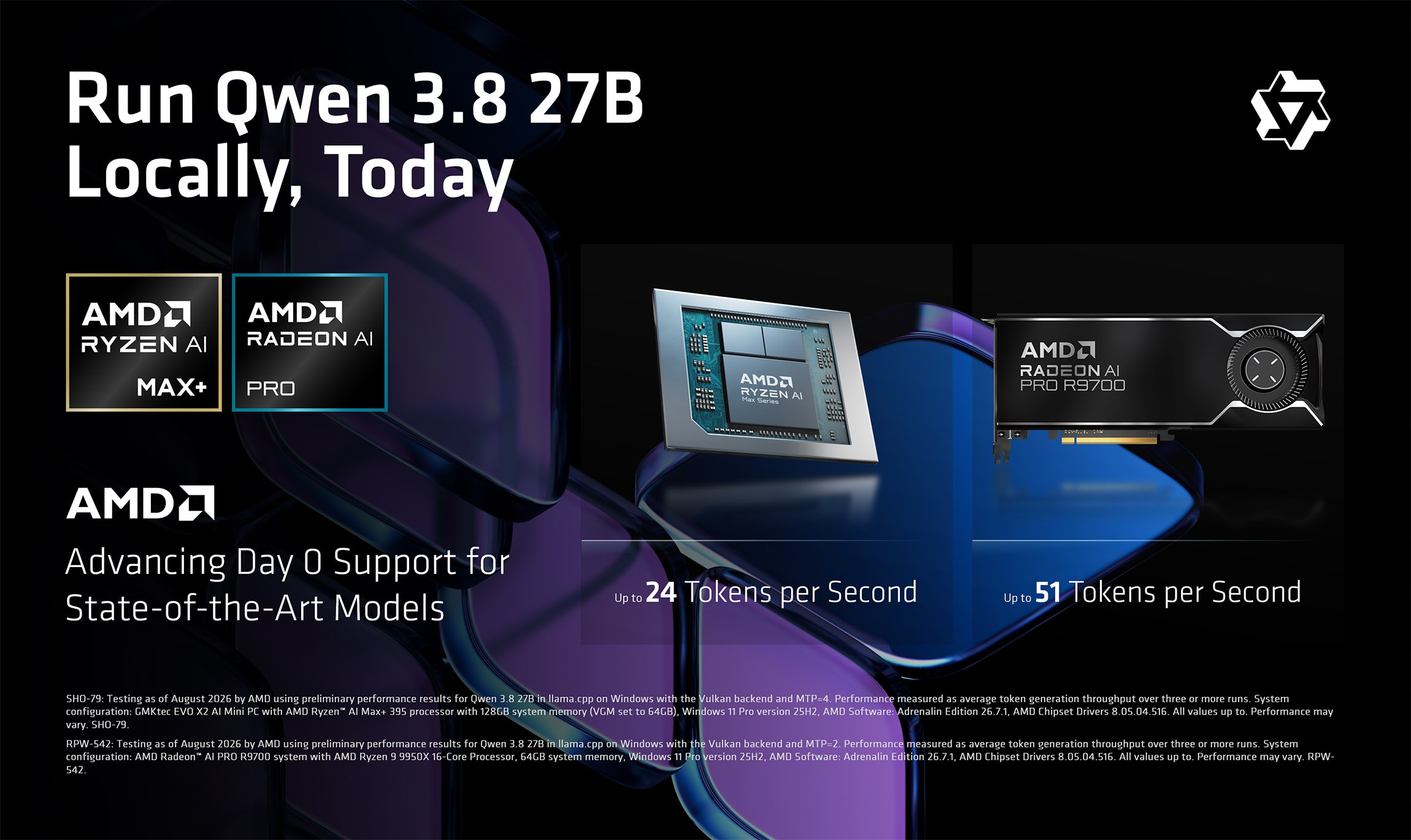
Early testing shows strong local performance for Qwen3.8 27B on AMD hardware, reaching up to 24.5 tokens per second on AMD Ryzen™ AI Max+ 395 and up to 51.8 tokens per second on a single AMD Radeon™ AI PRO R9700. As a 27B dense model, Qwen3.8 27B places substantial demands on memory capacity and compute, making capable local hardware especially important.
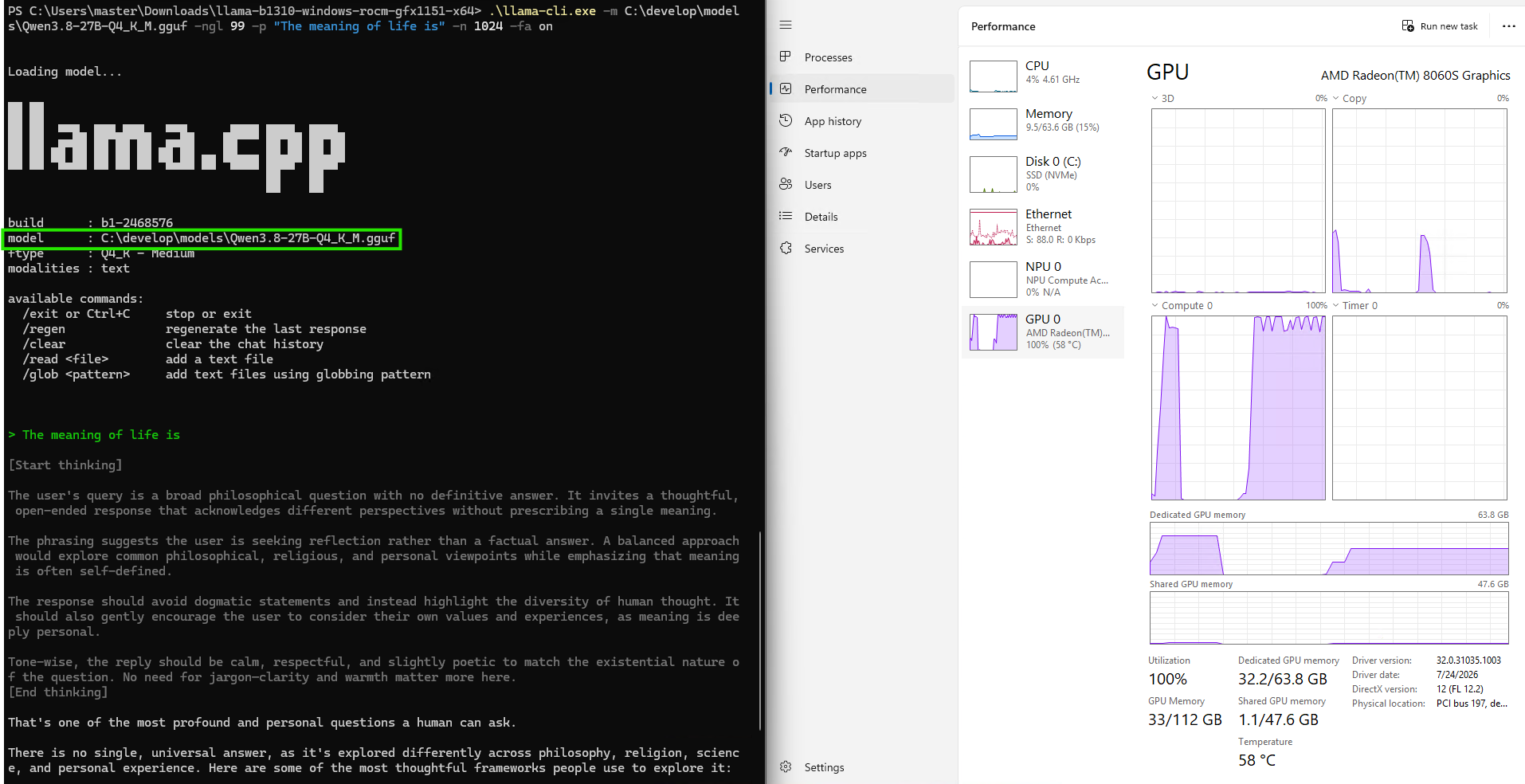
These preliminary results were measured on Windows using the popular llama.cpp project with the Vulkan backend, with MTP=4 on Ryzen AI Max+ 395 and MTP=2 on Radeon AI PRO R9700, using average token-generation throughput across three or more runs. With additional software and model optimizations still underway, we expect performance to continue improving as Day 0 support matures.
Run with LM Studio

For power users and enthusiasts who want to start using Qwen3.8 27B immediately, LM Studio provides a straightforward path to running the model locally.
On supported AMD systems, users can discover, download and begin working with the model from a familiar graphical experience. Qwen3.8 27B can be used with LM Studio on recommended AMD hardware including AMD Ryzen™ AI Max+ processor-based systems and the AMD Radeon™ AI PRO R9700 32 GB graphics card. Note that this model requires roughly 24GB of variable graphics memory (VGM) or VRAM to run comfortably and will also run on older, supported AMD platforms in LM Studio.
Note: MTP must be enabled and set to the correct number of draft tokens for optimal performance. Set 4 for AMD Ryzen™ AI Max+ and 2 for AMD Radeon™ AI PRO R9700. Uncheck "Try mmap" in advanced model load settings.
That makes LM Studio an easy first stop for exploring the model, testing prompts and workflows, and seeing what Qwen3.8 27B can do locally without writing a line of application code. For AMD users, LM Studio is part of a growing local AI ecosystem built around open models and broadly adopted inference technologies such as llama.cpp, giving users an accessible path from model download to local inference.
Integrate with Lemonade

Running a model is only the first step. The bigger developer opportunity is making local AI a native part of an application.
That is where Lemonade comes in.
Lemonade is AMD’s local-first developer platform designed to reduce the complexity of deploying AI across PCs. Its multi-engine architecture provides a unified interface while handling hardware-aware backend selection and optimization across available CPU, GPU, and NPU resources. AMD designed Lemonade specifically around the deployment challenges developers face when building local AI applications across different hardware configurations.
For application developers, Lemonade can be packaged alongside an app as a lightweight local inference layer, allowing the application to communicate with Qwen3.8 27B through familiar API patterns rather than requiring developers to build and maintain a hardware-specific inference stack themselves.
The result is a much simpler developer story: ship the application, start the local inference service, connect to the model, and let Lemonade handle the underlying AMD platform integration.
Advancing AI with Day 0 support for State-of-the-Art local models
The pace of open AI is not slowing down, and users should not have to wait for their hardware and software ecosystem to catch up every time a new model arrives.
Qwen3.8 27B is another important step forward for local AI, bringing a new generation of capabilities into a model users can put directly on their own systems.
AMD Ryzen AI Max+ processors and AMD Radeon AI PRO R9700 graphics give developers powerful local platforms to run it. LM Studio provides a fast path to experience it. Lemonade provides a path to turn it into an application.
And with Day 0 support from AMD, you can start building from day one.
Footnotes
SHO-79: Testing as of August 2026 by AMD using preliminary performance results for Qwen 3.8 27B in llama.cpp on Windows with the Vulkan backend and MTP=4. Performance measured as average token generation throughput over three or more runs. System configuration: GMKtec EVO X2 AI Mini PC with AMD Ryzen™ AI Max+ 395 processor with 128GB system memory (VGM set to 64GB), Windows 11 Pro version 25H2, AMD Software: Adrenalin Edition 26.7.1, AMD Chipset Drivers 8.05.04.516. All values up to. Performance may vary. SHO-79.
RPW-542: Testing as of August 2026 by AMD using preliminary performance results for Qwen 3.8 27B in llama.cpp on Windows with the Vulkan backend and MTP=2. Performance measured as average token generation throughput over three or more runs. System configuration: AMD Radeon™ AI PRO R9700 system with AMD Ryzen 9 9950X 16-Core Processor, 64GB system memory, Windows 11 Pro version 25H2, AMD Software: Adrenalin Edition 26.7.1, AMD Chipset Drivers 8.05.04.516. All values up to. Performance may vary. RPW-542.
Footnotes
SHO-79: Testing as of August 2026 by AMD using preliminary performance results for Qwen 3.8 27B in llama.cpp on Windows with the Vulkan backend and MTP=4. Performance measured as average token generation throughput over three or more runs. System configuration: GMKtec EVO X2 AI Mini PC with AMD Ryzen™ AI Max+ 395 processor with 128GB system memory (VGM set to 64GB), Windows 11 Pro version 25H2, AMD Software: Adrenalin Edition 26.7.1, AMD Chipset Drivers 8.05.04.516. All values up to. Performance may vary. SHO-79. |

Related Blogs
-
Meet the Next AMD Ryzen™ AI Halo
Meet the next AMD Ryzen™ AI Halo developer platform, powered by the AMD Ryzen™ AI Max+ PRO 495 processor. Run larger local LLMs, up to 300B parameters, thanks to the 192GB of unified memory that comes on the new platform.
October 12, 2026
-
AMD AI NIC™ Technology Driving AI-Ready Ethernet
Learn how AMD AI NIC™ technology helps organizations build AI-ready Ethernet networks with open standards, programmability, and transport innovation.
October 11, 2026
-
Kimi K3 on AMD Instinct GPUs with TokenSpeed
TokenSpeed delivers fast, agentic LLM inference on AMD Instinct™ MI355X GPUs, with optimized kernels and leading Kimi K3 performance.
October 09, 2026
-
MangoBoost Delivers Open AI Models Powered by AMD
Mango Inference a serverless inference service providing production-ready access to open models powered by AMD Instinct™ GPUs and AMD ROCm™ software
October 09, 2026
-
MoRI UMBP Empowers AMD Instinct GPUs
See how UMBP, MoRI and SGLang optimize KV cache reuse to boost AMD Instinct™ MI355X GPU agentic AI performance and cost efficiency
October 09, 2026
-
Pre-Training Hybrid LLMs from Scratch in Primus on AMD Instinct™ GPUs — ROCm Blogs
Pre-train hybrid LLMs mixing MLA attention with Gated DeltaNet, Kimi Delta Attention and Mamba2 mixers on AMD Instinct MI355X GPUs, with open recipes.
October 07, 2026
-
DI Series: Serving Kimi-K3 MXFP4 Wide-EP Disaggregated on AMD Instinct MI300X and MI325X — ROCm Blogs
Learn how to serve a 1.4 TiB Kimi-K3 MXFP4 mixture-of-experts model disaggregated across AMD Instinct MI300X and MI325X GPUs.
October 07, 2026
-
AMD Instinct MI455X vs MI355X: A Technical Look at the Advancing AI 2026 Inference Numbers — ROCm Blogs
Explore the MI455X vs MI355X inference numbers from Advancing AI 2026, and learn how each benchmark was measured and what it really means.
October 07, 2026