Accelerating Physical AI with AMD Contributions to OpenCV
Sep 09, 2026
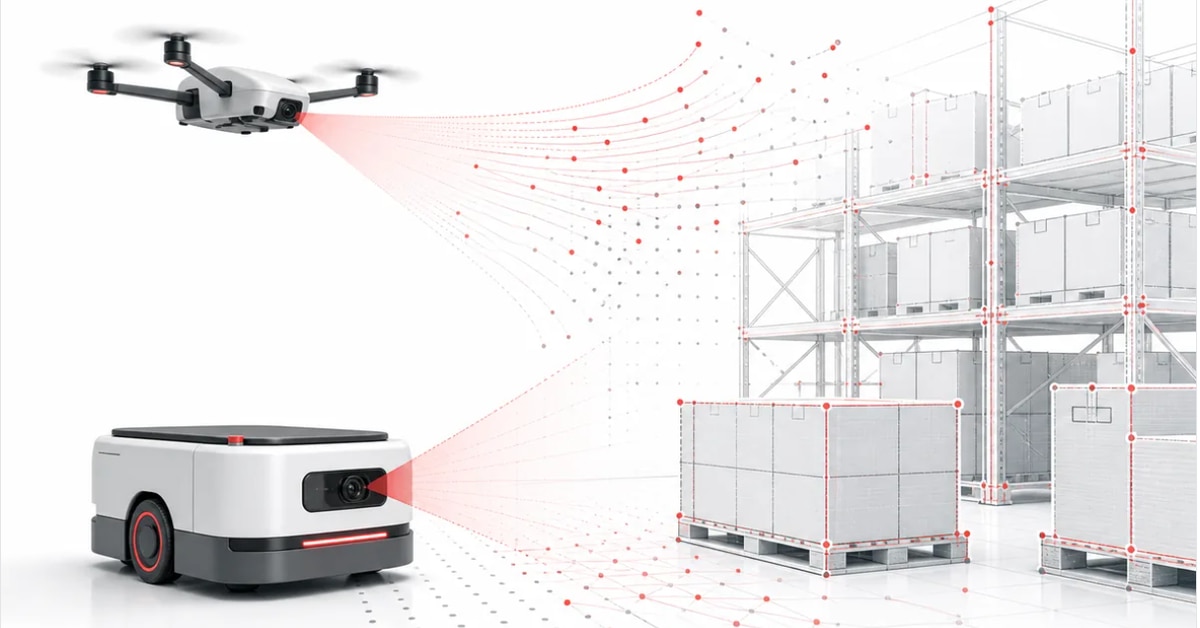
Physical AI systems are only as responsive as their perception pipelines. Between OpenCV 4.12 and 4.15, a series of upstream OpenCV contributions accelerated key functions across every major stage of the robot vision stack, from image acquisition and denoising to VSLAM matching and pose estimation.
Because these optimizations are portable SIMD, every gain below lands on the same AMD CPU already doing the robot's classical vision — no fork, no rewrite.
Key Takeaways
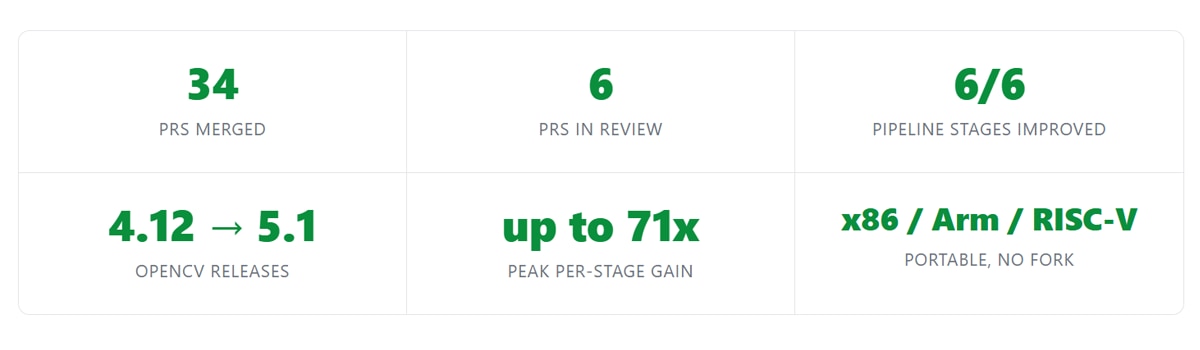
- 34 PRs merged into upstream OpenCV
- 6 perception pipeline stages improved
- Up to 71× acceleration in critical vision kernels
- Available in upstream OpenCV, no proprietary fork
- Spanning OpenCV 4.12 through 4.15
- Portable SIMD across x86, Arm, and RISC-V
- No application changes required
The optimizations discussed in this article were contributed by the author (Madan Mohan Manokar) and accepted into upstream OpenCV between releases 4.12 and 4.15.
These are not AMD-specific patches. The optimizations were accepted into upstream OpenCV and benefit the broader OpenCV ecosystem.
The Robot Perception Pipeline
Whether it is a warehouse AMR, a drone, or a manipulator, a Physical AI system turns pixels into action through a remarkably consistent chain of stages. Each runs on every frame, mostly on the CPU, and each stage's latency stacks directly onto the control loop:
- Acquisition & rectification - capture, color-convert, undistort
- Conditioning - denoise and normalize before analysis
- Feature extraction - gradients, edges, keypoints
- Tracking & temporal - optical flow, background modeling
- Matching & relocalization - descriptor distances for VSLAM / loop closure
- State estimation - pose, SVD, matrix algebra, statistics
Read the tables below as latency you get back on the control loop - undistortion, feature matching, and pose estimation are exactly the stages a robot cannot afford to be slow at.
Speedup = optimized patch vs. reference (higher is better). Peak values are the best single measured case on 5th Generation AMD EPYC™ Server CPUs (Turin); benchmarks were run on five targets - see the endnote for the full test configuration and the complete benchmarks.
Note: the speedups reported here were measured on AMD “Zen 5” (Turin) and “Zen 4” (Genoa) server machines. Because the optimizations are portable SIMD built on the same instruction sets, comparable gains are expected on embedded “Zen 5” platforms as well.
The following sections map each upstream OpenCV contribution to the stage of the perception pipeline where it delivers value.
STAGE 1: Acquisition & rectification
The first thing any perception stack does is turn a raw sensor frame into a clean, geometrically correct image: convert color, resize to the working resolution, and undistort using the camera model. Camera remap runs on every pixel of every frame, so it is a prime target.
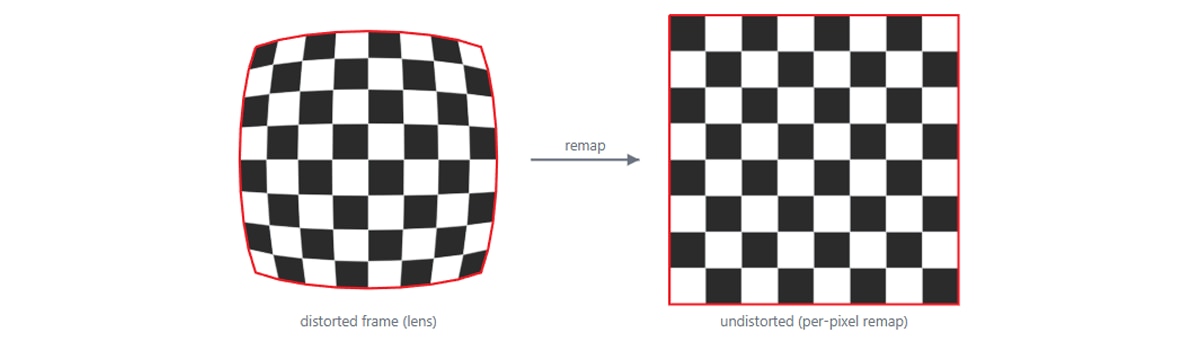
| Component | Function | Contribution | Release | Peak gain1 |
|---|---|---|---|---|
| Undistort / rectify | remap |
#29507 | 4.14 | 3.32x |
| Color conversion | cvtColor |
#28992 | 4.14 | 2.63x |
| Resize to working resolution | resize (NN / INTER_AREA) |
#29338 | 4.15 (in review) |
7.46x |
| Grayscale convert (bit-exact) | BGR(A)2GRAY |
#29848 | 4.15 | 1.71x |
Undistortion (remap) also scales strongly on Arm - up to 6.86x on an Apple M5 (NEON) proxy, which matters for Arm-based edge compute modules.
Rows marked in review are open pull requests (OpenCV 4.15 dev, not yet merged); figures are from each PR's own benchmark and may change before merge.
STAGE 2 - Conditioning: denoise & normalize
Before features can be trusted, frames are smoothed and their contrast normalized. In 4.15 the two most common blurs also gained an OpenCL fast path that now runs on non-Intel integrated GPUs — directly useful for the iGPUs in embedded SoCs.
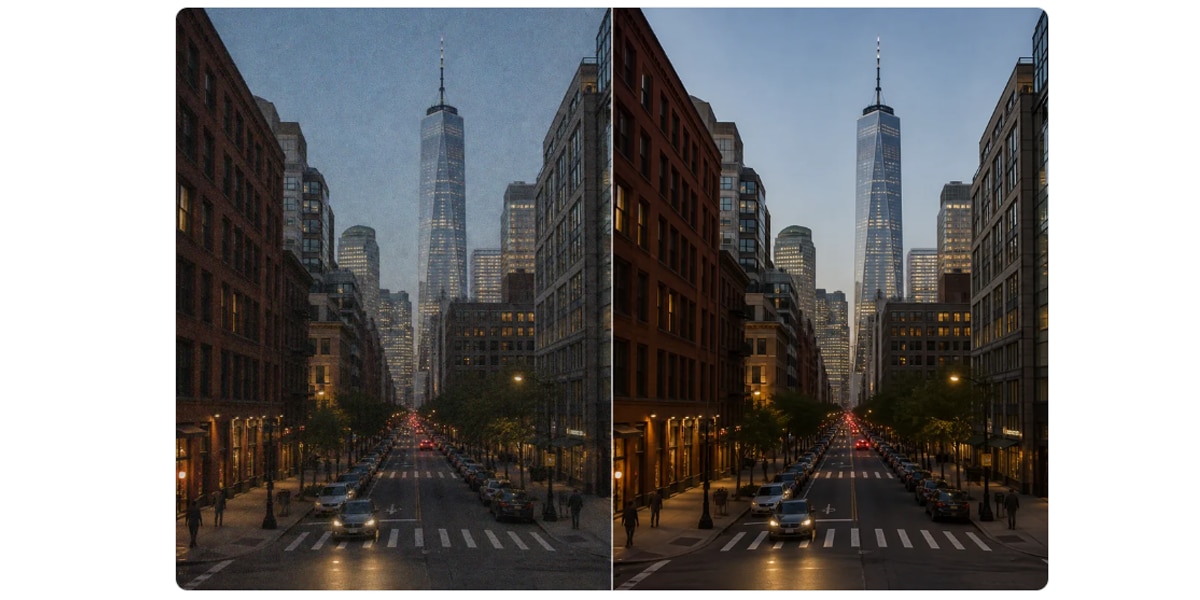
| Component | Function | Contribution | Release | Peak gain1 |
|---|---|---|---|---|
| Denoise | medianBlur |
#27299 | 4.12 | 9.29x |
| Smoothing | GaussianBlur |
#27795 | 4.13 | 2.17x |
| Bilateral denoise | bilateralFilter |
#27433 | 4.13 | 1.81x |
| Contrast normalize | LUT / equalizeHist |
#29250 | 4.14 | 17.03x |
| Denoise on iGPU | medianBlur / GaussianBlur (OpenCL) |
#29803, #29800 | 4.15 | GPU offload |
These denoise wins first landed in 4.12 - 4.13; medianBlur later gained an AVX-512 ICL dispatch path (#28394, 4.14) and bilateralFilter a 32f AVX-512 path (#28401, 4.14). The 4.15 OpenCL work enables GPU offload on non-Intel GPUs rather than a CPU speedup - freeing the CPU entirely on frames where an iGPU is available.
STAGE 3- Feature extraction: gradients & edges
Edges and gradients feed corner/line detection, calibration targets, and lane/obstacle boundaries. In 4.15 we extended the spatialGradient API and fused it with a dispatched SIMD Canny, removing a full pass over the image.
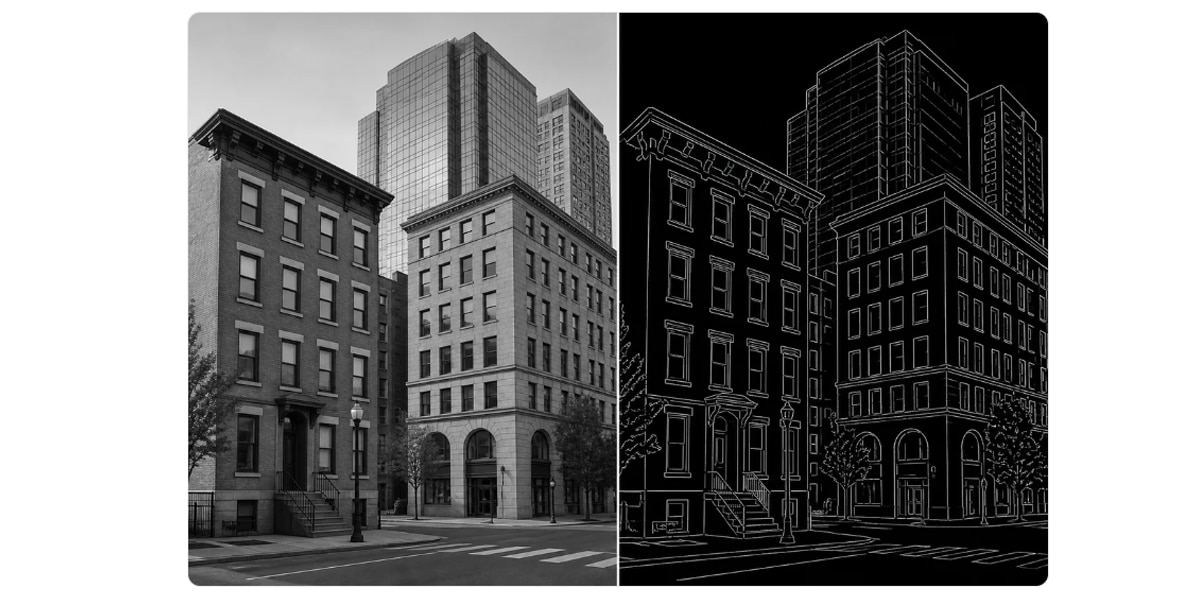
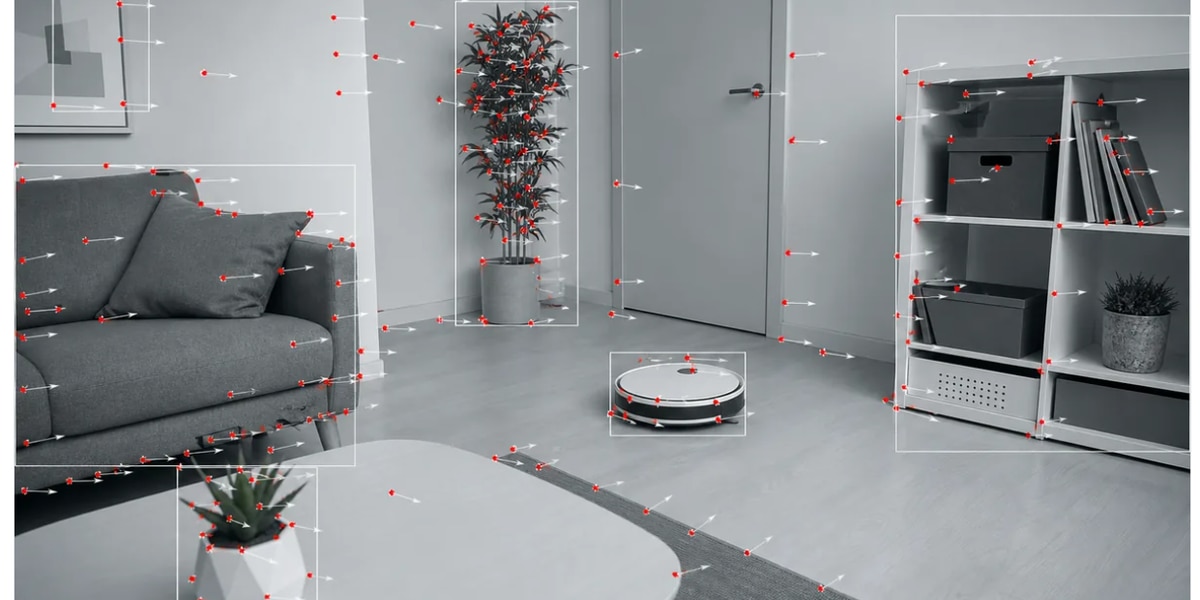
The outputs of the very functions optimized here (feature detection, OpticalFlowPyrLK, norm/Hamming matching).
STAGE 4 - Tracking & Temporal
Visual-inertial odometry tracks features frame-to-frame with pyramidal optical flow, while background/temporal accumulation underpins motion segmentation. Both were major targets.
| Component | Function | Contribution | Release | Peak gain1 |
|---|---|---|---|---|
| Pyramidal optical flow | OpticalFlowPyrLK (pyrDown) |
#28650 | 4.14 | 5.21x |
| Temporal / background model | accumulate |
#29718, #29394 | 4.15 | 17.47x |
STAGE 5 - Matching & Relocalization
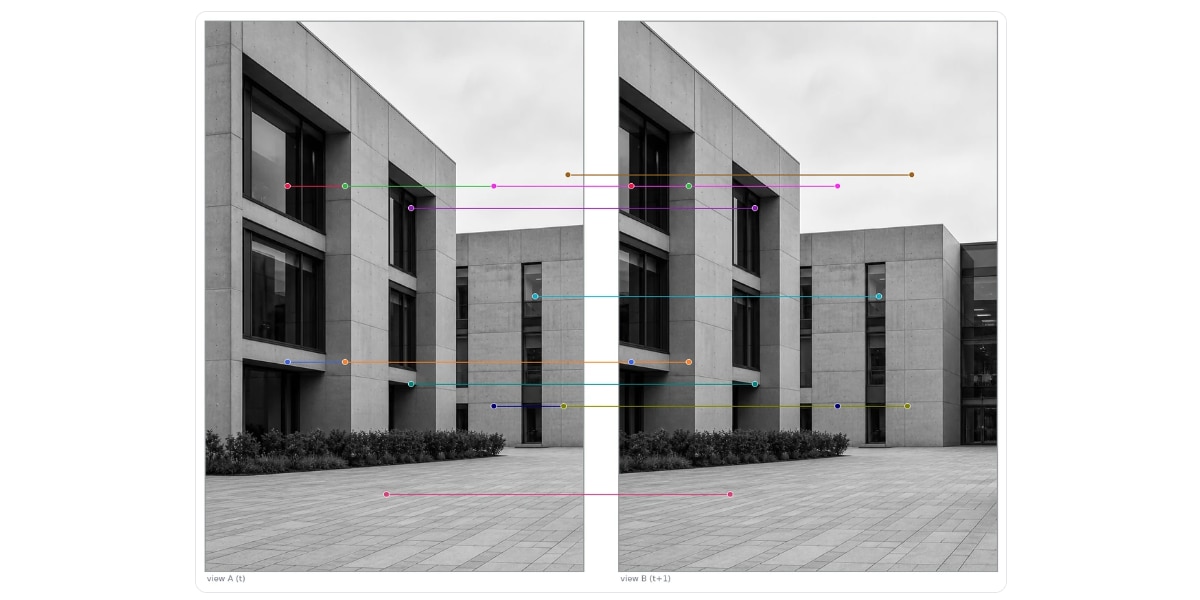
VSLAM lives or dies on feature matching - the Hamming / L2 distances behind ORB and BRISK are run millions of times for loop closure and relocalization. This is where the single largest gain landed.
| Component | Function | Contribution | Release | Peak gain1 |
|---|---|---|---|---|
| Descriptor matching (ORB/BRISK) | norm / distance / Hamming |
#29335 | 4.14 | 71.37x |
| Occupancy / mask counts | countNonZero |
#29390 | 4.14 | 1.34x |
The norm peak comes from masked-distance cases where SIMD replaces a scalar fallback - precisely the descriptor-matching inner loop in feature-based SLAM.
STAGE 6 - State estimation: pose, SVD & algebra
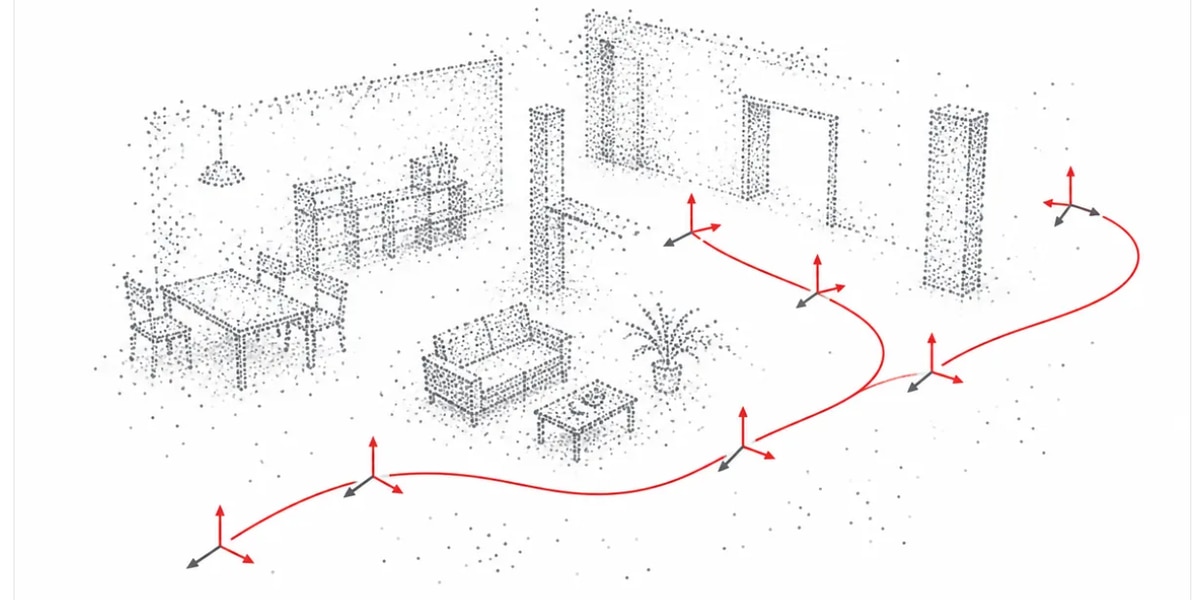
The final stage solves for motion and structure: matrix multiplies, singular-value decompositions for pose/PnP and calibration, and the statistics that normalize and gate the whole pipeline. In 4.15 we vectorized JacobiSVD - the SVD at the heart of pose estimation.
| Component | Function | Contribution | Release | Peak gain1 |
|---|---|---|---|---|
| Matrix algebra | gemm |
#29242 | 4.14 | 3.79x |
| SVD (pose / calibration) | JacobiSVD |
#29720 | 4.15 | 3.63x |
| Statistics / normalize | meanStdDev |
#29339 | 4.14 | 15.91x |
| Blend / residuals | mul32f / addWeighted32f |
#29413 | 4.14 | 1.62x |
| Reductions | minMaxLoc / sum |
#29340, #29400 | 4.14 | dispatch |
gemm scales even harder on older cores (14.5x on AMD 2nd Generation AMD EPYC™ Processors (EPYC 7742), which is common in fielded embedded x86. JacobiSVD gain shown for 100×100 decompositions; a companion fix (#29727) keeps the SIMD path bit-accurate to the scalar reference.
BRIDGE - Feeding the neural policy (DNN preprocessing)
Physical AI pairs classical CV with a neural network. The hand-off is blobFromImages, which packs preprocessed frames into the NCHW tensor layout the model consumes — memory-bound data movement that sits directly in front of every inference. Optimizing it shortens the gap between "frame ready" and "model running." This work is under review for 5.1.
| Component | Function | Contribution | Release | Peak gain1 |
|---|---|---|---|---|
| Image → tensor (NCHW packing) | blobFromImages |
#29852 | 5.1 (in review) |
1.93x |
Open pull request (not yet merged); figure is from the PR's own benchmark on AMD 5th Generation EPYC™ Processors (Turin) and may change before merge.
Cumulative impact: every stage accelerated
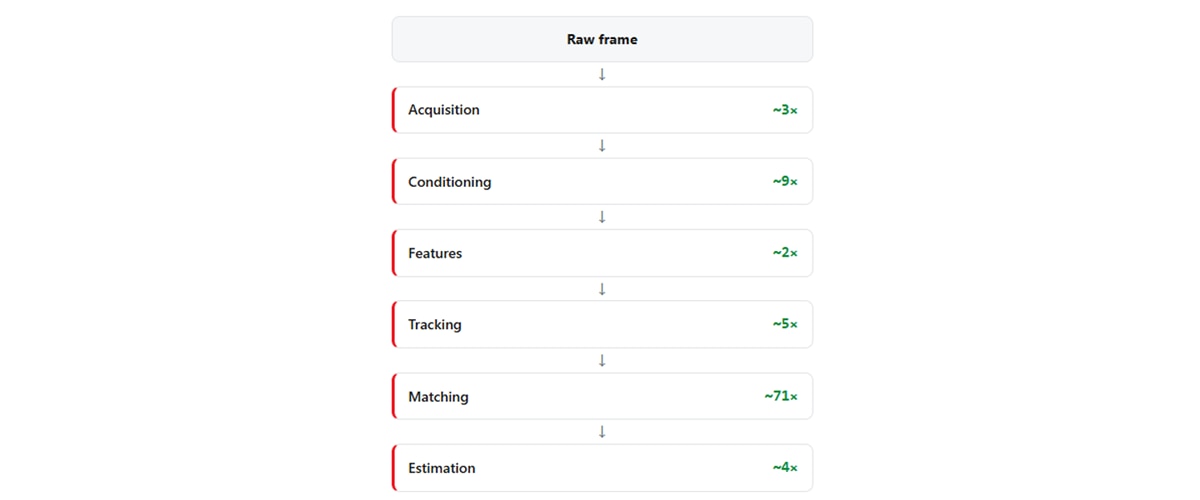
Read top to bottom, the perception loop now has an optimized fast path at every step — not one hot spot, but the whole chain. Representative peak speedups for functions commonly used at each stage (AMD Turin, “Zen 5”). These values are not multiplicative and should not be interpreted as end-to-end application speedups.
Why this compounds for Physical AI
- Every stage improved. The gains are not isolated - they span the entire sense-to-estimate chain, so end-to-end frame latency drops more than any single number.
- No new bottleneck. The improvements span acquisition, preprocessing, feature extraction, tracking, matching, and estimation, meaning throughput increases without shifting the bottleneck to another stage.
- The hot stages got the biggest wins: Feature matching (71x), temporal accumulation (17x), contrast normalization (17x), and statistics (16x) are exactly the high-frequency inner loops of VSLAM and VIO.
- Portable, so the edge benefits too: The same kernels run on Arm/NEON - e.g. norm 35.8x and remap 6.86x on an Apple M5 proxy, so an Arm compute module gets the wins without a special build.
- Zero adoption cost: Bump the OpenCV version and the same binary does more per frame on the CPU the robot already ships.
In practice: a visual SLAM pipeline
For a visual SLAM pipeline, improvements in remap, pyramidal optical flow, descriptor matching, and JacobiSVD collectively accelerate acquisition, tracking, relocalization, and pose estimation — without modifying application code.
Release by release, at a glance
- OpenCV 4.12 - 4.13 delivered the first denoise wins - medianBlur 9.3x (4.12), plus GaussianBlur 2.2x and bilateralFilter 1.8x (4.13).
- OpenCV 4.14 delivered the core SIMD wins across acquisition, matching, and estimation, including the headline norm 71x, LUT/equalizeHist 17x, remap 3.3x, and gemm 3.8x.
- OpenCV 4.15 (dev) extended into temporal accumulate (17.5x), JacobiSVD for pose (3.6x), fused Canny, bit-exact BGR(A)2GRAY (1.7x), and OpenCL offload on non-Intel GPUs.
- In review - open PRs still under maintainer review: resize (7.5x, 4.15 dev) and blobFromImages NCHW packing (1.9x, 5.1 dev).
The bottom line
Between OpenCV 4.12 and 4.15, upstream contributions accelerated every major stage of the Physical AI perception stack. Because these improvements were accepted into upstream OpenCV itself, the benefits extend beyond AMD platforms and are available to the broader robotics, VSLAM, edge AI, and computer-vision communities through standard OpenCV releases.
Footnotes
Footnotes
1 Testing conducted by AMD as of September 2026. Speedup = optimized patch vs. reference (higher is better). Benchmarks were run on five targets: AMD Turin (EPYC™ 9005 series, “Zen 5”, AVX-512), AMD Genoa (EPYC™ 9004 series, “Zen 4”, AVX-512), AMD Rome (EPYC™ 7742, “Zen 2”, AVX2), Intel Ice Lake (AVX-512), and Apple Mac M5. The "peak gain" figures shown in the tables are the best single measured case per function on AMD Turin (“Zen 5”), measured with OpenCV's own performance-test harness and the per-PR benchmark tables, excluding images narrower than 320 px (dominated by dispatch overhead). The gemm “Zen 2” figure is from AMD Rome (EPYC™ 7742, AVX2); Arm/NEON figures use the Apple M5 as an indicative proxy for edge-class Arm silicon and do not represent any specific embedded platform. "GPU offload" and "dispatch" denote capability/portability changes rather than a single-number CPU speedup. Actual performance will vary by hardware, workload, image size, data type, compiler, and system configuration. Full benchmark details are in the AMD technical article, Accelerating OpenCV with Portable SIMD. All contributions referenced are public on github.com/opencv/opencv.
Footnotes
Footnotes
1 Testing conducted by AMD as of September 2026. Speedup = optimized patch vs. reference (higher is better). Benchmarks were run on five targets: AMD Turin (EPYC™ 9005 series, “Zen 5”, AVX-512), AMD Genoa (EPYC™ 9004 series, “Zen 4”, AVX-512), AMD Rome (EPYC™ 7742, “Zen 2”, AVX2), Intel Ice Lake (AVX-512), and Apple Mac M5. The "peak gain" figures shown in the tables are the best single measured case per function on AMD Turin (“Zen 5”), measured with OpenCV's own performance-test harness and the per-PR benchmark tables, excluding images narrower than 320 px (dominated by dispatch overhead). The gemm “Zen 2” figure is from AMD Rome (EPYC™ 7742, AVX2); Arm/NEON figures use the Apple M5 as an indicative proxy for edge-class Arm silicon and do not represent any specific embedded platform. "GPU offload" and "dispatch" denote capability/portability changes rather than a single-number CPU speedup. Actual performance will vary by hardware, workload, image size, data type, compiler, and system configuration. Full benchmark details are in the AMD technical article, Accelerating OpenCV with Portable SIMD. All contributions referenced are public on github.com/opencv/opencv.


Related Blogs
-
Long Context, One Node: Serving GLM-5.3-FP8 on MI300X with DP8+EP8 — ROCm Blogs
Learn how to serve GLM-5.3-FP8 on one AMD Instinct™ MI300X node with DP8+EP8 and vLLM v0.28 for long-context workloads, and compare it with TP=8.
October 13, 2026
-
Meet the Next AMD Ryzen™ AI Halo
Meet the next AMD Ryzen™ AI Halo developer platform, powered by the AMD Ryzen™ AI Max+ PRO 495 processor. Run larger local LLMs, up to 300B parameters, thanks to the 192GB of unified memory that comes on the new platform.
October 12, 2026
-
AMD AI NIC™ Technology Driving AI-Ready Ethernet
Learn how AMD AI NIC™ technology helps organizations build AI-ready Ethernet networks with open standards, programmability, and transport innovation.
October 11, 2026
-
Kimi K3 on AMD Instinct GPUs with TokenSpeed
TokenSpeed delivers fast, agentic LLM inference on AMD Instinct™ MI355X GPUs, with optimized kernels and leading Kimi K3 performance.
October 09, 2026
-
MangoBoost Delivers Open AI Models Powered by AMD
Mango Inference a serverless inference service providing production-ready access to open models powered by AMD Instinct™ GPUs and AMD ROCm™ software
October 09, 2026
-
MoRI UMBP Empowers AMD Instinct GPUs
See how UMBP, MoRI and SGLang optimize KV cache reuse to boost AMD Instinct™ MI355X GPU agentic AI performance and cost efficiency
October 09, 2026
-
Pre-Training Hybrid LLMs from Scratch in Primus on AMD Instinct™ GPUs — ROCm Blogs
Pre-train hybrid LLMs mixing MLA attention with Gated DeltaNet, Kimi Delta Attention and Mamba2 mixers on AMD Instinct MI355X GPUs, with open recipes.
October 07, 2026
-
DI Series: Serving Kimi-K3 MXFP4 Wide-EP Disaggregated on AMD Instinct MI300X and MI325X — ROCm Blogs
Learn how to serve a 1.4 TiB Kimi-K3 MXFP4 mixture-of-experts model disaggregated across AMD Instinct MI300X and MI325X GPUs.
October 07, 2026