

Overview
The AI era is evolving, creating demands for a new class of compute and shifting the CPU/GPU equation. Generative AI introduced systems that could reason and respond on a prompt and response loop. Agentic AI augments these systems with agency to plan, act and complete tasks. AMD EPYC™ Server CPUs can prepare your data center for the Agentic AI era.
Agentic AI is Transforming Data Center Needs
AMD CVP of Compute and Enterprise AI, Madhusudhan Rangarajan explains how Agentic AI systems work and why they will transform the data center, reshaping the roles of CPUs and GPUs.


Inside the Agentic Workflow
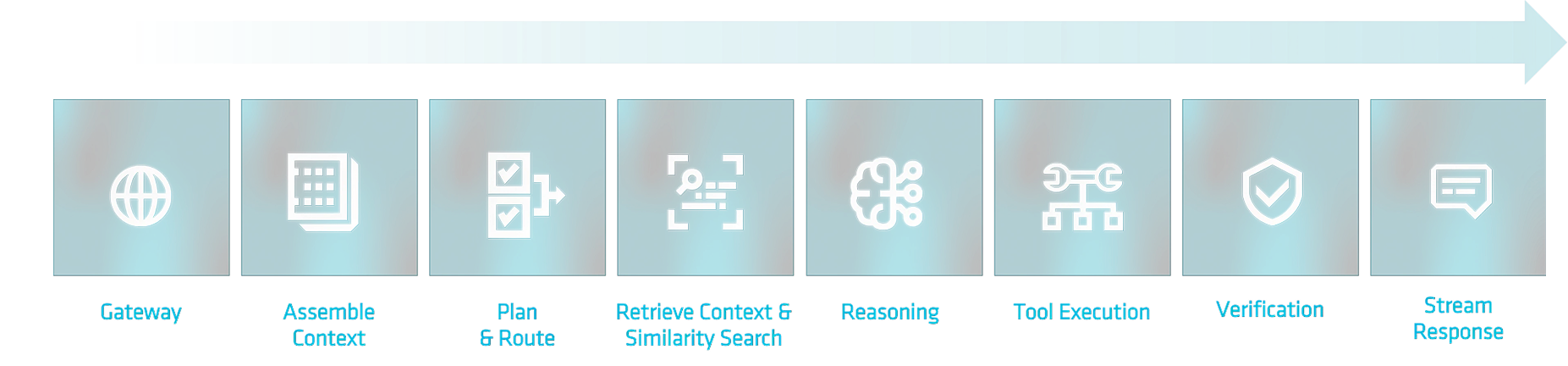
Agentic AI Is a Pipeline of Distinct Compute Stages
From Gateway to Response, Each Stage Places Unique Demands on the CPU. Agentic AI continuously moves through compute, memory, I/O, security, and acceleration-intensive stages.
Featured Resources
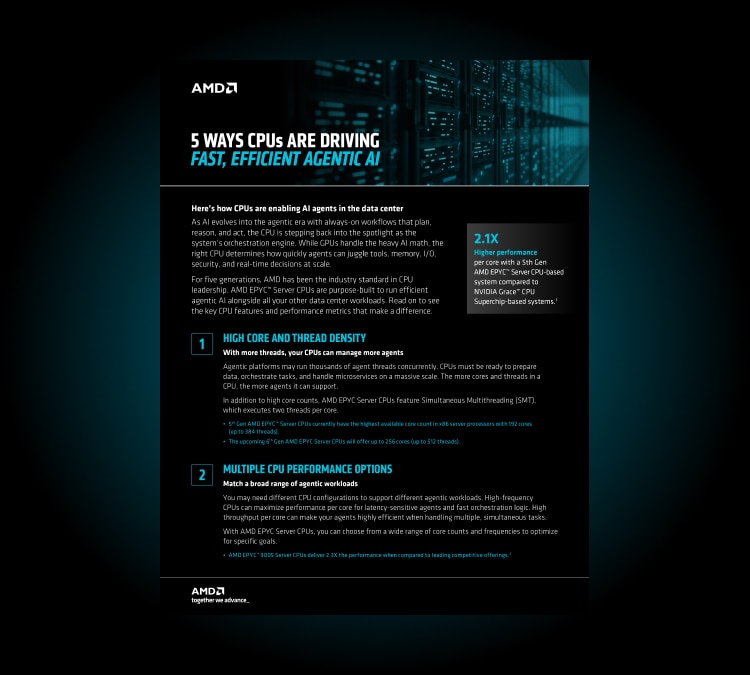
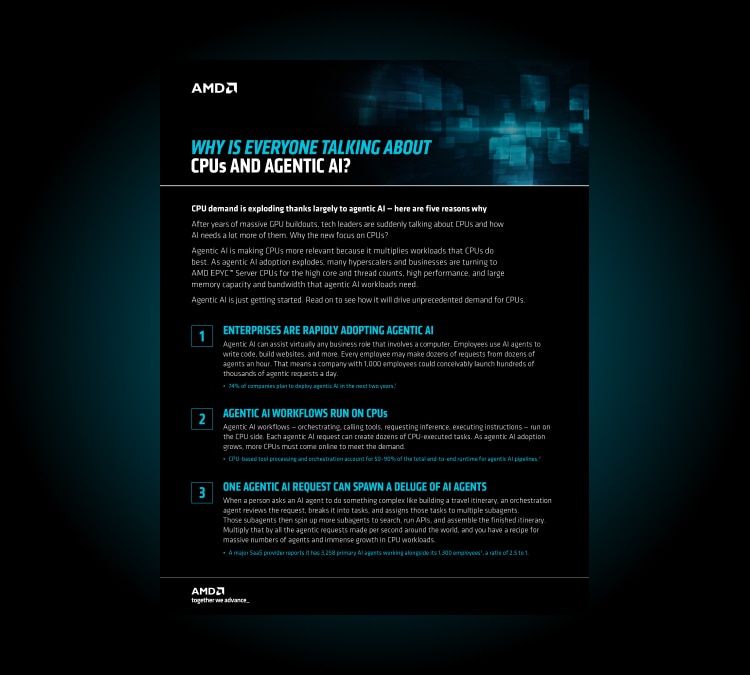
Get a deeper dive into how agentic workflows increase the CPU demand.
CPU Roles
As Agentic AI scales, each agent uses several CPUs to coordinate tasks, manage memory, connect with enterprise software, and handle data flow—driving up CPU demand across the board. The broad AMD EPYC™ Server CPU portfolio addresses these demands across three distinct roles: scaling agent sandboxes, maximizing AI host-node throughput, and powering the general-purpose workloads agents need to complete work.
Agent Sandbox CPU
Optimize agentic capacity built to deliver the most agents per watt, per dollar, and per rack with AMD EPYC Server CPUs’ leadership performance per watt, highest number of threads per dollar, and highest thread density per rack.2,3
AI Host Node CPU
Maximize GPU utilization and help boost token generation with high frequency AMD EPYC Server CPUs, enabling exceptional GPU efficiency and offering high performance per core.
General Purpose CPU
Orchestrate planning, tool use, and subagents with AMD EPYC Server CPUs broad portfolio, designed to extend leadership performance across general purpose workloads from databases, storage, compute, and search.
AMD EPYC Server CPUs for Agentic AI
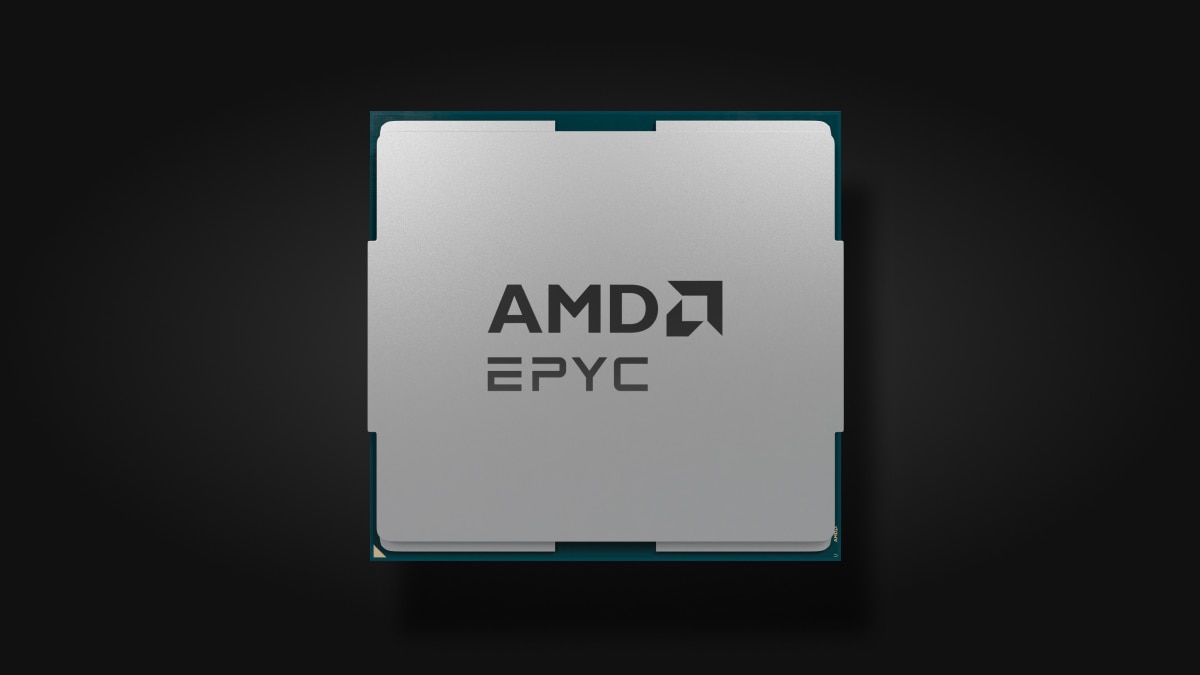
World’s best server CPU Portfolio for The Agentic Era
AMD EPYC™ Server CPUs offer the best Agentic AI Solution with leadership performance, power efficiency, and core and thread density to run many agents in parallel, all while optimizing your total cost of ownership (TCO).
Portfolio
Explore the world’s broadest server CPU portfolio for Agentic AI designed to help match your agentic needs.
Blogs



Frequently Asked Questions
Agentic AI typically works by combining reasoning, planning, tool use, memory, and feedback. An AI agent receives a goal, creates a plan, selects the right tools or data sources, performs actions, checks the outcome, and adjusts as needed. Depending on the use case, it may connect to business applications, databases, APIs, email, chat platforms, or workflow systems.
Generative AI creates content such as text, images, code, summaries, or recommendations. Agentic AI goes further by taking action. It can break a goal into steps, decide what to do next, use software tools, retrieve information, complete tasks, and monitor progress. In most cases, Agentic AI uses Generative AI, to provide the intelligence as part of the larger workflow.
Agentic AI can support complex workflows across many business functions. Common use cases include customer service, sales support, research, software development, data analysis, IT operations, marketing, HR, finance, and back-office automation. For example, an AI agent could research a prospect, update a CRM, draft a follow-up email, and schedule the next step.
Agentic AI can help organizations increase productivity, reduce repetitive work, speed up decision-making, and improve customer and employee experiences. Because it can manage multi-step processes, it is especially useful for work that requires coordination across systems, teams, or data sources. It can also help employees focus on higher-value tasks by handling routine or time-consuming activities.
Agentic AI can be safe and effective when it is designed with the right controls. Important safeguards include human oversight, clear permissions, data security, audit trails, testing, approval workflows, and limits on what actions an agent can take.
Resources

Footnotes
- EPYC-068 - The AMD EPYC server CPU portfolio spans the industry’s broadest ranges of data center deployments, from general-purpose enterprise, cloud, telecom, SMB, and HPC systems to emerging AI environments including sandboxed agentic AI deployments and GPU head node servers. AMD EPYC 6th Generation platforms extend this breadth by uniquely combining high core and thread density of up to 512 threads, advanced memory bandwidth of up to 16 channels of 12.8 GT/s MRDIMM support, next-generation PCIe® Gen 6 connectivity, and select SKUs with boost frequencies up to 5 GHz.
- 9xx6-013: Comparison based on published Top-of-stack core counts and 1Ku pricing for estimated highest Agents / CPU $ and threads / CPU $ AMD EPYC™ 9006 (512 threads), AMD EPYC™ 9005 (384 threads), and Intel® Xeon® 6 (256 threads) SKUs as of 7/22/2026. Threads derived as 2 threads per core (SMT). Intel and Xeon are trademarks of Intel Corporation or its subsidiaries.
Source: https://www.amd.com/content/dam/amd/en/documents/solutions/ai/methodology-description.pdf
Agent counts are estimates derived from available CPU thread resources used as a proxy under a consistent theoretical workload. Actual agent capacity and throughput will vary based on workload, model, memory, software, orchestration, and system configuration.
- 9xx6-005A:
vCPU support based on thread count, comparing Top of Stack 6th Gen EPYC 9996
CPU with 256 cores (512 threads) and 5th Gen EPYC 9965 with 192 cores (384
threads). In comparison, the highest thread count Intel® Xeon® processor is the
Intel Xeon 6990E at 288 threads, and the highest thread count Nvidia CPU is the
Nvidia Vera with 88 cores (176 threads).
For
reference, 6th Gen Intel Xeon CPUs support up to ~0.8x, ARM AGI is expected to
support up to ~0.7x, and Nvidia Vera is expected to support ~0.5x the thread
count of 5th Gen AMD EPYC CPUs.
- EPYC-068 - The AMD EPYC server CPU portfolio spans the industry’s broadest ranges of data center deployments, from general-purpose enterprise, cloud, telecom, SMB, and HPC systems to emerging AI environments including sandboxed agentic AI deployments and GPU head node servers. AMD EPYC 6th Generation platforms extend this breadth by uniquely combining high core and thread density of up to 512 threads, advanced memory bandwidth of up to 16 channels of 12.8 GT/s MRDIMM support, next-generation PCIe® Gen 6 connectivity, and select SKUs with boost frequencies up to 5 GHz.
- 9xx6-013: Comparison based on published Top-of-stack core counts and 1Ku pricing for estimated highest Agents / CPU $ and threads / CPU $ AMD EPYC™ 9006 (512 threads), AMD EPYC™ 9005 (384 threads), and Intel® Xeon® 6 (256 threads) SKUs as of 7/22/2026. Threads derived as 2 threads per core (SMT). Intel and Xeon are trademarks of Intel Corporation or its subsidiaries.
Source: https://www.amd.com/content/dam/amd/en/documents/solutions/ai/methodology-description.pdf
Agent counts are estimates derived from available CPU thread resources used as a proxy under a consistent theoretical workload. Actual agent capacity and throughput will vary based on workload, model, memory, software, orchestration, and system configuration. - 9xx6-005A:
vCPU support based on thread count, comparing Top of Stack 6th Gen EPYC 9996
CPU with 256 cores (512 threads) and 5th Gen EPYC 9965 with 192 cores (384
threads). In comparison, the highest thread count Intel® Xeon® processor is the
Intel Xeon 6990E at 288 threads, and the highest thread count Nvidia CPU is the
Nvidia Vera with 88 cores (176 threads).
For reference, 6th Gen Intel Xeon CPUs support up to ~0.8x, ARM AGI is expected to support up to ~0.7x, and Nvidia Vera is expected to support ~0.5x the thread count of 5th Gen AMD EPYC CPUs.