KIIT Expands Student Access to Advanced AI PCs with AMD Ryzen™ AI
HP laptops with AMD Ryzen and AMD Ryzen AI processors help KIIT students innovate with high-end mobile compute power
Kalinga Institute of Industrial Technology (KIIT) serves 40,000 students across 250 programs in Bhubaneswar, India. Its sister institution, Kalinga Institute of Social Sciences (KISS), educates another 40,000 students from indigenous backgrounds. Both are guided by a humanitarian philosophy focused on enabling student success. KIIT leaders call this transformation "Soil to Silver," built on the conviction that access to the right tools can shape learning from the start. At KIIT, that begins when every incoming student receives a personal laptop.
In 2024, KIIT began shifting away from its legacy Intel-based systems toward new HP laptops with AMD Ryzen™ and AMD Ryzen AI processors. That decision carried through 2025 and subsequent procurements so that laptops with AMD processors now make up approximately 40 percent of the student fleet. The rollout began with AMD Ryzen 7 8840HS processors and has grown to include AMD Ryzen AI 7 350 processors, providing students with the advanced processing and integrated AI acceleration needed for their most demanding research and coursework.

Workloads that demand more than a standard device
KIIT students are increasingly working on data-centric research and innovation. Their workloads span AI development, machine learning, data science, and 3D simulation, all tasks that previously required access to a data center. Students need to run TensorFlow, PyTorch, Keras, and Scikit-learn directly on their laptops, manage development environments in VS Code and JupyterLab, and experiment with Large Language Models using tools like Hugging Face and Ollama.
The bar is high. KIIT needed laptops with processors that could handle those tasks locally, remain relevant over a five-year lifecycle, streamline support for more than 27,000 laptops, and enable students to work without constant access to power outlets.
Prof. (Dr.) Jnyana Ranjan Mohanty, Registrar at KIIT, says, "We see increasing emphasis on students doing projects that involve capturing and working with data. For that, they need high-speed processing systems. Success starts with putting the high-end computational power offered by AMD Ryzen processors in every student's hand so they can innovate from day one."
AMD Ryzen 7 8840HS processors gave KIIT the performance and efficiency needed for coding, simulation, and data-centric coursework, while AMD Ryzen AI 7 350 processors made it easier for students to keep more AI work on the laptop itself.
AMD on-device AI changes how students learn
Laptops featuring AMD Ryzen AI processors include an integrated neural processing unit (NPU) that changes how the system handles modern AI workloads. Power-optimized, the NPU is designed to efficiently process supported AI tasks on the device, freeing CPU and GPU resources for other demanding work. At KIIT, that creates a responsive local AI experience while supporting the mobility students need across campus.
Professor Das says, Director General, ICT, at KIIT says, "The integrated NPU was a vital requirement for us. While the industry is moving toward a 40TOPS standard, AMD Ryzen AI processors already deliver 50TOPS." With that level of on-device processing, students can easily execute projects using tools such as Visual Studio Code AI extensions or Anaconda.
Professor Saranjit Singh, Vice Chancellor at KIIT, sees the impact extending past just getting work done. "The local AI processing capability provided by AMD Ryzen AI processors changes how students learn," he says. "On-device AI keeps many tasks within the system, making it possible for students to gain frequent, hands-on experience with new technologies they’ll encounter in the workforce."

A platform built to go the distance
Since KIIT envisions every laptop as a long-term investment in its students, the university needed a processor architecture that supports students from enrollment through the start of their careers. The shift to advanced AMD processors built on "Zen 4" and "Zen 5" architectures delivered the performance and power efficiency they’ll require to handle heavy multitasking, coding, and simulation well into the future.
"High performance and reliability were key factors in selecting AMD Ryzen and AMD Ryzen AI processors,” says Professor Singh, "but we were also looking at ROI."
Professor Das adds, "Our students take these laptops with them into their first jobs. AMD technology enables us to support their full educational journey and their early professional careers."
Managing 27,000 laptops across a distributed campus
KIIT's highly distributed campus comprises 12 sites spread across the city of Bhubaneswar. This has led the institution to develop one of the largest IT help desks in the region to provide the technical support needed to keep students' academic work moving without interruption. Supporting operations at this scale depends on consistent system performance, power efficiency, and hardware that the KIIT IT team can rely on.
"Achieving the level of resilience we need requires a commercial platform we can trust," says Professor Das. "With AMD Ryzen processors, KIIT maintains operational confidence that enables our students to be productive wherever they need to work."
AMD efficiency supports students on the move
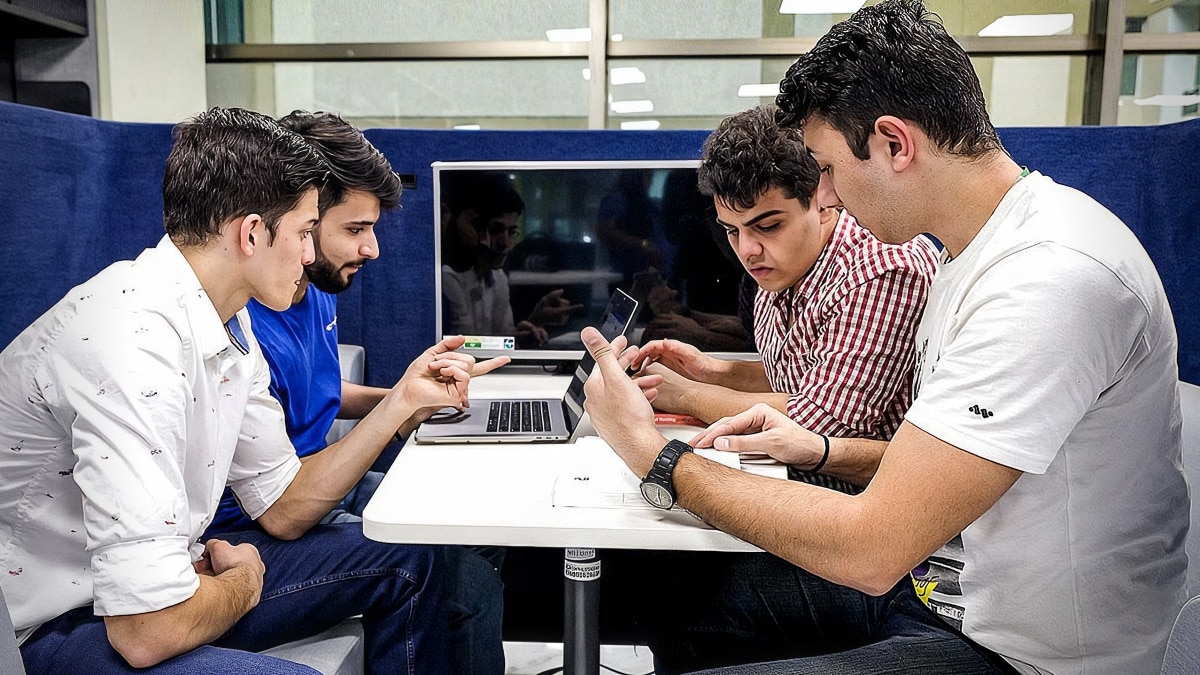
Students move continuously throughout the day between academic buildings, libraries, hostels, and living quarters while running demanding tools such as PyCharm, Eclipse, and Docker. A laptop that forces them to stop and recharge would disrupt their work and, more importantly, interrupt their learning.
"Our students work with their laptops everywhere," says Prabodh Chandra Panda, Chief Technical Officer, ICT at KIIT. "The efficiency of AMD Ryzen processors gives students a real advantage." Professor Das adds, “We see strong battery performance from AMD Ryzen processors, even when students run multitasking workloads and coding environments like GitHub Copilot and Google Colab simultaneously.”
A foundation for the future
"When we look beyond the specifications, we trust AMD, and that is a main reason we chose it," says Panda. "Our confidence has only grown as we continue to experience smooth deployments and reliable performance across our expanding fleet."
For a university whose students carry their education everywhere they go, the processor in their laptop shapes what each student can accomplish. AMD Ryzen and AMD Ryzen AI processors give KIIT the on-device AI performance, fleet-level manageability, and five-year platform stability to sustain its commitment to every student, from initial enrollment through graduation and the critical early years of a graduate's career.

About the Customer
KIIT, deemed to be University, Bhubaneswar, has grown from a modest institute into a globally reputed professional education hub. Founded by Dr. Achyuta Samanta in 1992 with an initial investment of ₹5,000 5,000 INR (Indian Rupee) only, KIIT today educates around 40,000 students, including 2,000 international students from 65 countries. Spread over a vast green academic township, KIIT offers world-class infrastructure, strong research facilities, a 2,600-bedded hospital, and excellent placement opportunities. With top national and international accreditations, strong rankings, and major contributions to sports, society and culture, KIIT stands as a university of compassion, excellence and humanitarianism. For more information visit kiit.ac.in.
Case Study Profile

- Industry:
Education - Challenges:
KIIT needed student laptops that could handle rising AI, data science, and simulation workloads, stay useful for years, and support a mobile campus at fleet scale - Solution:
KIIT adopted HP laptops with AMD Ryzen™ and AMD Ryzen AI processors to deliver local AI acceleration, five-year platform relevance, and the performance students need for demanding workloads - Results:
Laptops with AMD processors now make up about 40% of KIIT's student fleet, giving students more on-device AI capability, greater independence from centralized compute, and better performance on the move - AMD Technology at a Glance:
AMD Ryzen 7 8840HS processors
AMD Ryzen AI 7 350 processors - Technology Partners: