Versal Adaptive SoC – Secure Boot Bypass via Board Modifications and Crafted Boot Image
Summary
On Versal Adaptive SoC devices, USB boot mode is supported as an AMD-internal, test-only boot mode. USB boot mode is a slave boot mode that allows a host to download a boot image to a Versal device over USB using the DFU protocol.
USB boot mode can be enabled via non-trivial board modifications. When enabled on certain Versal devices, crafted images can overflow a buffer and overwrite an active function pointer, resulting in arbitrary code execution during boot.
CVE Details
Refer to Glossary for explanation of terms
| CVE | CVE Description | CVSS Base Score |
| CVE-2026-0482 | In AMD Versal™ Adaptive SoC devices, insufficient boundary checks within the USB boot mode—when enabled via board modifications—allow crafted images to overflow a buffer and overwrite an active function pointer, resulting in arbitrary code execution during boot. This can lead to the loss of confidentiality, integrity, and availability. | 5.4 (Medium) CVSS:4.0/AV:P/AC:H/AT:N/PR:N/UI:N/VC:H/VI:H/VA:H/SC:L/SI:L/SA:L |
Specific CVSS scores may change subject to your implementation. We encourage you to calculate CVSS scores independently for your system.
Affected Products
AMD recommends implementing the mitigated version indicated below.
*Note: Products believed to not be affected by the listed CVEs are not included.
AMD Adaptive SoCs
| Product | Mitigation | Mitigation Release Date |
| Versal™ Prime Series Adaptive SoCs | 2026.1 | 2026-06-23 |
| Versal™ Premium Series Adaptive SoCs | 2026.1 | 2026-06-23 |
| Versal™ AI Edge Series Adaptive SoCs | 2026.1 | 2026-06-23 |
| Versal™ AI Core Series Adaptive SoCs | 2026.1 | 2026-06-23 |
| Versal™ HBM Series Adaptive SoCs | 2026.1 | 2026-06-23 |
| Versal™ RF Series Adaptive SoCs | 2026.1 | 2026-06-23 |
| Versal Premium Series Gen 2 Adaptive SOCs (2VP3402, 2VP3502, 2VP3602) | 2026.1 | 2026-06-23 |
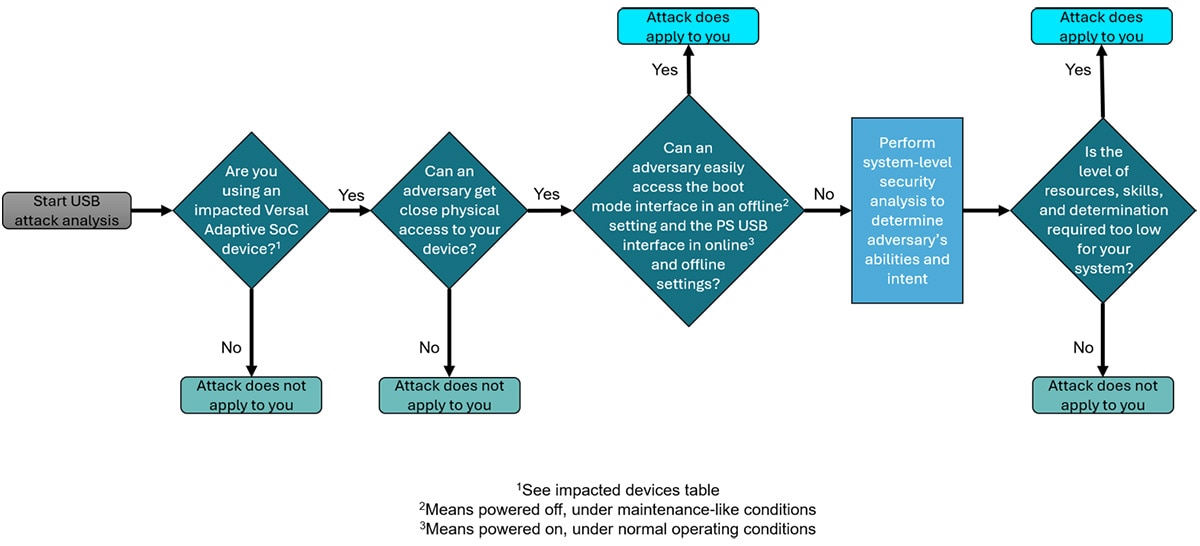
Figure 1 is a high-level summary that can be used to determine whether the attack applies to a system.
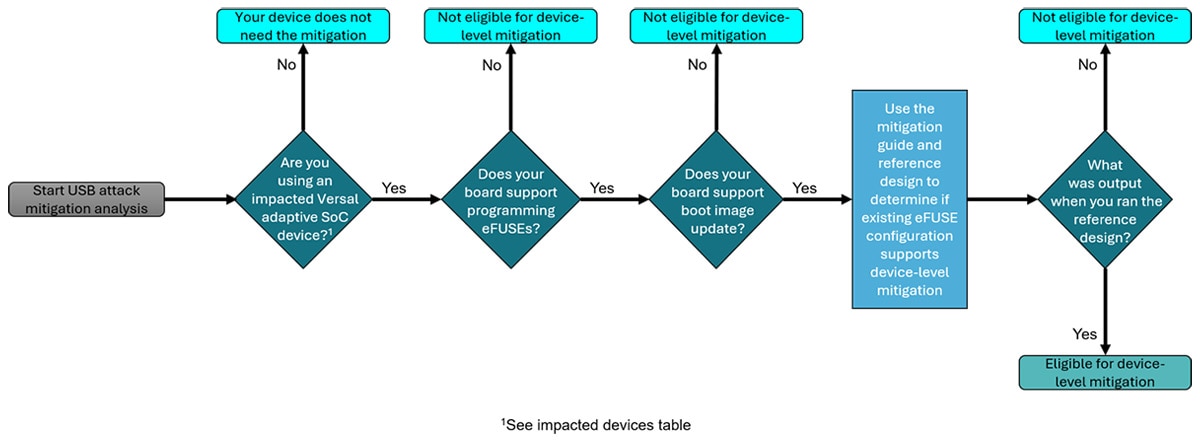
AMD has a device-level mitigation that can be applied in some circumstances when the attack applies to a system. The device-level mitigation uses the built-in self repair and halt on boot error functionalities to effectively disable the USB boot mode.
Figure 2 can be used to determine whether the device is eligible for the AMD device-level mitigation.
Both USB_Vulnerability_Mitigation_Guide.pptx and usb_vuln_mitigation.zip can be used to:
- Determine whether a device’s eFUSEs support the device-level mitigation
- Apply the device-level mitigation to a device whose eFUSEs support it
- Configure an application to run on a device with the device-level mitigation in place
- Determine system-level mitigations when device-level mitigation is not possible
For access to these items, please contact your AMD FAE.
To order parts that are eligible for mitigation and have the mitigation already performed, use SCD 5849.
Acknowledgement
This issue was discovered internally by AMD.
Revisions
| Revision Date | Description |
| 2026-10-06 | Added reference information to order parts that include the mitigation. |
| 2026-09-24 | Initial version |
DISCLAIMER
The information contained herein is for informational purposes only and is subject to change without notice. While every precaution has been taken in the preparation of this document, it may contain technical inaccuracies, omissions and typographical errors, and AMD is under no obligation to update or otherwise correct this information. Advanced Micro Devices, Inc. makes no representations or warranties with respect to the accuracy or completeness of the contents of this document, and assumes no liability of any kind, including the implied warranties of noninfringement, merchantability or fitness for particular purposes, with respect to the operation or use of AMD hardware, software or other products described herein. Any computer system has risks of security vulnerabilities that cannot be completely prevented or mitigated. No license, including implied or arising by estoppel, to any intellectual property rights is granted by this document. Terms and limitations applicable to the purchase or use of AMD's products are as set forth in a signed agreement between the parties or in AMD's Standard Terms and Conditions of Sale.
AMD, the AMD Arrow logo, Versal, and combinations thereof are trademarks of Advanced Micro Devices, Inc. CVE is a trademark of The MITRE Corporation. Other product names used in this publication are for identification purposes only and may be trademarks of their respective companies.
Third party content may be licensed to you directly by the third party that owns the content and is not licensed to you by AMD. ALL LINKED THIRD-PARTY CONTENT IS PROVIDED 'AS IS' WITHOUT A WARRANTY OF ANY KIND. USE OF SUCH THIRD-PARTY CONTENT IS DONE AT YOUR SOLE DISCRETION AND UNDER NO CIRCUMSTANCES WILL AMD BE LIABLE TO YOU FOR ANY THIRD PARTY CONTENT. YOU ASSUME ALL RISK AND ARE SOLELY RESPONSIBILITY FOR ANY DAMAGES THAT MAY ARISE FROM YOUR USE OF THIRD-PARTY CONTENT.
© 2026 Advanced Micro Devices, Inc. All rights reserved.