Evaluating AI and its Impact on the Modern Road Warrior
Dec 23, 2025

The arrival of artificial intelligence has electrified businesses like few tech breakthroughs before it. Companies are rapidly moving from proof-of-concept tests and limited rollouts to fleet-wide deployments and formal evaluations, with an eye towards measuring how AI improves productivity and lifts the bottom line.
AMD has partnered with the analyst firm Signal65 to better understand how artificial intelligence is likely to shape the future of work and where current AI tools most reliably boost productivity. Rather than focusing the conversation on product speeds, feeds, or performance ratings, we've created representative business personas and measured AI-accelerated time savings in a suite of tasks intended to reflect the work people perform in real life. Our first article examined this question through the eyes of knowledge workers. Here, we examine the same question from the perspective of a highly mobile business professional -- a "road warrior", if you will.
This question is particularly pertinent to me. My role at AMD requires that I frequently travel to other countries and often rely on battery power when visiting other branches of the company. Airport charging stations aren’t always available (or reliable) and buses and cars tend to lack plugs. I’m keenly interested in how AI can improve my own work on the day-to-day, but I want tools I can count on when I’m on the road – without tanking my laptop’s battery life.
AI and the Modern, Mobile Businessperson
To better assess the potential benefits of AI, Signal65 created representative scenarios that reflect the software business professionals often use and the actions they perform. Then, it compared the time to complete various tasks both when using and not using AI. This evaluation framework encompasses both cloud-based and AI software running directly on a local device to more closely mimic the reality of current AI software, which often runs in a variety of locations depending on workload requirements and vendor preferences.
While many modern systems can run artificial intelligence workloads to some degree, there are advantages to adopting an AI PC. In addition to the latest CPU and GPU technology, AI PCs contain a specialized neural processing unit, or NPU. As its acronym implies, the NPU is designed for AI tasks and can often run them more efficiently than the CPU or GPU. Signal65's testing measured the performance of a Lenovo ThinkPad T14S Gen 6 equipped with an AMD RyzenTM AI 7 PRO 360 processor. Their list of tasks and associated AI tools is shown below:
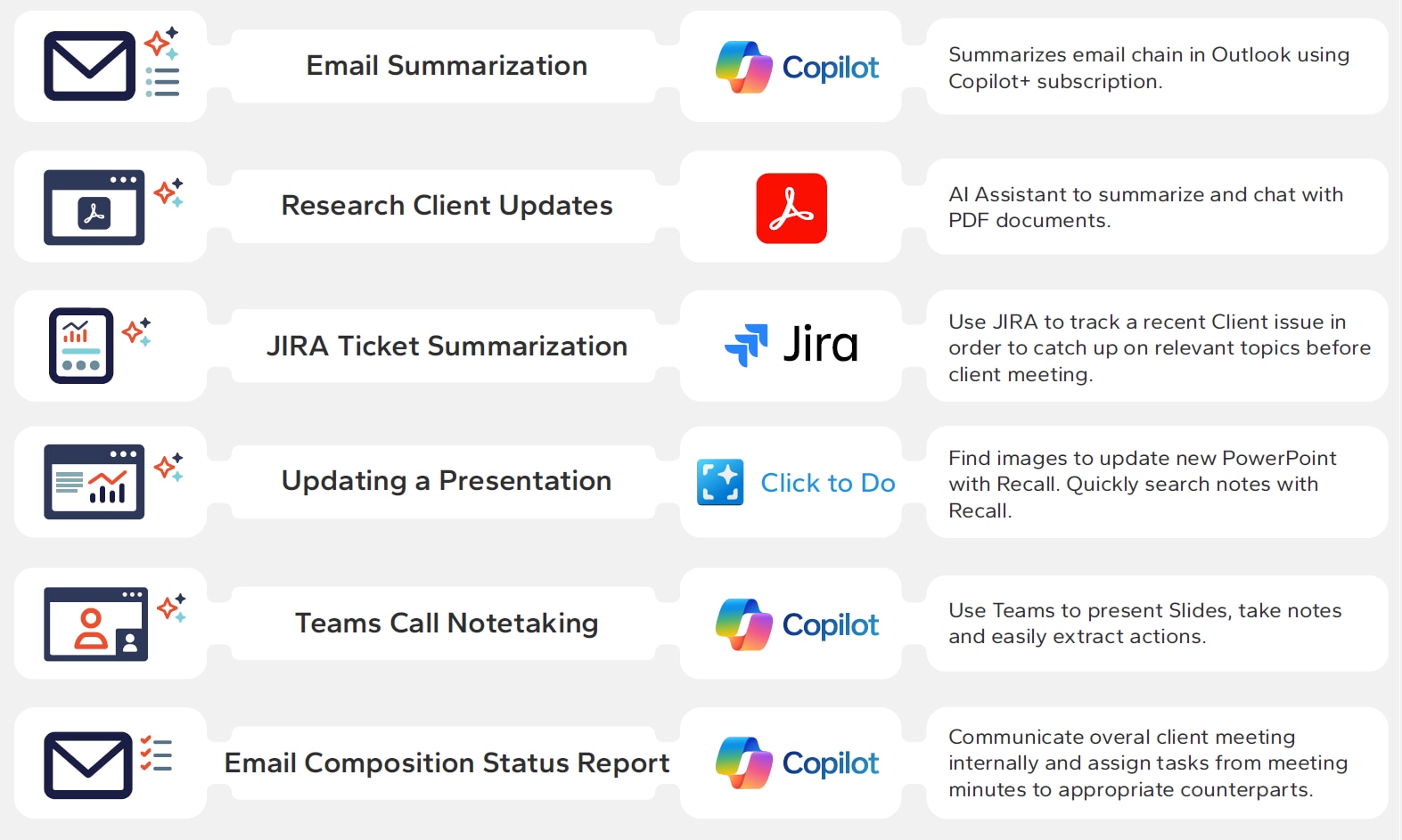
Road warriors are distinguished from office workers by the tasks they perform and how often they perform those tasks remotely. Highly mobile users need machines that perform well in every kind of environment and are assumed to prioritize battery life and mobile communication. While there is a degree of overlap between road warriors and office productivity workers, the differences between them are distinct enough to require a customized set of criteria when weighing the value of AI.
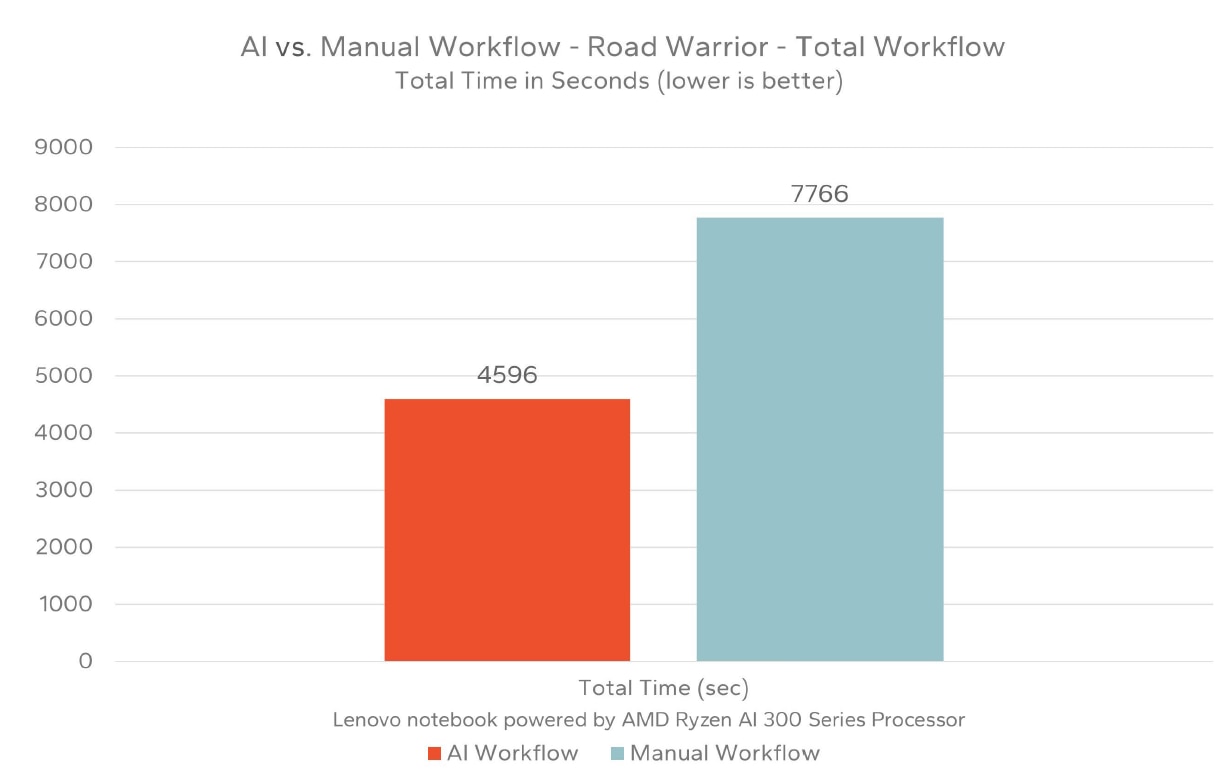
Signal65's testing found that its AI-enabled test suite took 4,596 seconds (76.6 minutes) to complete, compared to 7,766 seconds (129.4 minutes) when performing all tasks manually. This represents a time savings of approximately 41% and speaks to the advantages AI can deliver when it's comprehensively deployed across a range of workflows. As Signal65 points out, "If road warriors can save 1-2 hours daily through AI enhancement, a reasonable estimate based on our findings, this translates to 300+ hours annually per employee. That’s equivalent to 7 or more full work weeks of additional productive capacity without extending work hours or adding staff."
Client research updates account for the largest single reduction in total execution time. Taking advantage of Adobe Acrobat's built-in ability to summarize large PDFs as opposed to manually summarizing the document cut the required time from 1,068 seconds (17.8 minutes) to 59 seconds (<1 minute). That works out to a 94% reduction in time spent and represents a degree of acceleration even the fastest readers on Earth would struggle to match.
As impressive as these productivity gains are, reductions in time spent don't entirely capture the usefulness of AI and AI PCs for modern road warriors. Reducing how long repetitive tasks take can improve battery life by shrinking the hours business professionals spend attending to these aspects of their jobs. Streamlining content creation through Click to Do and using AI for content summarization can shave critical minutes off time-sensitive assignments while simultaneously making it easier to negotiate the hassles of travel via plane, train, or automobile. Generating client research updates more quickly allows those hours to be spent on new business acquisition or product development.
Successful AI adoptions require successful partners, and there are few companies in the world that can rival the level of investment and dedication AMD has poured into AI and AI PCs. From its launch of the first x86 CPU to feature an NPU in 2023 to its lineup of EPYCTM server CPUs and InstinctTM data center GPUs, AMD has prioritized extending the benefits of AI to more people and professionals. Its collaborations with independent software vendors (ISVs) like Adobe, Microsoft, Zoom, McAfee and partnerships with hardware OEMs like Dell, HP, and Lenovo are bedrock elements of an AI-enabled future that's expected to redefine what a PC is capable of. Laptops equipped with AMD Ryzen AI PRO processors also include the critical security, manageability, and business availability features of AMD PRO and the associated advantages this functionality provides.
Conclusion:
Any time new technology arrives, there's a certain understandable temptation to play a game of wait-and-see before moving to support or enable it. Where AI is concerned, this could be a significant unforced error. Many companies are already evaluating their first major fleet refreshes post-COVID, and the end of Windows 10 support makes it all the more important to move forward with such plans post-haste. Waiting to adopt AI and AI PCs could push company-wide availability out by years and slow the growth of employee proficiency and familiarity with AI-enabled products.
As Signal65 writes:
"Hardware refresh cycles should prioritize devices with integrated NPUs and modern GPUs capable of sustaining on-device AI acceleration. These capabilities are becoming essential as enterprise and productivity software increasingly rely on AI for summarization, automation, and security tasks. Organizations that wait risk deploying outdated systems that cannot fully leverage these tools... Companies that enable AI-enhanced mobility now are not just optimizing efficiency, they’re building the foundation for a workforce that can act faster, communicate clearly, and adapt from anywhere."
Don't think of artificial intelligence as a capstone to be set atop an existing business structure and declared good, but as a cornerstone of future business success. Just as there are companies today who trace their current market dominance back to early decisions to embrace the internet or to bet on the long-term popularity of mobile phones, there will eventually be companies who point back to their decision to prioritize AI as the moment when they stopped being also-rans in a crowded field and began the journey that established them as household names. Signal65's data demonstrates that the productivity improvements of AI are real and available to any company that wants to take advantage of them, right now, today. The only question is which firms will take steps to turn potential profits into fiscal reality -- and which will not.

Related Blogs
-
NeuroSpark Expands AI Compute Choice with AMD
NeuroSpark uses AMD Instinct GPUs and ROCm software on OCI to deliver flexible, cost-effective AI training and inference
October 23, 2026
-
Sovereign AI for European Customer Conversations
LeadDesk, QuTwo, and AMD Silo AI collaborate on a sovereign AI stack that brings near-frontier, open-weight models to European customer conversations.
October 22, 2026
-
AMD and Advantech - Architecting the Next Generation of Regulated Casino Games
Discover how Advantech and AMD are redefining regulated casino gaming with Ryzen Embedded 8000 Series processors, integrated RDNA 3 graphics, XDNA AI acceleration, and purpose-built DPX platforms. The solution enables immersive multi-screen experiences, predictive maintenance, stronger security, lower power consumption, simplified designs, and long-term platform availability for gaming OEMs worldwide.
October 21, 2026
-
Micro-World 2: Streaming Real-time Interactive World Model — ROCm Blogs
This blog demonstrates how Micro-World 2 combines precisely annotated action data, four-step diffusion distillation, and ROCm-optimized inference to deliver controllable, long-horizon, real-time world generation on a single AMD Instinct GPU through a fully open-source pipeline.
October 20, 2026
-
MoE Training Optimization with Primus — ROCm Blogs
Learn how to speed up MoE training on AMD Instinct GPUs with Primus: a fused MoE megakernel, FP8/MXFP8 expert GEMMs, and training-at-scale tuning.
October 20, 2026
-
Optimizing World Action Models on AMD GPUs — ROCm Blogs
Speed up World Action Models on AMD GPUs with GEAK kernels, fewer denoising steps, and latent actions, cutting FastWAM latency 25× at about 97 percent success.
October 20, 2026
-
Bringing Ultra-Fast, Interactive LLM Inference to AMD Instinct™ MI355X GPUs — ROCm Blogs
Accelerate single-request LLM inference on AMD Instinct MI355X with megakernels, speculative decoding, and MXFP4 for 1.9-3.3x faster decode.
October 19, 2026
-
hipCIM 26.06: GPU-Accelerated Whole-Slide Image I/O on AMD Instinct™ GPUs — ROCm Blogs
In this blog you will see how hipCIM 26.06 reads whole-slide images on AMD Instinct™ GPUs, and how fast and faithfully it decodes them.
October 19, 2026