How AI Can Help Tech Experts Save Several Days Per Week
Dec 22, 2025
Software engineers and technical experts don’t typically pick their chosen fields because they want to spend significant amounts of time summarizing email threads, cleaning up and distributing meeting notes, or sorting through Jira tickets. Unfortunately, plenty of development hours disappear into these types of work in the long run. This type of administrative overhead may keep projects moving, but it adds very little technical value. AI promises to relieve the tedium of such responsibilities, but it isn’t always easy for employers to evaluate its practical benefits and real-world productivity gains.
In a previous blog, we examined AI through office-based knowledge workers defined as on-the-go business professionals who prize mobility and battery life. Today, I’ll explore the issue from the perspective of technical experts and software developers.
Out of all the personas we've discussed thus far, tech experts arguably have the closest ringside seats to view and judge the rollout of artificial intelligence. The use of AI for coding has grown explosively since the first tools rolled out several years ago. Github Copilot (Microsoft), Claude for Coding (Anthropic), and Cursor are just a few of the software packages available, and their rapid adoption has even given rise to a new phrase -- "vibe coding" -- to describe cooperative, AI-assisted code development.
There's a lot of curiosity and buzz in the computer industry about what these tools can do and how quickly they can do it. At AMD, I’ve overseen efforts to deploy AI for multiple use cases, including technical document drafting and review, creating standardized scripts for data engineering, and boosting productivity in more generalized tasks. We are now writing nearly a third of our code with AI assistance, enabling faster development cycles and more consistent output. In parallel, we’ve established structured knowledge-transfer processes and requirement-documentation workflows that ensure AI-generated work can be scaled, audited, and reused across teams. We are also actively testing LLM-based models on PC-based platforms before deploying them in cloud environments, using a “test and learn” approach to optimize cost, performance, and reliability. A recent analysis by Principled Technologies (PT) evaluated AI’s ability to accelerate many of these initiatives, both for tech experts in general and software developers in particular, further validating our results and strategic direction.
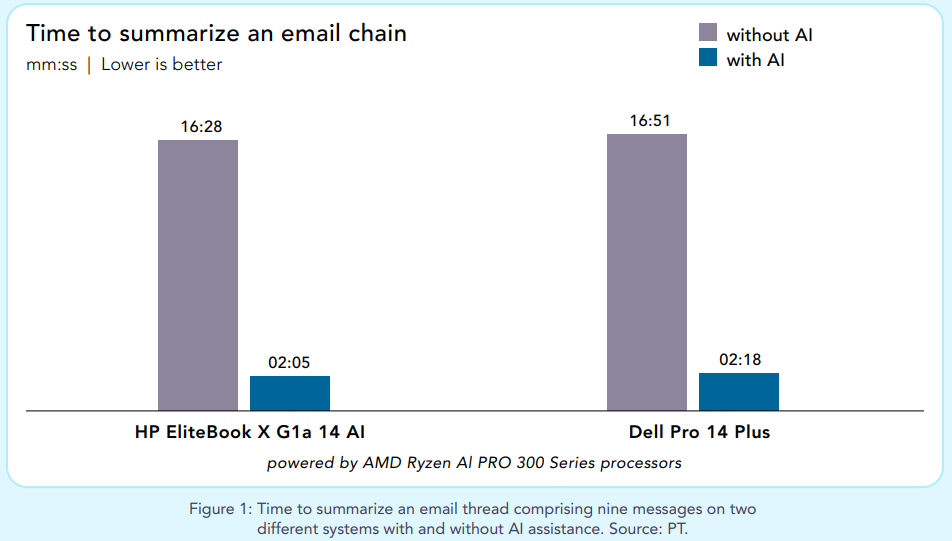
To calculate artificial intelligence's productivity enhancements, Principled Technologies compared task execution time for new, AI-enhanced activities against older, pre-AI methods of performing the same assignment. Two systems were tested: An HP EliteBook X G1a 14, featuring an AMD RyzenTM AI 9 HX 370 processor and a Dell Pro 14 Plus equipped with a Ryzen AI 7 PRO 350 processor. Both of these systems are optimized for emerging AI workloads thanks to the 50 TOPS neural processing unit (NPU) AMD includes as a standard feature on all Ryzen AI 300 Series CPUs. AMD led the x86 market when it introduced the first AI PC processor with a 10 TOPS NPU at CES 2023 and has pushed AI PC adoption forward by deploying a much more powerful neural processor across a wide range of products and a variety of price points.
Principled Technologies measured the usefulness of AI in a disparate range of scenarios, including email thread synopsis, video conference note-taking, Jira ticket summarization, application development, as well as document drafting and review. The advantage of using AI is different depending on the deliverable, but all of Principled Technologies' comparisons showed improvements.
In most contexts, the productivity-enhancing capabilities of AI are readily apparent. Principled Technologies claims an 86.8% reduction in time spent on email thread distillation, a 74.2% AI-assisted advantage in Jira ticket summarization, an 82% drop in predefined application development time, and 41% faster creation when drafting and reviewing reference documents.
There's one outlier within these results. In Principled Technologies' note-taking scenario, AI only boosted performance by roughly 6.5% compared to non-AI approaches. That's a relatively modest shift compared to the other tests, but shortening the time spent on any given job isn't the only way to measure the value of artificial intelligence. There's an additional benefit to using AI in this situation that a wall-clock comparison can't track.
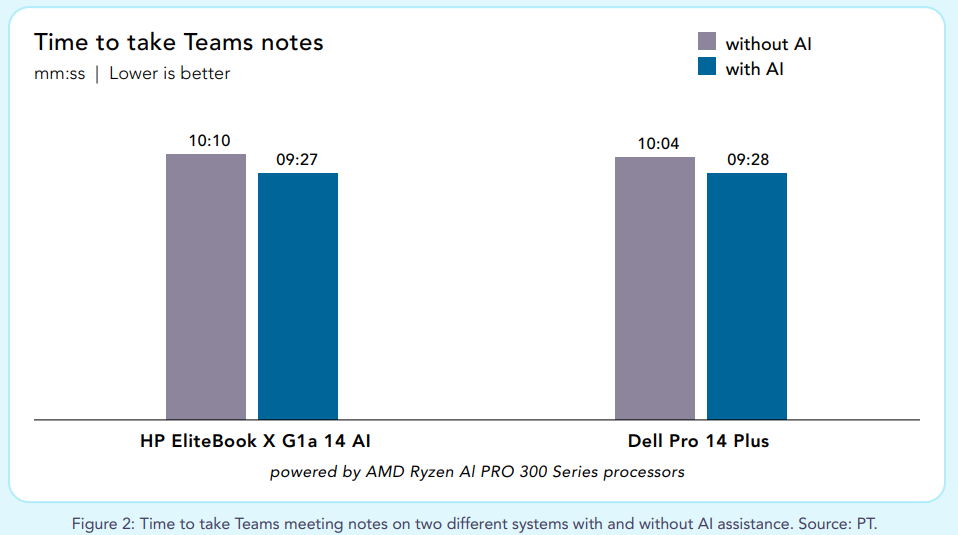
Offloading note-taking and meeting summarization to an AI allows the employees who formerly handled this necessary assignment to focus entirely on the gathering rather than tracking a multi-person conversation while attempting to make meaningful contributions of their own. Research has generally shown that multi-tasking can create inefficiency as people struggle to switch between different work contexts. A simple graph of time elapsed can't capture the reduced cognitive load and commensurately reduced stress of focusing on fewer tasks simultaneously.
The value of AI is particularly clear if one compares manual vs. AI-enhanced approaches over an entire week. Principled Technologies weights total weekly time savings with an estimate of how often a test is performed. A tech expert might summarize Jira tickets or create new documentation multiple times in a single week while authoring a new application only once every few months.
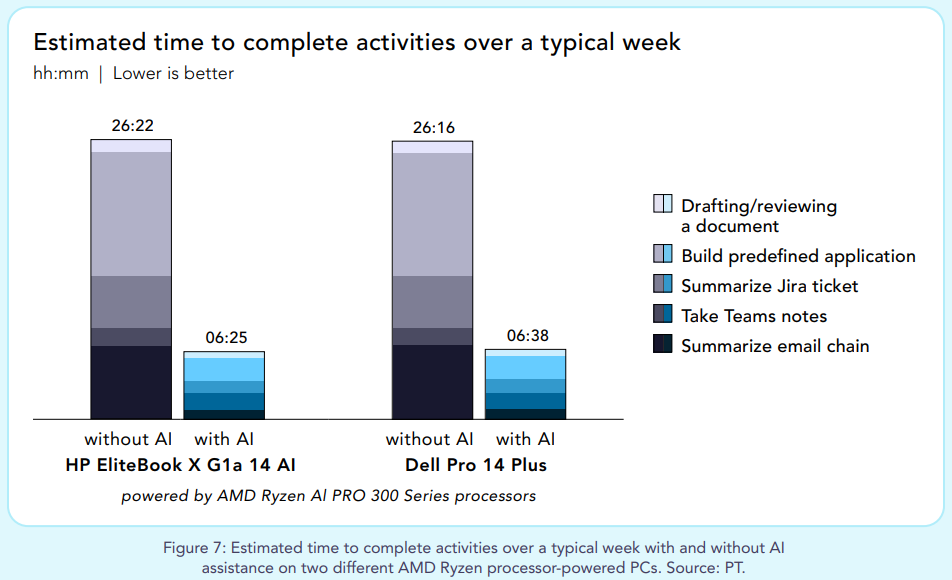
In total, PT reports employees could save over 19 hours -- more than two workdays -- per week. Software developers and other tech experts can dedicate that time to solving thornier problems or implementing new software features rather than spending time writing straightforward, boilerplate functions that provide critical functionality but precious little in the way of an intellectual challenge.
Vibe coding offers both amateur and professional programmers an AI assistant that can pilot new ideas or develop entire apps in a fraction of the time it might otherwise take. Other tech experts in different roles can still benefit from AI’s ability to simplify multi-tasking and accelerate rote, repetitive, responsibilities. PT’s findings suggest that AI already offers advantages today and that these advantages are likely to grow in the future as AI IDE (Integrated Development Environment) software packages mature and new, AI-enhanced software is brought to market.
AI doesn’t just fire the imagination because of its productivity-boosting potential, though that surely plays a part. Artificial intelligence is exciting because it attempts to improve both productivity and employee well-being, allowing tech experts to focus on the aspects of their work that inspired their career paths and long-term goals. Principled Technologies’ message is straightforward. An AI PC powered by Ryzen AI is not a novelty. It’s a workstation designed around the way you actually work.

Related Blogs
-
Modern Security from Silicon to OS: Why SMBs Should Move Beyond Windows Server 2016
Windows Server 2016 support is ending. Modernize SMB and ROBO security with Windows Server 2025 and AMD EPYC 4005 CPUs.
August 17, 2026
-
Bring Claude Code On‑Prem with AMD Instinct GPUs — ROCm Blogs
Start running Claude Code securely with a self-hosted SGLang LLM on AMD Instinct MI355X GPUs.
August 16, 2026
-
Run Qwen 3.8 27B on AMD Ryzen™ AI Max Agentic PCs and Radeon ™ GPUs
Qwen3.8 27B arrives with Day 0 support on AMD Ryzen™ AI processors and Radeon™ graphics cards. Run the latest Qwen model locally with LM Studio on supported AMD hardware. Build and ship local AI applications with Lemonade and first-class AMD inference support.
August 14, 2026
-
Becoming a 10x Productivity Engineer
AMD explores how agentic AI and its partnership with Anthropic can help engineers work faster and build the next AI era.
August 13, 2026
-
Production-Ready MXFP4 Online Rotation with Fused Kernels on AMD Instinct™ MI355X — ROCm Blogs
Learn how fused Gluon (Triton) kernels cut MXFP4 online-rotation overhead to near-zero on AMD Instinct MI355X, making it production-ready.
August 12, 2026
-
Day 0 Support for Qwen 3 8 on AMD Instinct GPUs
AMD is excited to announce Day-0 support for Alibaba's latest Qwen 3.8 model family on AMD Instinct™ MI300X, MI325X, and MI355X GPUs. Developers can immediately deploy and evaluate Qwen 3.8 using the AMD ROCm™ software together with SGLang and vLLM.
August 12, 2026
-
Using ODC to Accelerate AMD SFT Training — ROCm Blogs
Learn how we ported ODC on-demand P2P communication to AMD Instinct MI300X to cut FSDP bubbles and speed up variable-length SFT training.
August 11, 2026
-
Run Meta Muse Glimmer 30B on AMD Ryzen™ AI Max Agentic PCs and Radeon ™ GPUs
Meta's Muse Glimmer 30B brings powerful local AI to AMD systems. Run locally on AMD Ryzen™ AI Max+ agentic pcs or Radeon™ AI PRO R9700 graphics cards. Explore with LM Studio, build with Lemonade, and bring local AI into your apps.
August 10, 2026