Agentic AI Isn’t One Workload. It’s an End-to-End Workflow.
Jun 29, 2026

Much of the AI infrastructure conversation starts with an AI model running on GPUs. But in practice, AI infrastructure demands are increasingly determined by the workflow around the model.
Agentic AI systems do not simply answer a prompt. They interpret intent, retrieve context, plan next steps, call tools, apply policy, run sandbox code, execute transactions, observe outcomes and return a result.
Each step is a different workload, with all adding up to a varied workflow. Some demand high core density. Some benefit from high frequency and predictable latency. Others depend on memory capacity, I/O, data locality, power efficiency or the ability to host many concurrent services.
As agentic AI becomes more pervasive, infrastructure teams need more than a single compute profile. CIOs and enterprise decision-makers need a portfolio of CPUs matched to the full agentic workflow.
The AMD EPYC™ server CPU portfolio is ideally positioned to play those roles – not as a single CPU with a one-size-fits-all answer, but each as a unique part for agentic AI’s many workloads. (Learn more about CPU importance in agentic AI in my earlier blog, Agentic AI Changes the CPU/GPU Equation.)
Inside the Agentic AI Workflow
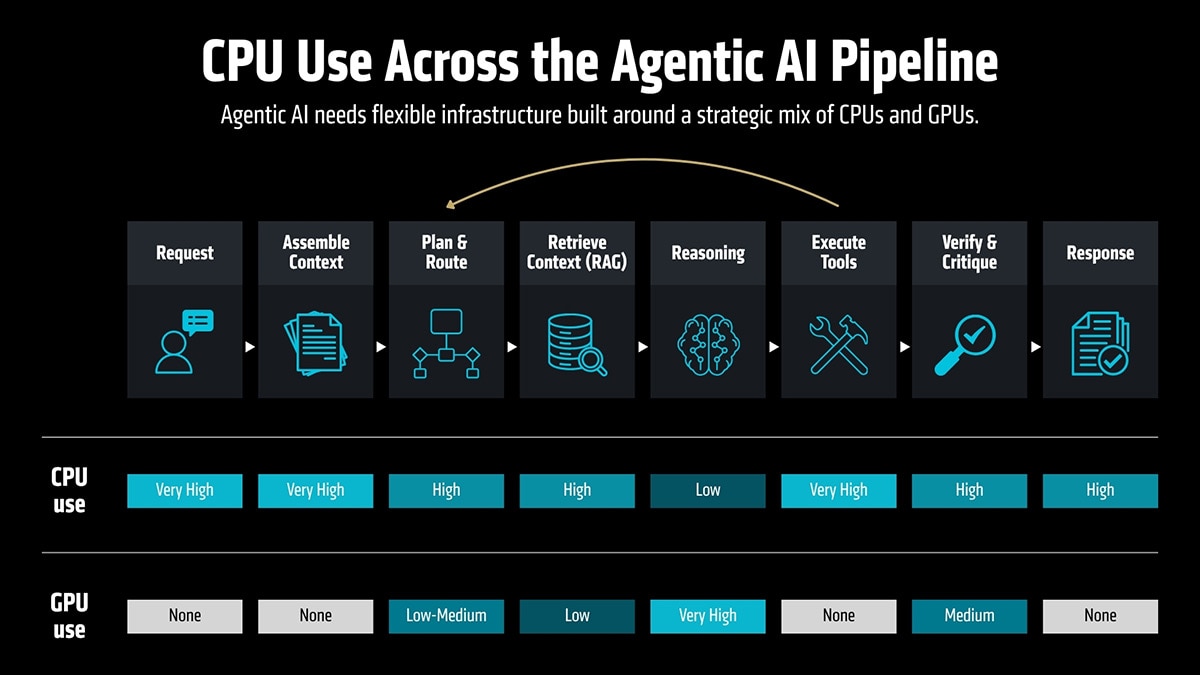
When an agent takes on a task, it breaks the goal into steps and works through them, often looping back multiple times before finishing. In a typical sequence, the request hits a gateway where policies are enforced. A planning layer – often running smaller AI models – determines how to route the task. The agent then queries databases, invokes a GPU cluster for deeper reasoning, executes tools based on that reasoning, verifies the output and decides whether to loop again or exit.
This explains why agentic AI should be viewed as an end-to-end workflow, not as a single workload. The right infrastructure strategy starts by mapping each workflow and then assigning the right CPU resources to it.
AMD focuses on every step along the workflow: EPYC CPUs for high-frequency and high-density compute, AMD Instinct™ accelerators for AI inference and training, and Pensando™ networking to help move data predictably.
Where Latency Matters, Where Throughput Wins – and Where You Need Both
Each stage of the workflow has different needs, which is why we built the AMD EPYC portfolio around a mix of profiles.
- Agentic orchestration, sandbox execution, tool calls: When you need many agents simultaneously running sandbox code (e.g., Python), calling APIs or querying databases, core density can matter more than clock speed. Our 5th Gen AMD EPYC™ server CPUs offer up to 192 cores and 384 threads with simultaneous multithreading. Later this year, our next-generation EPYC processors, codenamed “Venice,” will push that to 256 cores and 512 threads.
- Tool execution on enterprise applications: The ability to call the tools or enterprise applications makes agents useful. CPUs with a broad set of core counts combined with high performance handle the volume and variety of incoming requests. The AMD EPYC™ 9005 family of processors delivers on this balance with 8 to 192 cores and up to 640GB/s of memory bandwidth, with “Venice” extending core/thread count by 1.3x and memory bandwidth by 2.5x.
- Reasoning with inference: To provide the intelligence agents need to get work done, they rely on inference. Large language models predominantly run on GPUs with a host CPU keeping the GPUs fully utilized. To keep accelerators busy, host-node CPUs often benefit from strong per-core performance, high-frequencies and the right balance of cores (sometimes fewer are needed than you might think), memory bandwidth, I/O and networking. The correct mix in the host-node CPU can keep GPU clusters fed with instructions so each cluster delivers as many tokens as possible. The AMD EPYC™ 9575F processor delivers on this high single-core performance with 64 cores capable of running at up to 5Ghz. “Venice” will further extend EPYC CPUs’ high-frequency offerings.
The Legacy Challenge
In conversations with enterprise customers, a couple of patterns stand out.
First, many standardize their CPU infrastructure purchases around legacy specifications, such as using 16- and 32-core CPUs. Agentic workflows need higher core counts for some agentic stages, higher frequencies for others – and customers need the flexibility to configure for both. The mindset should shift from a single CPU standard to a portfolio matched to the agentic workflow.
Second, there’s a multiplier effect on enterprise applications and inference servers that comes as agents become greater users of existing IT infrastructure. Once you give employees the ability to build and deploy their own agents, agentic adoption grows rapidly. IT planning teams should ask what happens to their infrastructure – examples include databases; platforms for enterprise resource planning and customer relationship management, business intelligence, identity management; and inference servers – when agents dramatically increase usage.
The Question for CIOs
Agentic AI is changing how enterprises size their infrastructure. IT leaders who treat it as a monolithic problem – one GPU strategy or a one-size-fits-all CPU – will likely hit challenges. But as agents proliferate, those who plan for a diverse end-to-end workflow with different compute needs at each stage can scale more efficiently.
The question worth asking isn’t how many CPUs or GPUs your business needs for agentic AI. It’s whether you’re matching infrastructure to the way agentic AI works with its many stages across workloads. If you map those stages early and choose the right compute profile for each, your business will be well positioned for speed and efficiency as they scale.



Related Blogs
-
How Agentic AI Is Expanding the Role of the DPU
As agentic AI drives more stateful workloads, DPUs are becoming critical for networking, storage, KV-cache management, and infrastructure efficiency.
October 05, 2026
-
MoRI UMBP Empowers AMD Instinct GPUs
See how UMBP, MoRI and SGLang optimize KV cache reuse to boost AMD Instinct™ MI355X GPU agentic AI performance and cost efficiency
October 01, 2026
-
Automating Performance Bottleneck Identification with the TraceLens Agent — ROCm Blogs
TraceLens Agent is an agentic workflow that examines GPU traces to deliver a prioritized optimization report, detailing root causes and fixes.
September 29, 2026
-
MORI CCO
MORI CCO enables compute-communication overlap on AMD Instinct™ GPUs. Build faster distributed inference and training kernels with device-side communication.
September 29, 2026
-
Unlocking Sim2Real for a Robotic Arm with RL Accelerated by AMD Instinct GPUs — ROCm Blogs
Train an XArm-6 pick-and-lift policy with PPO in MuJoCo Warp on AMD Instinct GPUs, then transfer it to the real robot.
September 28, 2026
-
How AMD Ryzen AI Max PRO 400 Series Processors Bring Local Agentic AI to Business Customers
See how AMD Ryzen AI Max PRO 400 Series processors bring local agentic AI to business with more memory, flexible deployment, and lower costs.
September 28, 2026
-
UltraQuant on AMD Instinct: More Efficient Agentic Serving for Qwen3.8-MXFP4 — ROCm Blogs
A native 4-bit MXFP4 KV cache that speeds up Qwen3.8 decode over 8-bit KV on AMD Instinct MI355X, with no accuracy loss.
September 24, 2026
-
Local Quantization and Multi-Backend Deployment with AMD Quark on Strix Halo — ROCm Blogs
Quantize a 35B MoE model directly on AMD Strix Halo with AMD Quark, export to GGUF and safetensors, validate with llama.cpp and vLLM, and deploy through Lemonade.
September 24, 2026