Designed for the Agentic Era: AMD Ryzen™ AI Halo Delivers up to 34% Faster Agent Orchestration with Local Inference
Aug 03, 2026
Agent adoption is exploding and in most cases agents run inference in the cloud. The implications are clear: rising Cloud API costs, sensitive data leaves the device, and the workflow only runs when connected to the network. Running inference locally flips the equation: no per-token cloud cost, data that never leaves the machine, offline and low-latency operation, and full control over the model and the agent. The question is: Can you actually run a realistic agentic workload locally.
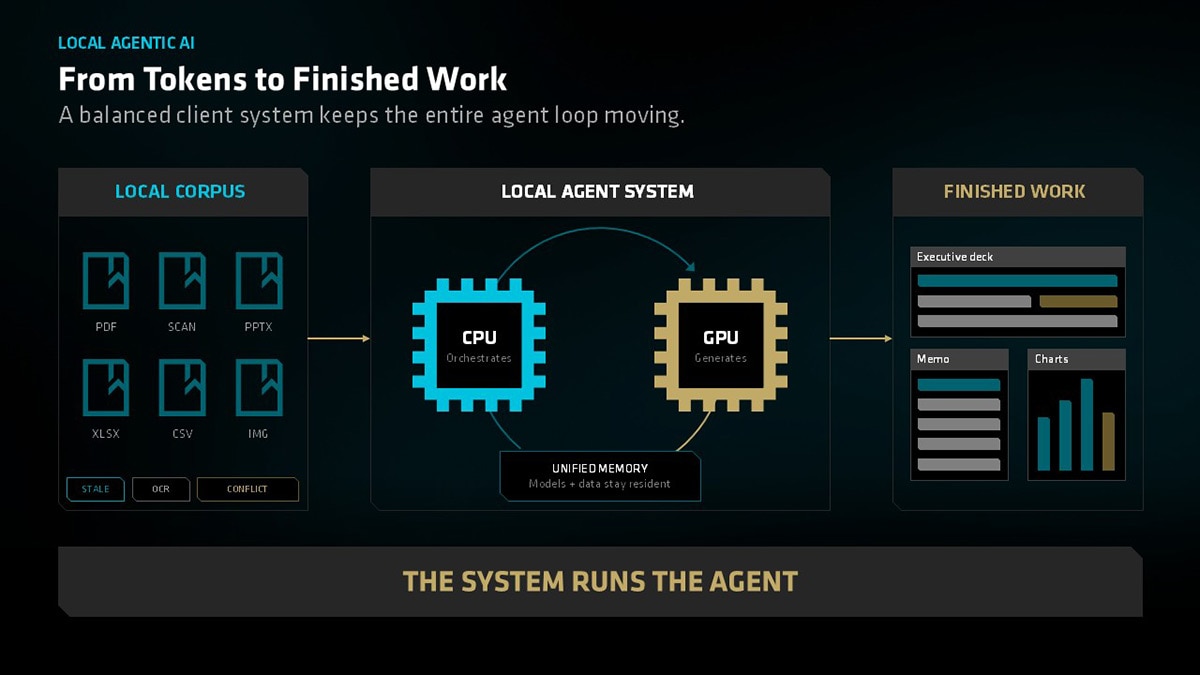
Previously, we showed that even when inference runs in the cloud, the most important upgrade might be the CPU in your system because the agent loop (planning, routing, moving data, assembling results) is orchestration, and orchestration is CPU work that runs locally no matter where the tokens are generated. Here, we complete the story for on-device inference. When the whole agent runs locally, the chat-era instinct is to ask which system has the better GPU. But agent workflows aren’t one large matrix multiply; it’s a pipeline of orchestration and inference that can include parse, OCR, chunk, embed, retrieve, generate, validate and most of those stages do not use the GPU. Workflows shaped like that are won by a balanced system, not just the biggest accelerator.
The metrics changed and that changes everything
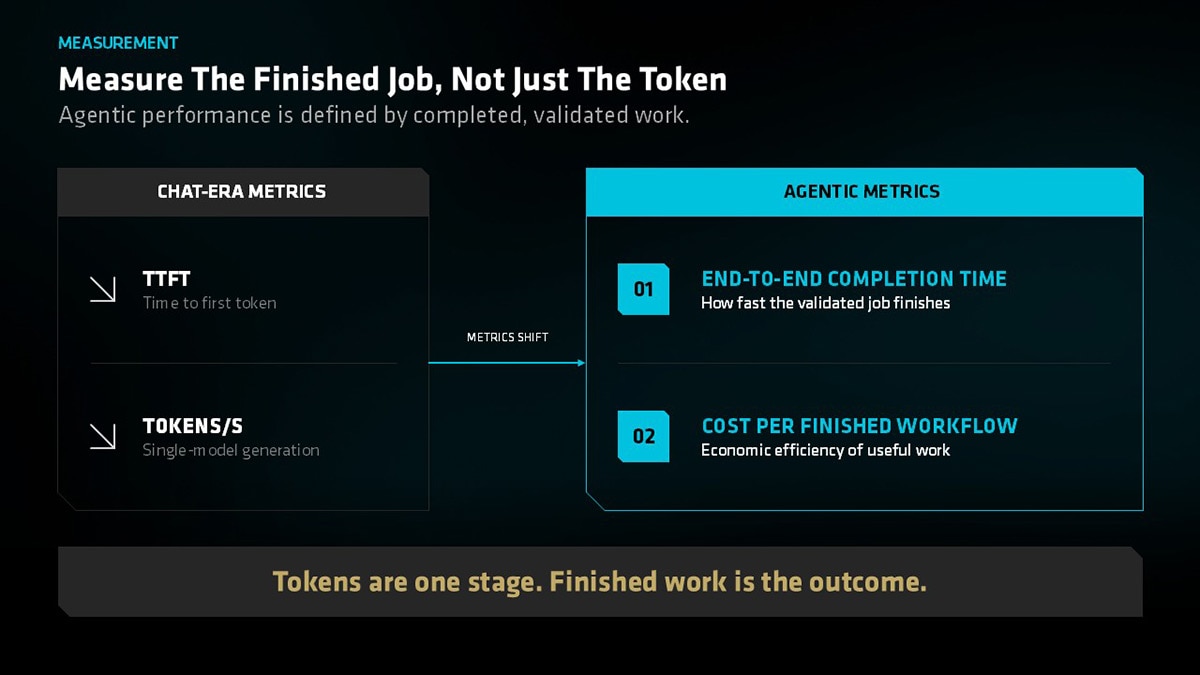
The chat era optimized two GPU-generation metrics: time-to-first token and tokens per second. Both describe how fast one model streams one response. Agents are evaluated differently — on completed, validated work so the KPIs shift to end-to-end completion time and cost per completed workflow. Token generation is only one stage of the workflow. Orchestrating involves preparing documents, embedding and retrieving evidence, moving data between engines, and validating output which can consume a significant amount of the end-to-end workflow completion time. High tokens per second on inference alone tells you very little about how fast the job actually finished, or what it cost. The bottom line is token generation and CPU orchestration are both stages of the pipeline but end –to-end completion time becomes the more meaningful metric for agentic workflows.
A realistic workload, measured end-to-end
To test this accurately, we created HEPA, the Hermes Executive Presentation Agent, which tasks a local agent with producing a board-ready executive presentation, a supporting memo, charts, and a cited source appendix, built from a fixed local dataset that represents a large shared team drive. HEPA measures end-to-end local agent performance on a realistic enterprise knowledge-worker workflow. The dataset is varied: relevant files mixed with redundant, old, and conflicting material, plus scanned and image-derived sources that require real OCR. The agent has to read that dataset, OCR the scanned inputs, chunk and embed everything, retrieve a bounded evidence pack, generate the deliverables, and pass deterministic quality gates. Then, it’s scored on finished, quality-gated work, not isolated model throughput.
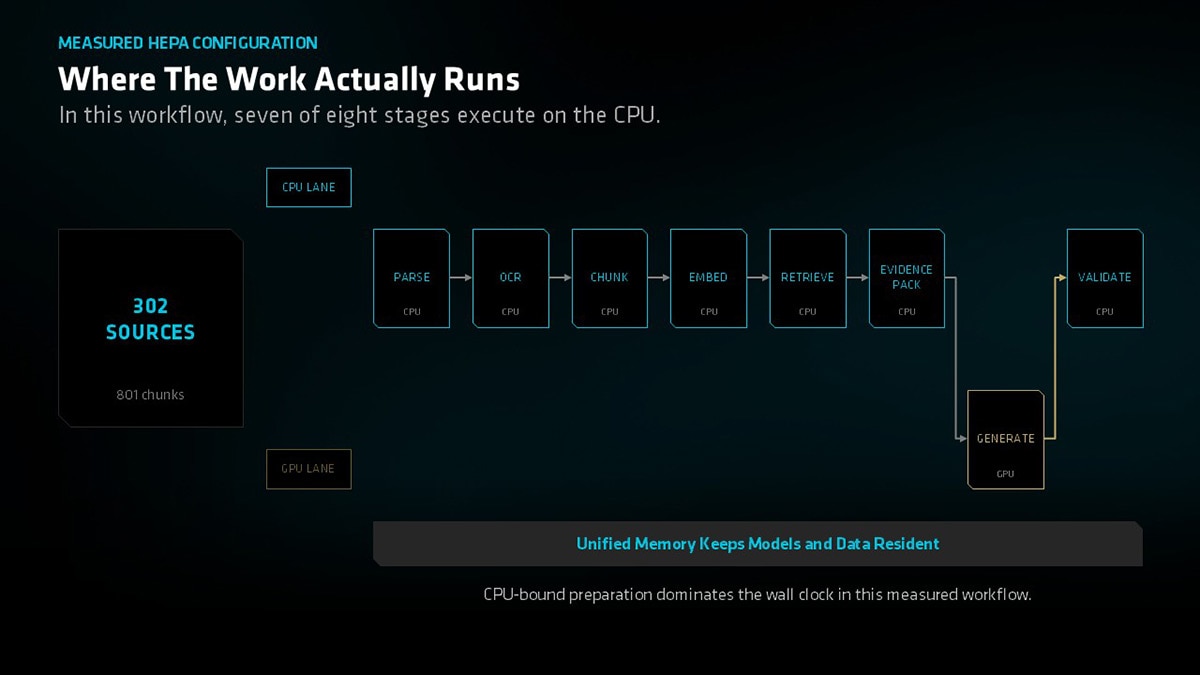
The measured setup: 302 local sources / 801 prepared chunks; orchestrator Qwen3.6-35B-A3B (mixture-of-experts, ~3B active, 4-bit) served via llama.cpp; FastEmbed ONNX nomic-embed-text-v1.5 embeddings and real Tesseract OCR both on the CPU; identical corpus, model, and settings on both machines; both platforms completed 5/5 valid runs and 25/25 deterministic checks. In this configuration, seven of the eight pipeline stages are executed on the CPU, while token generation runs on the GPU. (Full parameters in System Configurations below.)
The result: AMD finishes the job first and at lower cost
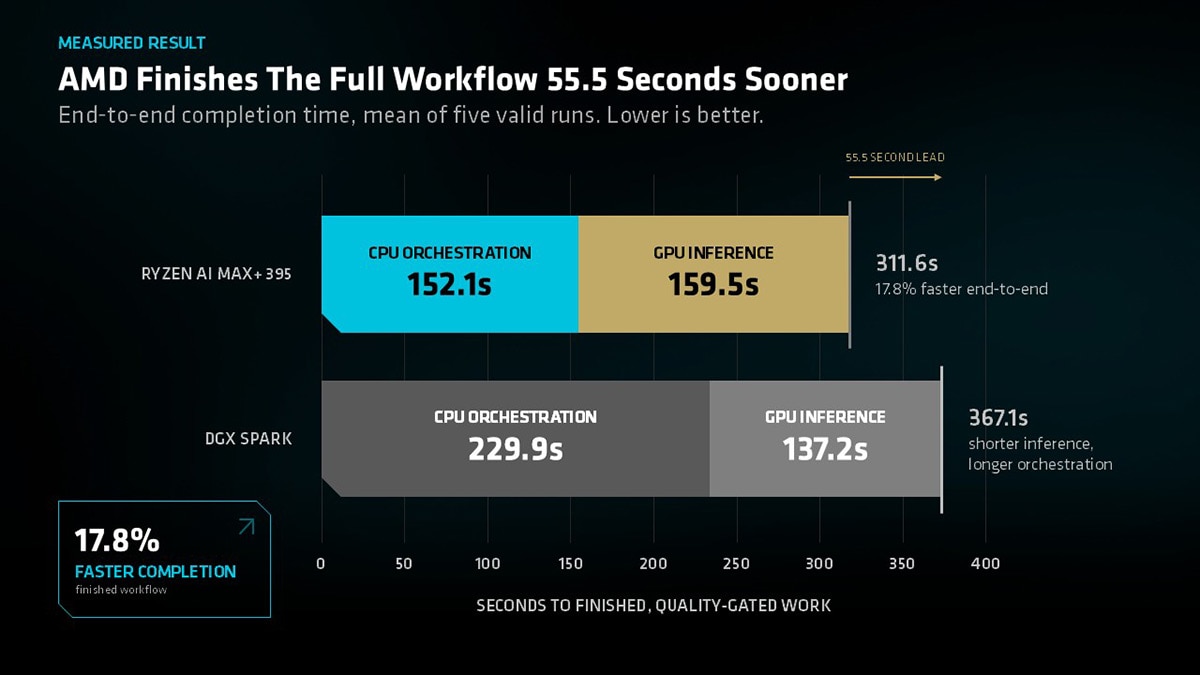
AMD Ryzen™ AI Halo power by the AMD Ryzen™ AI Max+ 395 processor was purpose-built for agentic workflows. Compared to the NVIDIA DGX Spark Grace Blackwell (GB10), both running Linux under the same five-run workflow, the AMD Ryzen™ AI Halo wins on end-to-end completion time, CPU orchestration, and cost per completed workflow.
AMD Ryzen™ AI Halo is 34% faster vs NVIDIA DGX Spark on CPU orchestration.1 AMD completes the CPU-side preparation in 152.1 s versus 229.9 s. The decisive component is embeddings and routing, which run on the CPU — AMD 71.5 s versus 139.6 s, a nearly 2× difference.
AMD Ryzen™ AI Halo completes the workflow 15% faster than NVIDA DGX Spark.2 AMD completes the validated workflow in 311.6 s versus 367.1 s for DGX Spark — 55.5 seconds faster. This is the headline agentic KPI: time to finished, quality-gated work.
AMD Ryzen™ AI Halo delivers a 27% lower cost per completed workflow vs NVIDIA DGX Spark.3 On a 3-year amortized hardware basis at continuous utilization (energy excluded), AMD runs about $0.0132 per workflow versus roughly $0.0182 for DGX — 27% less because it costs less to acquire and finishes more work in the same time.
Even though DGX Spark has an advantage on inference, it still loses the workflow because inference is only one stage, and the CPU-bound orchestration matters. The systems were optimally configured with the AMD system running llama.cpp on Vulkan while the NVIDIA system ran llama.cpp with CUDA and the AMD system conceded the inference stage, but it still completed the job first.
Why AMD wins the orchestration stage
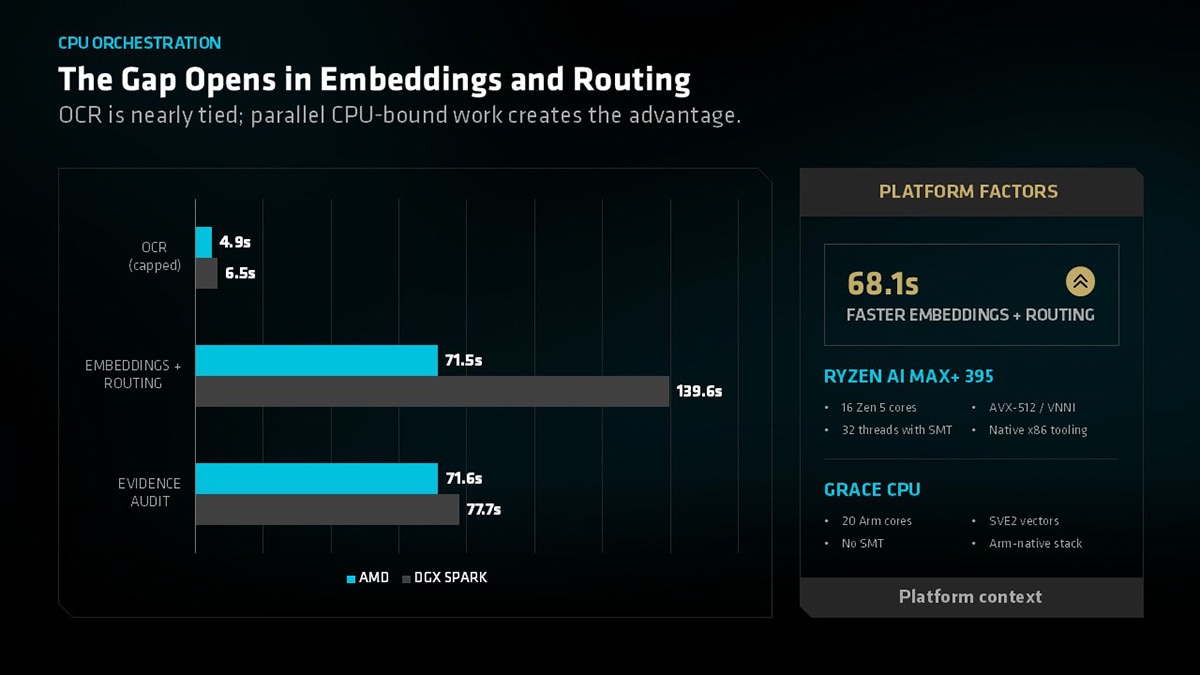
The advantage comes down to how the CPU-bound stages parallelize. Parsing, OCR (thread capped), embeddings, and routing are data-parallel work that scales with cores and threads and grows with the size of the dataset. The Ryzen™ AI Max+ 395 processor brings 16 “Zen 5” cores and 32 threads via SMT — 32 effective workers — plus AVX-512/VNNI vector acceleration and native x86 tooling for the document and retrieval stack. NVIDIA DGX Spark’s Grace Blackwell has 20 Arm cores with no SMT, and SVE2 rather than AVX-512. More threads and wider vectors mean more source files parsed, embedded, and routed at once — so the CPU-bound preparation that dominates an agent’s completion time simply runs faster.
One system, not one chip
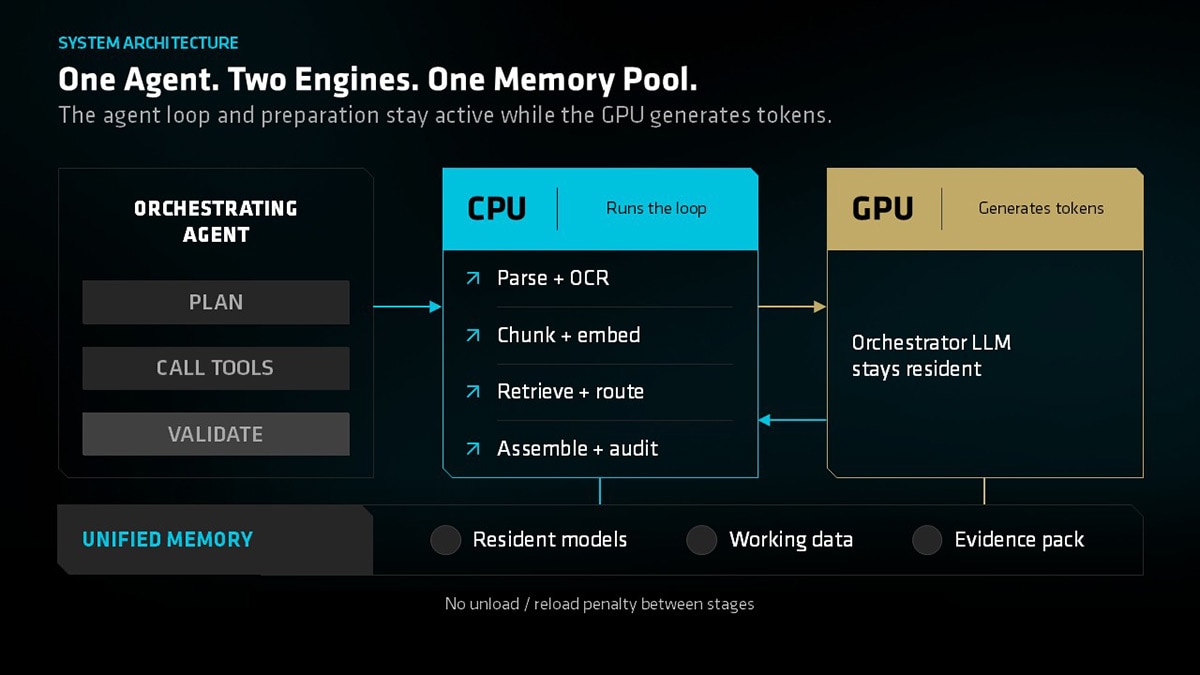
Under the hood it’s one orchestrating agent driving several resident models, with the work split across the system’s engines. The CPU runs the loop and the preparation stages — parsing 300+ sources, chunking, and running the embedding and routing model that decides what evidence matters. The GPU generates the tokens. And large unified memory keeps the models and data resident, so the hand-offs between them stay efficient — the capability that makes a full on-device model portfolio practical in the first place.
The chat era asked whose GPU was better. The agent era asks a better question: whose system finishes the workflow — fastest, and at lower cost? On device, the answer is a balanced system with CPU, GPU, and unified memory optimized for completion time and cost per workflow rather than tokens per second alone. AMD Ryzen™ AI Halo was optimized as a balanced system rather than simply maximizing GPU performance.
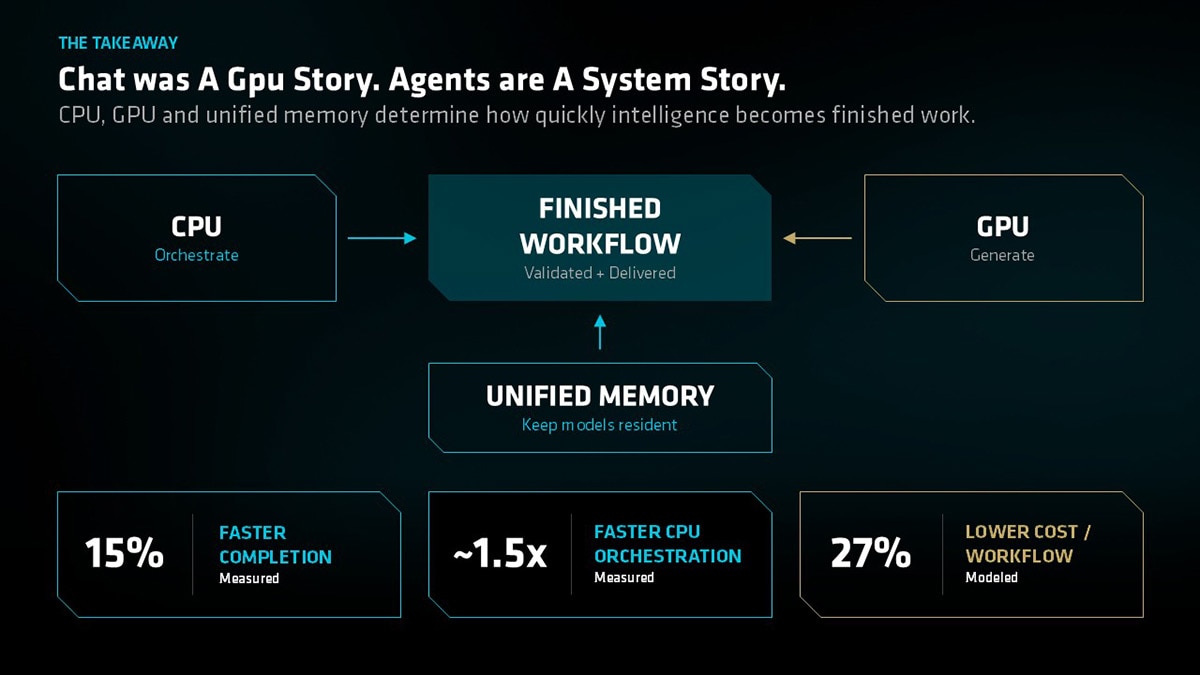
A system can win the token race and still lose the job. As on-device agents grow into full model portfolios — an orchestrator, an always-on small model, embedders, rerankers, OCR, speech, and image models — the balanced-system advantage compounds. Chat was a GPU story. Agents are a system story.
Footnotes
- Testing as of July 2026 by AMD on the following systems: (a) a Ryzen AI Halo developer box with Ryzen AI Max+ 395, 128GB LPDDR5-8G, Linux Debian 13, AMD Linux kernel/GPU driver 6.12.94+deb13-amd64; and (b) NVIDIA DGX Spark (GB10 with 20 Arm cores), 128GB LPDDR5-8.5G, Ubuntu aarch64 kernel 6.17.0-1018-nvidia, NVIDIA driver 580.159.03 / CUDA 13.0. Testing occurred on the following benchmark(s): Hermes Executive Presentation Agent (HEPA). HEPA is an AMD custom benchmark developed to represent a realistic agentic workflow and uses a local agent to read a fixed set of synthetic enterprise files representing a shared drive to create an executive level presentation. Benchmark. Testing compared completion time for CPU orchestration. System manufactures may vary configurations yielding different results. SHO-74.
- Testing as of July 2026 by AMD on the following systems: (a) a Ryzen AI Halo developer box with Ryzen AI Max+ 395, 128GB LPDDR5-8G, Linux Debian 13, AMD Linux kernel/GPU driver 6.12.94+deb13-amd64; and (b) NVIDIA DGX Spark (GB10 with 20 Arm cores), 128GB LPDDR5-8.5G, Ubuntu aarch64 kernel 6.17.0-1018-nvidia, NVIDIA driver 580.159.03 / CUDA 13.0. Testing occurred on the following benchmark(s): Hermes Executive Presentation Agent (HEPA). HEPA is an AMD custom benchmark developed to represent a realistic agentic workflow and uses a local agent to read a fixed set of synthetic enterprise files representing a shared drive to create an executive level presentation. Testing compared end to end completion time. Benchmark System manufactures may vary configurations yielding different results. SHO-75
- Testing as of July 2026 by AMD on a Ryzen AI Halo developer box with Ryzen AI Max+ 395 compared to NVIDIA DGX Spark (GB10 with 20 Arm cores). The cost of each system is as follows (i) AMD system $3999 from Microcenter; and (ii) NVIDIA system $4699 from NVIDIA marketplace. The term “completed workflow” refers to the time from start to validated output for 1 run of the Hermes Executive Presentation Agent (HEPA) benchmark. HEPA is an AMD custom benchmark developed to represent a realistic agentic workflow and uses a local agent to read a fixed set of synthetic enterprise files representing a shared drive to create an executive level presentation. Assumptions: 3 years. Cost per workflow equals the acquisition price divided by the 3yr seconds) / completion time in seconds. System manufactures may vary configurations yielding different results. SHO-76.
System Configuration: Ryzen AI Halo developer box with Ryzen AI Max+ 395 (16 cores / 32 threads); integrated Radeon™ GPU via a llama.cpp Linux Vulkan build (RADV GFX1151, --gpu-layers all, --threads 16, --threads-batch 32, --ctx-size 65536, --parallel 1), AMD Linux kernel GPU driver: 6.12.94+deb13-amd64, Linux Debian 13, 128GB LPDDR5-8G. Compared with NVIDIA DGX Spark (20 Arm cores, no SMT; 20 effective workers), Ubuntu aarch64 kernel 6.17.0-1018-nvidia, NVIDIA driver 580.159.03 / CUDA 13.0, llama-server v1 (9bebfcb) CUDA build (--gpu-layers all, --threads 20, --threads-batch 20, --parallel 1), Tesseract 5.3.4, Python 3.12.3, 128GB LPDDR5-8.5G.
Footnotes
- Testing as of July 2026 by AMD on the following systems: (a) a Ryzen AI Halo developer box with Ryzen AI Max+ 395, 128GB LPDDR5-8G, Linux Debian 13, AMD Linux kernel/GPU driver 6.12.94+deb13-amd64; and (b) NVIDIA DGX Spark (GB10 with 20 Arm cores), 128GB LPDDR5-8.5G, Ubuntu aarch64 kernel 6.17.0-1018-nvidia, NVIDIA driver 580.159.03 / CUDA 13.0. Testing occurred on the following benchmark(s): Hermes Executive Presentation Agent (HEPA). HEPA is an AMD custom benchmark developed to represent a realistic agentic workflow and uses a local agent to read a fixed set of synthetic enterprise files representing a shared drive to create an executive level presentation. Benchmark. Testing compared completion time for CPU orchestration. System manufactures may vary configurations yielding different results. SHO-74.
- Testing as of July 2026 by AMD on the following systems: (a) a Ryzen AI Halo developer box with Ryzen AI Max+ 395, 128GB LPDDR5-8G, Linux Debian 13, AMD Linux kernel/GPU driver 6.12.94+deb13-amd64; and (b) NVIDIA DGX Spark (GB10 with 20 Arm cores), 128GB LPDDR5-8.5G, Ubuntu aarch64 kernel 6.17.0-1018-nvidia, NVIDIA driver 580.159.03 / CUDA 13.0. Testing occurred on the following benchmark(s): Hermes Executive Presentation Agent (HEPA). HEPA is an AMD custom benchmark developed to represent a realistic agentic workflow and uses a local agent to read a fixed set of synthetic enterprise files representing a shared drive to create an executive level presentation. Testing compared end to end completion time. Benchmark System manufactures may vary configurations yielding different results. SHO-75
- Testing as of July 2026 by AMD on a Ryzen AI Halo developer box with Ryzen AI Max+ 395 compared to NVIDIA DGX Spark (GB10 with 20 Arm cores). The cost of each system is as follows (i) AMD system $3999 from Microcenter; and (ii) NVIDIA system $4699 from NVIDIA marketplace. The term “completed workflow” refers to the time from start to validated output for 1 run of the Hermes Executive Presentation Agent (HEPA) benchmark. HEPA is an AMD custom benchmark developed to represent a realistic agentic workflow and uses a local agent to read a fixed set of synthetic enterprise files representing a shared drive to create an executive level presentation. Assumptions: 3 years. Cost per workflow equals the acquisition price divided by the 3yr seconds) / completion time in seconds. System manufactures may vary configurations yielding different results. SHO-76.
System Configuration: Ryzen AI Halo developer box with Ryzen AI Max+ 395 (16 cores / 32 threads); integrated Radeon™ GPU via a llama.cpp Linux Vulkan build (RADV GFX1151, --gpu-layers all, --threads 16, --threads-batch 32, --ctx-size 65536, --parallel 1), AMD Linux kernel GPU driver: 6.12.94+deb13-amd64, Linux Debian 13, 128GB LPDDR5-8G. Compared with NVIDIA DGX Spark (20 Arm cores, no SMT; 20 effective workers), Ubuntu aarch64 kernel 6.17.0-1018-nvidia, NVIDIA driver 580.159.03 / CUDA 13.0, llama-server v1 (9bebfcb) CUDA build (--gpu-layers all, --threads 20, --threads-batch 20, --parallel 1), Tesseract 5.3.4, Python 3.12.3, 128GB LPDDR5-8.5G.

Related Blogs
-
NeuroSpark Expands AI Compute Choice with AMD
NeuroSpark uses AMD Instinct GPUs and ROCm software on OCI to deliver flexible, cost-effective AI training and inference
October 23, 2026
-
Sovereign AI for European Customer Conversations
LeadDesk, QuTwo, and AMD Silo AI collaborate on a sovereign AI stack that brings near-frontier, open-weight models to European customer conversations.
October 22, 2026
-
Micro-World 2: Streaming Real-time Interactive World Model — ROCm Blogs
This blog demonstrates how Micro-World 2 combines precisely annotated action data, four-step diffusion distillation, and ROCm-optimized inference to deliver controllable, long-horizon, real-time world generation on a single AMD Instinct GPU through a fully open-source pipeline.
October 20, 2026
-
MoE Training Optimization with Primus — ROCm Blogs
Learn how to speed up MoE training on AMD Instinct GPUs with Primus: a fused MoE megakernel, FP8/MXFP8 expert GEMMs, and training-at-scale tuning.
October 20, 2026
-
Optimizing World Action Models on AMD GPUs — ROCm Blogs
Speed up World Action Models on AMD GPUs with GEAK kernels, fewer denoising steps, and latent actions, cutting FastWAM latency 25× at about 97 percent success.
October 20, 2026
-
Bringing Ultra-Fast, Interactive LLM Inference to AMD Instinct™ MI355X GPUs — ROCm Blogs
Accelerate single-request LLM inference on AMD Instinct MI355X with megakernels, speculative decoding, and MXFP4 for 1.9-3.3x faster decode.
October 19, 2026
-
From Prompt to Playback: Nunchux Turns AMD Instinct™ GPU Performance into Responsive Video AI
See how AMD Instinct™ MI355X GPUs and AMD ROCm™ software enable faster-than-playback MiniMax-H3 video generation.
October 19, 2026
-
From AI That Answers to AI That Acts
Why physical AI requires a new definition of performance – one built around the whole system, not peak compute.
October 19, 2026