Running Cloud Agents? Your Most Important Upgrade Could be an AMD Zen 5 CPU
Jul 16, 2026
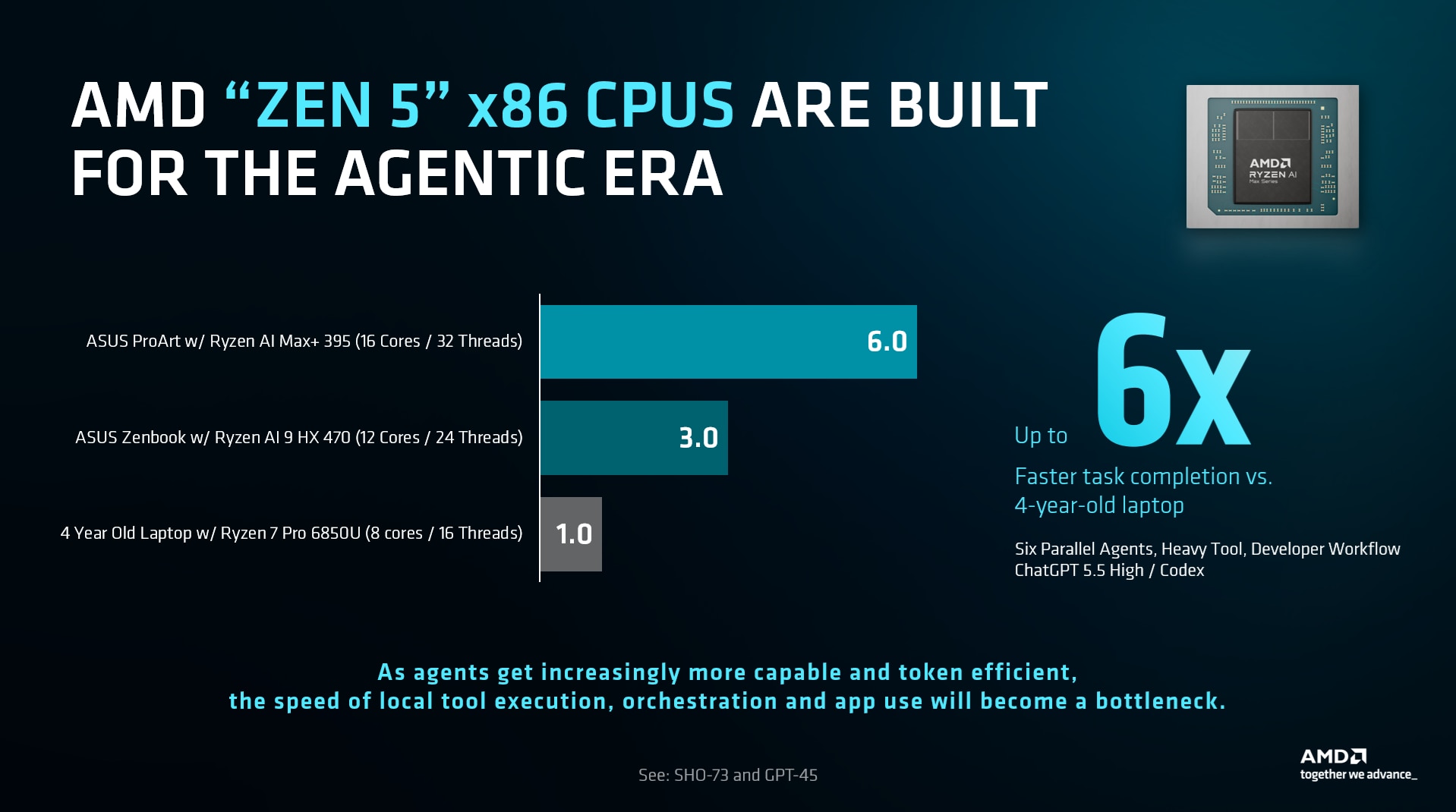
For the first wave of generative AI, the interaction model was simple: tokens in, tokens out. A user entered a prompt, a model processed it, and the response appeared on screen. Most of the visible work happened during inference, often on a cloud GPU.
That model is now changing.
AI agents can read files, execute code, use client-side applications, call tools and complete multi-step tasks. In this new era, inference remains important, but generating tokens is only the first step. The new model is: Tokens in. Actions out.
From answering questions to completing tasks
Consider the difference between asking an AI assistant how to file your taxes and asking an agent to help file them. The first task is largely a language problem. The second may require the agent to open documents, extract data, perform calculations, interact with software and validate the result.
This creates a continuous loop. The model decides what to do next, the agent calls a tool, the client CPU executes the action, and the result is sent back to the model.
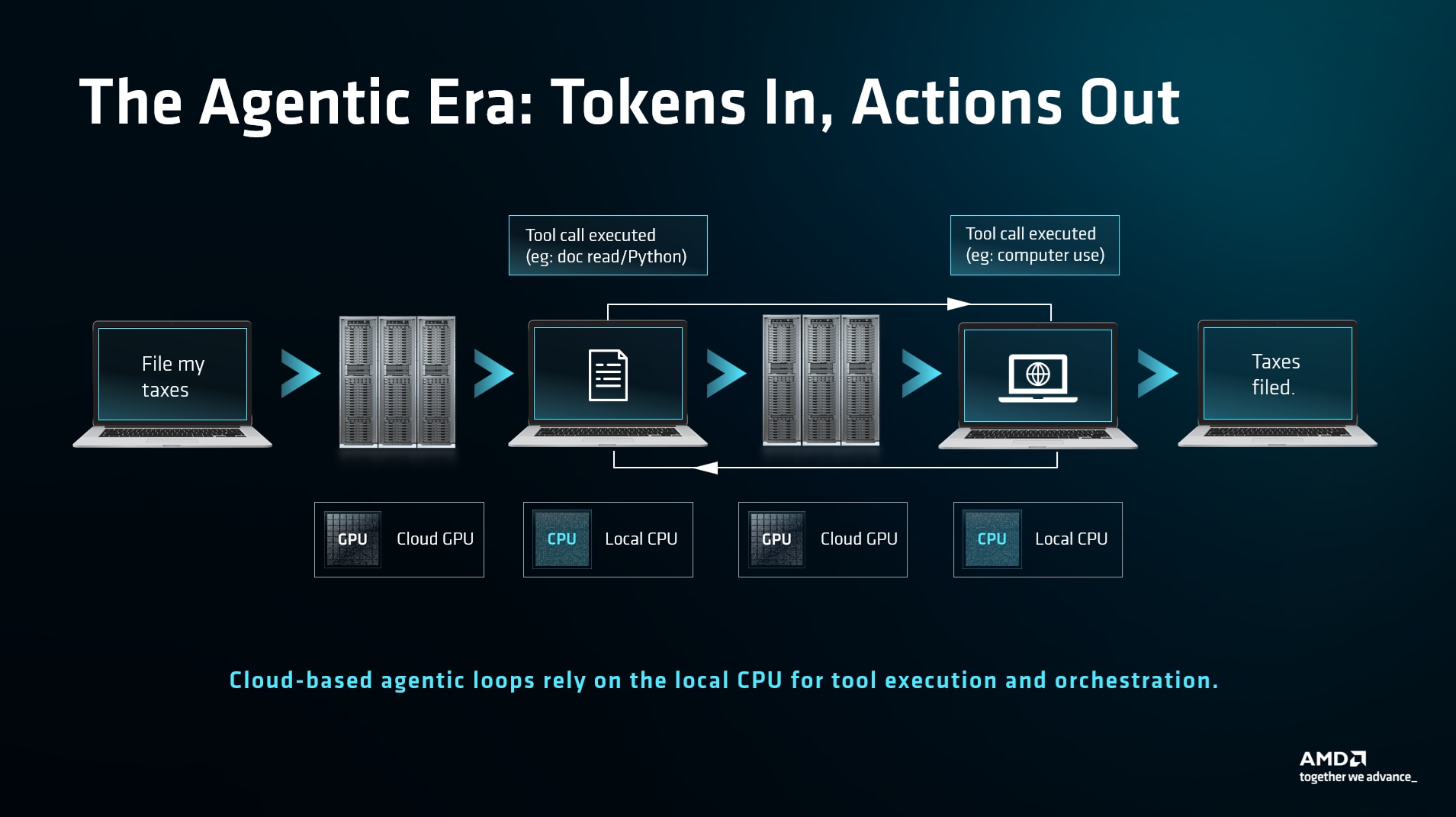
Many of these actions take place on the user’s computer. Reading local files, running Python, compiling code, searching a project directory and controlling applications all depend heavily on the client system.
As a result, agent performance is no longer defined only by how quickly a model generates tokens. It also depends on how quickly the computer can turn those tokens into useful work.
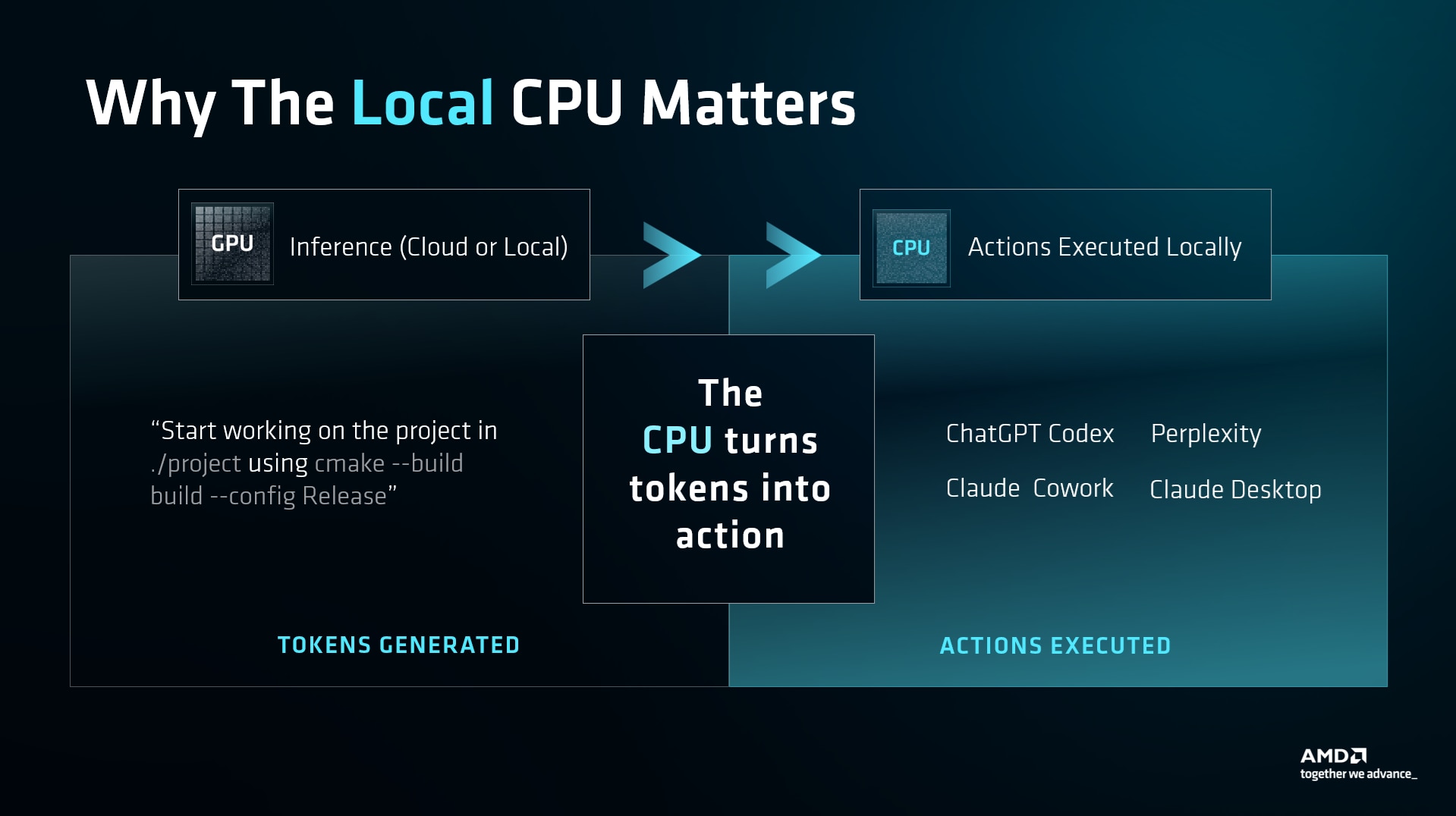
The local CPU turns tokens into action
Inference determines the next step. The CPU helps execute it. When an agent launches a process, parses a file, runs a command or coordinates several workers, the CPU handles much of the execution and scheduling. Even when AI inference runs on a GPU or NPU, the CPU keeps the wider workflow moving.
This becomes more important as agents take on larger tasks. A chatbot might generate one response but an agent may perform dozens of operations before completing a request. More advanced systems can also launch multiple subagents in parallel, each reading files, running commands and processing results all at the same time.
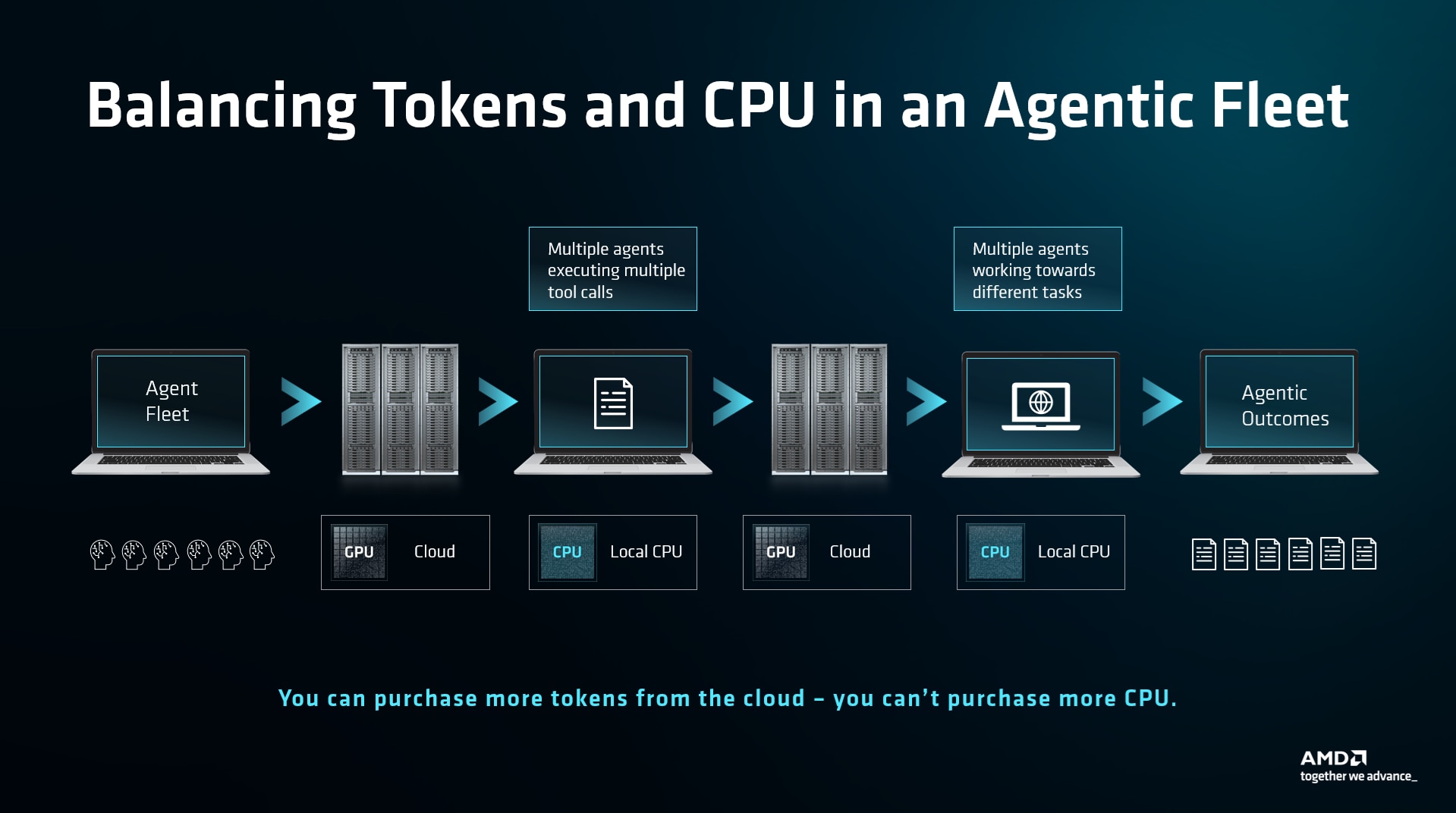
In these workloads, CPU performance can directly affect tool execution, compilation, local data processing, application responsiveness and total task completion time. A fast model cannot deliver its full value if every action is waiting for the client.
Built for agentic workloads
As models become faster and more token efficient, local execution can represent a larger share of the overall AI workload.
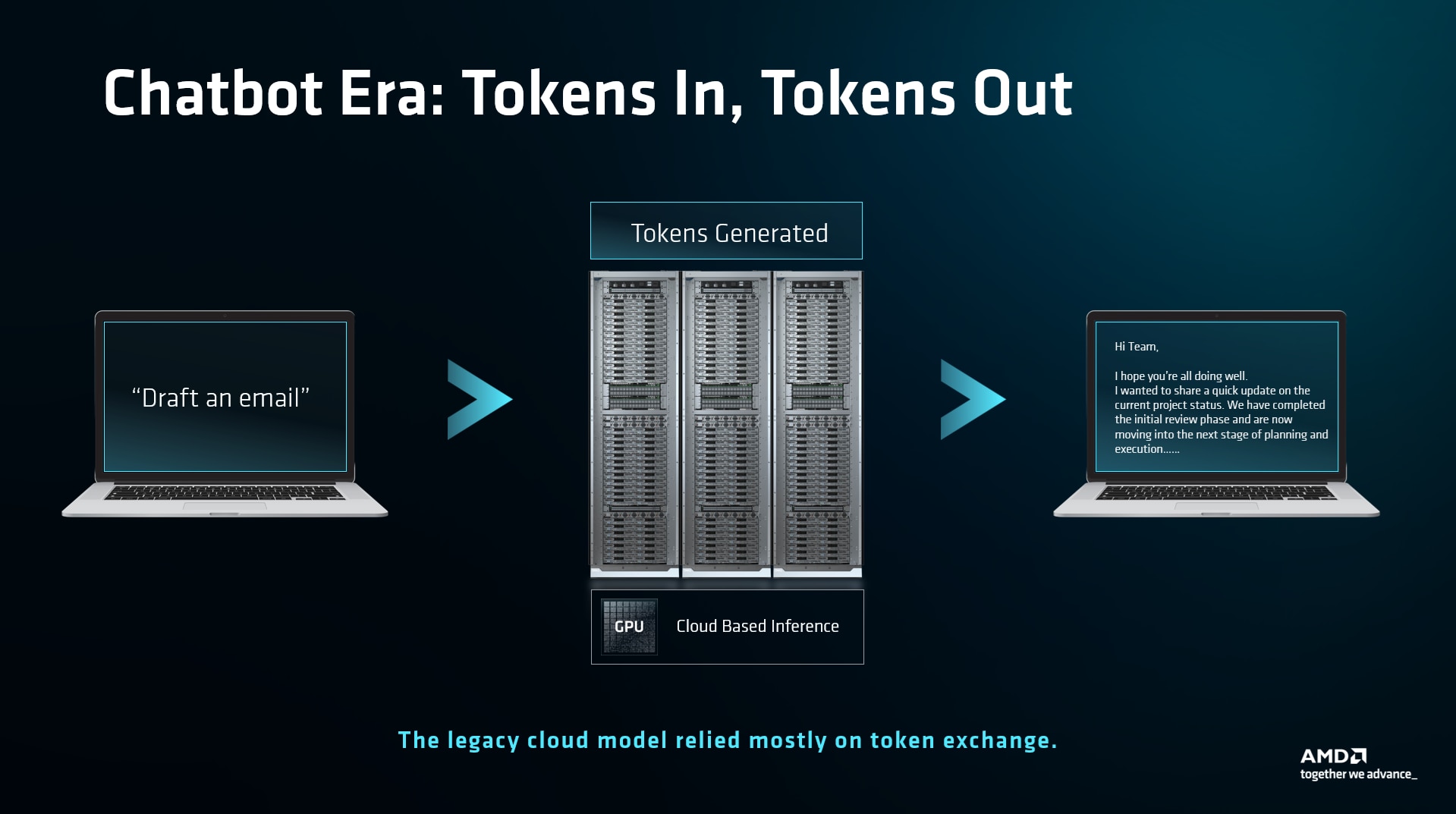
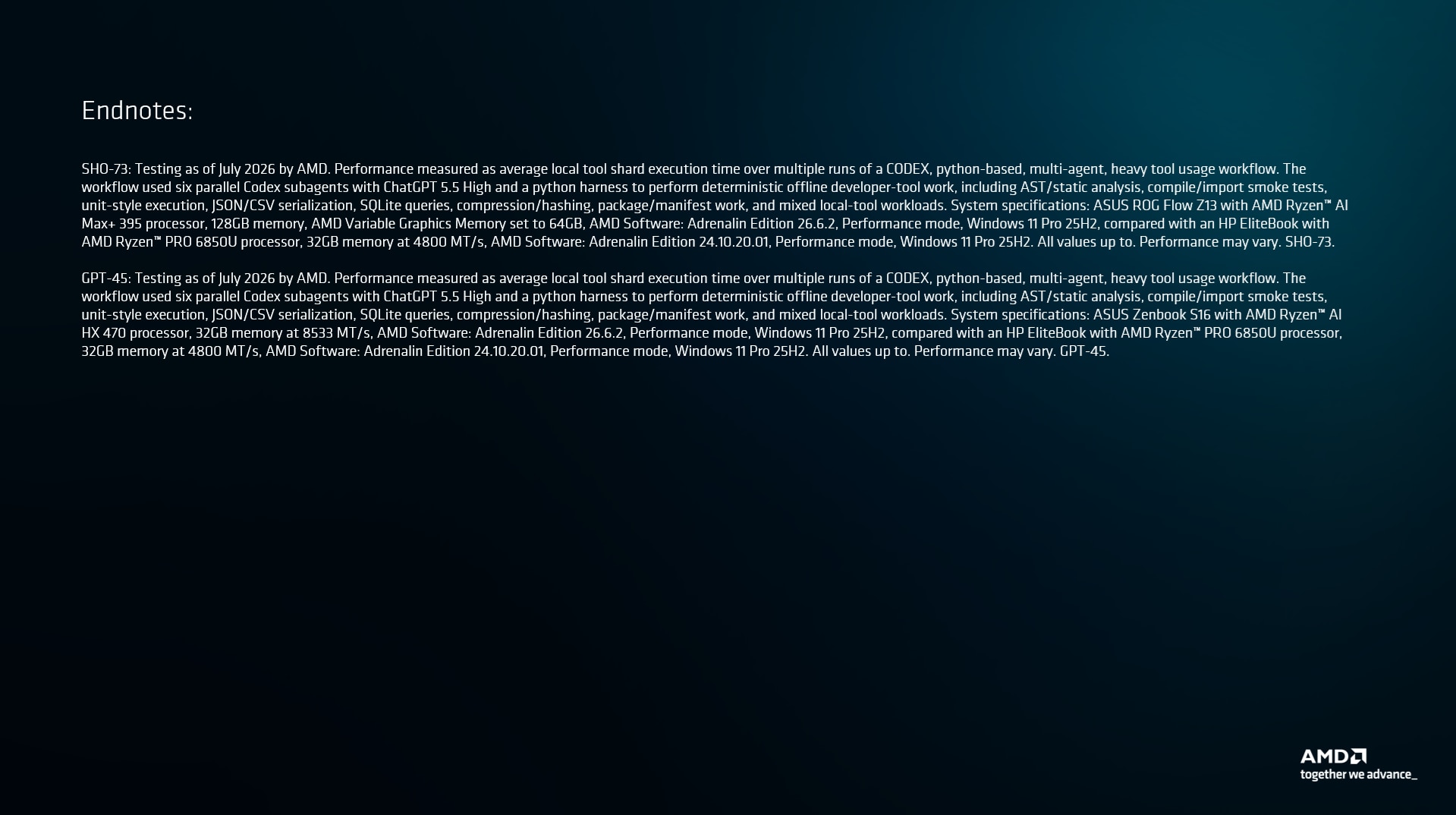
This can already be demonstrated using a tool-heavy Codex developer workflow running six concurrent ChatGPT 5.5 High agents. In the testing harness, each agent completed multiple tasks across AST and static analysis, compile and import smoke tests, unit-style execution, JSON and CSV serialization, SQLite queries, compression and hashing, package and manifest operations, and other mixed local-tool workload using a Python based harness implemented in Python.
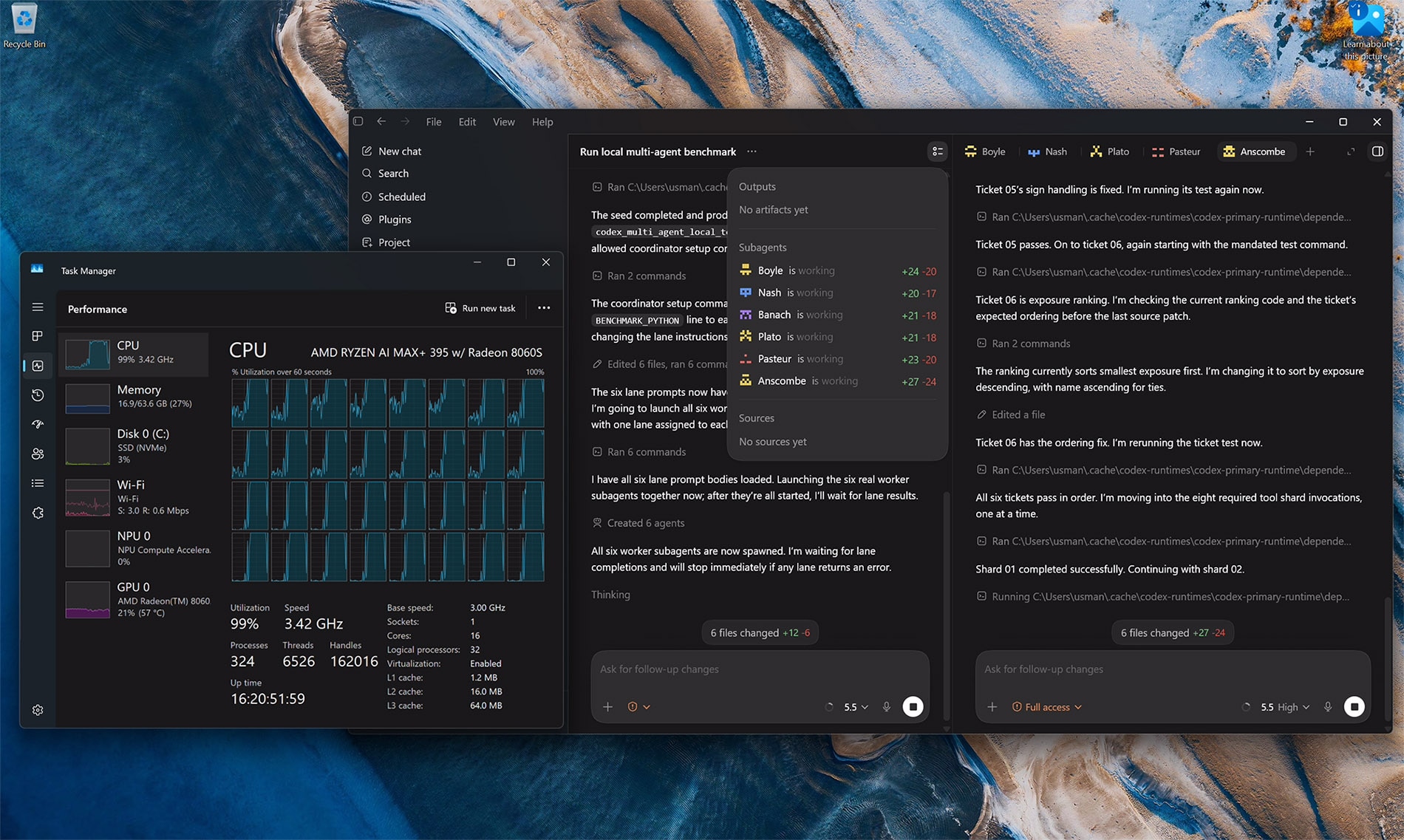
The ASUS ProArt system with an AMD Ryzen™ AI Max+ processor delivered up to 6X the CPU throughput of a four-year-old laptop in this multi-agent, heavy developer CODEX workflow. This result highlights an important shift. As agents perform more work across local files, applications and developer tools, CPU performance can directly affect how quickly the overall task is completed.
The takeaway is straightforward
As AI moves from generating responses to operating applications and completing tasks on your device, the client hardware becomes an active part of the intelligence loop.
Cloud GPUs may run the largest models. Local GPUs and NPUs can accelerate private and responsive inference, but it's the CPU that provides the execution environment agents need to act for both of these cases.
Agentic AI increases the importance of CPUs wherever agents execute. Whether running on a client PC or in the datacenter, CPUs provide the execution environment that transforms model outputs into real-world actions. AMD Ryzen AI and AMD EPYC each play complementary roles across that continuum.
Ultimately, the most meaningful measure of an AI agent is not how quickly it generates tokens, but how quickly it completes the task. Network conditions and cloud inference speed will always influence the experience, but once an agent begins reading files, running code, using applications and coordinating tools, local execution becomes a critical part of total time to completion. In the agentic era, the client CPU helps determine how quickly intelligence becomes useful work.

Related Blogs
-
NeuroSpark Expands AI Compute Choice with AMD
NeuroSpark uses AMD Instinct GPUs and ROCm software on OCI to deliver flexible, cost-effective AI training and inference
October 23, 2026
-
Sovereign AI for European Customer Conversations
LeadDesk, QuTwo, and AMD Silo AI collaborate on a sovereign AI stack that brings near-frontier, open-weight models to European customer conversations.
October 22, 2026
-
Micro-World 2: Streaming Real-time Interactive World Model — ROCm Blogs
This blog demonstrates how Micro-World 2 combines precisely annotated action data, four-step diffusion distillation, and ROCm-optimized inference to deliver controllable, long-horizon, real-time world generation on a single AMD Instinct GPU through a fully open-source pipeline.
October 20, 2026
-
MoE Training Optimization with Primus — ROCm Blogs
Learn how to speed up MoE training on AMD Instinct GPUs with Primus: a fused MoE megakernel, FP8/MXFP8 expert GEMMs, and training-at-scale tuning.
October 20, 2026
-
Optimizing World Action Models on AMD GPUs — ROCm Blogs
Speed up World Action Models on AMD GPUs with GEAK kernels, fewer denoising steps, and latent actions, cutting FastWAM latency 25× at about 97 percent success.
October 20, 2026
-
Bringing Ultra-Fast, Interactive LLM Inference to AMD Instinct™ MI355X GPUs — ROCm Blogs
Accelerate single-request LLM inference on AMD Instinct MI355X with megakernels, speculative decoding, and MXFP4 for 1.9-3.3x faster decode.
October 19, 2026
-
From Prompt to Playback: Nunchux Turns AMD Instinct™ GPU Performance into Responsive Video AI
See how AMD Instinct™ MI355X GPUs and AMD ROCm™ software enable faster-than-playback MiniMax-H3 video generation.
October 19, 2026
-
From AI That Answers to AI That Acts
Why physical AI requires a new definition of performance – one built around the whole system, not peak compute.
October 19, 2026