AMD Advances the Hybrid Future of Quantum Computing
Jun 19, 2026

Three Things to Know from AMD
- Quantum won’t replace classical computing; it will accelerate it through a hybrid architecture.
- AMD CPUs, GPUs, FPGAs and networking provide an essential classical foundation for quantum computing.
- AMD delivers a hybrid platform supporting classical technologies across HPC, AI and quantum systems.
For years, quantum computing was defined largely by scientific breakthroughs, laboratory demonstrations and long-term promises. Today, it’s increasingly viewed as a strategic technology. Governments, research institutions and enterprises are investing billions of dollars on quantum computing’s potential – in roles from economic competitiveness and scientific leadership to national security.
The U.S. Department of Commerce in May announced plans to invest more than $2 billion in quantum computing and quantum manufacturing initiatives. The investment reflects a growing confidence that quantum tech is nearing practical impact and a national priority to build a domestic quantum ecosystem.
But the future of quantum computing will not be built on quantum processors alone. Its foundation will be the convergence of quantum computing, high-performance computing and artificial intelligence.
Quantum computing systems are evolving toward hybrid architectures. It’s at this intersection of quantum and classical technologies where AMD lives.
With our long history and broad portfolio, we are uniquely qualified to enable quantum and all it promises. For nearly a decade, AMD has engineered technologies that make quantum computing practical. Our CPUs, GPUs, FPGAs, adaptive SoCs, networking and open software provide critical classical infrastructure needed to develop, operate and scale next-generation quantum systems.
Quantum’s Next Step is Hybrid
Quantum computers are not faster versions of classical computers. They are a fundamentally different computing model designed to use the properties of quantum mechanics to explore certain problems that classical systems struggle to solve efficiently. Promising long-term applications include chemistry, materials science, drug discovery, energy research, optimization and advanced scientific modeling. In each of these areas quantum systems could unlock new discoveries and new economic opportunities.
Yet today’s quantum systems remain constrained by factors such as error rates, coherence limitations, scaling challenges and system complexity. As a result, most current quantum workloads depend heavily on classical computing for functions that include control, calibration, orchestration, simulation, data preparation, post-processing and error correction. Even as quantum processors become more capable, classical requirements are expected to grow rather than disappear.
As we see it, the future is increasingly centered on hybrid quantum-classical computing, where quantum processors serve as specialized accelerators within larger computing environments. Quantum systems tackle the portions of problems where they may offer an advantage – the beyond-classical or many-body problems – while classical systems handle the surrounding computations that make those results useful.
It’s the same idea in high-performance computing, where workloads are assigned to CPUs or GPUs based on how much parallel processing they require. The existing suite of AMD ROCm™ software for HPC is evolving and is expected to provide support for orchestrating quantum accelerators in addition to GPUs.
Why AMD Technologies Matter
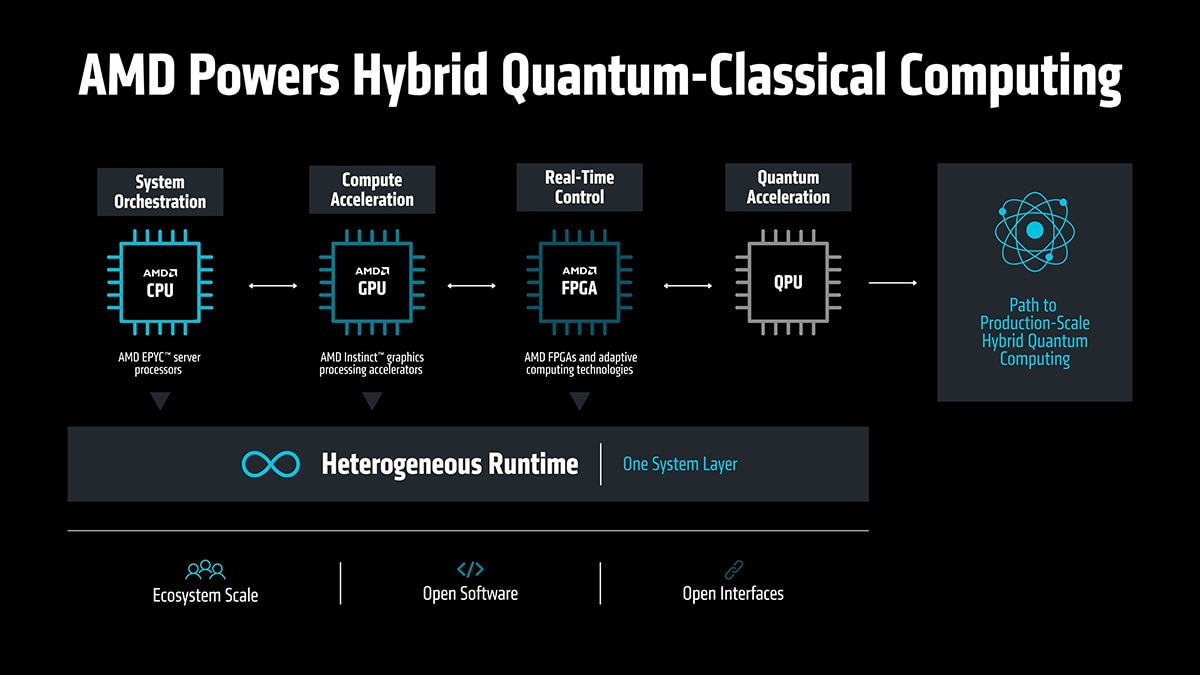
Every approach to quantum computing – superconducting, trapped-ion, neutral-atom, photonic and others – presents different control, timing and integration requirements. It’s not a single technology stack.
But what every approach shares is a need for powerful classical infrastructure. And that aligns across our portfolio:
- AMD EPYC™ server processors support orchestration, workflow management and high-performance computing workloads.
- AMD Instinct™ graphics processing accelerators power simulation, modeling and AI-assisted research.
- AMD FPGAs and adaptive computing technologies support low-latency control, readout and real-time error correction.
- AMD networking, software and system-level technologies connect these resources into scalable platforms.
AMD supports all quantum approaches. We are not tied to one quantum modality or one vertically integrated architecture. Instead, we help provide the heterogeneous compute foundation that different quantum approaches can build upon.
Collaboration Moves the Ecosystem Forward
Quantum computing progress requires collaboration across hardware, software, systems, research institutions and application developers. The role of AMD – working with ecosystem leaders to explore how quantum systems can be integrated with classical computing infrastructure – reflects that reality.
AMD collaborates with leaders in quantum computing, financial services and scientific research – including JPMorganChase and Oak Ridge National Laboratory – to explore the integration of quantum systems with AI and high-performance computing environments.
And our work with IBM focuses on quantum-centric supercomputing architectures that bring together quantum processors, HPC and AI resources. Our collective efforts explore how AMD CPUs, GPUs and adaptive computing technologies can work alongside IBM quantum systems to support emerging hybrid workloads.
This collaborative approach recognizes a fundamental truth about the industry: Quantum innovators typically need powerful classical infrastructure, and classical infrastructure providers play an essential role in helping the ecosystem advance.
Building the Infrastructure for the Quantum Era
Quantum computing is approaching a critical transition.
Large-scale fault-tolerant systems remain a long-term goal, but meaningful progress is happening through hybrid workflows, quantum simulation, error correction research and quantum-classical integration. Success in this space depends less on raw qubit counts and more on system architecture, software integration and compute efficiency.
Our strategy is to support broad quantum workflows and enabling technologies. It’s a platform strategy, not a component strategy. And in an emerging market, platform strategies tend to create more durable strategic leverage than point solutions.
We are not betting that one qubit modality will win quickly or that the market will settle around one vertically integrated provider. We are building infrastructure to support a broad range of quantum modalities. The Commerce Department's investment initiative signals that governments believe the time to build the supporting ecosystem is now.
As the quantum era transitions from ambitious laboratory curiosity to commercial necessity, AMD isn’t just participating in the ecosystem. We are building foundational computing technologies to support quantum computing at scale.
- Blogs:
- News:
- AMD and IBM:
Contributors

Related Blogs
-
Searching Biological Evolution at Scale with MMseqs2 on AMD
AMD Instinct GPUs accelerate protein sequence search and MSA generation with MMseqs2 and HIPSW++, reaching 97 TCUPS on eight MI325X GPUs.
October 14, 2026
-
Performance Profiling on AMD GPUs - Part 6: Advanced Thread Trace (ATT) - The Microscope for Your Application — ROCm Blogs
Explore rocprofv3 ATT and ROCprof Compute Viewer to trace GPU kernels and explain stalls, waits, and memory-bound performance.
September 21, 2026
-
Supercharging Genomics Alignment with AMD Instinct GPUs
How ROCm/HIP GPU acceleration brings long-read DNA alignment closer to real-time on AMD MI300X
July 30, 2026
-
Advancing Agentic Workflows With AMD EPYC™ 9006 Series Server CPUs
AMD EPYC™ 9006 Server CPUs power agentic AI with purpose-built CPUs for agent sandboxes, AI host nodes, and enterprise workloads at scale.
July 23, 2026
-
The Agentic Era Runs on a CPU Foundation — and It's Called AMD EPYC™ 9006 Series Server CPUs
Agentic AI needs more than GPUs and AMD EPYC™ 9006 Server CPUs power planning, orchestration, and enterprise workloads at scale efficiently.
July 23, 2026
-
Performance Profiling on AMD GPUs – Part 5: Profiling-Driven Kernel Optimization with an AI Code-Assist Tool — ROCm Blogs
Ready to slash HIP kernel runtimes? See how ROCm profiling + an AI code-assist agent delivered a 28.3× speedup on AMD Instinct MI250.
July 15, 2026
-
Announcing the ROCm Certification Program
Build AI and HPC expertise on AMD Instinctt™ GPUs. Earn the ROCmt™ Certification with hands-on, production-ready skills.
July 13, 2026
-
AMD Powers 4 of 10 Most Powerful Supercomputers, Advancing Global HPC and AI Leadership
AMD EPYC™ CPUs and AMD Instinct™ GPUs power leading systems across the latest TOP500 and Green500 rankings, delivering the performance and efficiency required for advanced scientific computing and AI.
June 23, 2026