Why a Data Intelligence Platform Is the Foundation for Autonomous AI
Feb 04, 2026
Enterprises are moving toward systems that can reason, make decisions, and ultimately operate with greater autonomy. The biggest constraint is no longer model performance—it is data. At AMD, we believe a data intelligence platform is the foundation for high-value, autonomous AI.
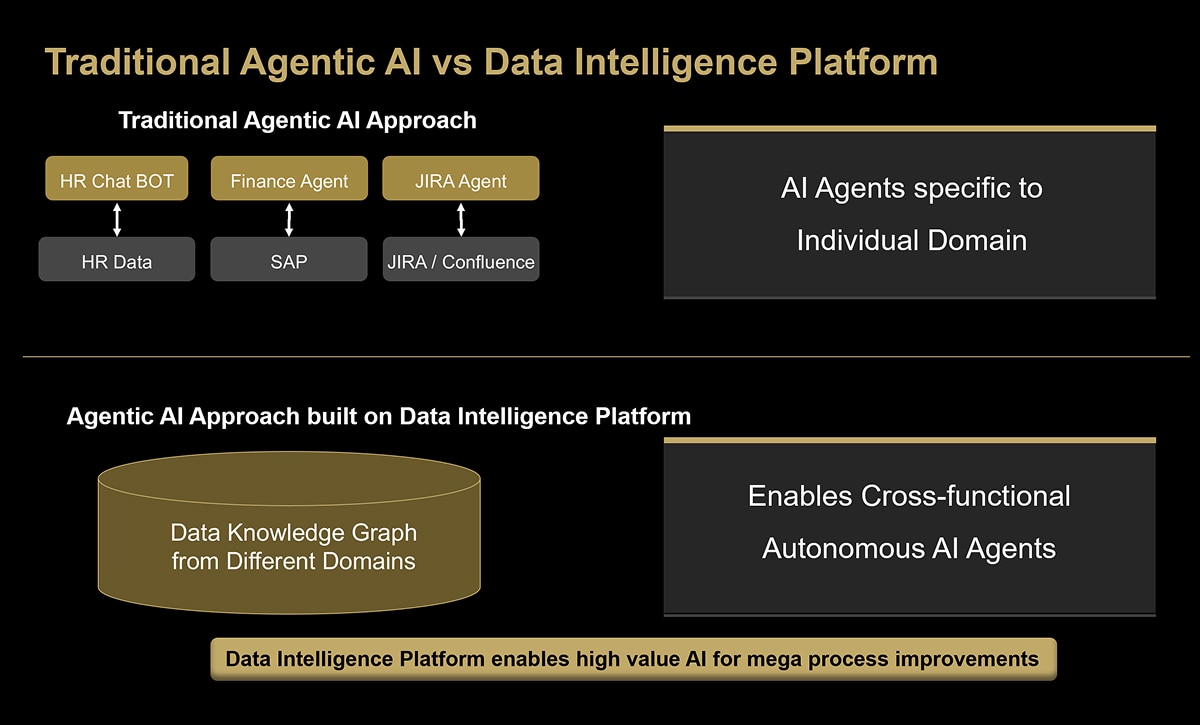
Today, many vendors offer agentic AI, but these agents typically operate within narrow boundaries. They rely on siloed, domain-specific data, which limits both their scope and their impact. As a result, they optimize locally rather than solving broader enterprise problems.
True autonomous AI requires access to cross-domain data. When AI systems can understand and connect data across the enterprise, they gain the context needed to tackle complex challenges and deliver scalable, business-wide value.
Autonomous AI does not emerge from algorithms alone. It is built on a data intelligence platform—one grounded in a deliberate, enterprise-wide data strategy that turns fragmented data into actionable intelligence.
From Analytics to Autonomy
For years, organizations have invested heavily in analytics, dashboards, and reports. These tools answer known questions, but autonomous systems must address unknown ones. They must adapt to changing conditions, correlate signals across domains, and make decisions in real time.
This transition from descriptive analytics to autonomous intelligence requires a fundamental shift in how data is treated. Data must evolve from a passive asset into an active decision substrate.
What a Data Strategy Really Means
A modern data strategy is not just about collecting more data. It is also about making data reliable, explainable, and usable by both humans and machines.
Key pillars include:
- Data quality and versioning: Autonomous systems depend on accurate, reproducible data. Versioning allows organizations to trace decisions back to the state of data at a specific point in time.
- Security and access control: As AI systems gain agency, access to data must be governed with precision. Trust is non-negotiable.
- Lineage and transparency: Understanding where data originates and how it flows through systems builds confidence in AI-driven outcomes.
- Multimodal readiness: Text, audio, video, images, and events must coexist within a unified framework.
Generative AI and the Need for Grounding
Large Language Models have transformed how we interact with data, but they lack native understanding of enterprise context. Retrieval-Augmented Generation (RAG) bridges this gap by grounding AI responses in authoritative, curated data.
Without a data intelligence platform, generative AI risks becoming disconnected from operational truth.
The Strategic Imperative
Autonomous AI is rapidly becoming a competitive differentiator for many organizations. Organizations that invest now in data intelligence platforms will be positioned to move faster, operate smarter, and scale innovation with confidence.
Takeaway: Autonomous AI starts with data strategy, and data strategy must be operationalized through a data intelligence platform.
To understand more about the foundation behind the strategy driving this transformation, continue to follow the series with Part 2.


Related Blogs
-
AIM: Unified User Experience from Profile Discovery to Deployment — ROCm Blogs
Learn how AIMs offer a unified user experience as you explore and deploy them across AMD Instinct, Radeon PRO, and EPYC.
September 29, 2026
-
Beyond TOPS: AMD Ryzen™ AI Embedded X100 at the Edge
Scale agentic AI at the edge with AMD Ryzen™ AI Embedded X100 Series: more concurrent agents, unified memory, x86 compatibility, and long life.
September 24, 2026
-
Advancing Gaming with AMD at G2E 2026
Discover how AMD Ryzen Embedded processors are powering next-generation casino gaming experiences at G2E 2026. Explore innovative platforms from ADLINK, Advantech, Axiomtek and Quixant, featuring high-performance computing, advanced graphics, AI capabilities, multi-display support and reliable, scalable designs built for demanding, always-on gaming environments worldwide and faster product development and deployment.
September 24, 2026
-
Advancing AI 2026: From Gigawatt Data Centers to Agentic PCs
Explore how AMD connects data center, cloud, and local AI to enable secure, cost-aware agentic workflows across enterprise PCs.
September 16, 2026
-
AMD Brings Local AI to Autodesk University 2026
See how AMD brings local AI and AI-ready workstations to Autodesk University 2026 for demanding design, engineering, and AEC workflows.
September 15, 2026
-
81% of Organizations Are Moving Toward AI PCs
Recent IDC research sponsored by AMD shows 81% of organizations are deploying, piloting, or planning near-term AI PC adoption.
September 14, 2026
-
Create, Connect, Control: AMD at IBC 2026
See how AMD and its partners are advancing practical AI, media workflows, high-resolution production, and security at IBC 2026.
September 11, 2026
-
AI Productivity at Scale: From Everyday Assistance to Autonomous Execution
How AMD scales AI productivity enterprise-wide with ACE, the Aria AI Suite, and autonomous systems that execute work instead of just assisting.
September 10, 2026