From Benchmarks to Behavior: Rethinking Performance in Autonomous Robotics
Jul 23, 2026
What the Open Navigation Robotics Workload Benchmark Reveals About Running Everything at Once
Autonomous Robotics is Becoming a Full-System Workload
Autonomous robots are being asked to do more locally: process sensor data, perceive the environment, maintain localization, plan motion, execute control loops and increasingly run AI-assisted reasoning in real time. Traditional benchmarks remain useful for measuring individual pieces of that workload, but they rarely show how the system behaves when perception, planning, control and AI are active at the same time.
For physical AI systems, the challenge is keeping those pipelines moving together while preserving enough timing margin for safe, predictable behavior. More GPU performance and inference efficiency helps, but the harder requirement is building a balanced architecture that can keep the whole robotic system moving under real operating pressure.
The OpenNav Robotics Workload Benchmark was built around that system-level reality. Instead of isolating one component, it evaluates what happens when the robotics stack runs together under deployment-like conditions, where the limiting factor is often not the fastest individual accelerator, but the ability to sustain real-time behavior across the complete application.
The Robot is the Workload
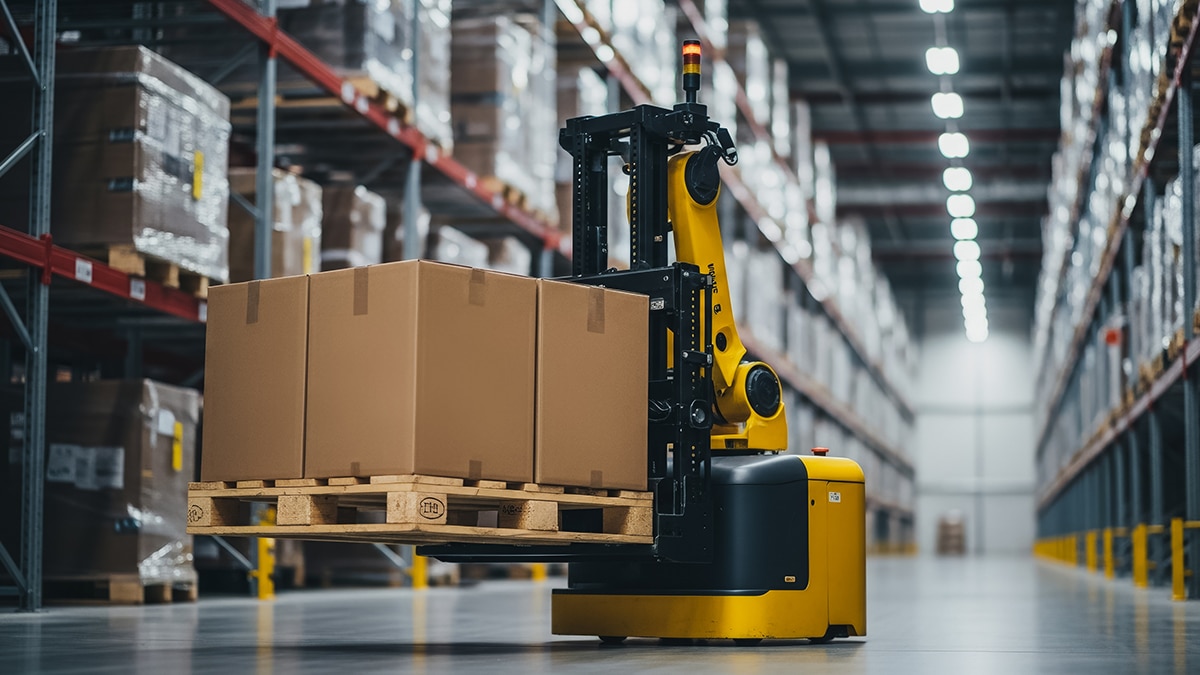
The OpenNav Robotics Workload Benchmark uses a scenario developers recognize: an autonomous forklift moving pallets through a large warehouse while processing LiDAR, RGB-D camera, vision and inertial measurement data. Its value is not just the scenario but the way it forces the system to manage concurrent work.
Localization, perception, planning and model predictive control run continuously, forming a closed loop that cannot pause while another task catches up. At the same time, the benchmark introduces a large vision-language model that interprets conditions, identifies hazards and can influence navigation decisions while the system continues issuing real-time motion commands.
VLM queries are issued to assess the environment, but the robot cannot stop and wait for the response. It must continue processing sensor data, update its control loop and navigate safely while AI runs in parallel. That overlap shows whether the system can support the full robotic application, not just one part of it.
Real-Time Behavior Depends on CPU Headroom
For robotics, few indicators are more important than whether the control loop runs on time. The control loop determines how often the robot updates its motion commands as it reacts to changing conditions. When control-loop deadlines are missed, the resulting timing gaps can affect path tracking quality, responsiveness and overall predictability and safety.
In the OpenNav Robotics Workload Benchmark, platforms running close to saturation missed control-loop deadlines more frequently. In that benchmark, the AMD Ryzen™ AI Embedded X100 Series showed up to 3.4x better real-time reliability for robotics navigation versus NVIDIA® Jetson™ T5000, based on fewer missed control-loop deadlines across ten missions.1
CPU performance is central to that behavior. Control-loop execution depends on trajectory planning, coordination and decision logic that cannot simply be pushed to an accelerator. When CPU resources are already tight, those tasks are more likely to fall behind, even if the GPU is still delivering strong performance on AI or signal processing workloads. A GPU can only sustain that performance when the CPU keeps it supplied with instructions, data and application context on time; if the CPU cannot sustain the required throughput under application load, the entire system can lose responsiveness and real-time predictability.
AI Acceleration is Only Part of the Platform Decision
A workload that includes a Gemma 4.0 31B parameter vision-language model might seem like a pure GPU story. GPU capability matters, but when GPU resources are heavily used, the more important question becomes what else the system can continue doing while AI is running.
The OpenNav Robotics Workload Benchmark therefore looks beyond whether the model can run. It looks at how many AI queries are completed while localization, perception, planning and control continue operating. In that context, the Ryzen AI Embedded X100 Series completes more vision-language model queries within the same timeframe vs. NVIDIA Jetson T5000, while still maintaining more system headroom for the robotics application workload.
Balanced Compute for Real-Time Robotics
The results point to a broader system requirement. GPU performance is important, but robotics workloads also depend on CPU capability, memory behavior, software orchestration and the ability to keep multiple pipelines active at once. What separates systems in deployment is how consistently they keep concurrent work moving.
The OpenNav results show that the Ryzen AI Embedded X100 Series keeps more CPU capacity available while running the full robotics stack alongside a large AI workload. In the same benchmark, the Ryzen AI Embedded X100 Series showed up to 1.6x higher spare compute capacity and up to 2.7x better CPU utilization for robotics navigation versus NVIDIA Jetson T5000.2 That margin helps the robot absorb workload variation, keep control loops on schedule, process more sensor data and run more complex algorithms without destabilizing the system.
Workload Consolidation Starts With the Platform
For many robotics teams, the alternative to a balanced integrated platform is a more complex system design. When a design needs more CPU headroom for planning, control or sensor fusion, developers may consider pairing a GPU system-on-module with a separate x86 processor, adding board complexity, power consumption, validation effort and integration work.
An integrated APU can simplify that design by bringing CPU, GPU, AI processing, and memory access closer together from the beginning, reducing the need to move data across separate devices and memory domains.
Ryzen AI Embedded X100 Series processors address this with a high-performance embedded x86 APU architecture that combines CPU cores, integrated graphics, AI processing and unified memory so system designers can consolidate more workloads on a single device.
Unified Memory and x86 Concurrency for Real-Time Robotics
Unified memory can change how a robotics system behaves under load. When CPU, GPU and NPU engines share access to memory, the system can reduce explicit data movement across processing stages, helping lower latency and improve determinism in pipelines that tightly couple perception, planning and control. The X100 Embedded Series shared memory architecture and large 32 MB MALL cache can also help enable zero-copy data sharing between the CPU, GPU and NPU, allowing sensor, AI and control workloads to exchange data more efficiently without repeatedly copying it across separate memory domains.
The CPU complex is also central. Robotics workloads are inherently parallel: perception, planning, control, middleware, networking, logging and orchestration can all be active at the same time. Strong multi-threaded x86 execution helps sustain that concurrency without oversubscription.
For more background on homogeneous x86 cores and deterministic execution in real-time AI systems, read the AMD blog “Uniform x86 Cores for Real-Time AI: Reducing the Hybrid-Core Tax in Physical AI Systems”.
Built for Embedded Deployment, Not Only Benchmark Performance
Many systems are expected to operate for years in factories, warehouses, outdoor environments or other harsh conditions where lifecycle support, thermal range, continuous operation and predictable CPU execution matter alongside peak AI acceleration.
The Ryzen AI Embedded X100 Series is designed for those embedded realities. The X100 Embedded Series supports up to 10 years of continuous 24/7 operation, whereas NVIDIA specifies five years of continuous operation for NVIDIA Jetson T5000. Select X100 Series industrial SKUs also support a -40°C to 105°C junction temperature range, while NVIDIA specifies a -25°C to 80°C TTP maximum operating range for NVIDIA Jetson T5000. With a 10-year product lifecycle, the X100 Series supports robotics programs that need longevity.
AMD also brings differentiated CPU and memory capabilities for physical AI. Ryzen AI Embedded X100 Series processors support AVX-512 vector acceleration across the CPU complex, providing 512-bit SIMD capability for signal processing, sensor fusion, image transforms, and other math-heavy stages around the inference pipeline. NVIDIA Jetson T5000 uses Arm® Neon™ with a 128-bit vector width. The CPU specification contrast also extends to concurrency: X100 Series processors support up to 16 high-performance x86 CPU cores and up to 32 processing threads, while NVIDIA Jetson T5000 provides 14 Arm application CPU cores and does not support simultaneous multithreading.
Ryzen AI Embedded X100 Series processors also support up to 273 GB/s of memory bandwidth, a unified memory architecture and a large shared 32 MB MALL cache, helping feed sensor fusion, AI, graphics and control workloads.
Open Software for Robotics Platforms That Need to Evolve
Robotics teams often carry substantial software investments across Linux, middleware, perception frameworks, GPU kernels, AI models, simulation tools and system-specific control code. The decision to choose a new embedded architecture must respect that investment while giving developers a practical path to more performance and integration.
Ryzen AI Embedded X100 Series processors build on familiar x86 development environments and an open software ecosystem. AMD ROCm™ software provides an open-source GPU compute stack, while HIP and HIPIFY help developers migrate CUDA®-based workloads toward portable code paths. ROCm HIPIFY preserves an average of 83% of CUDA code across foundational GPU workloads, 71% across compute-intensive applications and 72% across AI/ML workloads, helping reduce redevelopment effort while supporting portability across heterogeneous compute platforms.3
For software-defined robotics systems, that flexibility can matter as much as raw performance. Developers need support for today’s stack while leaving room for new models, sensors, autonomy features and deployment requirements. To learn more, read the AMD blog “From CUDA® to AMD ROCm™ Software Without Starting Over”.
What the OpenNav Robotics Workload Benchmark Makes Visible
By measuring real-time control, mission completions, LLM queries and available CPU capacity while the robot continues operating, the OpenNav Robotics Workload Benchmark makes visible a more complete view of robotics performance: not only how fast a system can run one isolated workload, but whether it can sustain real-time behavior when AI, perception, planning, control and system services run together.
Ryzen AI Embedded X100 Series processors are designed for that balance, combining CPU performance for deterministic execution, GPU and AI capabilities for perception and inference and shared memory architecture that can simplify system design. For autonomous robotics, that means a foundation for keeping the full workload running continuously.
Final Takeaway
Autonomous systems are getting more complex: more sensors, more data, larger models, tighter timing requirements and more software-defined behavior. As that complexity grows, the gap between peak performance and sustained system behavior becomes harder to ignore.
The OpenNav Robotics Workload Benchmark makes that gap visible. Ryzen AI Embedded X100 Series processors provide a balanced x86 foundation for autonomous robotics. To learn more about the Open Navigation Robotics Workload Benchmark read the OpenNav benchmark report, or try it yourself. Building robots that need sensing, planning, control, and AI to run at once? Explore AMD Kria™ AI Solutions to see how production-ready Ryzen AI Embedded X100 SOMs can help you accelerate AI-powered robotics from prototype to deployment.
AMD Ryzen™ AI Embedded X100 Series: Ready for What Robots Do Next.

Related Blogs
-
Meet the Next AMD Ryzen™ AI Halo
Meet the next AMD Ryzen™ AI Halo developer platform, powered by the AMD Ryzen™ AI Max+ PRO 495 processor. Run larger local LLMs, up to 300B parameters, thanks to the 192GB of unified memory that comes on the new platform.
October 12, 2026
-
Kimi K3 on AMD Instinct GPUs with TokenSpeed
TokenSpeed delivers fast, agentic LLM inference on AMD Instinct™ MI355X GPUs, with optimized kernels and leading Kimi K3 performance.
October 09, 2026
-
scikit workloads with AOCL Data Analytics
Accelerate supported scikit-learn workloads with AOCL-Data Analytics while keeping your existing Python code and familiar scikit-learn APIs.
October 09, 2026
-
MangoBoost Delivers Open AI Models Powered by AMD
Mango Inference a serverless inference service providing production-ready access to open models powered by AMD Instinct™ GPUs and AMD ROCm™ software
October 09, 2026
-
Pre-Training Hybrid LLMs from Scratch in Primus on AMD Instinct™ GPUs — ROCm Blogs
Pre-train hybrid LLMs mixing MLA attention with Gated DeltaNet, Kimi Delta Attention and Mamba2 mixers on AMD Instinct MI355X GPUs, with open recipes.
October 07, 2026
-
DI Series: Serving Kimi-K3 MXFP4 Wide-EP Disaggregated on AMD Instinct MI300X and MI325X — ROCm Blogs
Learn how to serve a 1.4 TiB Kimi-K3 MXFP4 mixture-of-experts model disaggregated across AMD Instinct MI300X and MI325X GPUs.
October 07, 2026
-
AMD Instinct MI455X vs MI355X: A Technical Look at the Advancing AI 2026 Inference Numbers — ROCm Blogs
Explore the MI455X vs MI355X inference numbers from Advancing AI 2026, and learn how each benchmark was measured and what it really means.
October 07, 2026
-
Rapid Validation on AMD Versal Silicon without Leaving MATLAB or Python
AMD Vitis™ Hardware in the Loop (Vitis HIL) bridges simulation and hardware bring-up by enabling system-level verification on evaluation hardware directly from existing MATLAB® or Python™ test environments.
October 07, 2026






Footnotes
- Based on the OpenNav Robotics Workload Benchmark commissioned by AMD, published by Open Navigation LLC on July 23, 2026, as measured on the GMKtec EVO-X2 AI Mini PC AMD Ryzen AI Max+ 395 configured to reflect Ryzen AI Embedded X199 specifications (5.1 GHz CPU, 2.9 GHz GPU, 120W TDP, LPDDR5X-7500), vs. the NVIDIA Jetson AGX Thor Developer Kit: https://opennav.org/news/opennav-robotics-workload-benchmark (REX-018)
- Based on the OpenNav Robotics Workload Benchmark commissioned by AMD, published by Open Navigation LLC on July 23, 2026, as measured on the GMKtec EVO-X2 AI Mini PC AMD Ryzen AI Max+ 395 configured to reflect Ryzen AI Embedded X199 specifications (5.1 GHz CPU, 2.9 GHz GPU, 120W TDP, LPDDR5X-7500), vs. the NVIDIA Jetson AGX Thor Developer Kit: https://opennav.org/news/opennav-robotics-workload-benchmark (REX-016)
- Based on AMD internal testing as of April 2026, validated on an AMD Ryzen AI Max+ 395 processor as a proxy for AMD Ryzen AI Embedded X100 Series CPUs, a CUDA-to-HIP validation suite consisting of 15 CUDA sample applications totaling 1,199 lines of code was migrated from CUDA to HIP. Code preservation was calculated as the percentage of original CUDA source retained after HIP conversion. Foundational workloads consisted of saxpy, matrix transpose, histogram, image blur and prefix sum. Compute-intensive workloads consisted of warp reduction, N-body, SpMV, multi-stream and cuBLAS GEMM. AI/ML workloads consisted of softmax, layer normalization, attention, convolution and radix sort. Actual results may vary based on application complexity, CUDA library usage, architecture-specific optimizations, low-level CUDA constructs, required code modifications following conversion or other factors. (REX-020)
© 2026 Advanced Micro Devices, Inc. All rights reserved. AMD, the AMD Arrow logo, Kria, ROCm, Ryzen, and combinations thereof are trademarks of Advanced Micro Devices, Inc. Arm and Neon are trademarks or registered trademarks of Arm Limited or its affiliates in the U.S. and other countries. CUDA, Jetson, NVIDIA, and Thor are trademarks and/or registered trademarks of NVIDIA Corporation in the U.S. and other countries. Linux is the registered trademark of Linus Torvalds in the U.S. and other countries. Other product or model names used herein are for identification purposes only and may be trademarks of their respective owners. Certain AMD technologies may require third-party enablement or activation. Supported features may vary by operating system. Please confirm with the system manufacturer for specific features. No technology or product can be completely secure.
Footnotes
- Based on the OpenNav Robotics Workload Benchmark commissioned by AMD, published by Open Navigation LLC on July 23, 2026, as measured on the GMKtec EVO-X2 AI Mini PC AMD Ryzen AI Max+ 395 configured to reflect Ryzen AI Embedded X199 specifications (5.1 GHz CPU, 2.9 GHz GPU, 120W TDP, LPDDR5X-7500), vs. the NVIDIA Jetson AGX Thor Developer Kit: https://opennav.org/news/opennav-robotics-workload-benchmark (REX-018)
- Based on the OpenNav Robotics Workload Benchmark commissioned by AMD, published by Open Navigation LLC on July 23, 2026, as measured on the GMKtec EVO-X2 AI Mini PC AMD Ryzen AI Max+ 395 configured to reflect Ryzen AI Embedded X199 specifications (5.1 GHz CPU, 2.9 GHz GPU, 120W TDP, LPDDR5X-7500), vs. the NVIDIA Jetson AGX Thor Developer Kit: https://opennav.org/news/opennav-robotics-workload-benchmark (REX-016)
- Based on AMD internal testing as of April 2026, validated on an AMD Ryzen AI Max+ 395 processor as a proxy for AMD Ryzen AI Embedded X100 Series CPUs, a CUDA-to-HIP validation suite consisting of 15 CUDA sample applications totaling 1,199 lines of code was migrated from CUDA to HIP. Code preservation was calculated as the percentage of original CUDA source retained after HIP conversion. Foundational workloads consisted of saxpy, matrix transpose, histogram, image blur and prefix sum. Compute-intensive workloads consisted of warp reduction, N-body, SpMV, multi-stream and cuBLAS GEMM. AI/ML workloads consisted of softmax, layer normalization, attention, convolution and radix sort. Actual results may vary based on application complexity, CUDA library usage, architecture-specific optimizations, low-level CUDA constructs, required code modifications following conversion or other factors. (REX-020)
© 2026 Advanced Micro Devices, Inc. All rights reserved. AMD, the AMD Arrow logo, Kria, ROCm, Ryzen, and combinations thereof are trademarks of Advanced Micro Devices, Inc. Arm and Neon are trademarks or registered trademarks of Arm Limited or its affiliates in the U.S. and other countries. CUDA, Jetson, NVIDIA, and Thor are trademarks and/or registered trademarks of NVIDIA Corporation in the U.S. and other countries. Linux is the registered trademark of Linus Torvalds in the U.S. and other countries. Other product or model names used herein are for identification purposes only and may be trademarks of their respective owners. Certain AMD technologies may require third-party enablement or activation. Supported features may vary by operating system. Please confirm with the system manufacturer for specific features. No technology or product can be completely secure.