AMD Offers Businesses Enterprise Performance Without Enterprise Complexity
Dec 04, 2025
Mid-size businesses with moderate employee headcounts and between $10 million to $1 billion in annual revenue are as interested in AI and the increased efficiency, productivity, and future growth it could unlock as any large enterprise, but they face challenges when attempting to take advantage of the early adopter wave.
Mid-tier companies face many of the same challenges as larger firms, but must address them with smaller teams and tighter budgets. Medium-sized businesses can often move more quickly than their larger counterparts, but they also tend to be more cost-sensitive, with a greater need to demonstrate quick returns on investment. Large enterprises can afford to run multiple simultaneous product or service evaluations across different teams, while mid-market companies have less flexibility for complicated, uncertain initiatives. Lean IT operations often leave a relatively small handful of staff wearing many hats, with correspondingly less time to spend acquiring expertise related to complex new technologies unless those technologies will have a direct, positive impact on the business as a whole.
Much of the discussion around AI tends to focus on the largest scale, both in terms of where AI workloads run (hyperscale data centers), and the size of the investments various companies have made. Scale, to be fair, makes for great headlines, but it doesn't always capture where the action is, any more than the sum total of US economic output can be measured solely by adding up the yearly revenue of the companies listed as part of the Dow Jones Industrial Average. Globally, middle market firms account for 30-50% of private sector GDP depending on the region, with an estimated 1.7 million businesses globally and $24 trillion in B2B payments every year.
Mid-market firms need access to the same leading-edge technologies as their enterprise cousins, even if they spend less money on upgrades or rollouts in absolute terms. AI PCs – PCs equipped with an integrated neural processing unit (NPU) – are a cornerstone of ongoing efforts to deliver the advantages of AI processing without relying entirely on cloud-based services.
According to a Gartner® report2 from August 2025, overall AI investment is expected to grow sharply in 2026. The analyst firm expects total AI spending in 2025 to total $1.47 trillion dollars, with 2026 projected to reach $2.02 trillion dollars. AI PC sales are a non-trivial fraction of that total, from $51.02 million spent in 2024 to $144.41 million in 2026.
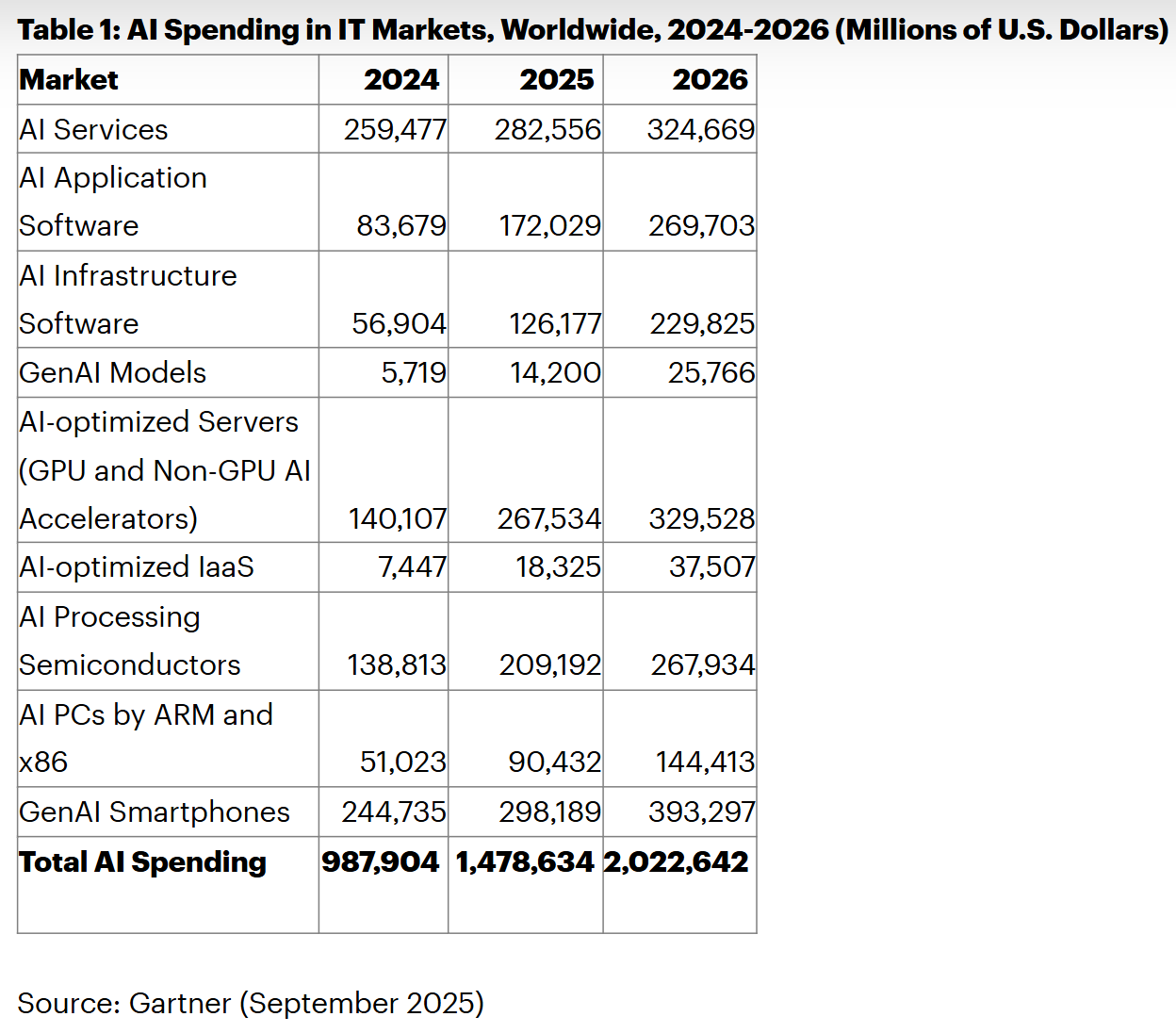
"The forecast assumes continued investment in AI infrastructure expansion, as major hyperscalers continue to increase investments in data centers with AI-optimized hardware and GPUs to scale their services,” said John-David Lovelock, Distinguished VP Analyst at Gartner.
Whether it’s a new set of pilot projects or moving from initial tests to full production, companies are looking to deploy AI more extensively than they have in the past. AI PC purchases, and the flexibility that comes with being able to run workloads locally, optimizing performance, and inference costs are an important part of that process.
When it comes to financial muscle, mid-market corporations typically aren’t quite as deep as large enterprises. The same lean operating principles and resource allocation that works well for the middle market in other contexts can leave them at a disadvantage relative to larger competitors when it comes to AI. Mid-market companies are looking to leverage many of the same AI advantages as enterprise customers, but cannot always afford the same degree of solution testing and pathfinding. They need technology partners that can help them level the playing field without the additional complexity and cost that often accompanies large enterprise deployments.
Enter AMD
AMD is one of the only companies with an end-to-end AI compute portfolio that spans from cloud to edge to endpoints across the enterprise. Whether you are looking to deploy artificial intelligence across commercial PCs, cloud, or hybrid services, AMD solutions deliver the enterprise-class performance and efficiency mid-sized companies need. From the launch of the first x86 processors with an integrated neural processing unit (NPU) in January 2023 to its extensive AI acquisitions across the computing industry, AMD is dedicated to building flexible compute pipelines that scale with you rather than forcing customers into a one-size fits all approach.
The NPU in every AMD RyzenTM AI and Ryzen AI PRO processor is capable of over 40 trillion AI operations per second. This allows some AI workloads to run efficiently directly on a local device rather than pushing every workload into the cloud. In the data center, AMD InstinctTM GPUs and EPYCTM server CPUs provide the compute engines AI and non-AI applications rely on. The high core counts and excellent efficiency of AMD EPYC server CPUs can help mid-size businesses consolidate their server needs by reducing data center physical footprints by as much as 87%1. Per-socket licensing costs and overall power consumption may drop if companies take advantage of the density advantage AMD EPYC server CPUs offer compared to competitor processors.
And AMD doesn't just design silicon and its associated software. We foster and maintain relationships with independent software vendors across the entire compute industry, helping to ensure that applications run well on every AMD platform and product. AI software developers can take advantage of AMD ROCmTM platform, a free, open-source software stack for GPU computing with no licensing fees or associated cost, or use Windows ML (Machine Learning) to develop ONNYX AI models for local execution on the CPU, GPU, or NPU.
In hardware, AMD has forged alliances with the top commercial PC and server manufacturers in the world, including Dell, HP, HPE, Lenovo, and Supermicro to make our processors available across the widest range of solutions providers. Additionally, AMD Infinity Guard and AMD PRO technologies provide enterprise-grade security and management tools across all EPYC, Ryzen PRO, and Ryzen AI PRO processors, streamlining the management of data center and client infrastructure life cycles at scale.
Conclusion
Middle market organizations are fully capable of punching above their weight class, provided they have the tools to do so. By partnering with AMD, IT leaders gain access to advanced technology expertise that supports the development and implementation of their AI initiatives. They can innovate without overspending and leverage cutting-edge technology to drive ROI. This combination of high-performance, energy-efficient compute, built-in security, and open infrastructure helps IT teams accomplish big goals while controlling the cost and complexity of any associated AI rollouts. Partnering with AMD means trading yesterday's limits for tomorrow's possibilities, and the tangible benefits those possibilities can deliver.
1 - This scenario contains many assumptions and estimates and, while based on AMD internal research and best approximations, should be considered an example for information purposes only, and not used as a basis for decision making over actual testing. The AMD Server & Greenhouse Gas Emissions TCO (total cost of ownership) Estimator Tool - version 1.12, compares the selected AMD EPYC and Intel® Xeon® CPU based server solutions required to deliver a TOTAL_PERFORMANCE of 391000 units of SPECrate2017_int_base performance as of October 10, 2024. This estimation compares a legacy 2P Intel Xeon 28 core Platinum_8280 based server with a score of 391 versus 2P EPYC 9965 (192C) powered server with a score of 3000 (https://www.spec.org/cpu2017/results/res2024q4/cpu2017-20240923-44837.pdf) along with a comparison upgrade to a 2P Intel Xeon Platinum 8592+ (64C) based server with a score of 1130 (https://spec.org/cpu2017/results/res2024q3/cpu2017-20240701-43948.pdf). Actual SPECrate®2017_int_base score for 2P EPYC 9965 will vary based on OEM publications. Environmental impact estimates made leveraging this data, using the Country / Region specific electricity factors from the 2024 International Country Specific Electricity Factors 10 – July 2024, and the United States Environmental Protection Agency 'Greenhouse Gas Equivalencies Calculator'. For additional details, see https://www.amd.com/en/legal/claims/epyc.html#q=epyc4#SP9xxTCO-002A.
2- Gartner press release, Gartner Says Worldwide AI Spending Will Total $1.5 Trillion in 2025, September 17, 2025
GARTNER is a registered trademark and service mark of Gartner, Inc. and/or its affiliates in the U.S. and internationally and is used herein with permission. All rights reserved.

Related Blogs
-
From Vector Search to Agentic RAG: Building an Enterprise Research Analyst with hipVS — ROCm Blogs
Learn how to build an agentic RAG research assistant using hipVS GPU-accelerated vector search on AMD Instinct GPUs, with multi-query decomposition, parallel retrieval, and cited sources synthesis.
July 14, 2026
-
When a Faster Kernel Doesn’t Speed Up Serving: Profiling FP8 KV Cache on AMD Instinct MI308X — ROCm Blogs
Learn how a 34% faster FP8 KV cache kernel delivered 0% E2E speedup, and how profiling attribution exposed the hidden dtype-cast cost on MI308X.
July 14, 2026
-
What to Expect at AMD Advancing AI 2026
Get a preview of AMD Advancing AI 2026, including key themes, sessions, and innovations shaping the future of AI. Discover how industry leaders are coming together to explore real-world use cases and strategies for scaling AI across the enterprise.
July 14, 2026
-
Local Image and Video Generation on AMD Ryzen™ AI Max+ Processor (Windows) — ROCm Blogs
Run ComfyUI natively on Windows on AMD Ryzen AI Max+ with ROCm 7.2.1—SDXL, Flux, and video workflows on the Radeon 8060S, no WSL.
July 13, 2026
-
Announcing the ROCm Certification Program
Build AI and HPC expertise on AMD Instinctt™ GPUs. Earn the ROCmt™ Certification with hands-on, production-ready skills.
July 13, 2026
-
Triton-Based Optimization of Video Sparse Attention on ROCm — ROCm Blogs
Optimize video sparse attention on ROCm with GEAK and linear global context for faster, more stable video generation on AMD GPUs.
July 12, 2026
-
QuickReduce INT3 Quantization and Benchmarking on MI355 — ROCm Blogs
Learn how QuickReduce uses INT3 quantization to accelerate all-reduce communication and evaluate its performance and accuracy on AMD Instinct MI355 GPUs.
July 12, 2026
-
GEAK Agent-Driven Optimization of the DeepSeekV4 MLA Kernel — ROCm Blogs
GEAK Agent accelerates DeepSeekV4 MLA kernel optimization with Triton and delivers SGLang E2E gains on AMD GPUs.
July 12, 2026