Three Tracks, One GPU: Lessons from the AMD DevMaster Hackathon
Aug 26, 2026
What happens when developers are given the freedom to build across three rapidly evolving areas of AI? At the AMD DevMaster Hackathon, nearly 3,900 participants took on the challenge across Multimodal AI, Agentic AI, and Physical AI, using AMD Radeon™ GPUs and the AMD ROCm™ software to turn their ideas into working applications. Looking across the submissions, three clear lessons emerged.
Lesson 1: The best multimodal applications solve a specific problem
The Multimodal AI track challenged developers to combine text, images, video, audio, and visual generation into practical experiences. With over 1,500 registrations, it was the second-largest track. The strongest submissions focused on applying multimodal capabilities to clearly defined user needs. The top three winning projects included:
- 1st Place: Team Rivet developed an intelligent advertising tool that helps small and micro businesses create and review commercial advertisements.
- 2nd Place: Team austin1997 created an accessibility tool that automatically generates voice narration for videos, helping make video content more accessible to visually impaired users.
- 3rd Place: Team N DIVIJ built a voice-driven storybook creation tool that turns spoken input into complete children’s story videos.
The other five teams among the top eight received Excellent awards: team Junjun Liu, team icuic, team peace_&_love, team panbu2007, and team gaojie.
The lesson: Multimodal AI becomes more valuable when multiple capabilities come together to solve a clearly defined problem. The submissions also demonstrated that Radeon GPUs can provide capable local compute for these workloads, helping developers build responsive experiences while keeping processing closer to the user.
Lesson 2: Effective agents need to reason, act, and verify
The Agentic AI track attracted the largest field, with over 1,700 approved registrations. Participants built local agents capable of reasoning, tool use, memory management, and task execution, with a strong emphasis on Radeon GPU and ROCm optimization. Top submissions treated inference and execution as core design constraints. Examples included a multi-agent financial research system on a ROCm-optimized runtime, a coding agent built with a custom HIP inference engine, and a QA agent combining retrieval, rule-based logic, automated testing, and human validation.
- 1st Place: Team SignalForge Labs built a locally deployed financial research workbench that gives individual investors a private environment for AI-powered research and analysis.
- 2nd Place: Team Aetheris Blackbox showcased a fully localized programming agent that supports both desktop and terminal environments.
- 3rd Place: Team Xieweikai created an enterprise customer service compliance agent that uses AI to inspect interactions and identify potential compliance issues.
The other five teams among the top eight received Excellent awards: team DarthCeltic, team 2SIN, team abidedavana, team Hipscope, and team himanshu748.
The lesson: Effective agents require more than reasoning ability. They must also execute reliably, run efficiently on local hardware, and produce verifiable outputs.
Lesson 3: Physical AI connects intelligence to the real world
The Physical AI track had over 500 registrations, spanning robotics, simulation, navigation, and embodied intelligence. A key theme among the strongest projects was sim-to-real: connecting what an AI system learns in simulation with how it performs in the physical world. Several projects also contributed to upstream open-source robotics ecosystems, reinforcing the importance of shared infrastructure.
- 1st Place: Team Binh Pham demonstrated a full-stack physical simulation, rendering, and reinforcement-learning environment running on a single Radeon GPU, bringing training and inference together for physical AI workloads.
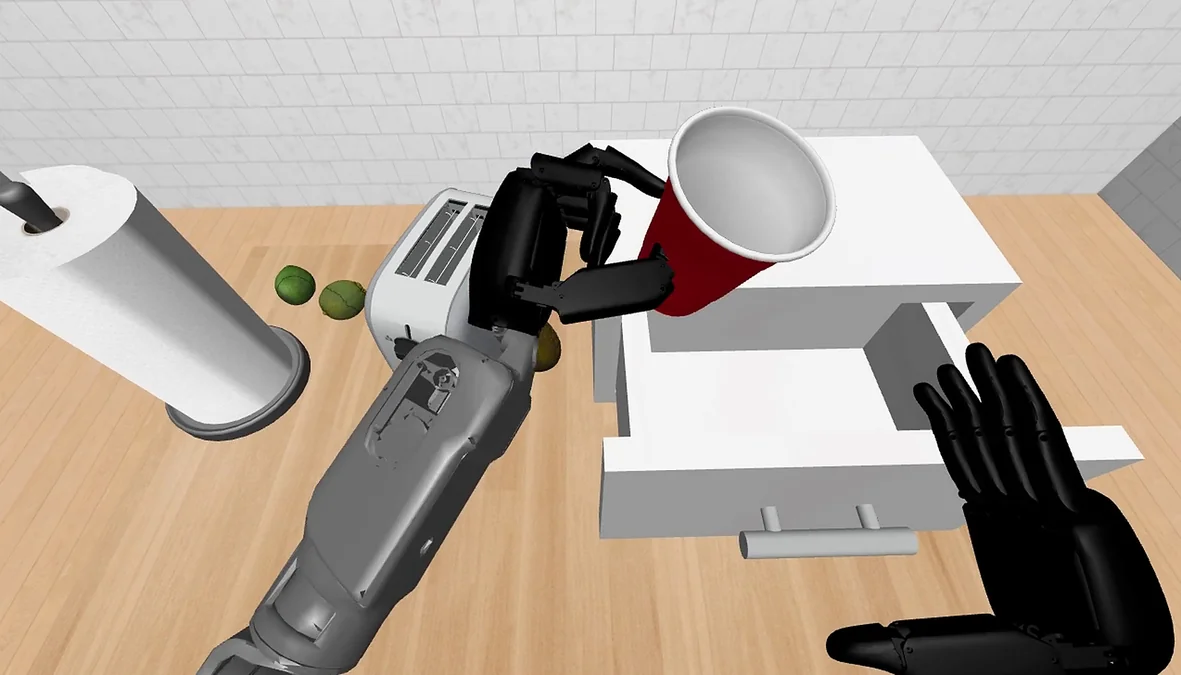
- 2nd Place: Team KINESYS developed a ROCm-native humanoid robot manipulation pipeline and demonstrated it through a real-world task involving retrieving tableware from a dishwasher.
- 3rd Place: Team Wenjie Ouyang introduced a solution that generates robot motion-control policies from monocular human videos, translating observed human movement into robotic behavior.
The other five teams among the top eight received Excellent awards: team Enoch, team Akbro23, team Yuhao Cao, team Robotics Gemini, and team Phi Media Lab.
The lesson: Physical AI requires more than an intelligent model. Simulation, compute, robotics software, and real-world behavior must work together.
Three tracks, one common theme
Across all three tracks, one theme was consistent: practical AI is no longer just about model capability. Developers are building systems that create, reason, act, and interact with the world, while treating hardware and software as part of the application itself.
Ready to keep building?
Join the AMD AI Developer Program to access cloud credits, free premium training, and a community of developers building the future of AI on AMD hardware.
The hackathon may be over, but the work it showcased is only beginning.

Related Blogs
-
NeuroSpark Expands AI Compute Choice with AMD
NeuroSpark uses AMD Instinct GPUs and ROCm software on OCI to deliver flexible, cost-effective AI training and inference
October 23, 2026
-
Sovereign AI for European Customer Conversations
LeadDesk, QuTwo, and AMD Silo AI collaborate on a sovereign AI stack that brings near-frontier, open-weight models to European customer conversations.
October 22, 2026
-
Scaling 3D Gaussian Splatting with Distributed Compute: Why One GPU Is Never Enough — ROCm Blogs
Learn how to scale 3D Gaussian splatting across GPUs with distributed training, RCCL, and real-world optimization tips for AMD Instinct GPUs
October 22, 2026
-
FP8 GEMM Optimization on AMD RDNA™ 4 Architecture — ROCm Blogs
Learn how to port an FP16 GEMM kernel to FP8 on AMD RDNA 4 and use the smaller element size to unlock larger tiles and deeper K slices.
October 22, 2026
-
Micro-World 2: Streaming Real-time Interactive World Model — ROCm Blogs
This blog demonstrates how Micro-World 2 combines precisely annotated action data, four-step diffusion distillation, and ROCm-optimized inference to deliver controllable, long-horizon, real-time world generation on a single AMD Instinct GPU through a fully open-source pipeline.
October 20, 2026
-
MoE Training Optimization with Primus — ROCm Blogs
Learn how to speed up MoE training on AMD Instinct GPUs with Primus: a fused MoE megakernel, FP8/MXFP8 expert GEMMs, and training-at-scale tuning.
October 20, 2026
-
Optimizing World Action Models on AMD GPUs — ROCm Blogs
Speed up World Action Models on AMD GPUs with GEAK kernels, fewer denoising steps, and latent actions, cutting FastWAM latency 25× at about 97 percent success.
October 20, 2026
-
Bringing Ultra-Fast, Interactive LLM Inference to AMD Instinct™ MI355X GPUs — ROCm Blogs
Accelerate single-request LLM inference on AMD Instinct MI355X with megakernels, speculative decoding, and MXFP4 for 1.9-3.3x faster decode.
October 19, 2026