The FFT on the 5G Critical Path: How AOCL-FFTZ speeds up the OCUDU PHY on AMD EPYC™ Server CPUs
Nov 23, 2026

TL;DR - We benchmarked AOCL-FFTZ 6.0.0, AMD's high-performance FFT library, inside OCUDU, an open-source 5G CU/DU in which it is integrated natively as a backend of the DFT processor. We compared it head-to-head with FFTW 3.3.10 across the 18 DFT sizes the OCUDU PHY uses most, on a dual-socket AMD “Zen 5” architecture ("Turin"‑class).
- On a single core, AOCL-FFTZ runs about 1.86× faster than FFTW on average across all 18 sizes, and up to 2.49× faster on the best size (4096).
- That advantage holds almost perfectly steady, at about 1.84×, at every core count from 1 to 256 and with every core-binding scheme we tried.
- With all 256 cores busy, the server sustains an average of ≈327 GSps per transform size with AOCL-FFTZ, versus ≈176 GSps with FFTW.
- Core binding matters as much as the library at high core counts: spreading Layer-1 work across CCX and NUMA domains held 94% scaling efficiency at 128 cores, where packing fell to 78%.
- No code rewrite: AOCL-FFTZ is a one-flag build option in OCUDU, under a permissive BSD-3-Clause license.
1. 5G Layer-1 is software now — and the FFT runs on every symbol
Virtualized RAN (vRAN), together with the open interfaces standardized by O-RAN, has moved 5G baseband processing — including much of the physical layer (PHY, or Layer 1) — off proprietary, vendor-locked appliances and onto commercial off-the-shelf (COTS) servers powered by general-purpose CPUs. AMD has been an active part of that shift: AMD EPYC™ platforms run software vRAN demonstrations and deployments with partners such as Software Radio Systems (SRS) (AMD Expands Telco Partner Ecosystem), and AMD has written about the economics of running Layer 1 on EPYC™ cores (Rewriting the Rules of 5G with AMD EPYC™ Processors, Advancing vRAN Economics with AMD EPYC™ 8005 Server CPUs).
When the PHY runs in software, one signal-processing operation sits on its critical path over and over: the Fast Fourier Transform (FFT). 5G NR is an OFDM system, so every transmitted OFDM symbol is synthesized with an inverse FFT (IFFT), and every received symbol is recovered with a forward FFT — per carrier, per antenna, per symbol. At 30 kHz subcarrier spacing that is one transform every ≈36 µs on every antenna, which adds up to hundreds of transforms per millisecond for a single 4T4R cell and thousands across a multi-cell DU, all inside a hard real-time slot budget.
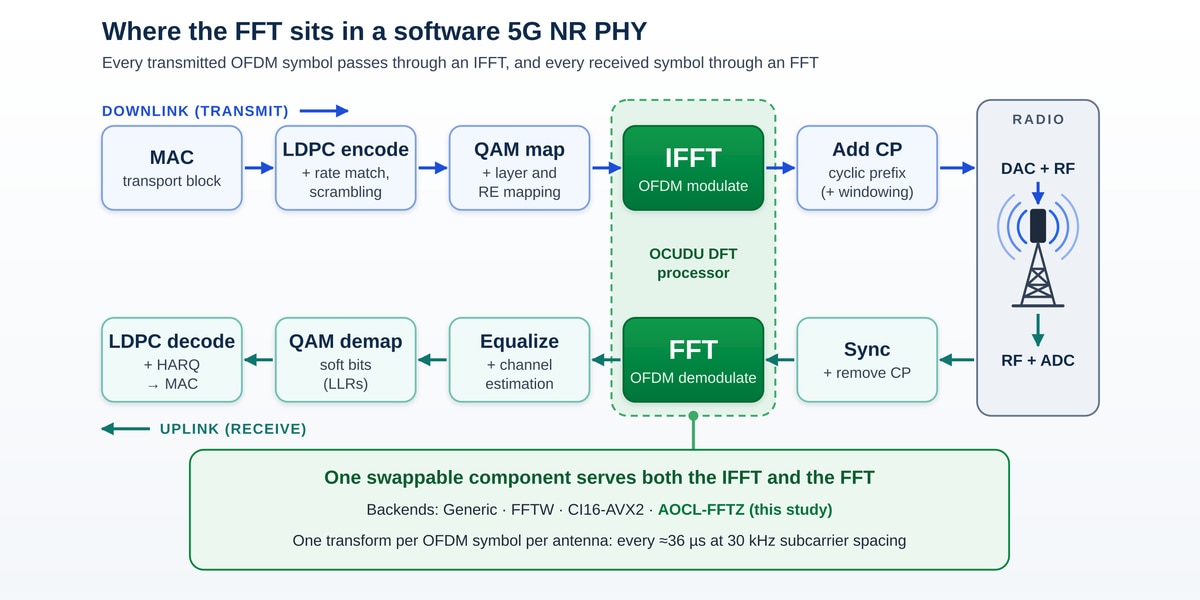
Read the top row of Figure 1 from left to right for the downlink. The MAC hands down a transport block, which is LDPC-encoded, rate-matched, and scrambled; mapped to QAM symbols and placed on the resource grid; converted into a time-domain OFDM symbol by the IFFT; given a cyclic prefix (CP); and passed to the radio for digital-to-analog conversion and RF transmission. The bottom row is the uplink mirror image, read from right to left: the radio digitizes the received signal, the receiver synchronizes and removes the cyclic prefix, the FFT returns the symbol to the frequency domain, and channel estimation, equalization, soft QAM demapping, and LDPC decoding with HARQ recover the transport block for the MAC.
An FFT is also not a single kernel. An FFT library factors each transform size into a plan of smaller sub-problems, handled by solvers such as Cooley-Tukey mixed-radix decomposition or Bluestein's algorithm, and then executes those stages with tuned, vectorized kernels. Because a 5G PHY runs the same handful of sizes over and over, how well that decomposition and those kernels fit the CPU decides the throughput. AOCL-FFTZ is a high-performance, FFTW-API-compatible replacement built for exactly this: existing FFTW-based code can adopt it seamlessly and run faster, and in OCUDU it is wired in natively.
2. Meet OCUDU and its pluggable DFT processor
OCUDU is an open-source 5G CU/DU stack (srsRAN lineage) designed to run on commodity servers. Its PHY routes its DFTs — OFDM modulation and demodulation, PRACH processing, and a few uplink estimators — through one abstraction, the DFT processor, behind which any of several backends can be selected at build time (Table 1).
Backend | What it is | Notes |
Generic | Portable C++ mixed-radix DFT (radix 2, 3, and 5) | Always available; the correctness baseline |
FFTW 3.3.10 | The de facto open-source FFT library (fftw.org) | Planned with FFTW_ESTIMATE by default |
CI16-AVX2 | Hand-written 16-bit fixed-point AVX2 DFT | Powers of two only (up to 8192); integer data path |
AOCL-FFTZ | AMD's high-performance FFT library for “Zen” CPUs | The focus of this study; integrated natively |
This study compares FFTW and AOCL-FFTZ. Both, like the Generic backend, compute the same operation here: a 1-D, out-of-place, complex-to-complex, single-precision transform (std::complex<float>, 8 bytes per sample), one transform per call (not batched), in the forward and inverse directions. That is the call shape OCUDU's PHY issues for OFDM modulation and demodulation and for PRACH processing. CI16-AVX2 computes the same transform in 16-bit fixed point, so it is not part of this floating-point comparison.
The benchmark covers the 18 DFT sizes OCUDU uses most — 6 powers of two and 12 mixed-radix sizes of the form 2a·3b:
- Powers of two (6): 128, 256, 512, 1024, 2048, 4096
- Mixed-radix 2a·3b (12): 384, 768, 1536, 3072, 4608, 6144, 9216, 12288, 18432, 24576, 36864, 49152
The mixed-radix sizes matter: many 5G NR transform sizes are not powers of two (for example, 1536 and 3072 come from NR's common sampling rates), and that is historically where generic FFT libraries struggle most.
Integration note. AOCL-FFTZ is integrated natively in OCUDU as a first-class DFT-processor backend (lib/phy/generic_functions/dft_processor_fftz_impl.cpp), contributed by the OCUDU open-source community. It calls AOCL-FFTZ's own API (aoclfftz_setup_f() and aoclfftz_execute()) rather than going through an FFTW compatibility layer. Turning it on takes a single CMake switch, -DENABLE_FFTZ=ON, with no changes to OCUDU's PHY code.
Benchmark used. All numbers come from OCUDU's own dft_processor_benchmark, run as dft_processor_benchmark -R 5000 across the 18 sizes. The single-thread results come from that benchmark directly; the multi-core results run many copies of it at the same time, one per core (Section 4).
3. Why not just use FFTW?
FFTW is excellent and ubiquitous, but for a commercial, real-time 5G DU it has four practical drawbacks that AOCL-FFTZ was designed to address:
- Planning cost and predictability: FFTW reaches its best performance with FFTW_MEASURE or FFTW_PATIENT, which time candidate plans at setup — a cost that grows with transform size and planning rigor and must be repeated, or managed through saved "wisdom" files, on each machine. OCUDU therefore defaults to FFTW_ESTIMATE, which plans heuristically and can leave performance on the table. AOCL-FFTZ's Selector finds a solution at setup time without a measurement sweep, so setup is fast and the solution it executes is still well tuned.
- Architecture utilization: FFTW's auto-generated "codelets" are hard to retune and don't always make optimal use of AVX-512 or the “Zen 5” FMA pipeline. AOCL-FFTZ ships hand-tuned AVX-128/256/512 kernels with a runtime dispatcher that selects the best ISA for the CPU it lands on.
- Scaling across cores: A DU consolidates many cells on one many-core server, so FFT performance must hold up as more cores are busy at once. AOCL-FFTZ is designed for this: its kernels are cache-aware, it also offers OpenMP multithreading within a transform, and AOCL-FFTZ 6.0.0 adds a thread-safe execution call (aoclfftz_execute_io) for sharing one plan across threads. OCUDU does not split a transform across threads; it runs many single-threaded transforms in parallel (Section 4), and in that mode AOCL-FFTZ's per-core advantage holds all the way to 256 cores (Sections 5.2–5.4).
- Licensing: FFTW is licensed under the GPL (a commercial license is sold separately), which is a hurdle for many ISVs shipping closed-source network software. AOCL-FFTZ uses a permissive BSD-3-Clause license, so it can be embedded and redistributed without GPL obligations.
AOCL-FFTZ is AMD's in-house high-performance FFT library for “Zen”-based CPUs, shipped as part of the AMD Optimizing CPU Libraries (AOCL). It debuted in AOCL 5.2 (January 2026) and gained FFTW3 API compatibility and new solver types in AOCL 5.3 (May 2026); this study uses AOCL-FFTZ 6.0.0, released with AOCL 6.0 (AOCL 6.0 release notes, API guide, GitHub release). It supports single and double precision, real and complex data, forward and backward transforms, 1-D and multi-dimensional sizes, in-place and out-of-place layouts, and OpenMP multithreading.
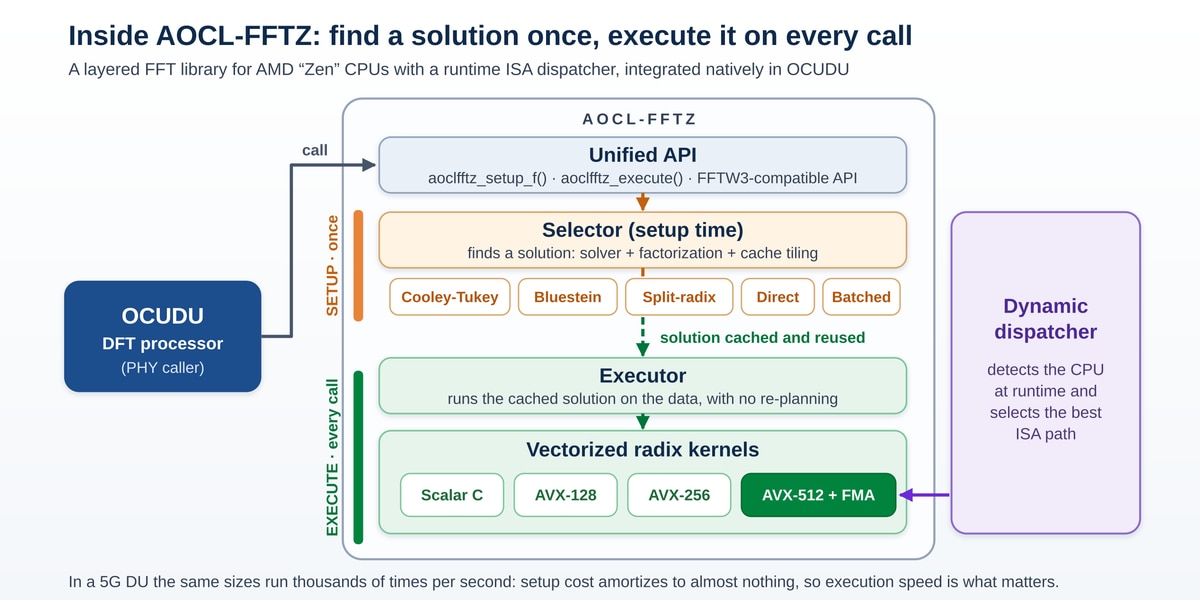
As Figure 2 shows, a unified API feeds the Selector (setup time), which finds a solution for the FFT problem: it chooses a solver (for example Cooley-Tukey, Bluestein, split-radix, direct, or batched), a factorization (how to break a size into a cascade of small radix stages), and a cache-tiling strategy. The Executor then runs that cached solution over the data with vectorized radix kernels, and a dynamic dispatcher detects the CPU at runtime and selects the best instruction-set path (AVX-512 with FMA on “Zen 5”). In a 5G DU the same sizes run thousands of times per second, so the one-time setup cost amortizes to almost nothing and execution speed is what counts — which is precisely what AOCL-FFTZ optimizes.
4. How we measured
- System under test — a dual-socket 5th Generation AMD EPYC™ Server CPU system:
- Cores: 2 × 128 = 256 physical cores (512 logical with SMT).
- Cache: 32 CCXs of 8 cores, each CCX sharing 32 MB of L3 cache.
- Memory topology: 8 NUMA nodes (NPS4, 4 per socket); 12 DDR5 channels per socket, ~614 GB/s per socket (theoretical peak).
- Vectorization: full-width AVX-512.
- OS and toolchain: Ubuntu 24.04 (Linux kernel 6.8), GCC 13.3, -O3.
- These specifications are consistent with the AMD EPYC™ 9005 architecture overview (8 cores and 32 MB of L3 per CCX).
Software and metric:
- Benchmark: OCUDU's
dft_processor_benchmark, run asdft_processor_benchmark -R 5000. - Repetitions and metric: 5000 repetitions per size and direction; we report the median (50th-percentile) throughput in MSps (millions of samples per second).
- Direction: we report the forward transform; the inverse shows the same picture (1.82× average single-core speedup versus 1.86× forward).
- Libraries: AOCL-FFTZ 6.0.0 (built from source, native API) versus FFTW 3.3.10 (single precision, built with SSE2, AVX, AVX2, and AVX-512 support, planned with
FFTW_ESTIMATE, the default in both OCUDU and the benchmark).
Single-thread (ST):
- One transform at a time, pinned to a single core: the raw per-core FFT throughput.
Multi-core (multi-instance) — stream-parallel:
- How OCUDU parallelizes FFTs: OCUDU never splits one transform across threads. Each DFT-processor call is single-threaded (AOCL-FFTZ is configured with one thread, and FFTW plans are not threaded). Parallelism comes from the application: worker threads process different cells, antennas, and OFDM symbols at the same time, and each concurrent task uses its own DFT-processor instance.
- How we measured it: we run N copies of the benchmark at the same time, each a single-threaded process pinned to its own physical core with
numactl --physcpubind … --localalloc, and sum their median throughputs into an aggregate throughput. This measures how many independent FFT streams one server sustains; it is not a multi-threaded FFT. - Scaling efficiency = aggregate throughput ÷ (N × single-core throughput).
- Sweep: N = 1, 8, 16, 24, 32, 64, 128, 256, under two core bindings:
- Packed - fill one socket (and its CCXs) first;
- Spread - distribute instances across CCXs, NUMA nodes, and both sockets.
Fairness and scope:
- Both libraries run the same single-precision, out-of-place, one-transform-per-call workload with the same sizes, repetitions, cores, and memory-allocation policy.
- FFTW uses
FFTW_ESTIMATEbecause that is OCUDU's default. Measured planning (FFTW_MEASURE) can find faster FFTW plans in exchange for a timed search at setup; we did not evaluate it here. - All results come from a single test system. Treat absolute throughput as indicative and the speedup ratios as the portable result; results depend on CPU, transform size, and threading model, so re-measure on your target platform.
5. Results
5.1 Single core: about 1.86× across the board
Across all 18 sizes, AOCL-FFTZ beats FFTW on every size, by 1.29x to 2.49x, and by about 1.86x on average (Figure 3). A single “Zen 5” core sustains up to ~2.56 GSps with AOCL-FFTZ (at size 1024).
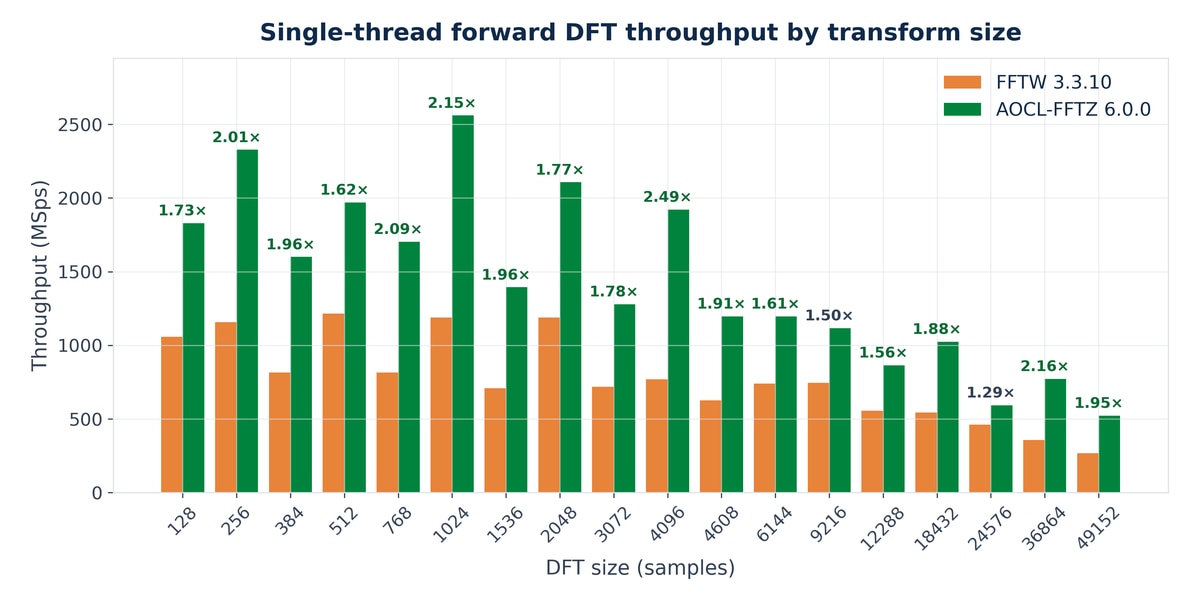
The wins are broad, not cherry-picked. AOCL-FFTZ averages 1.96x on the power-of-two sizes (4096: 2.49x, 1024: 2.15x) and 1.80x on the mixed-radix sizes (36864: 2.16x, 768: 2.09x, 4608: 1.91x). Strong results on the non-power-of-two sizes matter because that is where generic FFT libraries tend to stall.
5.2 Scaling to a full 256-core server
Because each core runs an independent transform stream, aggregate throughput scales almost linearly, and AOCL-FFTZ tracks the ideal-scaling line a constant factor above FFTW the entire way (Figure 4).
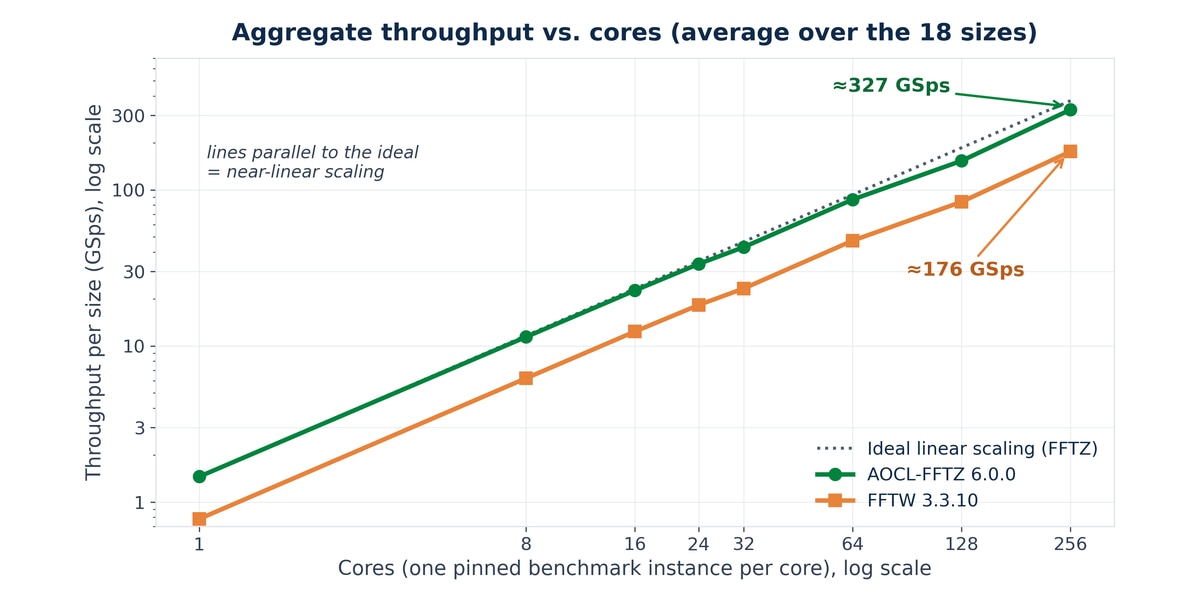
AOCL-FFTZ stays at least 92% efficient through 64 cores. With all 256 cores busy, it sustains ≈327 GSps per transform size on average, versus ≈176 GSps for FFTW. The single-core advantage is preserved, not eroded, at full machine scale.
5.3 The speedup is constant at every scale and binding
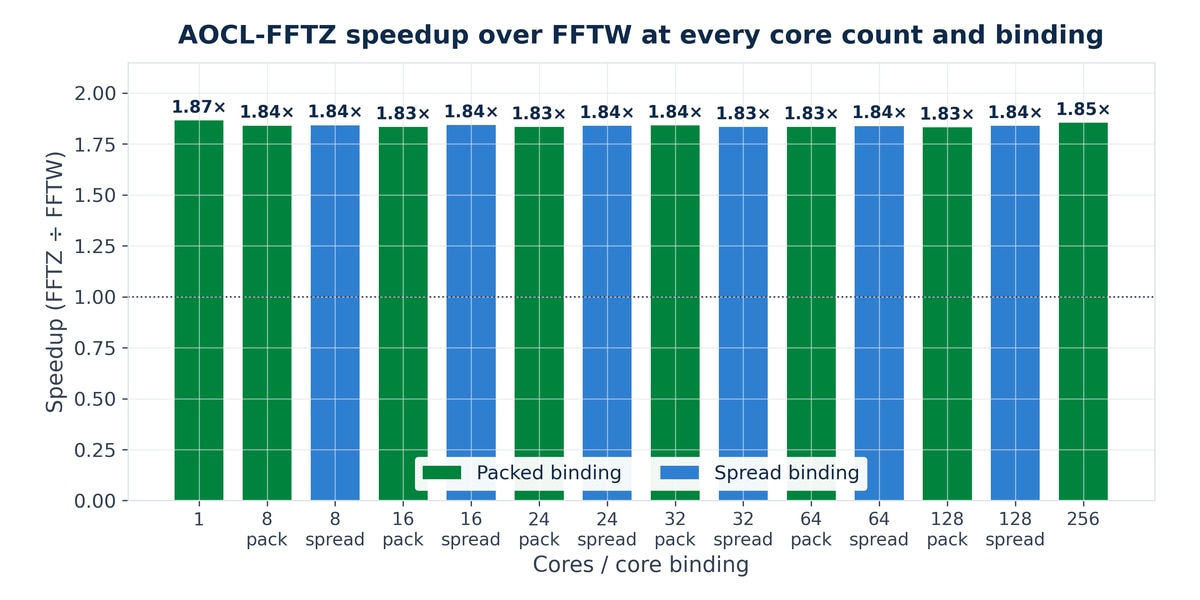
This is the most important chart for a capacity planner. Whether you run 1 core or 256, packed or spread, AOCL-FFTZ delivers 1.83-1.87x the throughput of FFTW — for example, +84% at 8 cores. The advantage is a property of the library, not an artifact of a particular core count or placement, so it carries straight into provisioning math.
5.4 Core binding is a first-class deployment lever
At low and moderate core counts, placement barely matters. At high core counts it dominates, because filling one socket saturates that socket's shared L3 caches and memory channels (Figure 6).
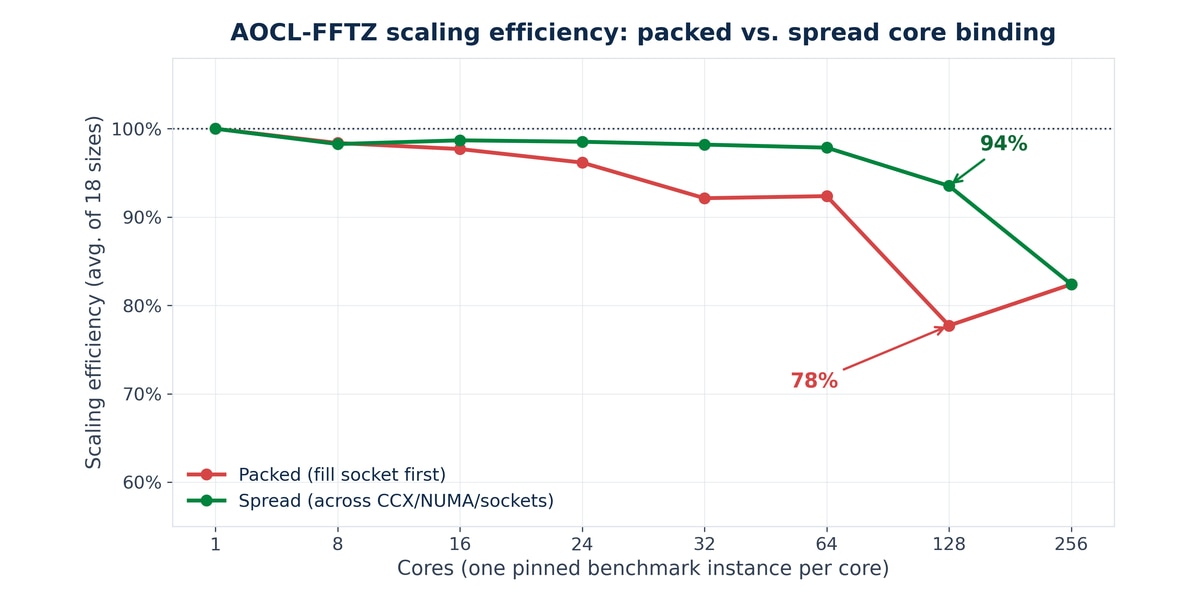
At 128 cores, packing a single socket dropped to 78% efficiency as instances contended for one socket's L3 and DRAM, while spreading across CCXs, NUMA nodes, and both sockets held 94%. At 256 cores (the whole machine) the two converge at about 82%, because there is nowhere left to spread. Takeaway for operators: pin Layer-1 worker threads across CCX and NUMA domains and keep each stream's buffers node-local — a free, roughly 16-point efficiency gain at high density.
6. What this means for a 5G operator
FFT throughput is not an academic score; it converts directly into RAN economics:
- More cells, carriers, or layers per server. A constant ~1.85× on the DFT work frees PHY CPU time that can go to more carriers, more MIMO layers, or more cells consolidated onto the same AMD EPYC™ server — the lever behind AMD's vRAN economics and 5G on EPYC™ work.
- Slot-budget headroom. A faster transform shortens OFDM modulation and demodulation, leaving more of the hard 5G slot deadline for scheduling, equalization, and channel decoding.
- No offload card needed for the FFT. These are CPU-only numbers. Where the DU runs OFDM processing itself, the FFT stays on the host cores, which simplifies the platform and avoids extra card cost, power, and integration work.
- A license you can ship. BSD-3-Clause AOCL-FFTZ can be embedded in a commercial DU where GPL-licensed FFTW raises legal obstacles.
- A placement playbook. Section 5.4 gives a concrete, free tuning rule (spread across CCX and NUMA domains, keep buffers local) that scales Layer 1 cleanly to high core counts on 5th Generation AMD EPYC™ CPUs.
- And because it is a one-flag build change, it is about as low-risk as a performance upgrade gets.
7. Reproduce it yourself
Everything here can be reproduced on a clean machine. The single-thread numbers are produced by OCUDU's own benchmark, dft_processor_benchmark, exactly as it ships, while the multi-core numbers come from a small wrapper we wrote (run_mt_benchmark.sh) that launches many copies of that same OCUDU binary at once, each pinned to its own core. A step-by-step repeatability guide covers cloning and building OCUDU, FFTW 3.3.10, and AOCL-FFTZ for each backend.
The three steps, as shell commands (lines starting with # are comments):
		# 1) Build OCUDU with both FFT backends compiled in
cmake -B build -DENABLE_FFTW=ON -DENABLE_FFTZ=ON ...
cmake --build build --target dft_processor_benchmark

# 2) Single-thread baseline: OCUDU's own benchmark, one core, all 18 sizes
./build/tests/benchmarks/phy/generic_functions/dft_processor_benchmark -R 5000

# 3) Multi-core sweep: our wrapper pins N copies of the same OCUDU benchmark
#    (N = 1, 8, 16, 24, 32, 64, 128, 256; packed and spread core binding)
./run_mt_benchmark.sh
8. Key takeaways
Swap a “Zen”-tuned FFT library into one of the most frequently executed operations in a software 5G PHY, and the payoff is immediate, broad, and predictable:
- About 1.86x faster FFTs for one build flag. On a single “Zen 5” core, AOCL-FFTZ beats FFTW on all 18 sizes (1.29x-2.49x, about 1.86x on average), enabled with
-DENABLE_FFTZ=ONand no changes to OCUDU's PHY code. - The speedup holds at scale. It stays at an essentially constant ~1.84x at every core count from 1 to 256 and under every core-binding scheme tested, so it carries straight into capacity planning instead of eroding as you scale out.
- About 1.85× more FFT work from the same server. Throughput scales near-linearly to 256 cores, reaching ≈327 GSps per transform size with AOCL-FFTZ versus ≈176 GSps with FFTW, and stays at least 92% efficient through 64 cores.
- Placement is a free lever. Spreading Layer-1 work across CCX and NUMA domains held 94% efficiency at 128 cores, where packing one socket fell to 78% — a roughly 16-point swing at no cost, and a concrete tuning rule for operators.
- Broad, not cherry-picked. The gains cover powers of two (1.96x average) and the mixed-radix NR sizes (1.80x average, up to 2.16x at 36864).
- Shippable and CPU-only. A permissive BSD-3-Clause license (versus FFTW's GPL) and no GPU or FPGA offload mean denser vRAN with simpler platform economics on AMD EPYC™ CPUs.
Bottom line: for anyone building open, CPU-based 5G RAN on AMD EPYC™ CPUs, switching the OCUDU DFT processor from FFTW to AOCL-FFTZ is one of the cheapest, lowest-risk performance wins in the Layer-1 pipeline — a one-flag change that pays off from the first core to a full 256-core server.
References
- AOCL-FFTZ on GitHub — https://github.com/amd/aocl-fftz
- AOCL 6.0 API guide: AOCL-FFTZ — https://docs.amd.com/r/en-US/68552-AOCL-api-guide/AOCL-FFTZ
- AOCL 6.0 release notes: AOCL-FFTZ — https://docs.amd.com/r/en-US/63855-AOCL-release-notes/AOCL-FFTZ
- AOCL-FFTZ 6.0.0 release on GitHub — https://github.com/amd/aocl-fftz/releases/tag/6.0.0
- AMD Optimizing CPU Libraries (AOCL) — https://www.amd.com/en/developer/aocl.html
- AMD EPYC™ 9005 architecture overview — https://docs.amd.com/api/khub/documents/iZ5eCtQ5v6PyPN7wEd8HQg/content
- Advancing vRAN Economics with AMD EPYC™ 8005 Server CPUs — https://www.amd.com/en/blogs/2026/advancing-vran-economics-with-amd-epyctm-8005-server-cpus.html
- Rewriting the Rules of 5G with AMD EPYC™ Processors — https://www.amd.com/en/solutions/data-center/insights/rewriting-the-rules-5g-amd-epyc-processors.html
- AMD Expands Telco Partner Ecosystem and Showcases Advances in 5G & 6G, vRAN, OpenRAN at MWC 2024 — https://www.amd.com/en/blogs/2024/amd-expands-telco-partner-ecosystem-and-showcases-.html
- OCUDU 5G CU/DU source repository — https://gitlab.com/ocudu/ocudu
- FFTW — https://www.fftw.org/


Related Blogs
-
Introducing the AMD Global Physical AI Behavioral Safety Challenge
Discover the AMD Global Physical AI Behavioral Safety Challenge, inviting developers to build AI models that help robots interact safely with people.
November 23, 2026
-
AMD Life Science 26.08: A Complete Medical Imaging Stack on AMD Instinct™ GPUs — ROCm Blogs
Explore the AMD Life Science 26.08 medical-imaging stack on AMD Instinct™ GPUs, from image I/O through inference to annotation.
November 11, 2026
-
Adobe MAX 2026: AMD and Adobe Advance Creativity
Discover how AMD and Adobe help creators work faster with AI-powered performance, Ryzen AI Max systems, and Creator Sessions at Adobe MAX 2026.
November 10, 2026
-
MONAILabel 0.8.5 on AMD Instinct™ GPUs: Interactive Medical-Image Annotation — ROCm Blogs
Learn how to run MONAILabel 0.8.5 for interactive medical-image annotation on AMD Instinct™ GPUs.
November 08, 2026
-
Blackfuel: Building a Global Cloud for AI Inference
Blackfuel creates first AMD-powered inference deployment for more open, outcome-driven future for AI infrastructure
November 05, 2026
-
Bringing the MONAI Model Zoo to AMD Instinct™ GPUs: Validated Inference on ROCm — ROCm Blogs
Learn how to run validated inference for five MONAI Model Zoo bundles on AMD Instinct™ GPUs using a ROCm overlay.
October 29, 2026
-
Accelerating MONAI Digital-Pathology Pipelines on AMD Instinct™ GPUs with hipCIM — ROCm Blogs
In this blog you will measure a MONAI digital-pathology pipeline on AMD Instinct™ GPUs using hipCIM as the WSIReader backend.
October 25, 2026
-
Sovereign AI for European Customer Conversations
LeadDesk, QuTwo, and AMD Silo AI collaborate on a sovereign AI stack that brings near-frontier, open-weight models to European customer conversations.
October 22, 2026