Upscale Everything: Super-Resolution Across AMD Hardware
Jun 11, 2026
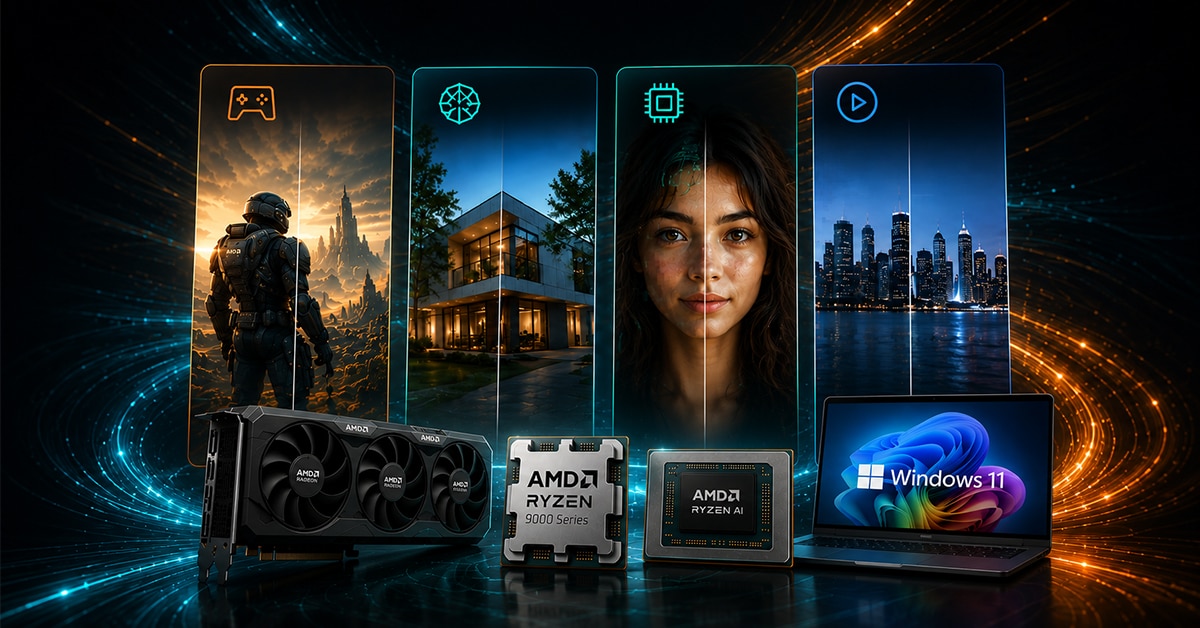
Super-resolution — the ability to reconstruct sharp, detailed images from low-resolution inputs — is already transforming how we game, communicate, and process visual data. AMD delivers super-resolution across its full hardware portfolio — discrete GPUs, CPUs, and NPUs. This blog covers four ways developers can implement or use super-resolution on AMD hardware, whether they are building games, building local AI apps with Lemonade, using the low-power NPU for inference, or using Microsoft’s AI Video Super Resolution:
- Gaming: AMD FSR™ brings ML-powered upscaling, frame generation, and ray-trace denoising to PC games on AMD Radeon™ GPUs (Figure 1).
- Lemonade: Lemonade is an open-source framework for serving AI models locally across AMD hardware, including super-resolution through the Real-ESRGAN model, exposed as a local REST API that applications can call and through a front-end component in the user interface (UI).
- NPU Inference: AMD Ryzen™ AI supports super-resolution inference on the NPU with quantized Real-ESRGAN and Super-Efficient Super Resolution (SESR) models. Refer to the the Ryzen AI SW repo with ready-to-run Hugging Face models.
- Microsoft’s AI Video Super Resolution (VSR): Microsoft’s VSR provides accelerated video upscaling on Copilot+ PCs, including AMD-based systems, to improve sharpness that would be lost due to poor network or bandwidth, compression, or low-quality content.


Figure 1: Horizon Forbidden West Complete Edition rendered at 1080p and upscaled to 4K on an AMD Radeon™ RX 9070 XT. The ML-powered FSR Upscaling (right) reduces ghosting on the moving character compared to FSR 3.1 (left). Source: AMD GPUOpen.
Gaming: AMD FSR Upscaling and Frame Generation
The most widely adopted super-resolution technology from AMD is the AMD FSR™, a collection of ML-powered rendering technologies built for gaming. Released in March of 2026, the AMD FSR™ “Redstone” SDK 2.2 includes 4 neural rendering features:
- FSR Upscaling 4.1
- FSR Frame Generation 4.0.0
- FSR Ray Regeneration 1.1.0, and
- FSR Radiance Caching 0.9 (in preview).
Crimson Desert by Pearl Abyss is the first game to ship with both FSR Upscaling 4.1 and FSR Ray Regeneration 1.1 (released on March 19, 2026).
FSR Upscaling
AMD FSR Upscaling is an ML-powered upscaler that reconstructs high-resolution frames from lower-resolution inputs. Trained on high-quality game data with AMD Instinct™ GPUs, it leverages dedicated ML acceleration in AMD Radeon RX 9000 Series. In Performance mode, FSR Upscaling renders 4K frames in approximately 1.3ms on an AMD Radeon RX 9070 XT.[1]
The FSR Upscaling 4.1 update brings inference updates for sharper images and improvements to Dynamic Resolution Scaling (DRS) for a smoother frame rate (AMD GPUOpen). Compared to previous FSR generations, FSR Upscaling delivers:
- Reduced ghosting on moving objects
- Improved preservation of particle effects
- Superior detail and temporal stability
An Unreal Engine (UE) 5 plugin is also available for versions 5.2 - 5.7.
BIG BONUS: Games that integrated FSR 3.1 can receive automatic upscaling updates with the latest AMD Software: Adrenalin Edition™, without requiring title-specific updates.
FSR Frame Generation
AMD FSR Frame Generation uses ML to generate high-quality intermediate frames between two consecutive rendered frames, predicting per-pixel motion and appearance to effectively double the frame rate. FSR Frame Generation achieves a 4.7x FPS increase over native rendering in Call of Duty: Black Ops 7 and Cyberpunk 2077 at 4K on an AMD Radeon RX 9070 XT, and 2.6x FPS increase in Grand Theft Auto V.[2]
FSR Ray Regeneration
AMD FSR Ray Regeneration is a standalone, ML-powered real-time denoiser that integrates with any game engine. It transforms noisy outputs from ray-traced workloads into clean, coherent images, and works best when combined with other FSR “Redstone” technologies. The 1.1 update includes quality and memory improvements along with new debug view modes.
Getting Started (Game Developers)
All technologies are packaged in the AMD FSR SDK 2.2, available on GitHub. The SDK uses pre-built, signed DLLs with the FSR API for easy integration. For gamers looking to enable FSR in supported titles, visit the AMD FSR Technologies page.
Lemonade: Super-Resolution as a Local API
Lemonade is an open-source model serving platform that helps users discover and run local AI by serving optimized LLMs, image models, and other multi-modal models, directly from GPUs, CPUs, and NPUs. Apps like n8n and Lemonade for GitHub Copilot already use Lemonade to run generative AI locally. With the addition of Real-ESRGAN support, Lemonade now serves 4x super-resolution as a local API that any application can call.
The API: Upscale Any Image Programmatically
Lemonade exposes a REST API that any script, application, or workflow can call to upscale images with Real-ESRGAN. First, make sure the Lemonade server is running — either launch the tray app, or start it from a terminal:
LemonadeServer
Send a base64-encoded image and a model name to `POST /api/v1/images/upscale` and receive the 4x-upscaled result. Here is a short Python script that upscales an image:
		import requests, base64

with open("photo.png", "rb") as f:
    image_b64 = base64.b64encode(f.read()).decode()

resp = requests.post("http://localhost:13305/api/v1/images/upscale", json={
    "model": "RealESRGAN-x4plus",
    "image": image_b64
})

upscaled = base64.b64decode(resp.json()["data"][0]["b64_json"])
with open("photo_4x.png", "wb") as f:
    f.write(upscaled)
Two ESRGAN models are available: RealESRGAN-x4plus for photorealistic content and RealESRGAN-x4plus-anime for illustrated styles. The models run on an AMD GPU with ROCm by default and CPU as backup, and auto-download on first use. Under the hood, Lemonade delegates to sd-cli -M upscale from stable-diffusion.cpp.
The Built-In User Interface
Lemonade also has a user interface, where you can try the super-resolution models directly (Figure 2). The Image Generation panel includes an Upscale dropdown: when a Real-ESRGAN model is selected, Lemonade generates an image with Stable Diffusion and then upscales it 4x. Both the original and upscaled images appear side by side and are downloadable.
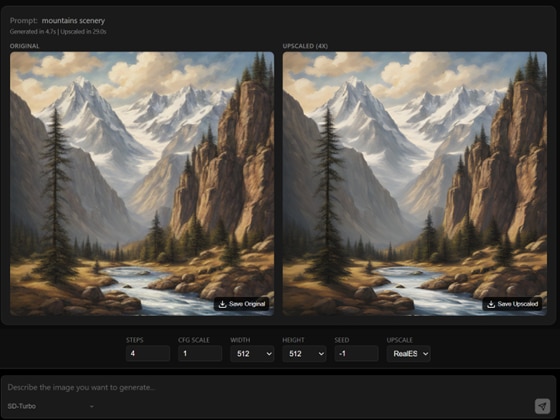
Figure 2: Lemonade’s Image Generation panel showing a Stable Diffusion output (left) and its 4x Real-ESRGAN upscaled version (right). Source: Lemonade.
To get started with Lemonade, visit lemonade-server.ai.
NPU Inference
For use cases where privacy, battery life, latency, or offloading operation are priorities, the AMD Ryzen AI NPU provides a dedicated, power-efficient inference path.
How It Works: Image Tiling on NPU
Processing a high-resolution image through a super-resolution model in a single pass can overwhelm available memory bandwidth. AMD’s approach breaks the input into smaller tiles that fit entirely in the NPU’s fast on-chip cache, processes each tile independently, and stitches the results back together — producing outputs identical to full-frame processing, with up to 40% lower latency (eg., 21 ms tiling vs. 35 ms full-frame).[3]
Because each tile stays in on-chip cache, the compiler can chain all model operations without writing intermediate results back to main memory. The runtime also reads tiles directly from the original image in place, avoiding buffer copies. For a full technical deep-dive, see Super Resolution Acceleration on Ryzen AI NPU. A C++ reference implementation of the tiling and zero-copy approach is open-sourced in the ImageTilingNPU repo. Zero-copy is a performance optimization step that allows the CPU and NPU to access the same physical memory, so that images need not be copied from one device to another.
Ready-to-Run Models on Hugging Face
AMD provides optimized super-resolution models on Hugging Face, quantized to INT8 and ready to run on any Ryzen AI PC. Figure 3 shows an example of running the Real-ESRGAN model to upscale a 320x480 pixel image up to 1280x1920. Find out more by visiting the model cards:
- amd/realesrgan-256x256-tiles-amdnpu — GAN-based 4x upscaling with strong perceptual quality
- amd/sesr-m7-256x256-tiles-amdnpu — A super-efficient CNN for 2x upscaling, ideal when speed and low power are the priority.
Input (320x480)

Output (1280x1920, 4x upscaled)

Figure 3: A 320x480 image upscaled to 1280x1920 by the Real-ESRGAN model running on an AMD Ryzen AI NPU. Source: EDSR Benchmark dataset.
Each model card includes inference scripts, pre-compiled model caches, evaluation tools, and benchmark results. After installing the Ryzen AI SW and activating the conda environment, getting started takes three commands:
		git clone https://hf.co/amd/realesrgan-256x256-tiles-amdnpu
cd realesrgan-256x256-tiles-amdnpu
python onnx_inference.py --onnx onnx-models/realesrgan_nchw_256x256_u8s8.onnx --input your_image.png --out-dir outputs --device npu
A complete walkthrough covering both model families is available in the RyzenAI-SW super-resolution example on GitHub.
Microsoft’s AI Video Super Resolution
For Windows application developers, super-resolution is becoming a platform-level capability. Microsoft’s Video Super Resolution (VSR) API provides AI-based video upsampling that runs on the NPU in Copilot+ PCs — including those powered by AMD Ryzen AI processors.
VSR accepts input from 240p to 1440p, produces output up to 1440p at 15–60 fps, and works through a straightforward VideoScaler API. Developers can integrate it without managing models or NPU scheduling directly.
Already Shipping: Teams Super Resolution
The most visible deployment of Video Super Resolution is in Microsoft Teams. Teams Super Resolution launched in general availability in March 2025 and automatically upscales low-bandwidth video feeds — for example, enhancing a 360p stream to a 720p viewport. In Microsoft’s own testing, “68% of users rated the super-resolution (SR) results as superior” to conventional upscaling, with “an average increase of +0.6 CMOS in quality” (Microsoft Teams Blog).
Video Super Resolution represents a broader opportunity for Windows developers: add a few API calls, and your application inherits hardware-accelerated super-resolution on AMD AI PCs.
Come Build with Us
AMD powers super-resolution at every level of the stack — from ML-accelerated rendering on Radeon GPUs, to local AI model serving with Lemonade, to inference on Ryzen AI NPUs, and to platform-level APIs in Windows. Whether you are a game developer, an application builder, or a researcher, there is an entry point for you.
Join the AMD AI Developer Program to get access to tools, resources, and a community of developers building on AMD hardware. And here is a great collection of other resources to build on AMD referenced throughout this article:
- AMD FSR SDK (gaming super-resolution): gpuopen.com/amd-fsr-sdk
- Lemonade (local AI server with super-resolution): lemonade-server.ai
- Super Resolution PR: PR #1176
- Ryzen AI Documentation: ryzenai.docs.amd.com
- Technical Deep-Dive — Tiling Strategy on NPU: Super Resolution Acceleration on Ryzen AI NPU
- Microsoft Video Super Resolution API: Get Started with AI Video Super Resolution
- AMD Developer Community Discord: discord.gg/amd-dev
- Hugging Face Model Cards:
Footnotes
[1] Performance measured on AMD Radeon™ RX 9070 XT using pre-release software. Source: AMD GPUOpen — FSR Upscaling Performance.
[2] Testing by AMD as of November 2025 on Sapphire Pure AMD Radeon™ RX 9070 XT, using an internal build of AMD Software: Adrenalin Edition driver and AMD FSR “Redstone.” System: ASRock X870E Taichi, AMD Ryzen 7 9800X3D, 32GB DDR5-6000MHz, Windows 11 Pro 25H2. Games tested at 4K native vs. FSR Upscaling Performance Mode + FSR Frame Generation enabled. FSR Ray Regeneration enabled for Call of Duty: Black Ops 7 only. Performance may vary by system configuration. Source: AMD GPUOpen — FSR Frame Generation endnote RS-707.
[3] Performance benchmarks from Super Resolution Acceleration on Ryzen AI NPU. See the article for full hardware and software configuration details.
Footnotes
[1] Performance measured on AMD Radeon™ RX 9070 XT using pre-release software. Source: AMD GPUOpen — FSR Upscaling Performance.
[2] Testing by AMD as of November 2025 on Sapphire Pure AMD Radeon™ RX 9070 XT, using an internal build of AMD Software: Adrenalin Edition driver and AMD FSR “Redstone.” System: ASRock X870E Taichi, AMD Ryzen 7 9800X3D, 32GB DDR5-6000MHz, Windows 11 Pro 25H2. Games tested at 4K native vs. FSR Upscaling Performance Mode + FSR Frame Generation enabled. FSR Ray Regeneration enabled for Call of Duty: Black Ops 7 only. Performance may vary by system configuration. Source: AMD GPUOpen — FSR Frame Generation endnote RS-707.
[3] Performance benchmarks from Super Resolution Acceleration on Ryzen AI NPU. See the article for full hardware and software configuration details.

Related Blogs
-
Kimi K3 on AMD Instinct GPUs with TokenSpeed
TokenSpeed delivers fast, agentic LLM inference on AMD Instinct™ MI355X GPUs, with optimized kernels and leading Kimi K3 performance.
October 09, 2026
-
MangoBoost Delivers Open AI Models Powered by AMD
Mango Inference a serverless inference service providing production-ready access to open models powered by AMD Instinct™ GPUs and AMD ROCm™ software
October 09, 2026
-
Pre-Training Hybrid LLMs from Scratch in Primus on AMD Instinct™ GPUs — ROCm Blogs
Pre-train hybrid LLMs mixing MLA attention with Gated DeltaNet, Kimi Delta Attention and Mamba2 mixers on AMD Instinct MI355X GPUs, with open recipes.
October 07, 2026
-
DI Series: Serving Kimi-K3 MXFP4 Wide-EP Disaggregated on AMD Instinct MI300X and MI325X — ROCm Blogs
Learn how to serve a 1.4 TiB Kimi-K3 MXFP4 mixture-of-experts model disaggregated across AMD Instinct MI300X and MI325X GPUs.
October 07, 2026
-
AMD Instinct MI455X vs MI355X: A Technical Look at the Advancing AI 2026 Inference Numbers — ROCm Blogs
Explore the MI455X vs MI355X inference numbers from Advancing AI 2026, and learn how each benchmark was measured and what it really means.
October 07, 2026
-
How Agentic AI Is Expanding the Role of the DPU
As agentic AI drives more stateful workloads, DPUs are becoming critical for networking, storage, KV-cache management, and infrastructure efficiency.
October 05, 2026
-
MoRI UMBP Empowers AMD Instinct GPUs
See how UMBP, MoRI and SGLang optimize KV cache reuse to boost AMD Instinct™ MI355X GPU agentic AI performance and cost efficiency
October 01, 2026
-
Automating Performance Bottleneck Identification with the TraceLens Agent — ROCm Blogs
TraceLens Agent is an agentic workflow that examines GPU traces to deliver a prioritized optimization report, detailing root causes and fixes.
September 29, 2026