

Right-Sized Compute for Enterprise and Agentic AI
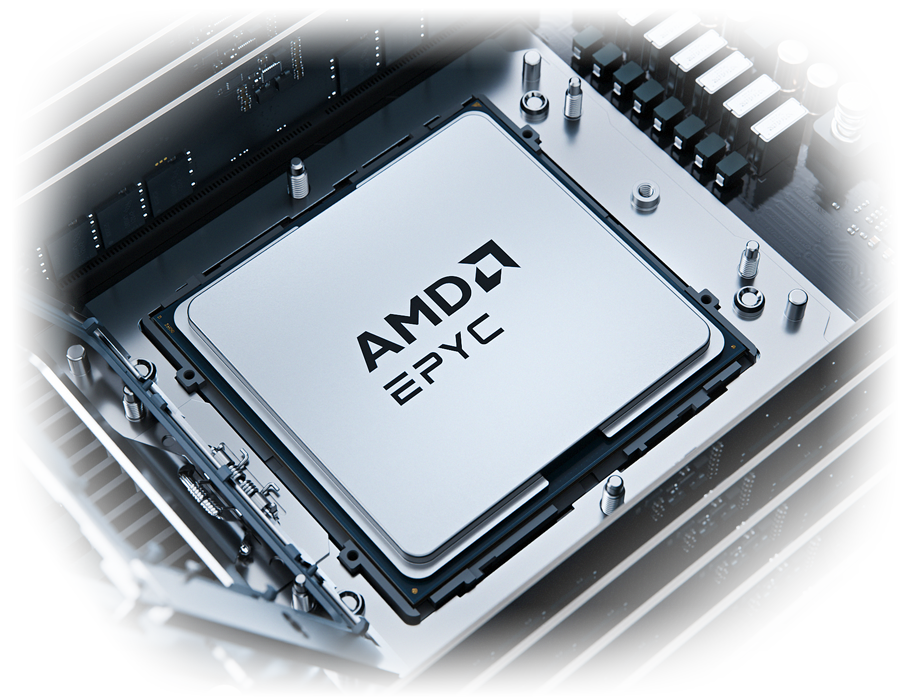
AMD EPYC™ 9006 SP8 Server CPUs combine reduced TCO, deployment flexibility, and balanced next-generation platform capabilities for enterprise and agentic AI workloads.
Get More Performance From Every System Dollar
Lower your TCO from the system to the data center with leadership performance per system dollar while helping improve data center efficiency and consolidation.1
CPU Roles: General Purpose CPU
Flexibility From Enterprise to Edge
Support Agent Sandbox CPU and General-Purpose CPU roles with right-sized deployment options to scale concurrent agents and help improve power efficiency and cost per agent.
CPU Roles: Agent Sandbox CPU
Next-Gen Capabilities. Balanced by Design.
Help scale agent concurrency with simultaneous multithreading, move data with PCIe® Gen 6, and feed workloads faster with first-to-market support for JEDEC-standard MRDIMM-12800.2
CPU Roles: General Purpose CPU


Performance Across the Enterprise
Designed to balance performance across diverse enterprise workloads while reducing TCO, improving right-sized compute, and leveraging next-gen capabilities.
Up to 23% Higher
Est. SPEC CPU 2026 Int Rate performance generation over generation.3
Up to 50% Higher
Est. performance per system cost with the AMD EPYC 9746 vs. the Intel Xeon 6980P.1
Architecture
Built-In Balance, Memory Features, and Next-Gen Connectivity
Deliver balanced compute across enterprise and agentic AI deployments with built-in “Zen 6” and “Zen 6c” architecture while supporting DDR5 and first-to-market JEDEC-standard MRDIMM memory for flexible capacity and bandwidth. Drive fast connectivity to networking, storage, and accelerators with built-in PCIe Gen 6 I/O, all backed by enterprise-grade security, RAS features, and broad x86 software support.
Specifications
AMD EPYC 9006 SP8 Server CPU Specs
Compare AMD EPYC™ 9006 SP8 Server CPUs. Use the filters to find processors by core count, frequency, cache, and Default CPU Power.
*Subject to Change
Frequently Asked Questions
AMD EPYC 9006 SP8 Server CPUs are designed for virtualization, databases, applications, storage, edge and telco, general-purpose workloads, and agentic sandbox deployments.
AMD EPYC 9006 SP8 Server CPUs offer flexible 8- to 128-core options for broad enterprise, edge, telco, and agentic AI workloads. AMD EPYC 9006 SP8 supports the Agent Sandbox CPU and General-Purpose CPU roles, while AMD EPYC 9006 SP7 Server CPUs address all three agentic AI CPU roles: Agent Sandbox CPU, AI Host Node CPU, and General-Purpose CPU.
AMD EPYC 9006 SP8 Server CPUs provide flexible core-count, high-frequency, and power options for virtualized and private-cloud infrastructure. Simultaneous multithreading and high thread density help maximize concurrency and throughput across virtual machines, containers, and agent sandbox deployments.
AMD EPYC 9006 SP8 Server CPUs balance compute, memory, and I/O with support for DDR5, first-to-market JEDEC-standard MRDIMM memory and first to market PCIe® Gen 6 for x86 connectivity to help keep data moving across mixed enterprise workloads.2,4
Resources

Footnotes
- 9xx6-136: SPECrate®2026_int_base performance per server $ comparison based on AMD internal testing of the AMD EPYC 9746 as of 11/08/2026 and the highest published 2P Intel Xeon 6980P score from www.spec.org as of 11/05/2026. AMD EPYC scores are estimates based on AMD internal testing. Server $ is the estimated server hardware acquisition cost (2 CPUs, memory, 1 TB storage and a 2S 2RU chassis) from the AMD EPYC™ Server TCO Greenhouse Gas Emission Estimation Tool. Results and configurations below are in the format of: [processor], [cores], [Default CPU Power or TDP], [1Ku price in USD], [memory], [score], [estimated server cost in USD], [score per $1,000 of server cost], [score / CPU W], [score / 1Ku price in USD], [Link to score]
2P AMD EPYC 9746, 256C, 400W, $11,679 USD, 16x 64GB DDR5-8000 RDIMM, estimated 1219, $72,603 USD, 16.79, 3.047, 0.1044
2P Intel Xeon 6980P, 256C, 500W, $13,955 USD, 24x 64GB MRDIMM-8800, 1120, $100,025 USD, 11.20, 2.240, 0.0803, https://www.spec.org/cpu2026/results/res2026q2/cpu2026-20260519-00255.html
For ~1.50x the performance per server $, ~1.09x the performance, ~27% lower estimated server cost, ~1.30x the performance per CPU $ and ~1.36x the performance per CPU W.
Estimated server cost: AMD EPYC 9746 server $23,358 CPUs, $45,240 memory, $625 storage, $3,380 chassis; Intel Xeon 6980P server $27,910 CPUs, $67,860 memory, $625 storage, $3,630 chassis. Memory for both servers priced at $2,827.52 USD per 64GB DIMM, based on published MRDIMM-8800 pricing from http://www.atic.ca/index.php?page=details&psku=315265 as of 10/27/2026, converted to USD from https://www.forbes.com/advisor/money-transfer/currency-converter/cad-usd/ as of 10/27/2026.
Starting with the 6th Gen AMD EPYC™ server processor family, AMD uses Default CPU Power to describe processor power consumption, succeeding AMD's historical TDP reference. Default CPU Power reflects total power consumed across the processor's compute and I/O dies for the stated performance target. Default CPU Power and TDP may both serve as processor power references for product comparison, platform planning, and performance-per-watt analysis.
SPEC®, SPEC CPU® and SPECrate® are registered trademarks of the Standard Performance Evaluation Corporation. See www.spec.org for more information.
AMD CPU prices as of 11/05/2026.
Intel CPU W and prices at https://ark.intel.com/ as of 11/05/2026.
Results may vary due to factors including system configurations, software versions and BIOS settings.
- EPYC-032E: AMD EPYC™ 9006 processors support up to 16 channels of 12,800 MT/s MRDIMM memory, providing up to 1,638.4 GB/s of theoretical memory bandwidth per socket. Intel® Xeon® 6 processors and ARM AGI processors support up to 12 channels of 8,800 MT/s MRDIMM memory, providing up to 844.8 GB/s of theoretical memory bandwidth per socket. AMD EPYC 9006 Series processors are the first CPUs to support JEDEC-standard MRDIMM memory at 12,800 MT/s, as of 11/05/2026.
- 9xx6-141: SPECrate®2026_int_base comparison of DDR5 RDIMM configurations, based on AMD internal testing of the AMD EPYC 9746 as of 11/08/2026 and the highest published 2P Intel Xeon 6980P, AMD EPYC 9745 and AMD EPYC 9755 scores with DDR5 RDIMM memory from www.spec.org as of 11/05/2026. AMD EPYC scores are estimates based on AMD internal testing. Results and configurations below are in the format of: [processor], [cores], [Default CPU Power or TDP], [memory], [score], [Link to score]
2P AMD EPYC 9746, 256C, 400W, 16x 64GB DDR5-8000 RDIMM, estimated 1219
2P AMD EPYC 9755, 256C, 500W, 24x 64GB DDR5-6400 RDIMM, 1140, https://www.spec.org/cpu2026/results/res2026q3/cpu2026-20260824-00481.html
2P AMD EPYC 9745, 256C, 400W, 24x 64GB DDR5-6400 RDIMM, 990, https://www.spec.org/cpu2026/results/res2026q4/cpu2026-20260922-00630.html
2P Intel Xeon 6980P, 256C, 500W, 24x 64GB DDR5-6400 RDIMM, 935, https://www.spec.org/cpu2026/results/res2026q2/cpu2026-20260210-00077.html
Relative performance (2P Intel Xeon 6980P = 1.00x): AMD EPYC 9746 ~1.30x, AMD EPYC 9755 ~1.22x, AMD EPYC 9745 ~1.06x.
AMD EPYC 9746 relative to AMD EPYC 9745: ~1.23x; relative to AMD EPYC 9755: ~1.07x.
Starting with the 6th Gen AMD EPYC™ server processor family, AMD uses Default CPU Power to describe processor power consumption, succeeding AMD's historical TDP reference. Default CPU Power reflects total power consumed across the processor's compute and I/O dies for the stated performance target. Default CPU Power and TDP may both serve as processor power references for product comparison, platform planning, and performance-per-watt analysis.
SPEC®, SPEC CPU® and SPECrate® are registered trademarks of the Standard Performance Evaluation Corporation. See www.spec.org for more information.
Results may vary due to factors including system configurations, software versions and BIOS settings.
- EPYC-035D: AMD EPYC 9006 CPUs are the only Server CPUs in production that support up to 128 PCIe® Gen 6 lanes in a single socket.
Footnotes
- 9xx6-136: SPECrate®2026_int_base performance per server $ comparison based on AMD internal testing of the AMD EPYC 9746 as of 11/08/2026 and the highest published 2P Intel Xeon 6980P score from www.spec.org as of 11/05/2026. AMD EPYC scores are estimates based on AMD internal testing. Server $ is the estimated server hardware acquisition cost (2 CPUs, memory, 1 TB storage and a 2S 2RU chassis) from the AMD EPYC™ Server TCO Greenhouse Gas Emission Estimation Tool. Results and configurations below are in the format of: [processor], [cores], [Default CPU Power or TDP], [1Ku price in USD], [memory], [score], [estimated server cost in USD], [score per $1,000 of server cost], [score / CPU W], [score / 1Ku price in USD], [Link to score]
2P AMD EPYC 9746, 256C, 400W, $11,679 USD, 16x 64GB DDR5-8000 RDIMM, estimated 1219, $72,603 USD, 16.79, 3.047, 0.1044
2P Intel Xeon 6980P, 256C, 500W, $13,955 USD, 24x 64GB MRDIMM-8800, 1120, $100,025 USD, 11.20, 2.240, 0.0803, https://www.spec.org/cpu2026/results/res2026q2/cpu2026-20260519-00255.html
For ~1.50x the performance per server $, ~1.09x the performance, ~27% lower estimated server cost, ~1.30x the performance per CPU $ and ~1.36x the performance per CPU W.
Estimated server cost: AMD EPYC 9746 server $23,358 CPUs, $45,240 memory, $625 storage, $3,380 chassis; Intel Xeon 6980P server $27,910 CPUs, $67,860 memory, $625 storage, $3,630 chassis. Memory for both servers priced at $2,827.52 USD per 64GB DIMM, based on published MRDIMM-8800 pricing from http://www.atic.ca/index.php?page=details&psku=315265 as of 10/27/2026, converted to USD from https://www.forbes.com/advisor/money-transfer/currency-converter/cad-usd/ as of 10/27/2026.
Starting with the 6th Gen AMD EPYC™ server processor family, AMD uses Default CPU Power to describe processor power consumption, succeeding AMD's historical TDP reference. Default CPU Power reflects total power consumed across the processor's compute and I/O dies for the stated performance target. Default CPU Power and TDP may both serve as processor power references for product comparison, platform planning, and performance-per-watt analysis.
SPEC®, SPEC CPU® and SPECrate® are registered trademarks of the Standard Performance Evaluation Corporation. See www.spec.org for more information.
AMD CPU prices as of 11/05/2026.
Intel CPU W and prices at https://ark.intel.com/ as of 11/05/2026.
Results may vary due to factors including system configurations, software versions and BIOS settings. - EPYC-032E: AMD EPYC™ 9006 processors support up to 16 channels of 12,800 MT/s MRDIMM memory, providing up to 1,638.4 GB/s of theoretical memory bandwidth per socket. Intel® Xeon® 6 processors and ARM AGI processors support up to 12 channels of 8,800 MT/s MRDIMM memory, providing up to 844.8 GB/s of theoretical memory bandwidth per socket. AMD EPYC 9006 Series processors are the first CPUs to support JEDEC-standard MRDIMM memory at 12,800 MT/s, as of 11/05/2026.
- 9xx6-141: SPECrate®2026_int_base comparison of DDR5 RDIMM configurations, based on AMD internal testing of the AMD EPYC 9746 as of 11/08/2026 and the highest published 2P Intel Xeon 6980P, AMD EPYC 9745 and AMD EPYC 9755 scores with DDR5 RDIMM memory from www.spec.org as of 11/05/2026. AMD EPYC scores are estimates based on AMD internal testing. Results and configurations below are in the format of: [processor], [cores], [Default CPU Power or TDP], [memory], [score], [Link to score]
2P AMD EPYC 9746, 256C, 400W, 16x 64GB DDR5-8000 RDIMM, estimated 1219
2P AMD EPYC 9755, 256C, 500W, 24x 64GB DDR5-6400 RDIMM, 1140, https://www.spec.org/cpu2026/results/res2026q3/cpu2026-20260824-00481.html
2P AMD EPYC 9745, 256C, 400W, 24x 64GB DDR5-6400 RDIMM, 990, https://www.spec.org/cpu2026/results/res2026q4/cpu2026-20260922-00630.html
2P Intel Xeon 6980P, 256C, 500W, 24x 64GB DDR5-6400 RDIMM, 935, https://www.spec.org/cpu2026/results/res2026q2/cpu2026-20260210-00077.html
Relative performance (2P Intel Xeon 6980P = 1.00x): AMD EPYC 9746 ~1.30x, AMD EPYC 9755 ~1.22x, AMD EPYC 9745 ~1.06x.
AMD EPYC 9746 relative to AMD EPYC 9745: ~1.23x; relative to AMD EPYC 9755: ~1.07x.
Starting with the 6th Gen AMD EPYC™ server processor family, AMD uses Default CPU Power to describe processor power consumption, succeeding AMD's historical TDP reference. Default CPU Power reflects total power consumed across the processor's compute and I/O dies for the stated performance target. Default CPU Power and TDP may both serve as processor power references for product comparison, platform planning, and performance-per-watt analysis.
SPEC®, SPEC CPU® and SPECrate® are registered trademarks of the Standard Performance Evaluation Corporation. See www.spec.org for more information.
Results may vary due to factors including system configurations, software versions and BIOS settings. - EPYC-035D: AMD EPYC 9006 CPUs are the only Server CPUs in production that support up to 128 PCIe® Gen 6 lanes in a single socket.