Accelerating Biochemical Research with GROMACS on AMD
Jan 13, 2026
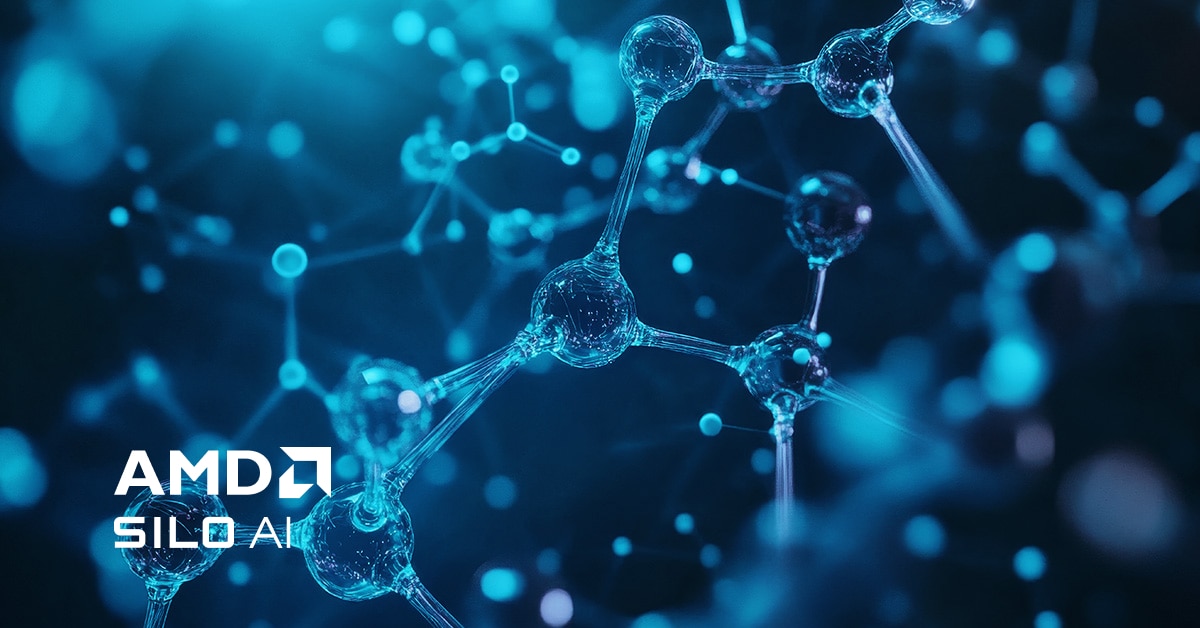
Molecular dynamics (MD) simulations are one of the quiet workhorses of modern life-science research, helping scientists understand how proteins move, how ligands bind, and how biological molecules interact over time.
GROMACS is a simulation tool for MD designed for speed, flexibility, and precision that enables modelling complex molecular systems, predicting interactions, and validating hypotheses before a single experiment is run in the lab.
Optimizing GROMACS for end-to-end compute solutions from AMD unlocks more accurate AI-guided design, smarter prioritization of drug candidates, and ultimately, quicker progress toward new medicines.
“Improved molecular dynamics performance on AMD hardware doesn’t just accelerate today’s simulations, it helps build tomorrow’s intelligent systems for drug discovery. Enabling faster, scalable, and physics-based data generation advances most areas of data- and model-driven drug design,” says Heikki Käsnänen, Head of Molecular Prospecting and Modelling at Orion Pharma.
Accelerated Value Creation with AMD
A strength of GROMACS is its hardware versatility. The software suite can be run on a PC or workstation, enabling small-scale simulations with CPU or single-GPU acceleration, or it can be scaled to a multi-GPU system, or a data-center-scale HPC cluster for more ambitious use cases.
This flexibility means researchers can make GROMACS part of their development pipelines, starting small and scaling up as needed, without rewriting code or changing workflows.
By optimizing GROMACS for scalable, end-to-end compute solutions from AMD, such as AMD Instinct™ accelerators and the AMD Enterprise AI Suite software, specifically the Inference Microservices and Solution Blueprints, weeks of manual work can be reduced to hours.
The modular and open nature of the Enterprise AI Suite allows researchers to minimize the time from AI experimentation to production, unlocking benefits such as:
- In silico experiment reproducibility: AMD Enterprise AI Suite components AIMs and Solution Blueprints enable standardized protocols, minimizing human error and ensuring reproducible results.
- Simulation Accuracy: Active-learning-based AI-driven optimization selects best simulation parameters for speed and accuracy, improving confidence in computational predictions.
- Scalable Performance: The same AMD ROCm™ open-source code across platforms, while features, such as GPU partitioning, enable research to be conducted on anything from laptops to the world’s fastest supercomputers.
- Cost Efficiency: Scaling enables running more simulations in parallel, accelerating identification of most suitable experiment candidates. Thus, reliance on expensive experiments is reduced, leading to lower costs as well as more sustainable wet-lab practices.
Faster and more scalable compute allows researchers to explore new opportunities within MD simulation, unlocking much broader pipeline automation and new breakthroughs within life science research. The ease of deployment of GROMACS with the AMD Enterprise AI Suite is a continuation of ample prior work.
Looking ahead
The convergence of high-performance computing, AI-driven automation, and open science is redefining what’s possible in molecular simulation.
With GROMACS optimized for AMD compute platforms and orchestrated with AMD Enterprise AI Suite, faster design-make-test-analyze (DMTA) cycles can be achieved. Exemplified by the work done by AMD in collaboration with AstraZeneca and Orion Pharma, this can lead to accelerated candidate screening, reduced R&D costs, and improved sustainability metrics.

Related Blogs
-
AMD and Advantech - Architecting the Next Generation of Regulated Casino Games
Discover how Advantech and AMD are redefining regulated casino gaming with Ryzen Embedded 8000 Series processors, integrated RDNA 3 graphics, XDNA AI acceleration, and purpose-built DPX platforms. The solution enables immersive multi-screen experiences, predictive maintenance, stronger security, lower power consumption, simplified designs, and long-term platform availability for gaming OEMs worldwide.
October 21, 2026
-
Micro-World 2: Streaming Real-time Interactive World Model — ROCm Blogs
This blog demonstrates how Micro-World 2 combines precisely annotated action data, four-step diffusion distillation, and ROCm-optimized inference to deliver controllable, long-horizon, real-time world generation on a single AMD Instinct GPU through a fully open-source pipeline.
October 20, 2026
-
MoE Training Optimization with Primus — ROCm Blogs
Learn how to speed up MoE training on AMD Instinct GPUs with Primus: a fused MoE megakernel, FP8/MXFP8 expert GEMMs, and training-at-scale tuning.
October 20, 2026
-
Optimizing World Action Models on AMD GPUs — ROCm Blogs
Speed up World Action Models on AMD GPUs with GEAK kernels, fewer denoising steps, and latent actions, cutting FastWAM latency 25× at about 97 percent success.
October 20, 2026
-
Introducing rocOpt: GPU-Accelerated Decision Optimization on AMD ROCm — ROCm Blogs
Run large-scale MILP, LP, QP, and vehicle routing problems on AMD Instinct GPUs - introducing rocopt, optimization built for ROCm.
October 19, 2026
-
Bringing Ultra-Fast, Interactive LLM Inference to AMD Instinct™ MI355X GPUs — ROCm Blogs
Accelerate single-request LLM inference on AMD Instinct MI355X with megakernels, speculative decoding, and MXFP4 for 1.9-3.3x faster decode.
October 19, 2026
-
hipCIM 26.06: GPU-Accelerated Whole-Slide Image I/O on AMD Instinct™ GPUs — ROCm Blogs
In this blog you will see how hipCIM 26.06 reads whole-slide images on AMD Instinct™ GPUs, and how fast and faithfully it decodes them.
October 19, 2026
-
From Prompt to Playback: Nunchux Turns AMD Instinct™ GPU Performance into Responsive Video AI
See how AMD Instinct™ MI355X GPUs and AMD ROCm™ software enable faster-than-playback MiniMax-H3 video generation.
October 19, 2026