The Benefits of AI for Project Managers and Power Users
Dec 29, 2025

At AMD. we've explored the ways that artificial intelligence (AI) is professionally useful for different roles and use cases. Generative AI's benefits aren't misty predictions over a still-distant horizon, but concrete realities corporations and employees can harness to save time and increase job satisfaction. We've already discussed the value of AI for knowledge workers, frequently traveling road warriors, and technical experts. Today, we'll highlight the fourth major persona in this series: Power users.
Power users, in this parlance, are employees who manage communication both within and across teams. They ensure the free flow of institutional knowledge across an organization while keeping projects, launches, and partnerships on track. Many of the responsibilities associated with this role, like email summarization, note-taking, and responding to service tickets, are important, but they aren’t always the most intellectually engaging part of the job. AI can potentially handle many of these tasks today, freeing employees to spend more time on higher-level strategizing and larger company goals.
I’ve managed enough cross-functional programs at AMD to know leaders aren’t held back by the big decisions, we’re held back by the constant documentation wrapped around them. When AI can take on meeting notes, summaries, and updates, it frees me to lead where it matters most: bringing teams into alignment, anticipating what’s next, and focusing on the strategic work that actually drives results.
AMD has partnered with the analyst firm Principled Technologies to better understand the salient advantages of AI for employees who fit the overall power user persona. Principled Technologies performed this analysis by comparing the amount of time it took a user to perform relevant actions both with and without AI assistance. Two systems were evaluated: An HP EliteBook X G1a 14 with a high-end AMD RyzenTM AI 9 HX PRO 375 processor and a Dell Pro 14 Plus with a Ryzen AI 7 PRO 350 processor. Both of these CPUs feature a neural processing unit (NPU) capable of up to 50 TOPS and perform similarly (within 6% of each other) in the measured AI workloads.
Principled Technologies tested currently available AI tools in the following scenarios:
- Summarizing an email thread
- Taking notes during a video conference
- Creating a Gantt chart
- Jira ticket summarization
- Project planning
- Email composition
The amount of time saved varies depending on the use case in question, but all of the data points in the same direction. Some tasks, like email summarization, were fully 87% faster when AI tools were deployed, a meaningful improvement for anyone managing high-volume communication. Formal email composition improved even more, with creation time dropping 94% thanks to artificial intelligence.

AI can improve the productivity of many professional positions, but power users and project managers are particularly well positioned to capitalize on its strengths. Meeting summarizations, project plans, timeline development, and cross-team collaboration are all critical components of the role. They aren’t necessarily the most energizing parts of the job, however, and being responsible for updating so many different lines of communication on a daily or weekly basis can lead to burnout.
Principled Technologies testing shows that many power user tasks that could be fairly characterized as "Necessary, but not necessarily fulfilling" can be turned over to AI. Even after accounting for time spent on human oversight, Principled Technologies found substantial time savings across its test scenarios.
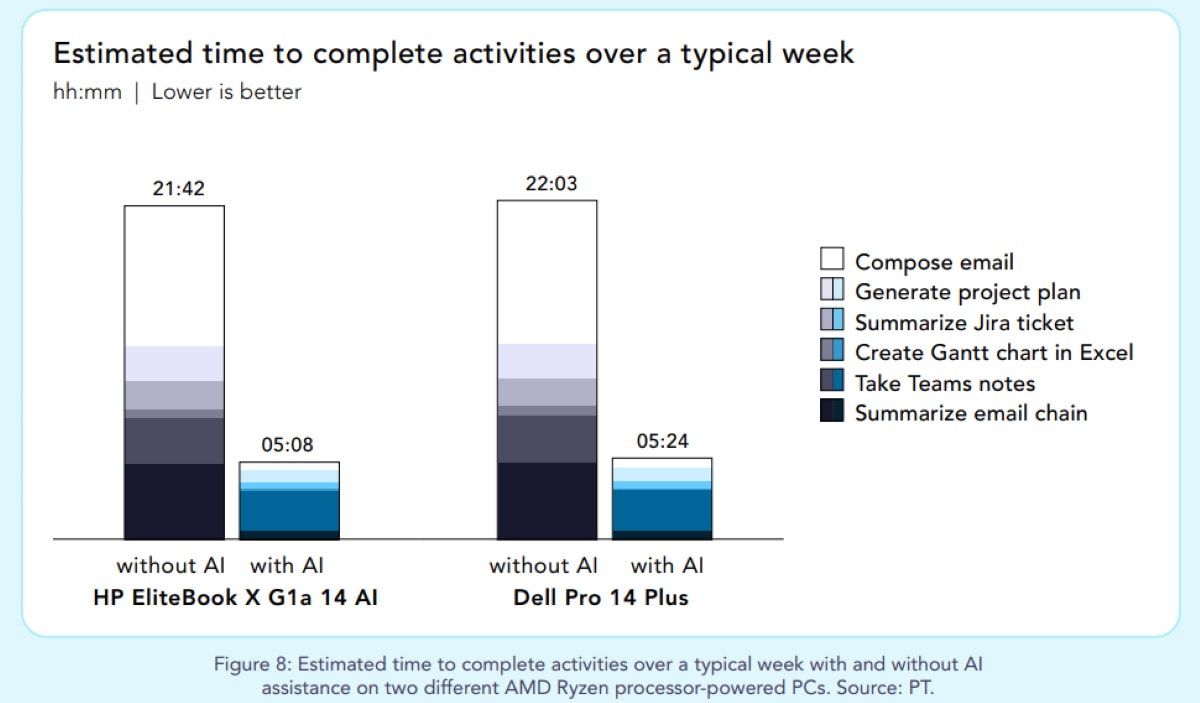
The analyst firm writes: "By estimating the frequency with which the test tasks would occur each week, we extrapolated that using AI technologies on these PCs could reduce the weekly work time from 21 hours and 53 minutes to 5 hours and 16 minutes on average—a savings of over 16 work hours, two full typical work days."
Across a year, that translates to 108 working days at eight hours per day per employee, per year. The total time savings and productivity improvements of any single company won't match these figures exactly, but the potential productivity gains from AI are demonstrably significant. Even limited deployments could reduce the amount of time power users spend on these assignments by weeks or months across a full work year.
These power user-specific findings echo what third-party analysts have reported for other personas, including tech experts, knowledge workers, and road warriors. Generative artificial intelligence’s benefits are available to companies today, whether they want to run models locally on AI PCs, deploy cloud services, or mix-and-match between the two to fit their particular needs, giving organizations the flexibility to build an AI strategy that aligns with their teams, workflows, and security requirements. The exact time savings and associated productivity boosts will vary, but the trend is clear.

Related Blogs
-
Kimi K3 on AMD Instinct GPUs with TokenSpeed
TokenSpeed delivers fast, agentic LLM inference on AMD Instinct™ MI355X GPUs, with optimized kernels and leading Kimi K3 performance.
October 09, 2026
-
MangoBoost Delivers Open AI Models Powered by AMD
Mango Inference a serverless inference service providing production-ready access to open models powered by AMD Instinct™ GPUs and AMD ROCm™ software
October 09, 2026
-
Pre-Training Hybrid LLMs from Scratch in Primus on AMD Instinct™ GPUs — ROCm Blogs
Pre-train hybrid LLMs mixing MLA attention with Gated DeltaNet, Kimi Delta Attention and Mamba2 mixers on AMD Instinct MI355X GPUs, with open recipes.
October 07, 2026
-
DI Series: Serving Kimi-K3 MXFP4 Wide-EP Disaggregated on AMD Instinct MI300X and MI325X — ROCm Blogs
Learn how to serve a 1.4 TiB Kimi-K3 MXFP4 mixture-of-experts model disaggregated across AMD Instinct MI300X and MI325X GPUs.
October 07, 2026
-
AMD Instinct MI455X vs MI355X: A Technical Look at the Advancing AI 2026 Inference Numbers — ROCm Blogs
Explore the MI455X vs MI355X inference numbers from Advancing AI 2026, and learn how each benchmark was measured and what it really means.
October 07, 2026
-
How Agentic AI Is Expanding the Role of the DPU
As agentic AI drives more stateful workloads, DPUs are becoming critical for networking, storage, KV-cache management, and infrastructure efficiency.
October 05, 2026
-
MoRI UMBP Empowers AMD Instinct GPUs
See how UMBP, MoRI and SGLang optimize KV cache reuse to boost AMD Instinct™ MI355X GPU agentic AI performance and cost efficiency
October 01, 2026
-
Rightsizing Cloud Workloads on AMD Part 1 Foundations
Learn the foundations of rightsizing cloud workloads on AMD: define goals, choose the right time, classify workloads, and select relevant benchmarks.
October 01, 2026