What is a DPU?
Feb 25, 2026
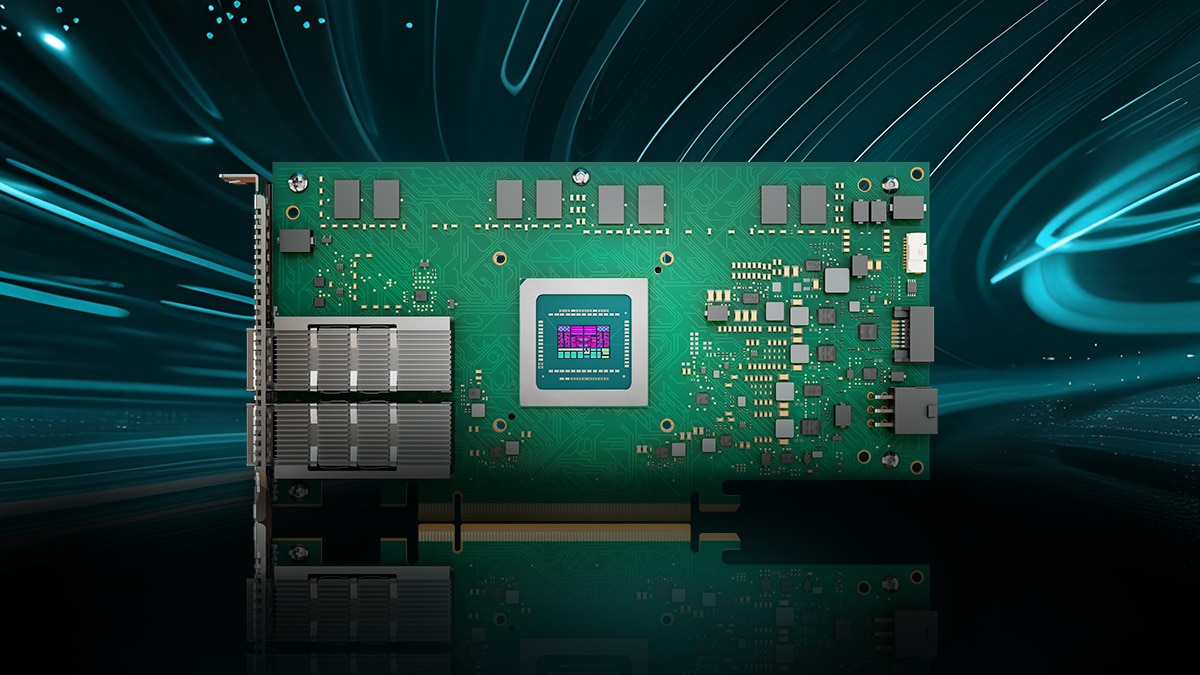
A Data Processing Unit (DPU) is a specialized processor designed to offload networking, storage, and security tasks from the CPU. It accelerates data transfer and infrastructure services in modern data centers, improving efficiency and scalability, which are crucial for running modern AI workloads.
In this blog post, we will explore DPUs, what role they play in the modern data center, and how they work alongside other critical data center components.
Introduction to DPUs
DPUs are processors designed to handle high-bandwidth, latency-sensitive tasks around data transfers. Commonly found in data centers and other compute-intensive areas, DPUs improve can performance by taking over demanding tasks from CPUs, such as managing network traffic, encrypting data, collecting performance metrics, and offloading storage, thereby helping the CPU be more efficient.
DPUs also provide flexibility for companies to adjust to new network needs without replacing hardware. This is critical, especially for artificial intelligence, cloud computing, and high-performance computing scenarios, where demand for AI workloads is growing quickly and driving increasing bandwidth requirements.
DPUs are important in transforming how networking is handled in the modern data center. By offloading key networking, security, and infrastructure management tasks from the CPU, DPUs enable data centers to operate with greater efficiency and agility.
Why are DPUs critical for modern data centers?
As bandwidth demands increase and workloads become more complex, DPUs play a critical role in streamlining network traffic, improving throughput, and enhancing security.
Whether deployed in data centers or integrated into advanced network switches, DPUs are essential for building high-performance, scalable, and secure networks within data centers.
How do CPUs, GPUs, DPUs and AI NICs work together in the data center?
In the data center, the CPU, GPU, DPU, and AI NIC work together, thereby enabling efficient, high-speed, and secure movement of data between various endpoints.
The CPU is critical to the data center, managing workloads, orchestrating services, and running both the system OS and applications. The DPU offloads tasks from the CPU, such as networking, storage, and security, helping reduce CPU overhead and improve overall data center efficiency. The GPU serves as the AI accelerator, focusing on handling AI/ML workloads, such as training and inference. AI NICs accelerate low-latency, high-bandwidth GPU communication while managing congestion, enhancing reliability, and optimizing network performance for large-scale AI data centers.
Let’s explore what this looks like when a user uses a cloud computing service. The process starts with a user request that hits a cloud service endpoint. The DPU inspects and routes the packet from the user’s computer securely to the right service. After, the CPU processes application logic and coordinates the response while the AI NIC accelerates high-speed data movement across the network for GPU workloads. Lastly, the GPUs analyze traffic patterns to detect anomalies and optimize future routing.
How are DPUs deployed within the data center?
In modern data centers, the DPU is typically integrated into frontend networking components, where it processes and accelerates data traffic entering and leaving the infrastructure. Its primary role is to offload and accelerate networking, storage, and security functions to maximize overall system throughput.
In certain scenarios, DPUs are deployed more broadly, often within servers or at the host level. They can also reside inside Top-of-Rack (ToR) smart switches, where they are combined with traditional network ASICs. In these deployments, DPUs prioritize offloading virtualization, storage, and security tasks from the CPU to reduce power consumption and improve scalability.
Want to learn more? Explore how AMD is deploying DPUs with leading hyperscalers and partners here.
FAQs
How is a DPU different from a traditional NIC?
A NIC handles basic network connectivity, while a DPU adds programmable compute to offload networking, storage, and security tasks, reducing CPU overhead.
DPU vs SmartNIC vs AI NIC – what’s the difference?
A SmartNIC adds limited offload capabilities, while a DPU offers full programmability and infrastructure services. AI NICs are optimized for AI workloads, whereas DPUs target general-purpose data center tasks.
Do you need DPUs for Ethernet-based AI clusters?
Yes, DPUs can accelerate east-west traffic, enforce security, and optimize storage for Ethernet AI clusters, improving overall performance.

Related Blogs
-
-
Rightsizing Cloud Workloads on AMD Part 1 Foundations
Learn the foundations of rightsizing cloud workloads on AMD: define goals, choose the right time, classify workloads, and select relevant benchmarks.
October 01, 2026
-
EPYC CPUs Deliver for Every Layer of the Agentic AI Stack
Agentic systems combine multiple CPU roles into a workflow. The latest AMD EPYC CPU generation lets customers optimize for each task.
September 18, 2026
-
Building Infrastructure for an AI World in Motion
The biggest risk is not choosing the wrong technology today. It is building infrastructure that cannot adapt tomorrow.
September 17, 2026
-
Advancing AI 2026: From Gigawatt Data Centers to Agentic PCs
Explore how AMD connects data center, cloud, and local AI to enable secure, cost-aware agentic workflows across enterprise PCs.
September 16, 2026
-
From LEAP 2026: Advancing AI Across the Middle East
At LEAP 2026, AMD’s role helping build open AI infrastructure and turn investments into measurable business and economic value was on display.
September 09, 2026
-
Optimize SQL Server Costs with AMD on AWS
Optimize SQL Server licensing costs on AWS with AMD-powered Amazon EC2 and Amazon RDS instances while maintaining performance.
September 03, 2026
-
The Data Center Math has Changed
Run more work on fewer servers to reduce power, space and licensing costs while creating capacity for what comes next.
September 02, 2026