Maximize your SQL Server investments on RDS with 5th Gen AMD EPYC Server CPUs!
May 08, 2026

With the recent adoption of 5th Gen AMD EPYC CPUs by Amazon Relational Database Service (RDS) for SQL Server, AWS customers are expected to provide significant performance and efficiency gains for enterprise database workloads. These 8th generation AWS instances, powered by 5th Gen EPYC processors, provide architectural advancements in processing power and memory bandwidth. This represents a pivotal shift in the enterprise database landscape on AWS. For customers running mission-critical workloads, AMD CPU-powered Amazon EC2 instances offer high performance, cost-effective computing, particularly instances with the 5th Gen AMD EPYC processors. By using these advanced processors with Amazon RDS for SQL Server, a managed service, AWS is not just offering a new CPU option; it is redefining the performance-per-watt standard for relational databases. For AWS customers with little experience with AMD, this adoption is public validation from AWS that AMD infrastructure is production-ready for their most demanding, mission-critical database workloads. Given the historically rigorous data required for a foundational managed service like Amazon RDS for SQL Server to adopt new compute options, this deployment option provides expanded compute options by introducing RDS on instance families, including those powered by 5th Gen AMD EPYC CPUs. This expansion offers significant cost-performance benefits for database workloads
For readers unfamiliar with Amazon RDS for SQL Server, this section provides a brief overview with links to resources for more information. Microsoft SQL Server is a relational database management system developed by Microsoft, beginning with SQL Server 1.0 in 1989. RDS launched support for Microsoft SQL Server in May 2012. With Amazon RDS for SQL Server, you can deploy multiple editions of SQL Server in minutes with cost-efficient and re-sizable compute capacity. Amazon RDS for SQL Server frees you up to focus on application development by managing time-consuming database administration tasks, including provisioning, backups, software patching, monitoring, and hardware scaling.
Amazon RDS for SQL Server supports the “License Included” licensing model for SQL Server. License-included pricing is inclusive of software, underlying hardware resources, and Amazon RDS management capabilities.
Amazon RDS for SQL Server offers hourly pricing with no upfront fees or long-term commitments. In addition, you also have the option to purchase Reserved DB Instances under one-or three-year reservation terms. Reserved DB Instances offer a low, one-time, upfront payment for each DB Instance and then pay a discounted hourly usage rate, up to 69% net cost savings, see here for more details.
On 05/07/2026 Amazon RDS for SQL Server started offering 5th Gen AMD EPYC Server CPUs for deployment in select regions (N. VA, Ohio, Oregon, and more) You can now deploy db.m8a.medium-48xl (including db.m8a.metal-24xl-48xl) and db.r8a.medium-48xl (including db.r8a.metal-24xl-48xl) instances. The rest of this post will focus on the benefits 5th Gen AMD EPYC processors bring to Amazon RDS for SQL Server customers.
AMD powered instances used by Amazon RDS for SQL Server
The Amazon Elastic Compute Cloud (EC2) instances selected by the Amazon RDS for SQL Server service are m8a.medium-48xl (including m8a.metal-24xl-48xl) and r8a.medium-48xl (including r8a.metal-24xl-48xl) instances. The same model of 5th Gen AMD EPYC (9R45) processor powers the instances, such as c8a and hpc8a.
CPU and Amazon EC2 specifications
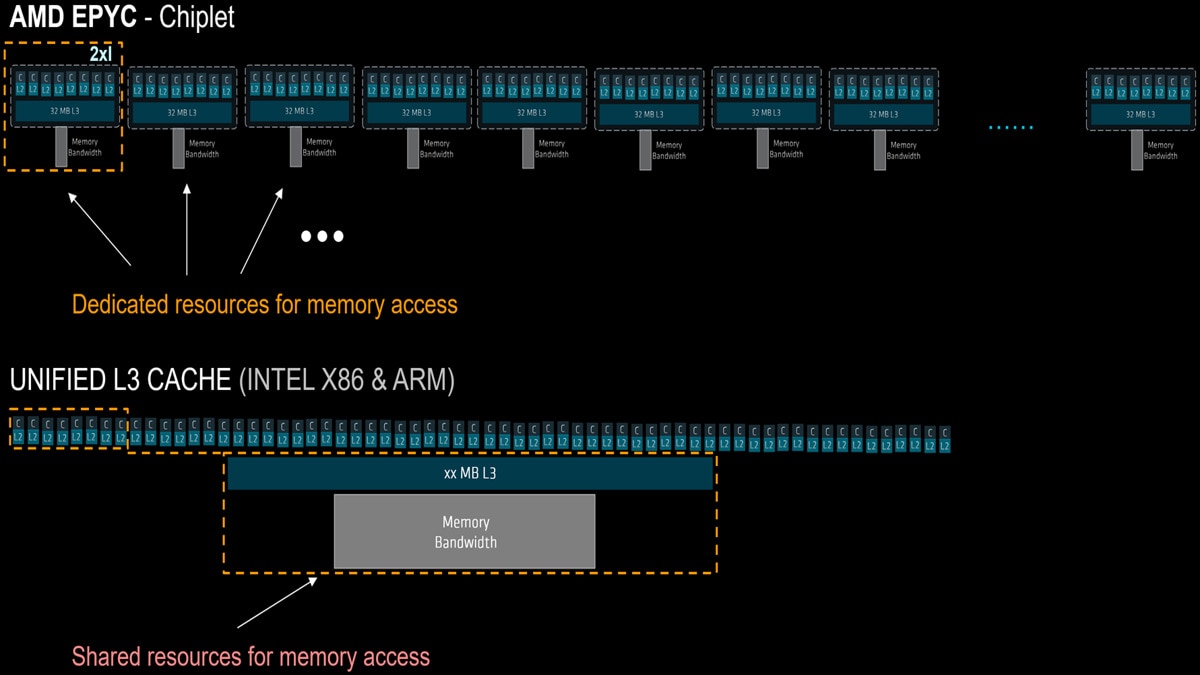
Before we dive into the AWS specifics, let’s look under the hood of the 5th Gen AMD EPYC CPU. The AMD EPYC CPU is the fifth generation of EPYC server-class CPUs released by AMD since 2017. It is based on the “Zen 5” architecture and built using 4nm CPU process technology. AMD designed the EPYC CPU on AWS with a chiplet architecture. In traditional monolithic architecture, all the CPU cores on a chip share memory bandwidth and L3 cache. This can lead to a “noisy neighbor” situation where a single instance’s vCPUs could consume most L3 cache and memory bandwidth which will constrain those resources for other instances to consume. With AMD chiplet architecture, each 8-core CCD (chiplet) has its own dedicated L3 cache and memory bandwidth, in a noisy neighbor situation limits the blast radius for resource contention to the cores that comprise the chiplet instead of all cores in the CPU.
AMD EPYC 9R45 CPU detailed specifications
- Amazon EC2 Instance families: c8a, hpc8a, m8a (excl. m8azn), r8a
- Sockets per host: 2
- Core Architecture: “Zen 5”
- CPU Process Technology: 4nm
- I/O Die Process Technology: 6nm
- Cores: 96
- Cores per CCD: 8
- L3 Cache: 384 MB
- Max Frequency: 4.5GHz
- Memory channels: 12
- Memory type: DDR5-6400
- Max Power Consumption: 320W (hpc8a = 500W)
- CPU Options:
- Advanced Vector Extensions (AVX) 3-512 (single 512-byte pipe vs two 256-byte pipes in 7a / Genoa)
- AVX-512 Vector Neural Network Instructions (VNNI)
- Bfloat16
- AMD Secure Memory Encryption (AMD SME)
- AMD Secure Encrypted Virtualization - Secure Nested Paging, disabled
- AMD Secure Encrypted Virtualization - Trusted I/O, enabled
- Simultaneous Multi-Threading (SMT) disabled, every vCPU tied to pCore
The Amazon EC2 instance specifications
The instance families selected by the Amazon RDS for SQL Server service are m8a and r8a. Both instance families are powered by the same 5th Gen EPYC processor model. Their “t-shirt sizes” differentiate the instances; the m8a family offers a 1vCPU to 4GiB RAM ratio, and the r8a family offers instances with a 1vCPU to 8GiB RAM ratio. Deciding between the two is finding the size that matches the requirements at the desired cost.
All 8a instance families are built on AWS’s Nitro system. Specifically, the 8a instance families are built on the latest generation Nitro v6. The Nitro System is a collection of hardware (Nitro cards) and software components built by AWS that enable high performance, high availability, and high security. This allows AWS to get the maximum value and performance out of its hosts.
Performance of Amazon RDS for SQL Server with AMD
Now that you have learned about what is powering Amazon RDS for SQL Server, let’s dive into the benchmarks that back up the performance and efficiency claims. AMD benchmarked a variety of “m” and “r” Amazon EC2 instance types to show AMD performance and cost advantages to Amazon RDS and its customers.
The benchmark setup
For benchmarking purposes, AMD utilized commercially available Amazon EC2 instances without implementing specific modifications intended to enhance AMD performance or diminish Intel's results. We used an OLTP workload derived from TPC-E to load the instances, and the details are described below. This benchmark is derived from a TPC benchmark and is not comparable to published TPC results. Keep in mind these benchmarks only look at CPU efficiency and performance. IO and memory performance were not evaluated because the AWS platform controls and defines those parameters.
- Microsoft Windows Server 2022 w/ SQL Server 2022 CU1 Amazon EC2 instances tested:
- r8a vs. r8i: xl, 2xl, 4xl, 8xl, 16xl
- EBS storage configuration:
- Logs disk: (1) io2, 5K IOPS, 1000GiB
- DB disk: (1) io2, 80K IOPS, 399GiB
- Microsoft TPC benchmarking tools generated TPC-E load.
- OLTP workload derived from TPC-E
The results:
Diving into the results, you will see AMD holds sizable transactions per second (TPS) performance and cost per TPS advantage over its Intel-powered counterparts. Keep in mind that AMD estimates that Intel-powered Amazon EC2 instances consume over 585 watts, where the AMD CPU-powered instance only consumes 320 watts. See here for more on how AMD calculated the power consumption of Amazon EC2 instances. Also, keep in mind these performance results are from regular Amazon EC2 instances, not from Amazon RDS for SQL Server. The customer value for Amazon RDS for SQL Server will also apply to running Microsoft SQL Server on Amazon EC2 instances.
R8a versus R8i
The r8a and r8i instances represent the latest generation of server-class CPUs from Intel and AMD powering AWS’s mainstream memory-optimized instances.
The first chart shows the Microsoft SQL Server transactions with price performance per second normalized to the performance of the Intel-powered instances Excluding SQL Server license cost, is a simple statistic where the CPU processing more DB transactions per second is the performance leader. The AMD CPU-powered instances’ transactions per second are up to 63% better compared against the same size / generation Intel-powered instances.
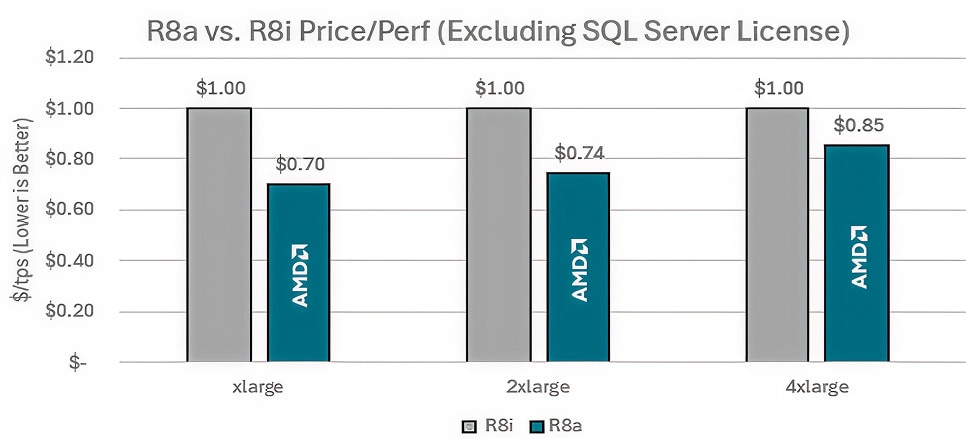
Now that performance has been demonstrated, what does this mean for licensing? With Amazon RDS for SQL Server, you are billed per vCPU for the Windows and SQL Servers licenses applied to the overall Amazon RDS DB Instance cost. Fewer vCPUs lead to reduced instance costs due to the reduced licensing burden. Windows and MSSQL licensing costs combined are over 80% of an instance’s costs.
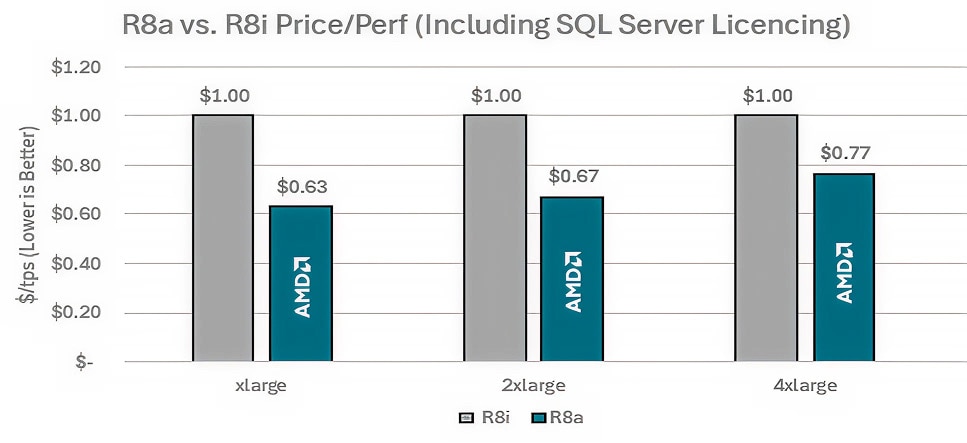
In the chart below, we have normalized the cost per transaction per second to the Intel-powered instances including SQL server licensing. The data shows AMD is anywhere from $0.37 per transaction per second to $0.23 cheaper than its Intel peer instance. The performance data above, while a great story, only shows the raw performance of the CPU. The actual cost of processing the workload is where business decisions are made. AWS customers using AMD-powered instances with Amazon RDS for SQL Server achieve industry-leading cost-efficient transactions per second compared to any other x86 CPU on Amazon RDS for SQL Server.
Summary
The data is clear: AMD holds a sizable performance and total cost advantage for Microsoft SQL Server workloads on AWS. Consider Amazon RDS customers can now optimize their Amazon RDS instance’s vCPU count, which can drive further savings on their Amazon RDS for SQL Server deployments. We will post a follow-up blog post detailing how you can properly size your Amazon RDS for SQL Server and self-hosted SQL Server Amazon EC2 instances to drive additional value from your AWS investments.
Don’t Go At It Alone
Whether you’re modernizing, downsizing, or simply looking for cost efficiency for your SQL Server workloads on AWS in Amazon RDS or on Amazon EC2, AMD offers expertise to guide the way. Many organizations combine multiple strategies across different workloads to achieve maximum ROI. If you need help deciding what best fits your architecture, AMD and its partners are ready to assist. To offer feedback on this post or suggest future topics, please reach out to AWS@AMD.com.
Footnotes
9xx5C-087: Testing by AMD Performance Labs as of 1/30/2026. R8a.xlarge score comparison to R8i xlarge running the following benchmarks:
SQL Server (TPC_E)
Note:- For AWS instances, AMD instance R8a.xl default is SMT off and for Intel instance R8i.xl default is HT on. Testing done using defaults.
Performance differences (normalized to R8i-baseline)
R8A.XL 4 vCPU vs R8i.XL 4 vCPU
Perf (tps) $/Perf(tps) OpEx Savings
SQL Server TPC_E (average) with SQL Server license
1.63 0.63 36%
R8A.XL 4 vCPU vs R8i.XL 4 vCPU
Perf (tps) $/Perf(tps) OpEx Savings
SQL Server TPC_E (average) without SQL Server license
1.63 0.70 29%
On-demand hourly pricing from https://aws.amazon.com/ec2/pricing/on-demand/ (us-east) as of 1/30/2026: R8A.XL: $0.3195, R8i.XL $0.2778
https://www.microsoft.com/en-us/sql-server/sql-server-2022-pricing?msockid=14b2f44032d66f682f23e2cd33e46e14 (MS Sql server pricing)
Hours/Year 8766 Compute max
Enterprise SQL Server License cost (2-core pack) $15123/yr Unlimited
Standard SQL Server License cost (2-core pack) $3945/yr 24 cores
SQL Server 2022—Pricing | Microsoft
EC2 On-Demand Instance Pricing
8766hrs/yr*hourly cost of EC2 instance
Cloud performance results presented are based on the test date in the configuration. Results may vary due to changes to the underlying configuration, and other conditions such as the placement of the VM and its resources, optimizations by the cloud service provider, accessed cloud regions, co-tenants, and the types of other workloads exercised at the same time on the system.
OpEx savings calculated from relative runtime and instance cost ratio.
The SQL Server TPC-E derivative is derived from TPC-E Benchmark standard and as such is not comparable to published TPC-E results as the results do not comply with the TPC-E Benchmark standard.
9xx5C-088: Testing by AMD Performance Labs as of 1/30/2026. R8a.2xlarge score comparison to R8i 2xlarge running the following benchmarks:
SQL Server (TPC_E)
Note:- For AWS instances, AMD instance R8a.2xl default is SMT off and for Intel instance R8i.2xl default is HT on. Testing done using defaults.
Performance differences (normalized to R8i-baseline)
R8A.2XL 8 vCPU vs R8i.2XL 8 vCPU
Perf (tps) $/Perf(tps) OpEx Savings
SQL Server TPC_E (average) with SQL Server license
1.54 0.67 32%
R8A.2XL 8 vCPU vs R8i.2XL 8 vCPU
Perf (tps) $/Perf(tps) OpEx Savings
SQL Server TPC_E (average) without SQL Server license
1.54 0.74 25%
On-demand hourly pricing from https://aws.amazon.com/ec2/pricing/on-demand/ (us-east) as of 1/30/2026: R8A.2XL: $0.6390, R8i.2XL $0.5556
https://www.microsoft.com/en-us/sql-server/sql-server-2022-pricing?msockid=14b2f44032d66f682f23e2cd33e46e14 (MS Sql server pricing)
Hours/Year 8766 Compute max
Enterprise SQL Server License cost (2-core pack) $15123/yr Unlimited
Standard SQL Server License cost (2-core pack) $3945/yr 24 cores
SQL Server 2022—Pricing | Microsoft
EC2 On-Demand Instance Pricing
8766hrs/yr*hourly cost of EC2 instance
Cloud performance results presented are based on the test date in the configuration. Results may vary due to changes to the underlying configuration, and other conditions such as the placement of the VM and its resources, optimizations by the cloud service provider, accessed cloud regions, co-tenants, and the types of other workloads exercised at the same time on the system.
OpEx savings calculated from relative runtime and instance cost ratio.
The SQL Server TPC-E derivative is derived from TPC-E Benchmark standard and as such is not comparable to published TPC-E results as the results do not comply with the TPC-E Benchmark standard.
9xx5C-089: Testing by AMD Performance Labs as of 1/30/2026. R8a.4xlarge score comparison to R8i 4xlarge running the following benchmarks:
SQL Server (TPC_E)
Note:- For AWS instances, AMD instance R8a.4xl default is SMT off and for Intel instance R8i.4xl default is HT on. Testing done using defaults.
Performance differences (normalized to R8i-baseline)
R8A.4XL 16 vCPU vs R8i.4XL 16 vCPU
Perf (tps) $/Perf(tps) OpEx Savings
SQL Server TPC_E (average) with SQL Server license
1.35 0.77 23%
R8A.4XL 16 vCPU vs R8i.4XL 16 vCPU
Perf (tps) $/Perf(tps) OpEx Savings
SQL Server TPC_E (average) without SQL Server license
1.35 0.85 14%
On-demand hourly pricing from https://aws.amazon.com/ec2/pricing/on-demand/ (us-east) as of 1/30/2026: R8A.4XL: $1.2780, R8i.4XL $1.1113
https://www.microsoft.com/en-us/sql-server/sql-server-2022-pricing?msockid=14b2f44032d66f682f23e2cd33e46e14 (MS Sql server pricing)
Hours/Year 8766 Compute max
Enterprise SQL Server License cost (2-core pack) $15123/yr Unlimited
Standard SQL Server License cost (2-core pack) $3945/yr 24 cores
SQL Server 2022—Pricing | Microsoft
EC2 On-Demand Instance Pricing
8766hrs/yr*hourly cost of EC2 instance
Cloud performance results presented are based on the test date in the configuration. Results may vary due to changes to the underlying configuration, and other conditions such as the placement of the VM and its resources, optimizations by the cloud service provider, accessed cloud regions, co-tenants, and the types of other workloads exercised at the same time on the system.
OpEx savings calculated from relative runtime and instance cost ratio.
The SQL Server TPC-E derivative is derived from TPC-E Benchmark standard and as such is not comparable to published TPC-E results as the results do not comply with the TPC-E Benchmark standard.
Footnotes
9xx5C-087: Testing by AMD Performance Labs as of 1/30/2026. R8a.xlarge score comparison to R8i xlarge running the following benchmarks:
SQL Server (TPC_E)
Note:- For AWS instances, AMD instance R8a.xl default is SMT off and for Intel instance R8i.xl default is HT on. Testing done using defaults.
Performance differences (normalized to R8i-baseline)
R8A.XL 4 vCPU vs R8i.XL 4 vCPU
Perf (tps) $/Perf(tps) OpEx Savings
SQL Server TPC_E (average) with SQL Server license
1.63 0.63 36%
R8A.XL 4 vCPU vs R8i.XL 4 vCPU
Perf (tps) $/Perf(tps) OpEx Savings
SQL Server TPC_E (average) without SQL Server license
1.63 0.70 29%
On-demand hourly pricing from https://aws.amazon.com/ec2/pricing/on-demand/ (us-east) as of 1/30/2026: R8A.XL: $0.3195, R8i.XL $0.2778
https://www.microsoft.com/en-us/sql-server/sql-server-2022-pricing?msockid=14b2f44032d66f682f23e2cd33e46e14 (MS Sql server pricing)
Hours/Year 8766 Compute max
Enterprise SQL Server License cost (2-core pack) $15123/yr Unlimited
Standard SQL Server License cost (2-core pack) $3945/yr 24 cores
SQL Server 2022—Pricing | Microsoft
EC2 On-Demand Instance Pricing
8766hrs/yr*hourly cost of EC2 instance
Cloud performance results presented are based on the test date in the configuration. Results may vary due to changes to the underlying configuration, and other conditions such as the placement of the VM and its resources, optimizations by the cloud service provider, accessed cloud regions, co-tenants, and the types of other workloads exercised at the same time on the system.
OpEx savings calculated from relative runtime and instance cost ratio.
The SQL Server TPC-E derivative is derived from TPC-E Benchmark standard and as such is not comparable to published TPC-E results as the results do not comply with the TPC-E Benchmark standard.
9xx5C-088: Testing by AMD Performance Labs as of 1/30/2026. R8a.2xlarge score comparison to R8i 2xlarge running the following benchmarks:
SQL Server (TPC_E)
Note:- For AWS instances, AMD instance R8a.2xl default is SMT off and for Intel instance R8i.2xl default is HT on. Testing done using defaults.
Performance differences (normalized to R8i-baseline)
R8A.2XL 8 vCPU vs R8i.2XL 8 vCPU
Perf (tps) $/Perf(tps) OpEx Savings
SQL Server TPC_E (average) with SQL Server license
1.54 0.67 32%
R8A.2XL 8 vCPU vs R8i.2XL 8 vCPU
Perf (tps) $/Perf(tps) OpEx Savings
SQL Server TPC_E (average) without SQL Server license
1.54 0.74 25%
On-demand hourly pricing from https://aws.amazon.com/ec2/pricing/on-demand/ (us-east) as of 1/30/2026: R8A.2XL: $0.6390, R8i.2XL $0.5556
https://www.microsoft.com/en-us/sql-server/sql-server-2022-pricing?msockid=14b2f44032d66f682f23e2cd33e46e14 (MS Sql server pricing)
Hours/Year 8766 Compute max
Enterprise SQL Server License cost (2-core pack) $15123/yr Unlimited
Standard SQL Server License cost (2-core pack) $3945/yr 24 cores
SQL Server 2022—Pricing | Microsoft
EC2 On-Demand Instance Pricing
8766hrs/yr*hourly cost of EC2 instance
Cloud performance results presented are based on the test date in the configuration. Results may vary due to changes to the underlying configuration, and other conditions such as the placement of the VM and its resources, optimizations by the cloud service provider, accessed cloud regions, co-tenants, and the types of other workloads exercised at the same time on the system.
OpEx savings calculated from relative runtime and instance cost ratio.
The SQL Server TPC-E derivative is derived from TPC-E Benchmark standard and as such is not comparable to published TPC-E results as the results do not comply with the TPC-E Benchmark standard.
9xx5C-089: Testing by AMD Performance Labs as of 1/30/2026. R8a.4xlarge score comparison to R8i 4xlarge running the following benchmarks:
SQL Server (TPC_E)
Note:- For AWS instances, AMD instance R8a.4xl default is SMT off and for Intel instance R8i.4xl default is HT on. Testing done using defaults.
Performance differences (normalized to R8i-baseline)
R8A.4XL 16 vCPU vs R8i.4XL 16 vCPU
Perf (tps) $/Perf(tps) OpEx Savings
SQL Server TPC_E (average) with SQL Server license
1.35 0.77 23%
R8A.4XL 16 vCPU vs R8i.4XL 16 vCPU
Perf (tps) $/Perf(tps) OpEx Savings
SQL Server TPC_E (average) without SQL Server license
1.35 0.85 14%
On-demand hourly pricing from https://aws.amazon.com/ec2/pricing/on-demand/ (us-east) as of 1/30/2026: R8A.4XL: $1.2780, R8i.4XL $1.1113
https://www.microsoft.com/en-us/sql-server/sql-server-2022-pricing?msockid=14b2f44032d66f682f23e2cd33e46e14 (MS Sql server pricing)
Hours/Year 8766 Compute max
Enterprise SQL Server License cost (2-core pack) $15123/yr Unlimited
Standard SQL Server License cost (2-core pack) $3945/yr 24 cores
SQL Server 2022—Pricing | Microsoft
EC2 On-Demand Instance Pricing
8766hrs/yr*hourly cost of EC2 instance
Cloud performance results presented are based on the test date in the configuration. Results may vary due to changes to the underlying configuration, and other conditions such as the placement of the VM and its resources, optimizations by the cloud service provider, accessed cloud regions, co-tenants, and the types of other workloads exercised at the same time on the system.
OpEx savings calculated from relative runtime and instance cost ratio.
The SQL Server TPC-E derivative is derived from TPC-E Benchmark standard and as such is not comparable to published TPC-E results as the results do not comply with the TPC-E Benchmark standard.

Related Blogs
-
-
Rightsizing Cloud Workloads on AMD Part 1 Foundations
Learn the foundations of rightsizing cloud workloads on AMD: define goals, choose the right time, classify workloads, and select relevant benchmarks.
October 01, 2026
-
EPYC CPUs Deliver for Every Layer of the Agentic AI Stack
Agentic systems combine multiple CPU roles into a workflow. The latest AMD EPYC CPU generation lets customers optimize for each task.
September 18, 2026
-
Building Infrastructure for an AI World in Motion
The biggest risk is not choosing the wrong technology today. It is building infrastructure that cannot adapt tomorrow.
September 17, 2026
-
Advancing AI 2026: From Gigawatt Data Centers to Agentic PCs
Explore how AMD connects data center, cloud, and local AI to enable secure, cost-aware agentic workflows across enterprise PCs.
September 16, 2026
-
From LEAP 2026: Advancing AI Across the Middle East
At LEAP 2026, AMD’s role helping build open AI infrastructure and turn investments into measurable business and economic value was on display.
September 09, 2026
-
Optimize SQL Server Costs with AMD on AWS
Optimize SQL Server licensing costs on AWS with AMD-powered Amazon EC2 and Amazon RDS instances while maintaining performance.
September 03, 2026
-
The Data Center Math has Changed
Run more work on fewer servers to reduce power, space and licensing costs while creating capacity for what comes next.
September 02, 2026