A Look Ahead: Extending Server Energy Efficiency with LPDDR5X Memory
Apr 06, 2026

Introduction
As modern data centers continue to evolve, memory has established itself as a critical component enabling overall system performance. The rapid growth of AI workloads, cloud-native applications, and large-scale data analytics has placed increasing demands on server memory subsystems to scale in capacity and performance. While traditional Double Data Rate (DDR)-based memory modules compliant with JEDEC standards such as Registered Dual Inline Memory Module (RDIMM) have evolved through multiple generations to keep pace with compute and IO technology advances in servers, alternative approaches are always being evaluated.
Emerging memory technologies that are proven in other market segments such as mobile devices are beginning to offer new opportunities to improve server efficiency and performance. One of the most promising developments is Low Power Double Data Rate 5X (LPDDR5X) memory deployed using the recently JEDEC approved Small Outline Compression Attached Memory Module (SOCAMM2) form factor, which promises to combine the proven power efficiency of LPDDR5 mobile memory with the modularity and serviceability required in server environments.
The Growing Memory Challenge in Data Centers
In many modern servers, memory is no longer just a supporting component—it is often a significant factor in a system’s performance, power consumption, and overall compute density. Memory-intensive workloads such as AI inference, real-time analytics, and distributed databases place enormous demand for increased memory bandwidth and often capacity.
At the same time, power consumption has become a material issue for data center operations, including the point where it can limit capacity and growth in the data center. While advanced CPUs and GPUs have long been targets as major consumers of system power, memory also accounts for some a portion of a server’s total power budget—and IT is interested in reducing wattage wherever possible. As data center operators look to maximize performance per watt and reduce operational costs, they are demanding that vendors continue to improve system efficiency. AMD has thrived by offering leadership performance and efficiency in CPUs, and now greater memory efficiency has become an increasingly significant design objective.
This is where LPDDR5X SOCAMM2 memory enters the conversation.
What is LPDDR5X SOCAMM2?
LPDDR5X is a low-power memory technology originally developed for mobile and client devices. Compared to conventional DDR memory, LPDDR5X is designed to operate at lower voltages while supporting high per-pin data rates, improving energy efficiency. These characteristics make it particularly attractive for environments where power efficiency and bandwidth are critical. It would seem like a natural opportunity for servers, right? There was only one catch: LPDDR5 modules were designed to be soldered directly onto the device’s motherboard, which limits upgradeability and complicates maintenance. Earlier proprietary SOCAMM implementations for servers addressed this constraint but were rapidly iterated as the industry moved toward broader ecosystem support and standardization.
Data center servers need a more serviceable, modular and multi-vendor approach such as DIMMs. The SOCAMM2 standard addresses this challenge by providing a consistent, open modular form factor designed specifically for LPDDR memory in server environments. SOCAMM2 modules allow LPDDR5X to be deployed in a replaceable and serviceable module, combining the efficiency of LPDDR with the operational flexibility data centers require.
Why LPDDR5X Can Make an Impact for Servers?
The key benefit of LPDDR5X lies in its energy efficiency. Compared with traditional server DDR5 memory technologies, LPDDR5X is designed to operate at lower voltages and is optimized with technologies to reduce power consumption during both active operation and idle states. In large-scale deployments, even modest improvements in per-server memory efficiency can translate into substantial savings in power and cooling costs—given that each high-end server may contain terabytes of memory.
Another major benefit is bandwidth. LPDDR5X supports very high data rates, enabling servers to move data quickly between processors and memory. Of course, DDR5 also continues to improve its data rates, with next generation RDIMMs targeting over 8,000MT/s and JEDEC-standard MRDIMMs planned for 12,800MT/s and above. For workloads that are heavily dependent on memory throughput such as AI inference, data streaming, and large-scale web services, higher bandwidth can significantly improve performance. In combination, these characteristics can help servers deliver better performance per watt. In 2027, it appears customers will have increasingly strong choices for memory technologies based on priorities for energy consumption, reliability, availability and serviceability (RAS) features and cost.
SOCAMM2 vs Traditional RDIMM Server Memory
As noted, industry-standard server memory is typically packaged as DDR5 RDIMMs (and soon, JEDEC-standard MRDIMMs), which offer high capacity, capabilities and mature ecosystem support, but will typically consume more power and occupy larger physical space. Figure 1 below highlights the difference in physical dimensions and connector types.
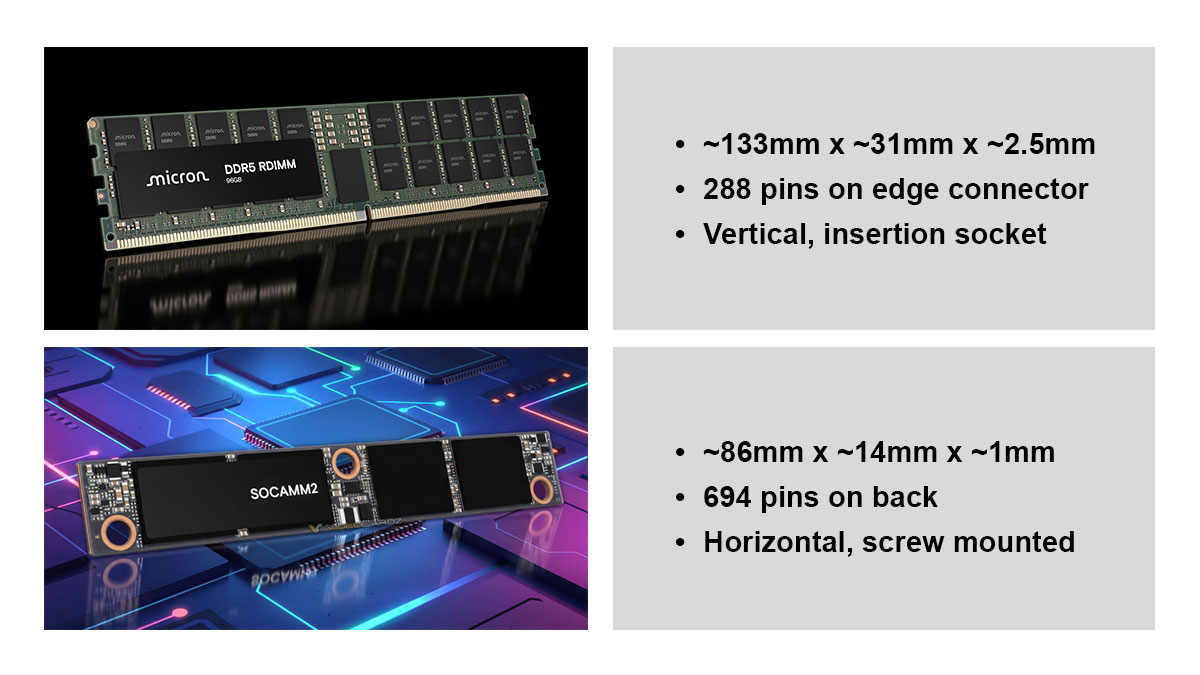
Figure 1 shows snapshots of RDIMM and SOCAMM2 modules.
SOCAMM2 modules containing LPDDR5X memory are designed to consume less energy and provide a smaller physical form factor and a new horizontal interconnect to the system board. This allows for memory that:
Takes up less physical space inside the server; and
Sits horizontally to allow for better system airflow or simpler cold plate designs.
This combination allows system designers to build servers that are optimized for efficiency while still maintaining the modular serviceability that operators expect in production environments.
While these are positive attributes for sure, there is one area that the LPDDR5X technology needs to strengthen to better match the capabilities that are well established in mature, data-center ready DDR DIMMs: RAS. The mobile device design point of LPDDR5 did not have the same uptime and error correction requirements typical of 24 x 7 server operation. Server DRAM modules have proven on-die Error Correction Code (ECC) covering memory cell-level operation and is supplemented by DIMM-level ECC capabilities that help correct errors within the overall DIMM—with link level and multi-bit failure support. They often also have “spare” memory modules on board that can allow for some level of component failure without impacting the systems’ operation.
The new wave of LPDDR5X SOCAMM2 products are designed to close some of the gap—with vendors working on enhancements including additional on-package chips, software and memory controller-based features to bolster the RAS capabilities. But even these enhanced modules will require more capabilities to match the proven levels of robustness of RDIMMs that are essential for most server deployment environments. These capabilities will be refined and enhanced over time, much the same way that the DDR RAS capability has grown generationally. In the meantime, the current RAS capabilities of the LPDDR5X based modules may initially constrain suitability of this memory to select use cases, predominantly in environments where the software stacks are highly resilient and don’t require all the hardware-based RAS capabilities provided by RDIMMs.
With this promise, many of the world’s leading DRAM manufacturers are readying a portfolio of LPDDR5X SOCAMM2 products. Micron Technology, Samsung and SK hynix have each announced or demonstrated initial products to begin to meet the needs of next-generation servers designed for environments where performance per system watt is crucial.
Fostering System Design Innovation
For new server and data center deployments, SOCAMM2 offers new possibilities for server design. Lower memory power consumption can enable higher server density within a rack. When each system consumes less energy and generates less heat, data center operators can then deploy more resources in the same physical space. Reduced thermal output can also simplify cooling requirements, which can further reduce infrastructure costs. Additionally, the compact size of SOCAMM2 modules allows for flexible system layouts, promising smaller footprints or optimization for deployment scenarios where efficiency is paramount.
The Memory Ecosystem Does its Part
The need for energy reduction is felt across the systems landscape—every watt counts. As mentioned, the growing performance and capacity requirements of servers makes memory a powerful leverage point, and the memory industry has responded through the development of LPDDR5X and SOCAMM2. The energy challenge will require the whole ecosystem to work together closely.
Looking Ahead
JEDEC-standard DRAM and RDIMMS have allowed for incredible performance and efficiency gains, and we anticipate they will remain the standard for general purpose computing for years to come thanks to mature RAS functionality, incredible volume, affordability and a strong roadmap of enhancements in DDR6 and beyond.
But as data center workloads and deployment models continue to diversify, the industry is also exploring additional memory and system architectures that emphasize performance per watt. LPDDR5X SOCAMM2 memory represents one step in this direction by bringing together high-bandwidth, low-power memory with the modularity required in server environments.
In addition to our technical leadership in contributing to JEDEC memory standards, AMD has been working with the leading memory manufacturers on next-generation server platforms to assure compatibility as well as the optimization needed to reach the solution level performance per watt objectives.
AMD EPYC Server CPU Adoption of LPDDR5X SOCAMM2
The 6th generation AMD EPYC Server CPU family will support industry-standard DDR5 RDIMM and MRDIMMs based memory. It will also offer SKUs that support the new LPDDR5x SOCAMM2-based memory. In the server market, AMD plans to first support LPDDR5X SOCAMM2 memory with the 6th Generation AMD EPYC Server CPU code-named “Verano” available in 2027. Verano will be the optimized host CPU for the future generations of AMD Instinct GPUs and leverage LPDDR5X SOCAMM2 to deliver optimized Perf/System-Watt in AI Rack Scale Solutions from AMD. This combination of bandwidth, power efficiency, and serviceability is expected to make LPDDR5X SOCAMM2 components a valuable, complementary component of next-generation AI and data center infrastructure.
Contributors

Related Blogs
-
-
Rightsizing Cloud Workloads on AMD Part 1 Foundations
Learn the foundations of rightsizing cloud workloads on AMD: define goals, choose the right time, classify workloads, and select relevant benchmarks.
October 01, 2026
-
EPYC CPUs Deliver for Every Layer of the Agentic AI Stack
Agentic systems combine multiple CPU roles into a workflow. The latest AMD EPYC CPU generation lets customers optimize for each task.
September 18, 2026
-
Building Infrastructure for an AI World in Motion
The biggest risk is not choosing the wrong technology today. It is building infrastructure that cannot adapt tomorrow.
September 17, 2026
-
Advancing AI 2026: From Gigawatt Data Centers to Agentic PCs
Explore how AMD connects data center, cloud, and local AI to enable secure, cost-aware agentic workflows across enterprise PCs.
September 16, 2026
-
From LEAP 2026: Advancing AI Across the Middle East
At LEAP 2026, AMD’s role helping build open AI infrastructure and turn investments into measurable business and economic value was on display.
September 09, 2026
-
Optimize SQL Server Costs with AMD on AWS
Optimize SQL Server licensing costs on AWS with AMD-powered Amazon EC2 and Amazon RDS instances while maintaining performance.
September 03, 2026
-
The Data Center Math has Changed
Run more work on fewer servers to reduce power, space and licensing costs while creating capacity for what comes next.
September 02, 2026