Agent Computers: Pay Once for Cloud-Grade Intelligence
May 20, 2026
AI has changed what a single person can do. A developer can build faster. A creator can generate video, music, images, and 3D assets in hours instead of weeks. A business can automate research, support, analysis, and repetitive workflows with agents that keep working long after the first prompt.
But as AI moves from occasional use to continuous use, one thing becomes clear: generation can get expensive.
Every video render, every music prompt, every agent loop, every coding session, every document pass, and every tool call consumes compute. In the cloud, that often means credits, subscriptions, or token-based pricing. The more useful AI becomes, the more often people want to use it. And the more they use it, the more the bill matters.
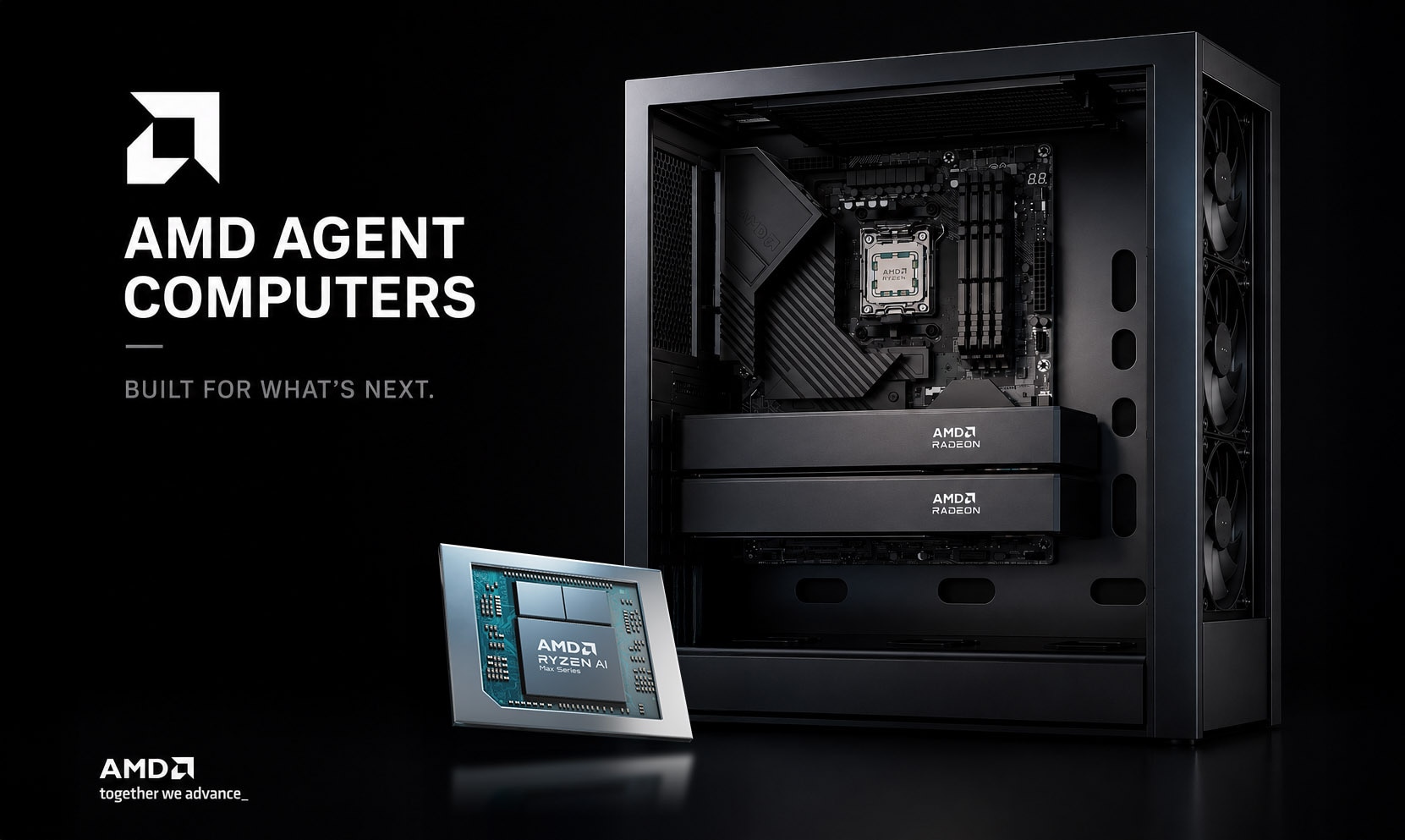
That is where the Agent Computer comes in.
An Agent Computer is a dedicated local system built to run AI workloads continuously. It is not just a PC someone occasionally opens to chat with a model. It is a local AI engine for agents, developers, creators, and small teams — a machine that can reason, generate, automate, and iterate without sending every task to the cloud.
With AMD Ryzen™ AI Max processors, AMD Radeon™ AI PRO graphics cards, and AMD ROCm™ software, that future is already taking shape.
AI demand is becoming continuous
The first wave of generative AI was about prompts. The next wave is about agents.
Agents do not just answer once. They read, plan, revise, call tools, inspect results, and continue working. That makes them powerful, but it also makes them hungry. A single agent harness can consume more than a million tokens per day. For teams running coding agents, research agents, content agents, or workflow automation, token demand can grow quickly.
The right answer is not to stop using cloud AI. The right answer is to run the right workloads in the right place.
Frontier cloud models will continue to matter for the hardest reasoning tasks. But many workflows do not need a frontier model for every step. A local model can handle drafting, summarization, code iteration, document processing, structured extraction, and repetitive “grunt work”; especially when the task benefits from privacy, low latency, and predictable cost.
That is the role of the Agent Computer: move high-volume AI execution closer to the user.
Local models are ready for real work
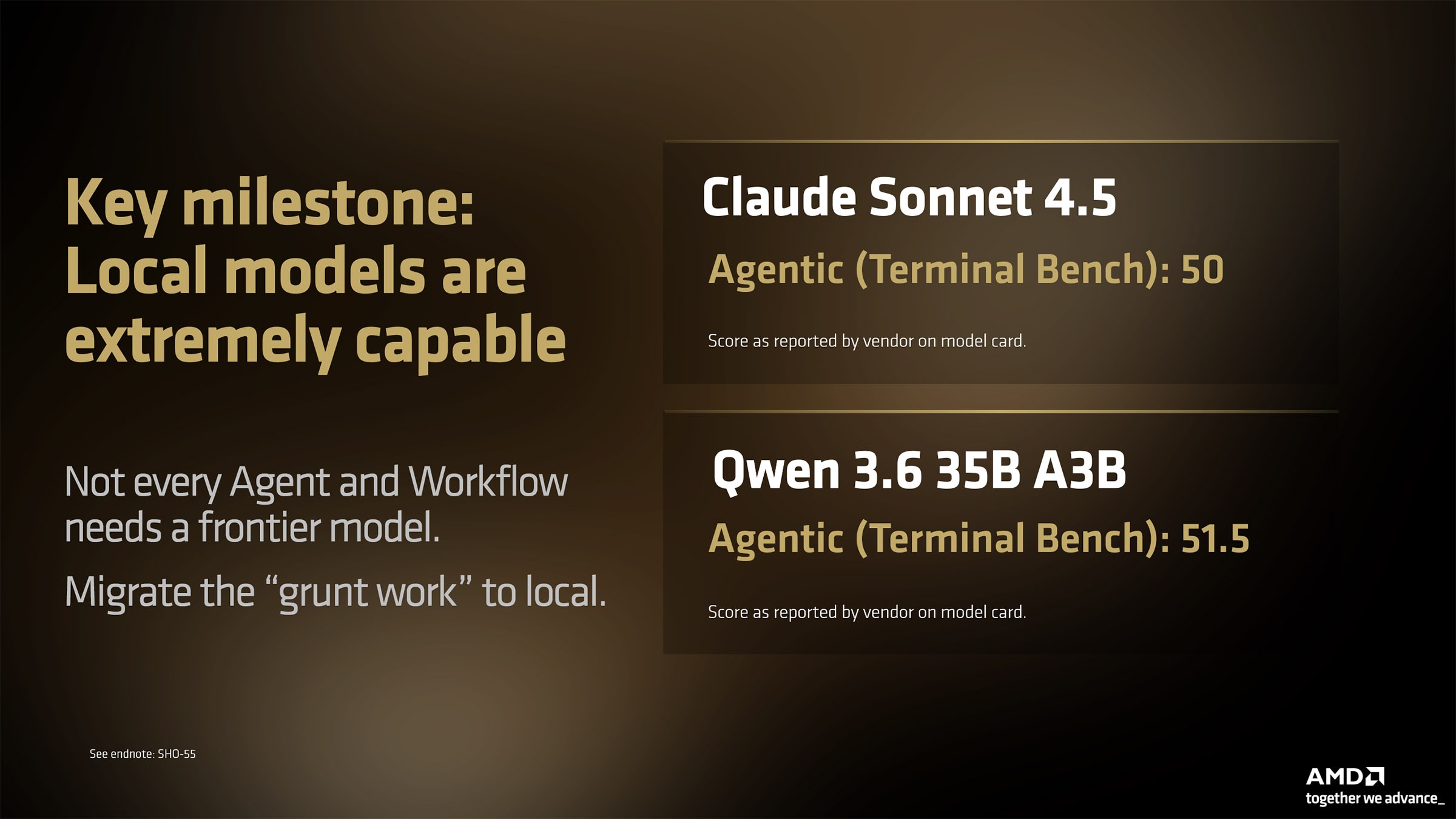
A major shift is happening in model capability. Local models are no longer just experimental companions for hobbyists. They are becoming strong enough for serious agentic workflows.
In agentic terminal benchmarks, compact open models are now competitive with leading cloud models for many practical tasks. Qwen 3.6 35B A3B, for example, demonstrates that a local model can deliver highly capable agent behavior in a footprint that makes sense for advanced local systems.
Pay once, then run
The economics of an Agent Computer become especially compelling when AI usage is steady.
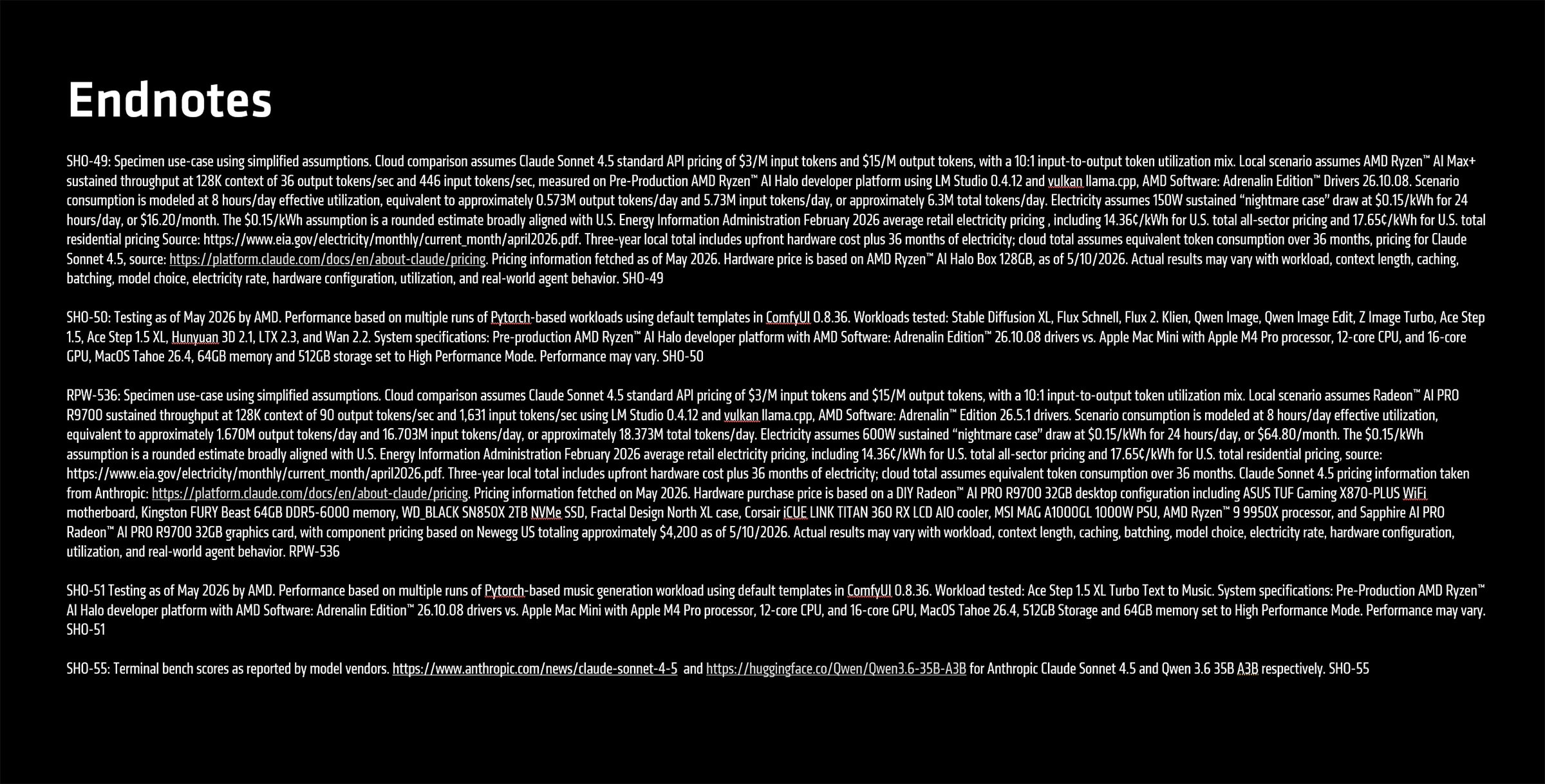
Claude Sonnet 4.5 standard API pricing is $3 per million input tokens and $15 per million output tokens. That pricing model works well for flexible, on-demand access to frontier AI, but it also means that sustained agent workloads can become costly as token usage grows.
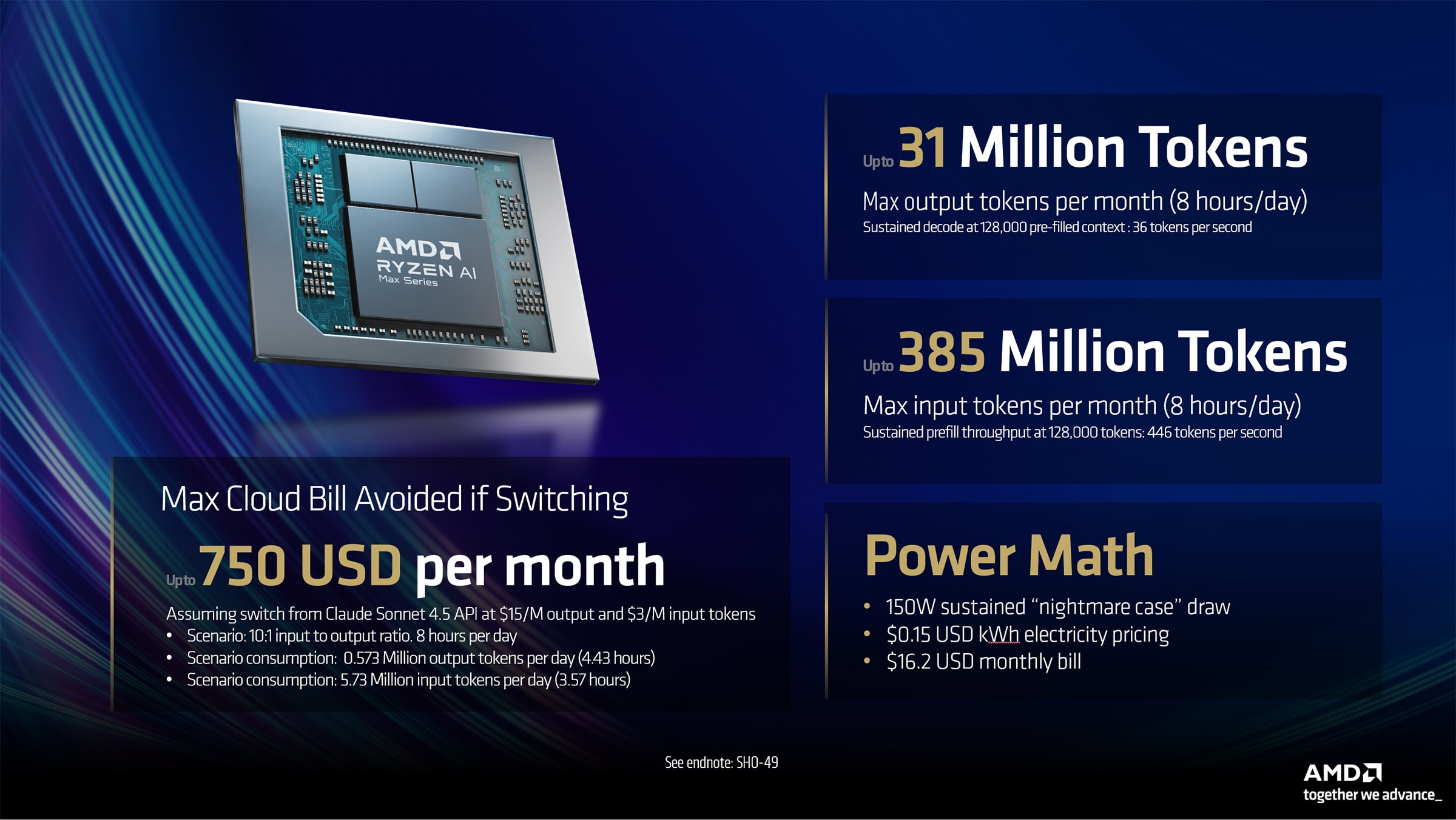
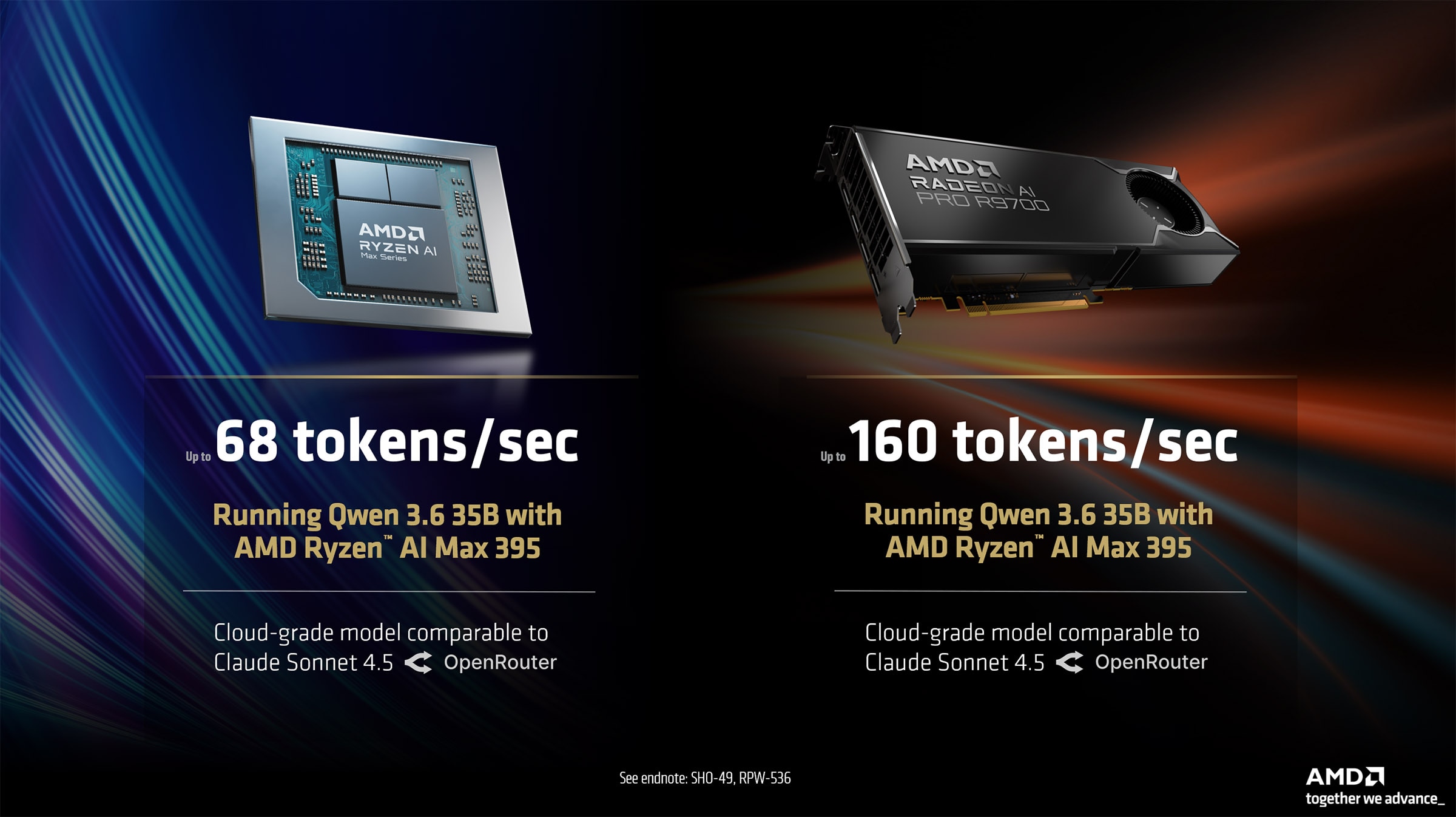
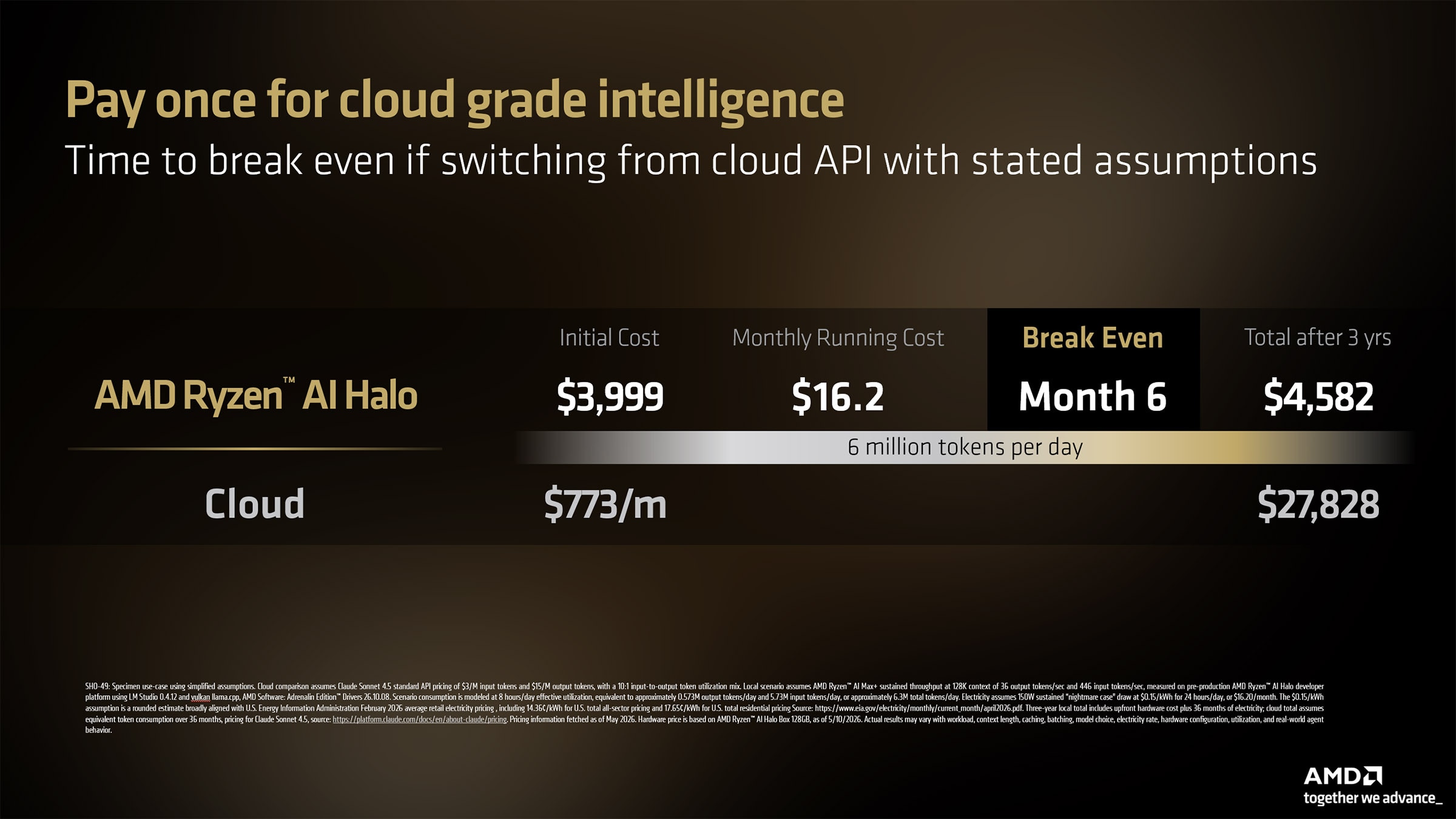
Consider a local AMD Ryzen™ AI Halo system running a cloud-grade model workflow at sustained utilization. Under the assumptions used here, the system can support roughly 6 million tokens per day, with electricity modeled at about $16.20 per month. Compared with equivalent Claude Sonnet 4.5 API usage, that scenario can avoid up to $750 per month in cloud API cost and reach break-even around month 6.
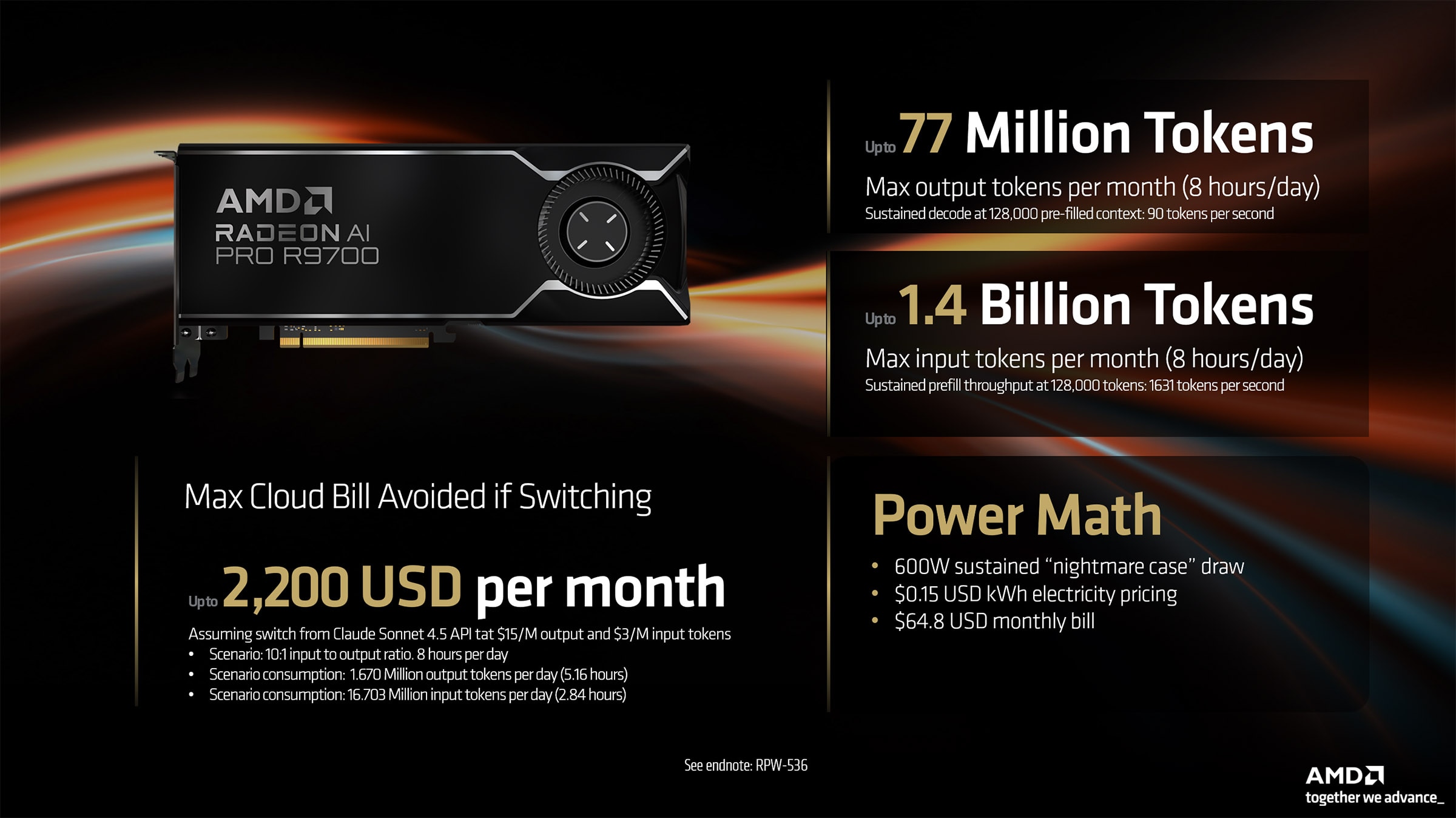
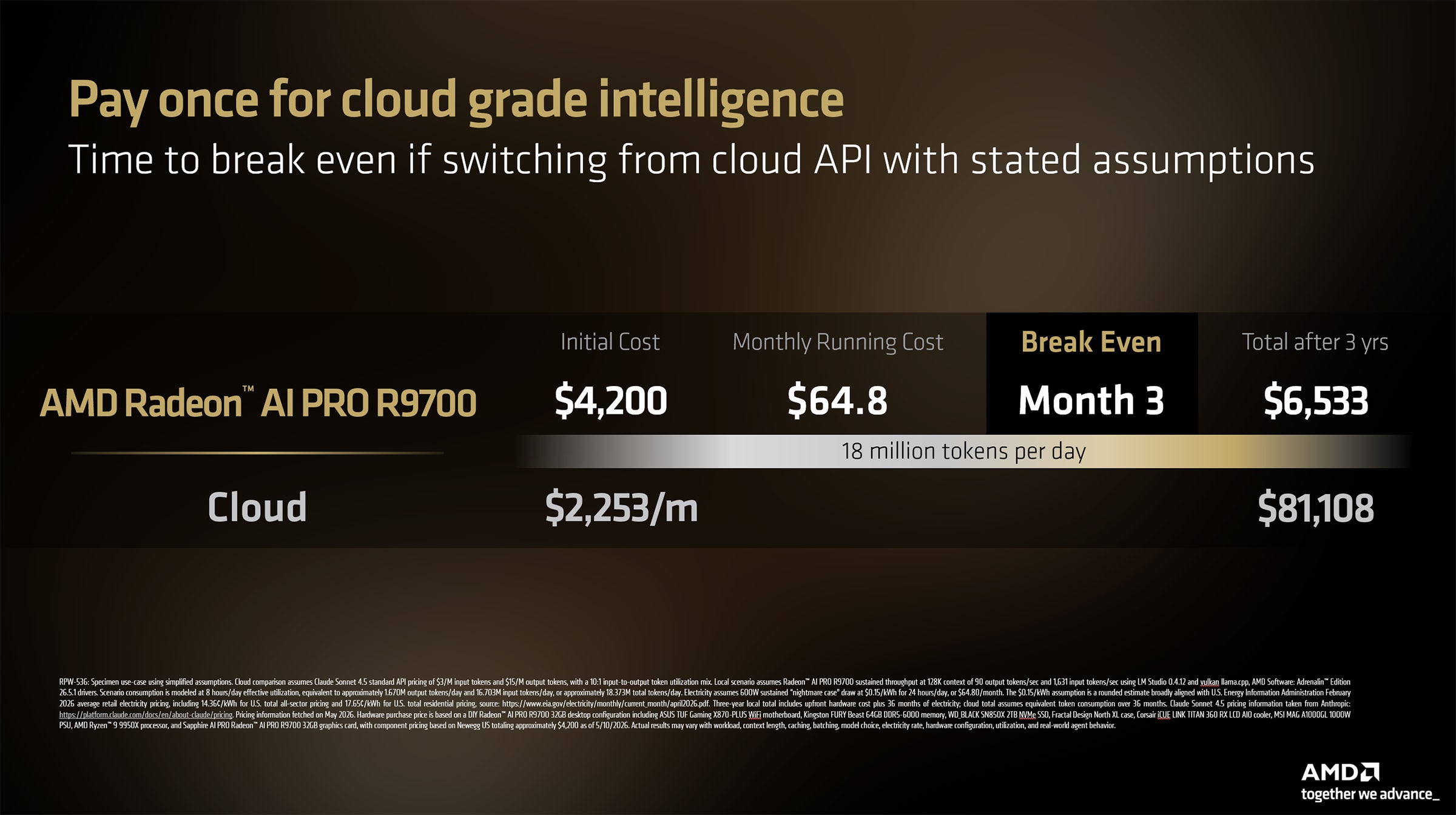
For higher-throughput local AI, a Radeon™ AI PRO R9700 desktop configuration changes the scale again. Under the same cloud comparison assumptions, the system can support roughly 18 million tokens per day, with electricity modeled at about $64.80 per month. In that scenario, the local system reaches break-even around month 3 and can significantly reduce three-year operating cost compared with equivalent cloud API consumption.
Actual results will vary. Workload, context length, caching, batching, model choice, electricity rate, hardware configuration, utilization, and real-world agent behavior all matter. But the principle is straightforward: once AI becomes a daily workload, owning the compute can become a powerful economic advantage.
Local creative generation stays human-led
Agent Computers are not only about text and code, but creative generation as well. You can run a ComfyUI server and serve it over local host. Video, music, image, and 3D workflows are still highly collaborative. The human drives the concept, taste, direction, selection, editing, and final output. AI accelerates the loop.
That distinction matters.
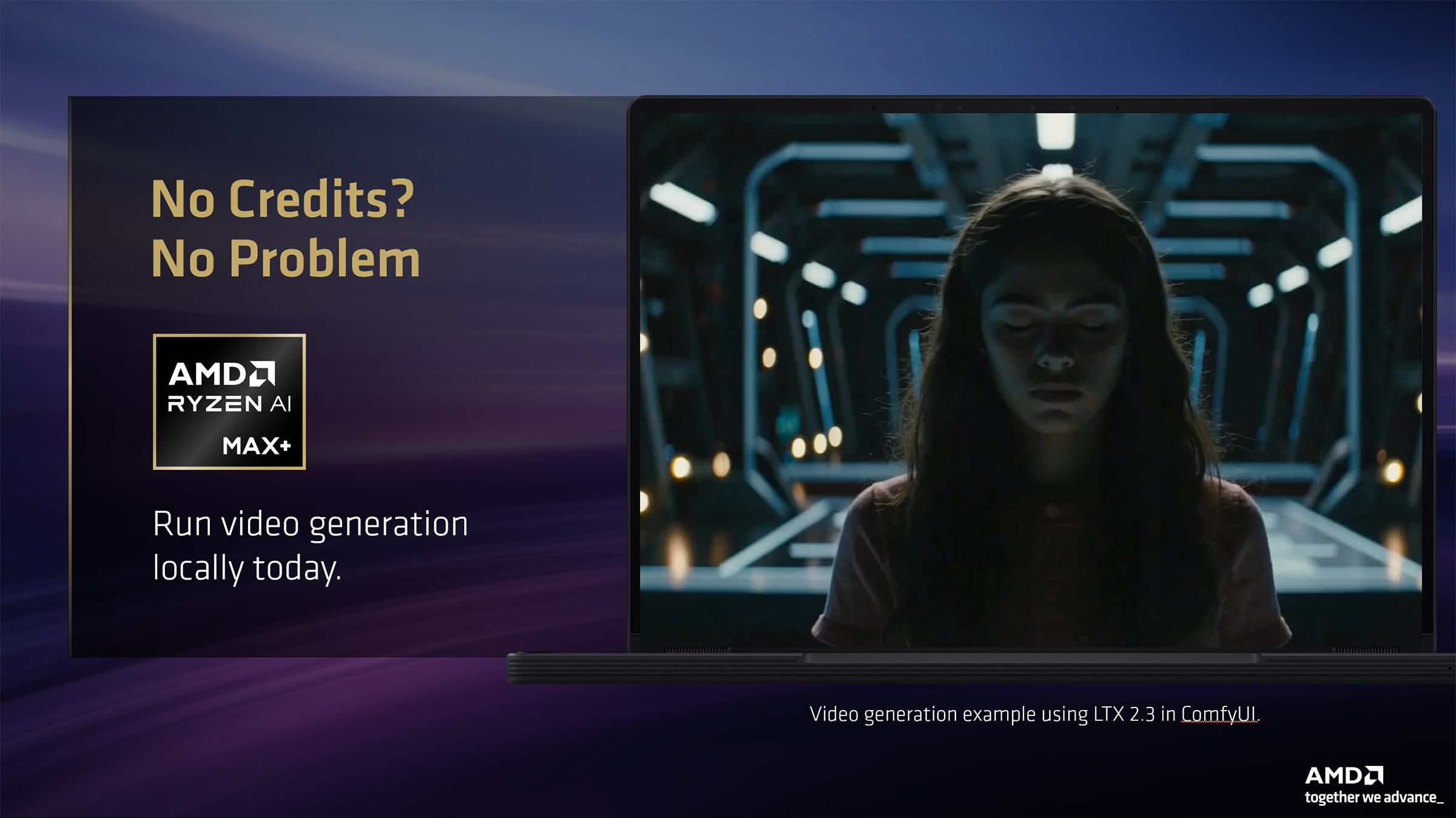
For creators, the value of local AI is not that the machine replaces the creative process. It is that it gives the creator more room to experiment. Video and music generation can be compute-intensive, and cloud-based services often rely on subscriptions, credits, or limited monthly usage. That can make each iteration feel expensive. Local compute helps remove that friction.
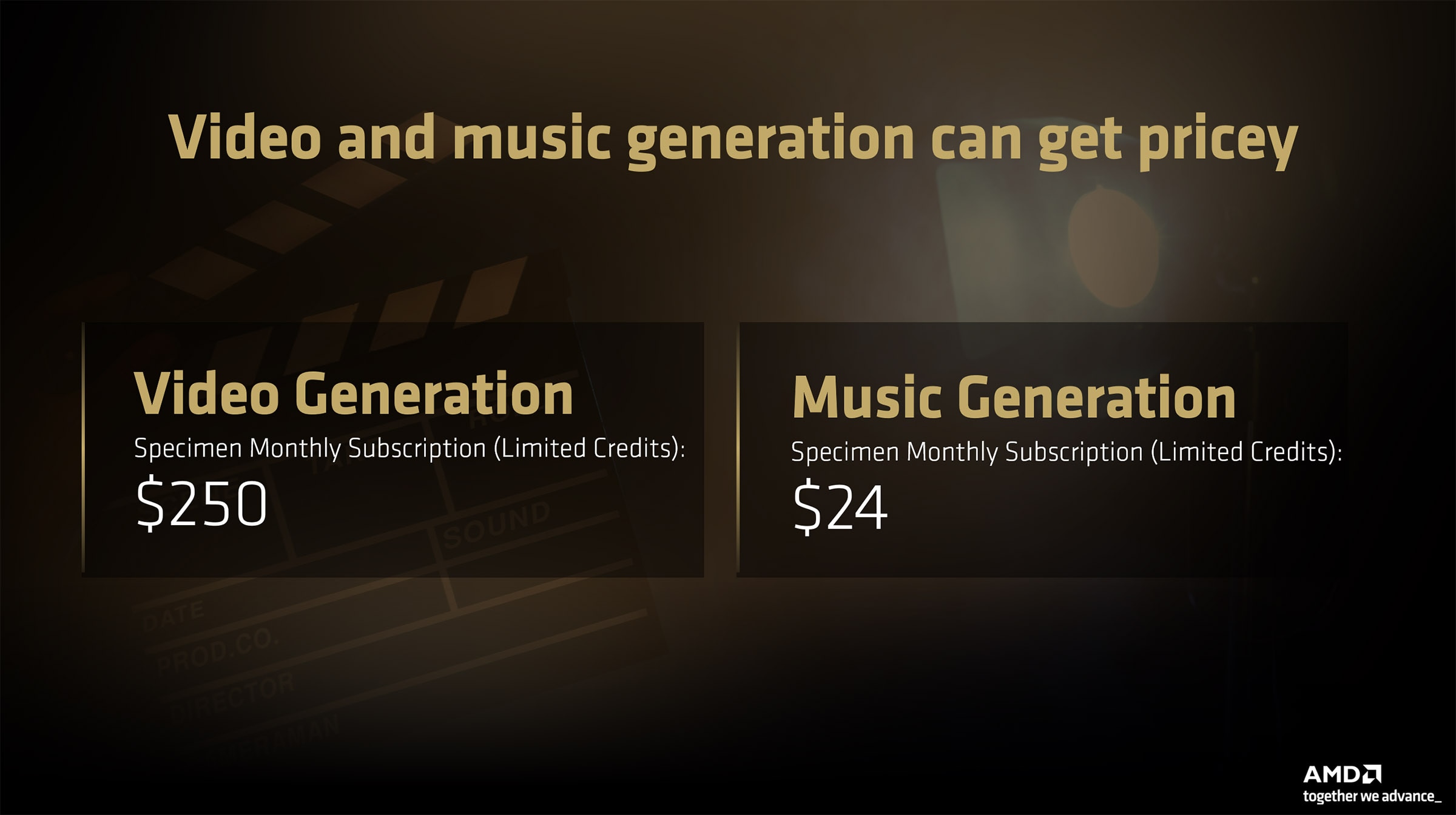
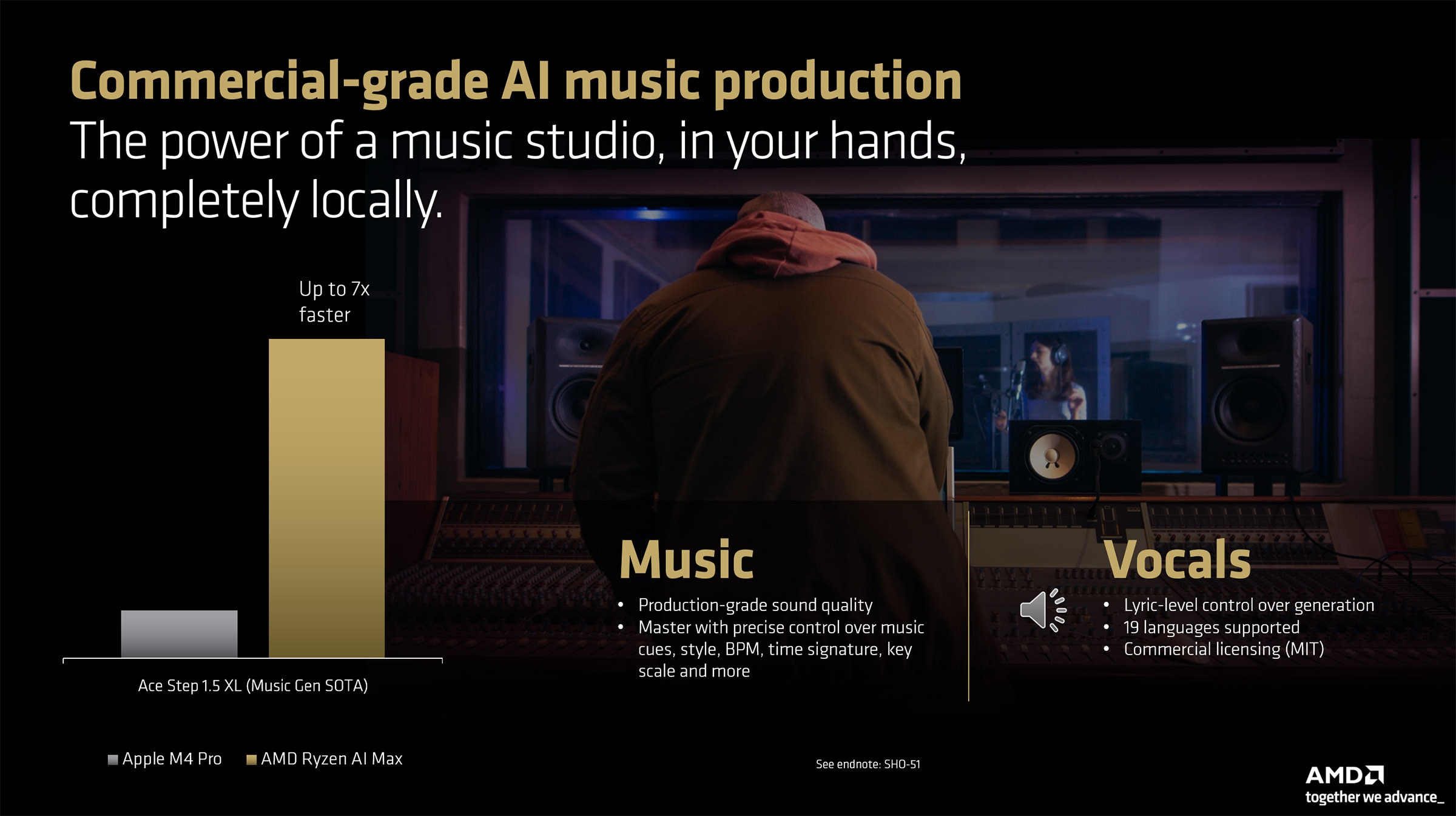
With AMD Ryzen™ AI Max+ systems, creators can run video generation locally using workflows such as LTX 2.3 in ComfyUI. Instead of waiting on cloud credits, users can explore more ideas, test more prompts, refine more scenes, and iterate at their own pace. For music generation, workloads such as Ace Step 1.5 XL Turbo Text to Music bring production-grade sound generation closer to the creator, with control over cues, style, BPM, time signature, key scale, lyrics, and vocals.
Creativity is iterative. The best idea rarely arrives on the first generation. Local AI gives creators a faster, more flexible workspace while keeping the human firmly in control.
Performance needs a real software stack
Running AI locally is not just about raw silicon. It requires a software stack that can keep up with modern models and workflows.
Video generation, image generation, 3D generation, music generation, and local LLM inference all depend on frameworks, drivers, libraries, and workflow tools working together. When that stack is incomplete, the experience breaks. When it is optimized, local AI becomes practical.
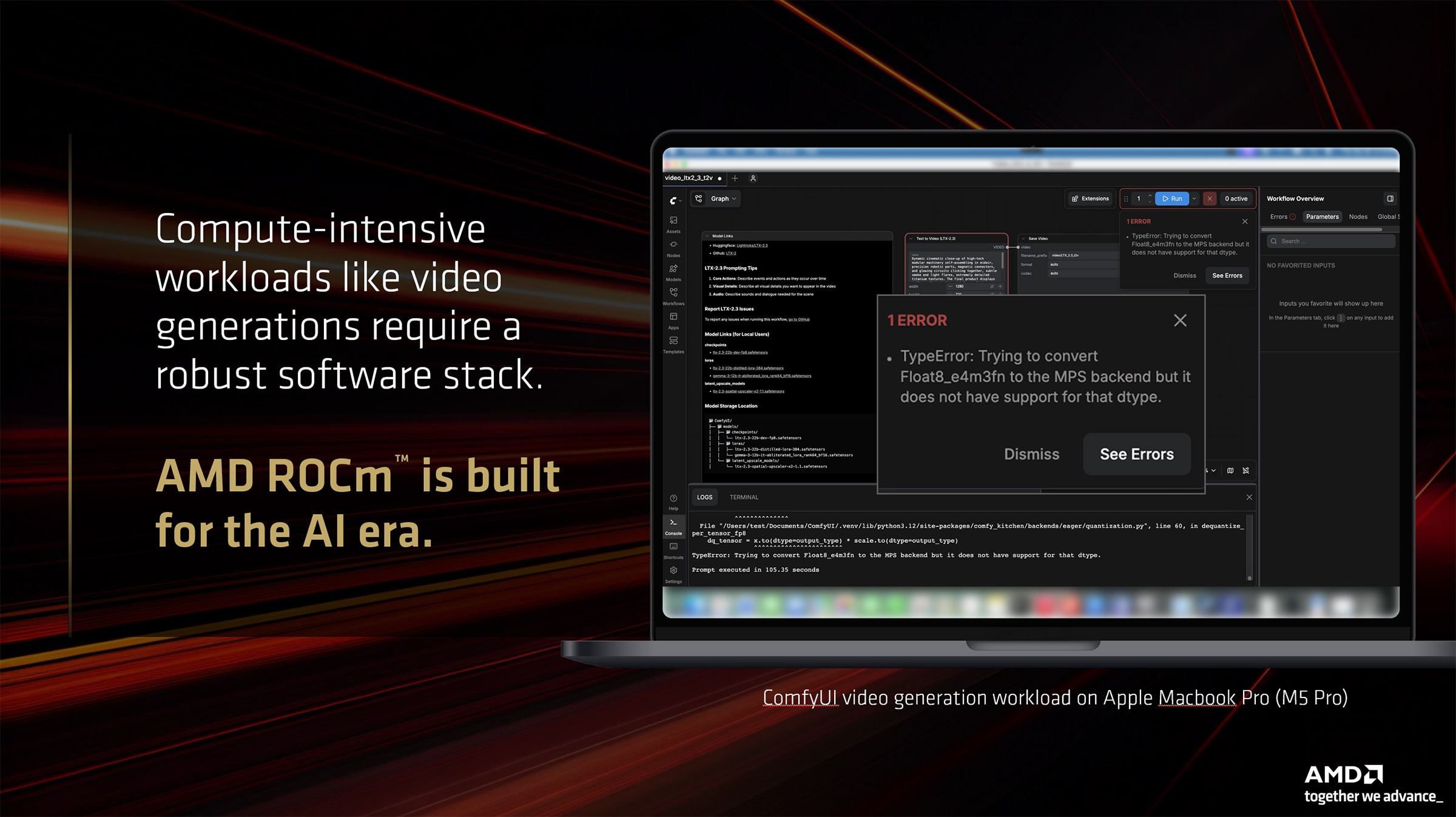
AMD ROCm™ is built for this era. It helps enable demanding generative AI workloads and supports the performance foundation needed for local creation and agent execution. Across PyTorch-based ComfyUI workloads, AMD Ryzen™ AI Max demonstrates strong generative AI performance across image, video, music, and 3D generation use cases — from Stable Diffusion XL and Flux to Qwen Image, Hunyuan 3D, Ace Step, LTX, and Wan.
For users, that means the Agent Computer is not a science project. It is a practical local AI platform.
The future is hybrid
Cloud AI is not going away. It should not.
The cloud is essential for the largest models, shared services, elastic scaling, and centralized deployment. But not every token needs to be rented. Not every creative experiment needs to run through a subscription. Not every agent step needs to leave the local machine.
The future of AI computing is hybrid: cloud when you need maximum scale, local when you need control, cost efficiency, privacy, and sustained throughput.
An Agent Computer gives users a new option. It lets developers run coding agents locally. It lets creators generate video and music without watching credits disappear. It lets small teams automate internal workflows with predictable cost. It lets businesses move repetitive AI execution closer to where the work happens.
The next AI workstation
The PC has always evolved around the workloads that define an era. Productivity shaped the office PC. Graphics shaped the gaming PC. Content creation shaped the workstation. Now agents are shaping the next computing category.
The Agent Computer is that category: a dedicated local AI system for continuous intelligence.
With AMD Ryzen™ AI Max, Radeon™ AI PRO, and AMD ROCm™, AMD is helping bring cloud-grade intelligence to local hardware — so users can pay once, run continuously, and put AI to work on their own terms.

Related Blogs
-
Pre-Training Hybrid LLMs from Scratch in Primus on AMD Instinct™ GPUs — ROCm Blogs
Pre-train hybrid LLMs mixing MLA attention with Gated DeltaNet, Kimi Delta Attention and Mamba2 mixers on AMD Instinct MI355X GPUs, with open recipes.
October 07, 2026
-
DI Series: Serving Kimi-K3 MXFP4 Wide-EP Disaggregated on AMD Instinct MI300X and MI325X — ROCm Blogs
Learn how to serve a 1.4 TiB Kimi-K3 MXFP4 mixture-of-experts model disaggregated across AMD Instinct MI300X and MI325X GPUs.
October 07, 2026
-
AMD Instinct MI455X vs MI355X: A Technical Look at the Advancing AI 2026 Inference Numbers — ROCm Blogs
Explore the MI455X vs MI355X inference numbers from Advancing AI 2026, and learn how each benchmark was measured and what it really means.
October 07, 2026
-
Completing the GPU Performance Picture: Understanding TAF Alongside Peak FLOPs and MAF — ROCm Blogs
Learn how Typical Attained FLOPs complements Peak FLOPs and Max-Achievable FLOPs, including the methodology and MI325X results
October 05, 2026
-
How Agentic AI Is Expanding the Role of the DPU
As agentic AI drives more stateful workloads, DPUs are becoming critical for networking, storage, KV-cache management, and infrastructure efficiency.
October 05, 2026
-
ROCm 10.1: Breaking the Data-Movement Bottleneck — ROCm Blogs
ROCm 10.1 targets the data-movement bottleneck with AMD Infinity Storage, NUMA-aware memory, and a modernized stack.
October 04, 2026
-
MoRI UMBP Empowers AMD Instinct GPUs
See how UMBP, MoRI and SGLang optimize KV cache reuse to boost AMD Instinct™ MI355X GPU agentic AI performance and cost efficiency
October 01, 2026
-
Automating Performance Bottleneck Identification with the TraceLens Agent — ROCm Blogs
TraceLens Agent is an agentic workflow that examines GPU traces to deliver a prioritized optimization report, detailing root causes and fixes.
September 29, 2026