From Independent Artist to Production Scale: How Pixar, Ranch Computing, and AMD Helped Bring Production-Grade Rendering to Creators Worldwide
Jul 17, 2026
Introduction
Pixar’s RenderMan Art Challenge gives independent artists, students, hobbyists, and professionals an opportunity to create original work using the same rendering technology trusted in feature animation and visual effects production. The 2025 challenge, themed “First Contact,” attracted 239 entrants, produced 109 completed submissions, and resulted in 51 finalists, making it the largest RenderMan Art Challenge to date.
For Pixar, Ranch Computing, and AMD, the opportunity is to extend production-grade rendering workflows to artists and smaller creative teams that typically do not have access to studio-scale infrastructure.
Pixar’s own pipeline shows what that kind of infrastructure enables at production scale. Artists need responsive systems while they create, and scalable compute when scenes become more complex or final-quality output is required.
The Pixar Pipeline: Interactive Creation, Scalable Rendering
Pixar’s artist workstations are built around AMD EPYC™ server CPUs and virtualized to support multiple artists per physical machine. In its top-end artist configuration, Pixar uses dual-socket systems with two AMD EPYC 9654 server CPUs and four GPUs, divided into four virtual machines. Each artist receives 47 CPU cores, with one core reserved per socket for the hypervisor, along with access to a dedicated GPU.
Pixar uses a similar model with AMD EPYC 7763 server CPUs, where each dual-socket system also supports four artists, with each artist receiving 31 CPU cores and a GPU.
That setup supports the interactive side of the creative process. Artists create, refine, light, shade, and iterate on virtual workstations built with AMD EPYC server CPUs. Once they’re satisfied with their work, they send final renders, physics simulations, and other compute-intensive jobs to Pixar’s render farm, which is also built with AMD EPYC server CPUs.
The result is a continuous workflow: interactive development on virtual machines built with AMD EPYC server CPUs, followed by scalable rendering and simulation on render farm infrastructure built with the same CPU family.
The Challenge: 239 Artists, One Renderer
For the 2025 RenderMan “First Contact” Art Challenge, participants were required to use RenderMan 26 with RIS rendering, Pixar’s CPU-based production renderer. That requirement gave all participants a consistent technical foundation while offering experience with workflows like those used in professional production environments.
“I know we keep saying this,” said Leif Pedersen of Pixar’s RenderMan team, “but with record participation and community engagement, this was our most successful art challenge yet.”
The challenge also reflected the international reach of the RenderMan community. During the competition, 22 artists from across 12 countries used the AMD Creator Cloud via Ranch Computing, collectively submitting 569 projects and consuming more than 66 days of cumulative compute time.
Mentorship and Community Support
The challenge also gave artists access to structured mentorship and feedback throughout the competition.
Thoughtful 3D, led by Mike “Cash” Cacciamani and Conor Woodard, helped participants think through the creative process, including inspiration, artistic intent, and managing deadlines. Ozone Story Tech, led by Rich Hurrey, a 13-year Pixar veteran and Ozone’s Founder and Head of Product, gave artists feedback rooted in feature-animation character design and storytelling.
That mentorship became an important part of the 2025 challenge. Pixar’s team noted a strong correlation between mentorship participation and finalist success, particularly among artists who attended feedback sessions consistently and applied that input throughout development.
Three Winners, Different Workflows
The top three winning entries demonstrated different ways artists used the challenge ecosystem. Felix Gourlaouen and Noémie Layre leaned heavily on mentorship and feedback, while Elio Humbert benefited from scalable cloud rendering. Together, their experiences show that production-grade creative work depends on more than any single tool, platform, or piece of infrastructure.
Felix Gourlaouen — “Something’s Fishy”
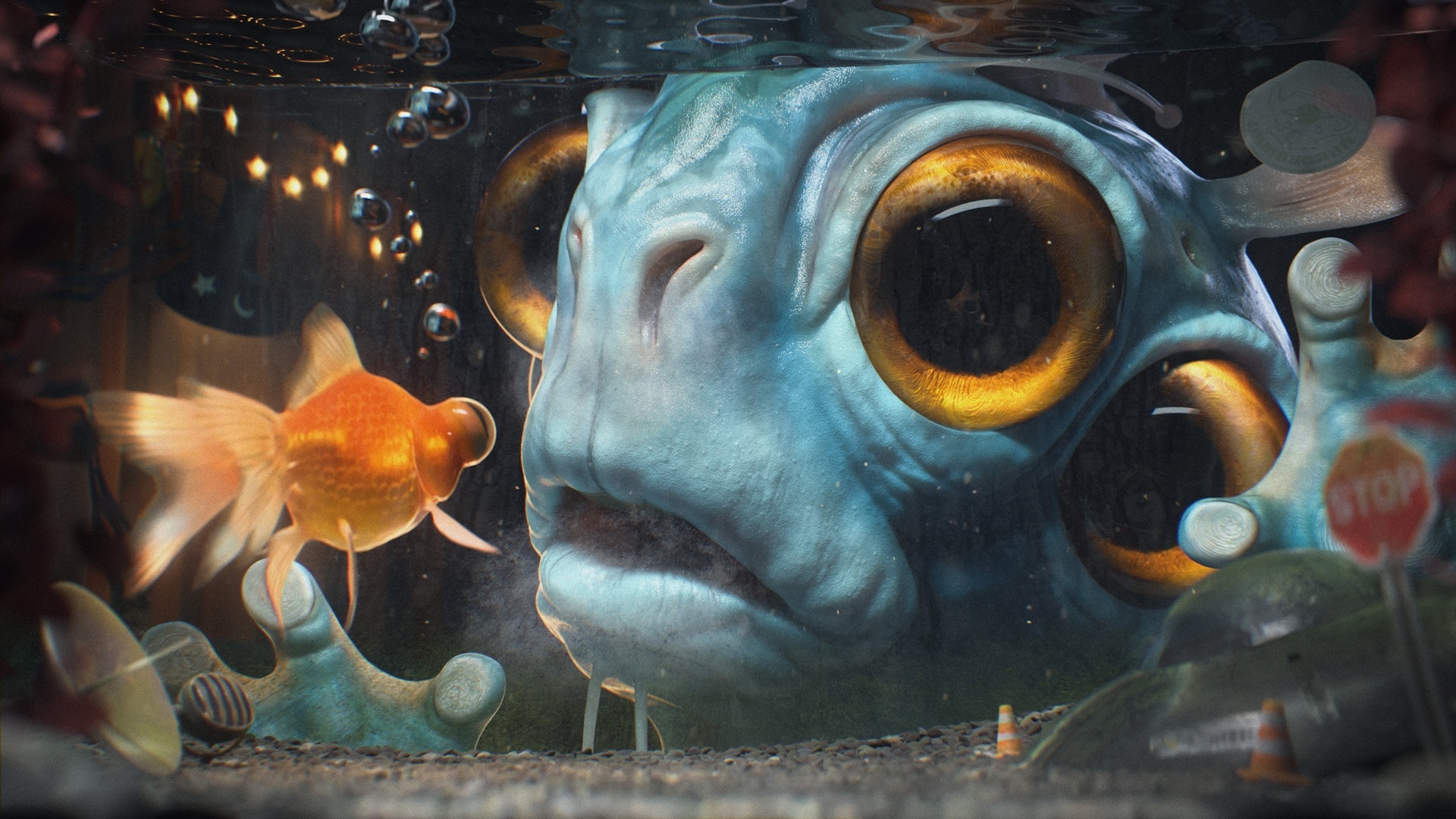
First-place winner Felix Gourlaouen created “Something’s Fishy,” an image built around a massive alien creature pressed against the outside of a fish tank.
One important refinement came through the challenge’s mentorship program. By lowering the water level so the top of the water remained visible, Gourlaouen strengthened the visual read that the creature was outside the tank rather than submerged within it.
“They helped me expand on my ideas, never trying to steer me away from the image I wanted to create,” Gourlaouen said. “The back and forth over those few weeks enabled me to brainstorm and exchange with talented artists that have a keen eye for detail. Most notably, the detail that I think made my image work was lowering the water level, which was initially out of frame. This note helped sell that the creature was not submerged in the fish tank, but rather outside, pressed against the glass.”
Gourlaouen rendered the final 4K frame locally with RenderMan 26. To manage iteration speed during development, he worked at half resolution before rendering the final image at full resolution for submission.
“I definitely want to try cloud rendering,” Gourlaouen said, looking ahead, “to test out how freeing up my machine can save me precious time and resources. I usually like to multi-task on my computer so I think there would be a place for it in my workflow.”
Noémie Layre — “Starry Eyed”
Second-place winner Noémie Layre returned to the RenderMan Art Challenge after placing third in the previous year’s “SciTech” edition.
Her entry, “Starry Eyed,” imagines an alien child dreaming of a first encounter with Earth’s ocean, surrounded by objects gathered from a cosmic junkyard in preparation for that future trip. Layre described the concept in her ArtStation post, where she also thanked the RenderMan community, Thoughtful3D, and the Ozone Story Tech team for their support during the challenge.

Like Gourlaouen, Layre rendered locally with RenderMan 26 and made extensive use of mentorship opportunities throughout the challenge.
“I did tune into the Thoughtful 3D and Ozone mentorship sessions,” Layre said. “It was wonderful to learn and take feedback from professionals like them! I’m so grateful that I had the opportunity to meet all of them!”
Layre’s second-place finish reflected both her continued growth as an artist and the value of sustained engagement with the RenderMan community.
Elio Humbert — “The Patient X”
Third-place winner Elio Humbert approached “The Patient X” as a mood-driven scene, using lighting, volumetrics, and environmental detail to create tension around an unseen encounter.
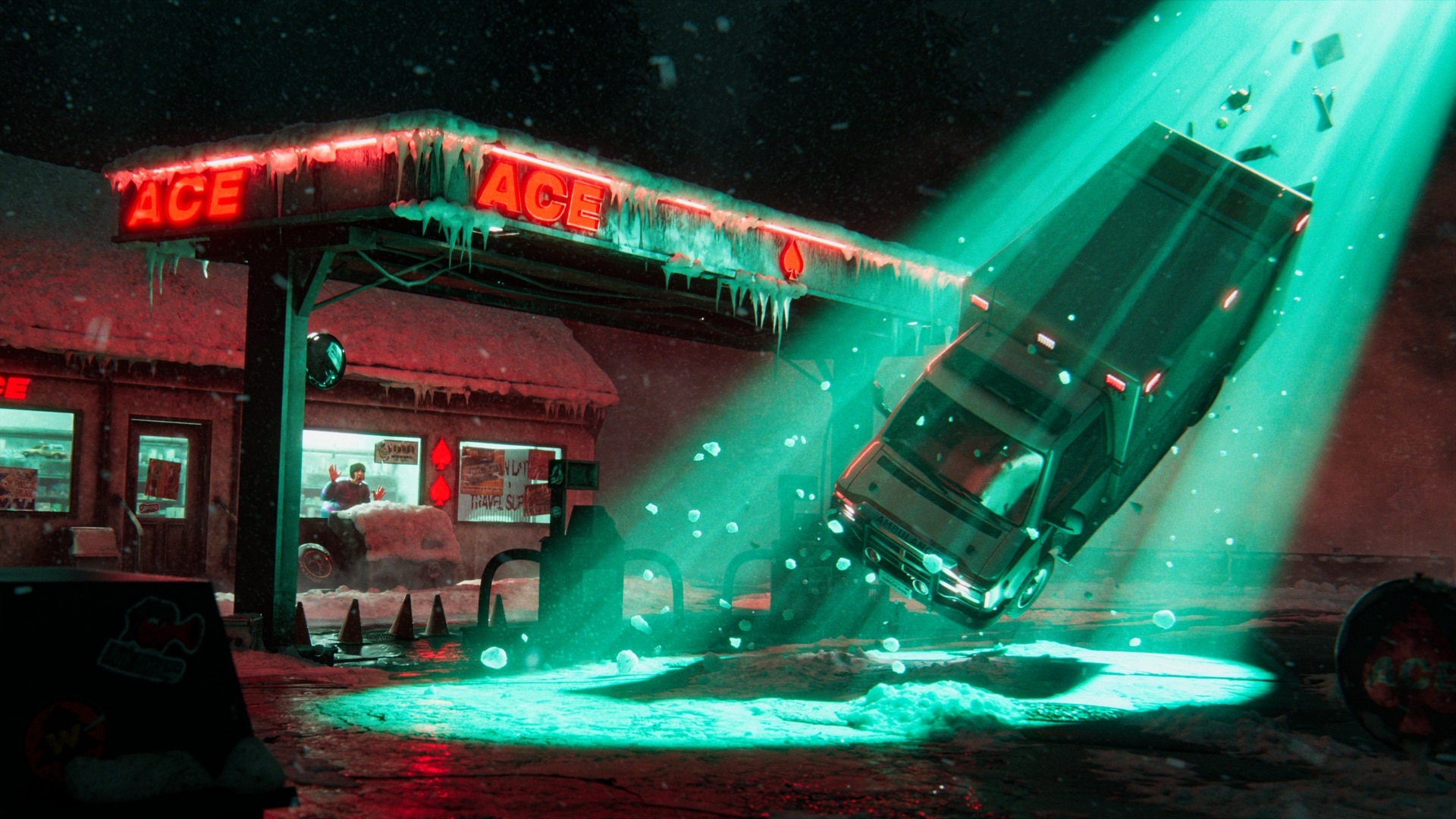
“The First Contact theme pushed me to suggest the encounter rather than show it directly, using mood and environment to create ambiguity and let the viewer imagine what’s happening,” Humbert said.
Working in Houdini with a USD-based Solaris pipeline, Humbert built a render-intensive scene that Pixar described as “probably the most technically difficult” among the winners. That complexity highlighted the value of being able to burst to the cloud for more demanding work.
That is where the AMD Creator Cloud via Ranch Computing made a measurable difference.
“On the AMD Creator Cloud, overall render times were roughly twice as fast, which made a noticeable difference,” Humbert said. “Without cloud rendering, I would have done far fewer iterations, and the project would have moved at a much slower pace... it easily enabled ten to twenty additional iterations and helped avoid the mental fatigue that usually comes with long render times.”
For Humbert, the benefit was not just faster rendering, but the ability to keep working while renders processed remotely.
“The cloud allowed me to keep creating without interruption by rendering remotely, maintaining creative momentum in a way that wouldn’t have been possible with local rendering alone,” he said.
Extending Production-Grade Rendering Beyond the Studio
The AMD Creator Cloud, delivered through Ranch Computing, gave RenderMan Art Challenge participants access to professional rendering infrastructure at no cost during the competition, turning Ranch’s cloud rendering platform into the bridge between individual artists and production-scale compute.
During the “First Contact” challenge, 22 artists from 12 countries used the platform. Together, they submitted 569 projects and consumed more than 66 days of cumulative compute time. Those artists represented North America, Europe, Asia-Pacific, and South America.
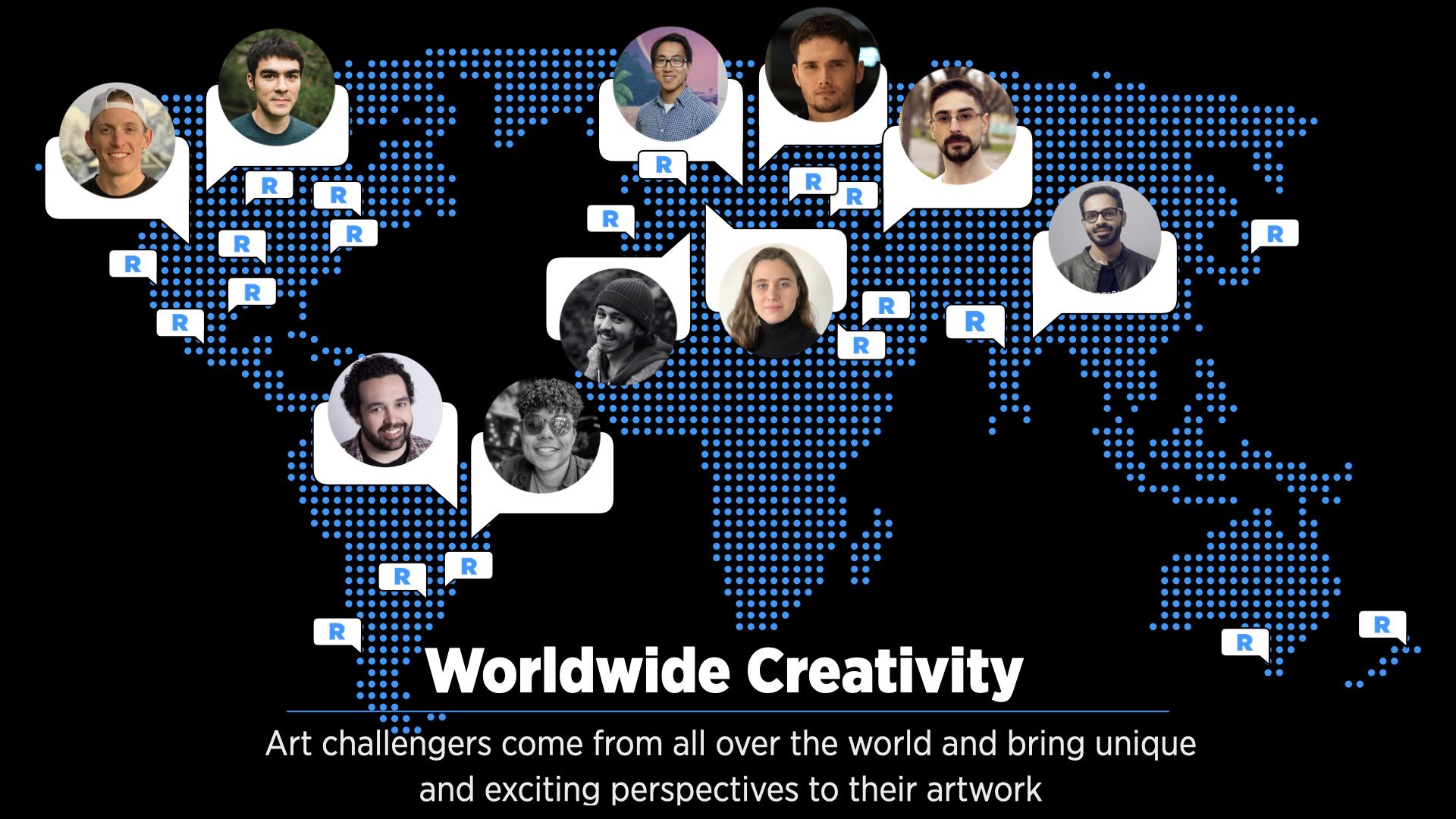
“In most global territories, hardware can be prohibitively expensive to single artists looking to create images of production quality and complexity,” Pixar’s team noted.
The AMD Creator Cloud helped reduce that barrier by giving artists access to scalable rendering resources without requiring them to own high-end local hardware.
As Ranch Computing put it: “Challengers can iterate as much as they need to without worrying about render costs, time, etc. This gives them creative freedom not limited by a personal computer.”
From Challenge Entry to Career Momentum
The impact of the RenderMan Art Challenge can extend beyond a single submission.
Jamal Ulbricht, who placed second in the 2022 “NASA Exploration” Art Challenge, used the AMD Creator Cloud while traveling through Japan, rendering remotely from a laptop on the bullet train. That experience helped him complete a winning entry and build momentum toward a career in visual effects.
“My journey really did go full circle,” Ulbricht said. “Being one of the winners of the RenderMan Art Challenge happened while I was traveling through Japan. I was working on my submission on a laptop right there on the trains, relying on the AMD Creator Cloud to handle the rendering. That breakthrough changed my trajectory and got me into a renowned VFX university in Germany.”
Today, Ulbricht works at Megalis VFX in Tokyo, developing stylized shading systems for main characters and photorealistic materials for VFX.
His path shows how access to professional rendering resources, combined with a strong creative community, can help artists turn challenge work into a longer-term opportunity. For artists working outside traditional studio infrastructure, that access can make the difference between waiting on hardware and continuing to create.
Why Infrastructure Matters
The “First Contact” challenge showed that different artists need different kinds of support.
For Gourlaouen and Layre, mentorship played a significant role in refining their work. For Humbert, cloud rendering helped increase iteration speed and reduce the friction created by long render times. Across the competition, RenderMan provided a common rendering foundation, while mentorship and cloud infrastructure helped artists push their entries further.
This mirrors the way production pipelines work at larger studios. Artists need responsive tools while they create, but they also need access to scalable compute when scenes become more complex or final-quality output is required.
That is the same model Pixar uses internally: artists develop their work on virtual machines built with AMD EPYC server CPUs, then scale rendering and simulation across Pixar’s AMD EPYC server CPU render farm.
Across the artist stories, the common thread is not a single workflow, but access to the right combination of tools, feedback, and compute to help each artist push their work further. That is the practical value of production-grade rendering at scale. It is not just faster final frames, but more time and freedom for artists to explore, refine and create.
RenderMan XPU, Toy Story 5, and the Future of the Challenge
The 2025 “First Contact” challenge used RenderMan 26 with RIS rendering, while Pixar was beginning to deploy RenderMan XPU during production of Toy Story 5. That timing made for an interesting transition point. Participants were working in the final RenderMan Art Challenge centered on RIS, even as Pixar’s own production pipeline was moving toward XPU through its work on Toy Story 5.
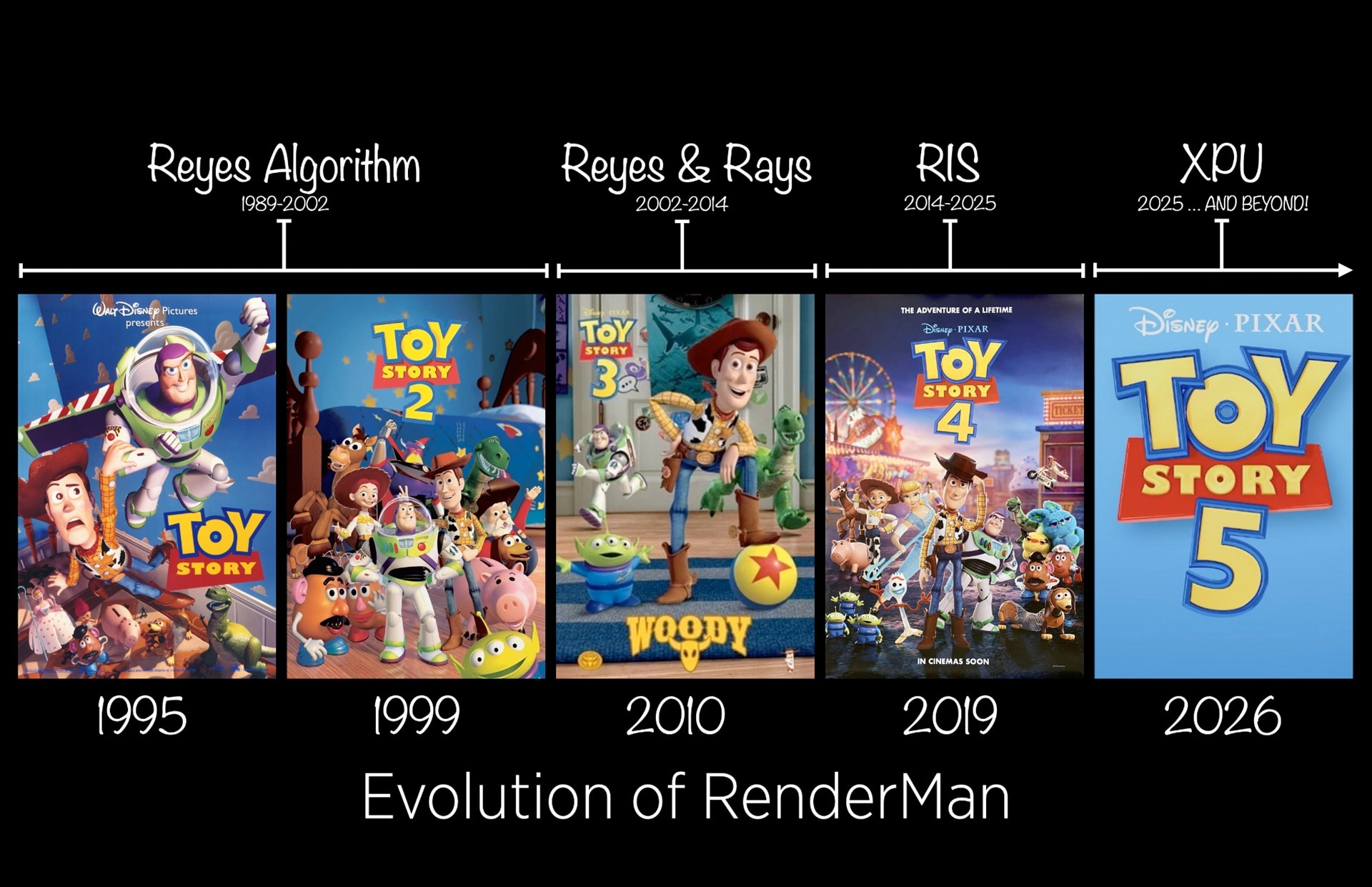
During Toy Story 5 production, Pixar used both RenderMan 26 with RIS rendering and RenderMan 27 with XPU rendering. XPU was not introduced as a clean, one-time replacement across the entire film. Instead, Pixar rolled XPU into production while RIS continued to support other parts of the pipeline, making Toy Story 5 the first Pixar feature to use RenderMan XPU for final-frame rendering.
RenderMan 27 expands XPU into final-frame production rendering, combining CPU and GPU resources to accelerate workflows and reduce the time between creative decisions and visual results. For future RenderMan Art Challenges, that transition brings participants closer to the rendering path that Pixar has begun deploying in feature production.
Pixar has confirmed several relevant performance data points:
Rendering Mode |
Performance Gain |
Configuration |
XPU, CPU only |
Up to 3x faster than RIS |
AMD EPYC server CPU |
XPU, CPU + dual GPU |
Up to 10x faster than RIS |
AMD EPYC server CPU + 2x NVIDIA RTX A6000 |
Toy Story 5 sequence benchmark |
Up to 4x faster |
Pixar production benchmark |
AMD architecture upgrade |
Up to an additional 22% |
3rd Gen EPYC (Codenamed “Milan”) to 4th Gen EPYC (Codenamed “Genoa”), same core count |
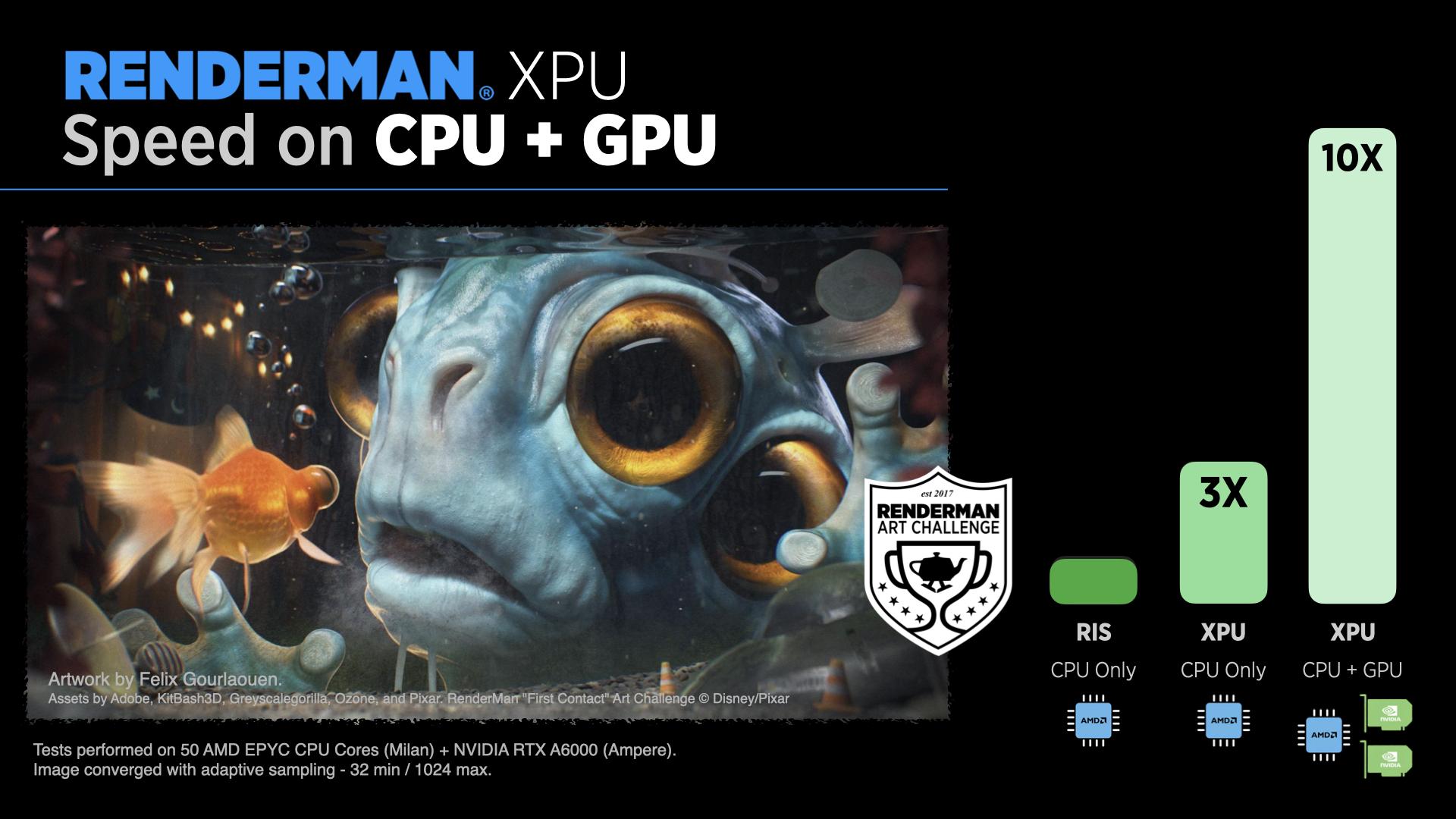
Image Zoom
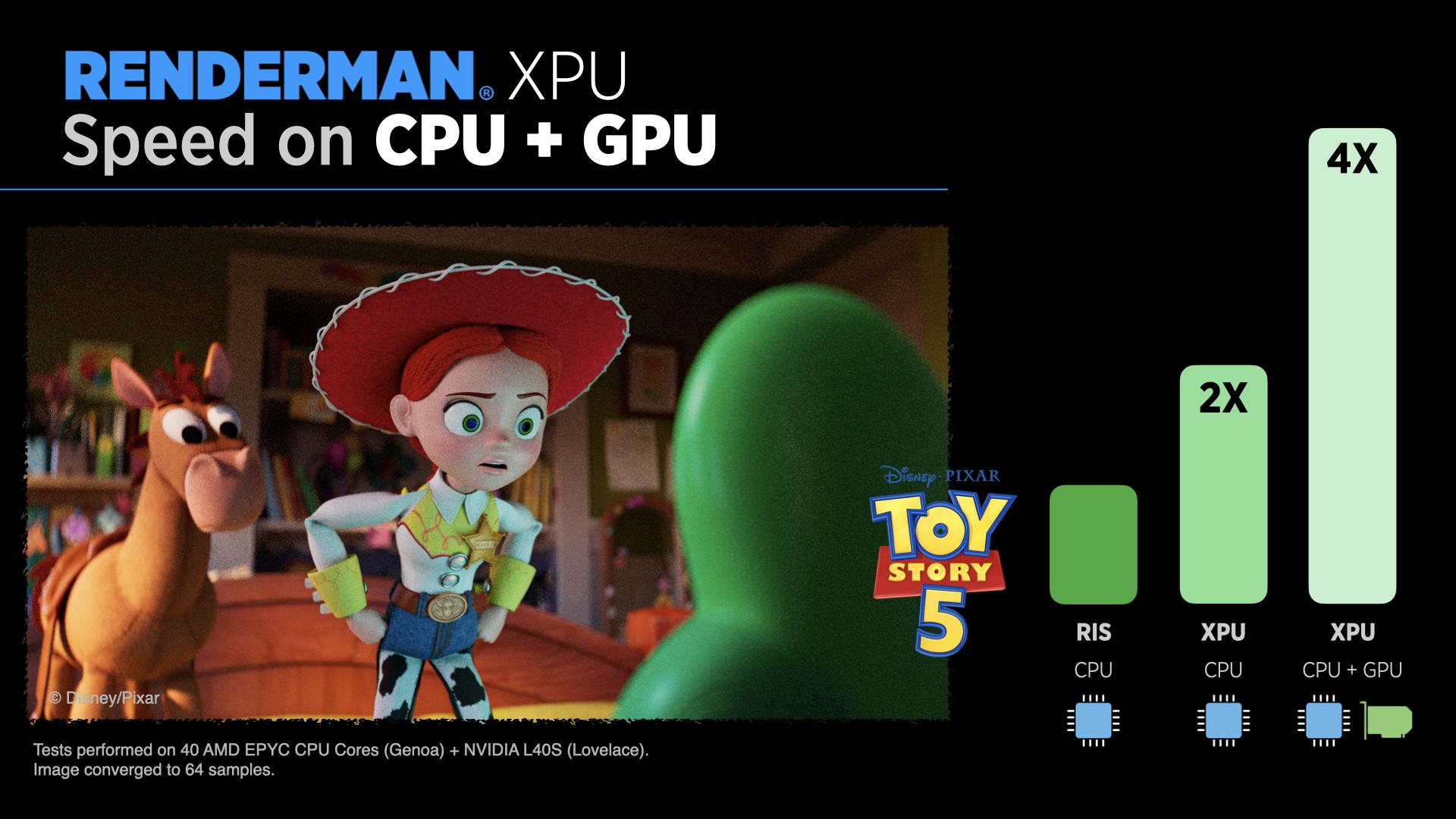
Image Zoom
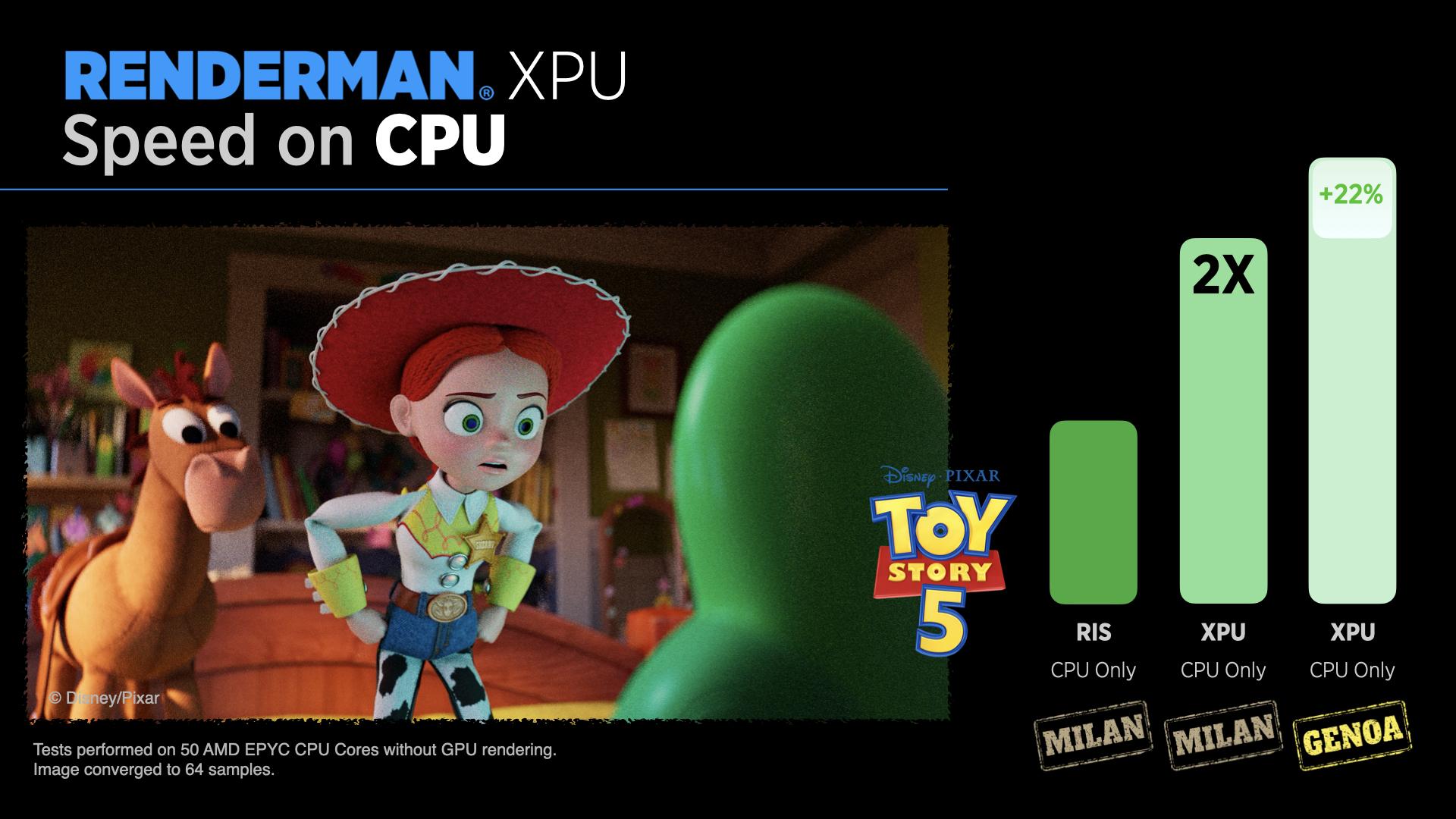
The up-to-22% “Milan”-to-“Genoa” uplift represents an additional architecture gain on top of other XPU-related improvements, rather than a replacement for them. Actual performance varies by scene and configuration.
Today, RenderMan XPU’s GPU acceleration requires CUDA and therefore supports NVIDIA GPUs for that portion of the workflow. That may change in the future, but current XPU GPU acceleration depends on NVIDIA hardware.
For AMD, the CPU side of this transition remains highly relevant. Pixar has tested AMD EPYC server CPUs with up to 192 cores and observed near-linear scaling, with little to no drop-off in performance as core counts increased. For rendering workloads, that kind of predictable scaling is valuable because more compute can translate directly into more iteration, more exploration, and more production capacity.
Dylan Sisson, Head of RenderMan Creative Engagement at Pixar, framed the creative importance this way:
Video comparisons
Video preview: side-by-side RIS and XPU rendering of “Something’s Fishy.”
Video preview: side-by-side RIS and XPU rendering from Toy Story 5.
Looking Ahead
Beginning in 2026, the RenderMan Art Challenge is expected to give participants more direct experience with Pixar’s evolving XPU workflow, including the rendering path the studio began deploying during Toy Story 5 production.
For challenge participants, the transition increases the value of responsive, scalable compute. More interactive rendering means artists can evaluate creative decisions faster, but complex scenes still benefit from infrastructure that can scale beyond a local workstation.
That is where the partnership between Pixar, Ranch Computing, and AMD becomes especially relevant. Through the AMD Creator Cloud, artists can experience a production-style workflow, creating and refining locally, then scaling rendering when their work demands it, without needing to build or access a studio-scale render farm of their own.
Pixar is expected to announce the 13th Annual RenderMan Art Challenge at the RenderMan Art & Science Fair during SIGGRAPH, on Wednesday, July 22, 2026, at the Belasco Theater. That announcement will provide the next opportunity to see how the challenge evolves as RenderMan XPU becomes more central to future participant workflows.
For more information on the AMD Creator Cloud via Ranch Computing, visit ranchcomputing.com. To view all “First Contact” finalist entries and honorable mentions, visit the RenderMan Art Challenge results page.
Image copyright: Assets by Adobe, KitBash3D, Greyscalegorilla, Ozone, and Pixar. RenderMan “First Contact” Art Challenge © Disney/Pixar.
Performance claims provided by Pixar and have not been independently verified by AMD. Results are specific to Pixar and may not be typical.

Related Blogs
-
Accelerating MONAI Digital-Pathology Pipelines on AMD Instinct™ GPUs with hipCIM — ROCm Blogs
In this blog you will measure a MONAI digital-pathology pipeline on AMD Instinct™ GPUs using hipCIM as the WSIReader backend.
October 25, 2026
-
Sovereign AI for European Customer Conversations
LeadDesk, QuTwo, and AMD Silo AI collaborate on a sovereign AI stack that brings near-frontier, open-weight models to European customer conversations.
October 22, 2026
-
AMD and Advantech - Architecting the Next Generation of Regulated Casino Games
Discover how Advantech and AMD are redefining regulated casino gaming with Ryzen Embedded 8000 Series processors, integrated RDNA 3 graphics, XDNA AI acceleration, and purpose-built DPX platforms. The solution enables immersive multi-screen experiences, predictive maintenance, stronger security, lower power consumption, simplified designs, and long-term platform availability for gaming OEMs worldwide.
October 21, 2026
-
hipCIM 26.06: GPU-Accelerated Whole-Slide Image I/O on AMD Instinct™ GPUs — ROCm Blogs
In this blog you will see how hipCIM 26.06 reads whole-slide images on AMD Instinct™ GPUs, and how fast and faithfully it decodes them.
October 19, 2026
-
Absci Accelerates AI Antibody Design on AMD Instinct™ GPUs
AMD and Absci achieved a 3x speedup in AI antibody design by running the AbsciBind co-folding model on Instinct™ GPUs with optimized Triton kernels.
October 18, 2026
-
AIM: Unified User Experience from Profile Discovery to Deployment — ROCm Blogs
Learn how AIMs offer a unified user experience as you explore and deploy them across AMD Instinct, Radeon PRO, and EPYC.
September 29, 2026
-
Advancing Gaming with AMD at G2E 2026
Discover how AMD Ryzen Embedded processors are powering next-generation casino gaming experiences at G2E 2026. Explore innovative platforms from ADLINK, Advantech, Axiomtek and Quixant, featuring high-performance computing, advanced graphics, AI capabilities, multi-display support and reliable, scalable designs built for demanding, always-on gaming environments worldwide and faster product development and deployment.
September 24, 2026
-
Advancing AI 2026: From Gigawatt Data Centers to Agentic PCs
Explore how AMD connects data center, cloud, and local AI to enable secure, cost-aware agentic workflows across enterprise PCs.
September 16, 2026