AMD Ryzen™ AI Embedded X100 Series: Consolidating Compute, Graphics and AI at the Edge
Jul 23, 2026
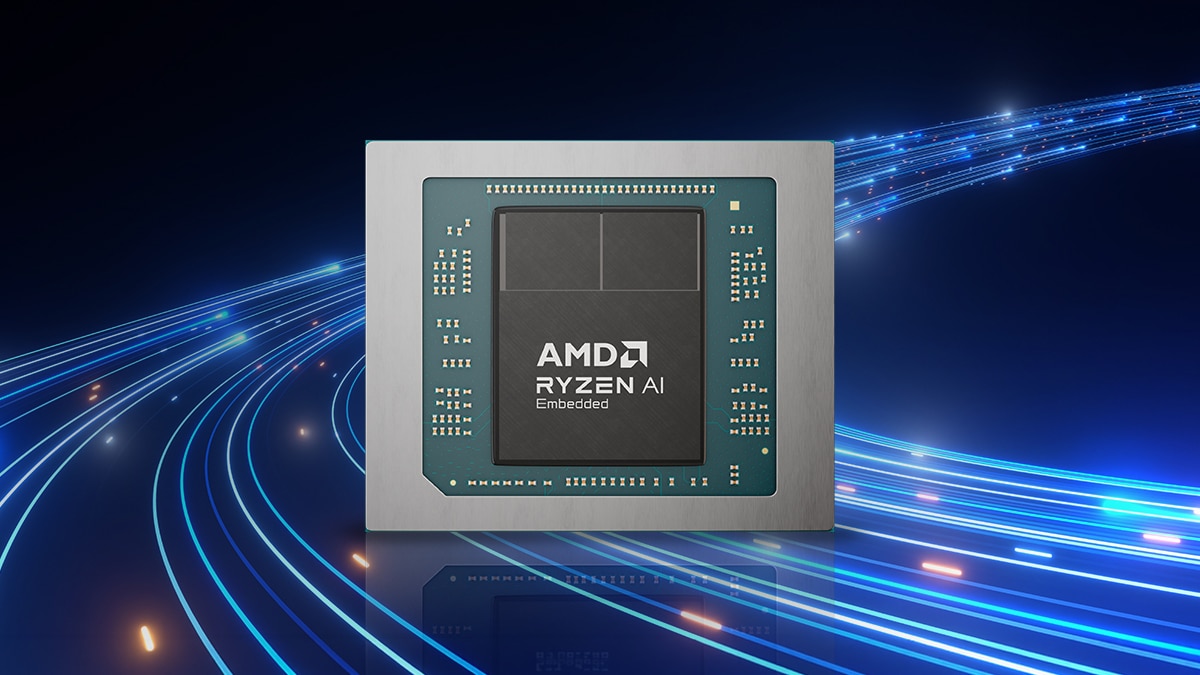
AMD Ryzen™ AI Embedded X100 Series: Consolidating Compute, Graphics and AI at the Edge
Embedded systems are being asked to do more locally. They need to acquire and process sensor data, render rich displays, run AI-assisted analysis and support software-defined features, often inside tight power, thermal and space envelopes.
The common challenge is not only more compute, graphics or AI. It is bringing those capabilities together in performant silicon that can keep demanding workloads moving with enough headroom for the next software release, the next model update and the next generation of customer requirements.
That is the idea behind Ryzen AI Embedded X100 Series processors: a high-performance x86 embedded APU platform that combines high-performance CPU cores, a discrete-class integrated GPU, NPU acceleration and unified memory for demanding edge workloads.
The Embedded System Is Becoming the Workload
In many embedded designs, the application is no longer a neat single pipeline. It is a collection of pipelines, services, displays, accelerators and software layers that must all work together.
Medical ultrasound combines filtering, beamforming, postprocessing image formation, AI-assisted detection and real-time visualization. Radar and electronic warfare systems may combine signal processing, RF classification, track management, and secure data transfer. Software-defined broadcast and casino gaming systems may combine graphics rendering, video pipelines, multi-display output, analytics and field-updatable application logic.
These workloads do not map cleanly to a single compute engine. Some tasks are scalar, some are vectorized, some are massively parallel and some map naturally to AI acceleration. The hard part is that many of them are active at the same time.
That is why broad-market embedded platforms increasingly need heterogeneous compute. CPU performance matters for orchestration, middleware, networking, storage and application code. GPU performance matters for visualization, graphics, video, AI and DSP compute. NPU performance helps support efficient inference at the edge. And of crucial importance, memory architecture determines how efficiently data moves between processing stages, directly affecting system latency and throughput.
Medical Imaging: Beamforming, Visualization and AI
High-end ultrasound stresses nearly every part of the embedded system: beamforming, signal processing, image formation, visualization and AI-assisted analysis. Adding discrete accelerators can increase board complexity, thermal load, validation effort and power consumption.
Ryzen AI Embedded X100 Series processors help address this by combining x86 CPU cores, discrete-class integrated GPU, NPU acceleration and unified memory in one APU. The CPU can coordinate acquisition, control, application logic and workflow management. The GPU can accelerate data-parallel processing and visualization. The NPU can support efficient inference for AI-assisted imaging or workflow features.
The proof point is directly relevant. Internal AMD testing shows Ryzen AI Embedded X100 Series processors enable on average 1.7x faster beamforming for medical ultrasound scanning compared to a Ryzen 7 CPU connected to a discrete NVIDIA® GPU.¹ This ability to replace discrete GPUs with an integrated X100 device in portable cart-based ultrasound systems can result in significant space, power and BOM cost savings for the medical equipment maker.
Software portability can also matter in this market. In AMD internal testing across several phased-array beamforming applications, AMD ROCm™ HIPIFY preserved up to 81% of NVIDIA CUDA® code, helping reduce redevelopment effort while maintaining portability across heterogeneous compute platforms.²
Ultrasound performance depends not only on raw compute, but also on how efficiently data moves through the system. Ryzen AI Embedded X100 Series CPUs support up to 273 GB/s of memory bandwidth and a shared 32 MB MALL cache and deliver 1.3x higher sustained memory bandwidth on the STREAM benchmark (geomean) compared to Intel Core Ultra Series 3 CPUs.³
Aerospace and Defense: Signal Processing Under Real Constraints
Aerospace and defense systems often combine high-performance signal processing with strict size, weight, power, ruggedization and lifecycle requirements. Radar, electronic warfare, multi-sensor fusion, communications and autonomous systems all depend on fast math, high memory bandwidth, responsive control and reliable operation in demanding environments.
These workloads are often parallel and data intensive. They may require FP32 computation, SIMD acceleration, fast memory access, concurrent services, secure software stacks, virtualization, field updates and long service lives.
The X100 Series is designed for that class of problem. The processor family integrates up to 16 uniform AMD “Zen 5” CPU cores with simultaneous multithreading support, providing up to 32 processing threads. It also supports AVX-512 across the CPU complex, helping developers apply wide vector acceleration to signal processing, filtering, transforms and sensor fusion.
The integrated GPU adds DSP compute for workloads that benefit from GPU acceleration while shared access to unified memory enables zero-copy across processing stages. Ryzen AI Embedded X199 CPUs also deliver up to 3x higher peak FP32 performance than NVIDIA Jetson T5000, giving developers more headroom for math-intensive workloads in compact embedded systems. For radar and signal processing workloads, that compute foundation translates into practical application performance: Ryzen AI Embedded X100 Series processors enable Synthetic Aperture Radar backprojection at up to 500 fps for 586 pulses per frame.⁴
For aerospace and defense programs, the value is workload consolidation: signal processing, visualization, AI, control and software-defined functionality in a long-lifecycle embedded platform.
Professional AV, Broadcast and Casino Gaming: From Fixed Function to Software Defined
Professional AV and broadcast systems are moving from fixed-function hardware toward software-defined platforms. Encoding, decoding, playout, AV-over-IP routing, interactive graphics, multi-display output and AI-enhanced workflows increasingly run on flexible x86 systems. That shift changes the processor decision: the platform must support media pipelines, rendering, operator interfaces, analytics and networked workflows while giving system builders a way to add new codecs, features and deployment models without replacing hardware.
The X100 Series extends that value proposition with a discrete-class integrated GPU supporting up to four 4k120 or two 8k60 displays and a CPU/GPU/NPU architecture optimized for concurrent media, graphics and AI workloads. On GFXBench 5.0.0, Ryzen AI Embedded X100 Series processors are expected to deliver an offscreen geometric mean of 1.7x higher OpenGL® graphics performance and a geometric mean of 1.4x higher Vulkan® graphics performance compared to Intel Core Ultra Series 3 CPUs.⁵ ⁶ This performance can help drive graphics-rich interfaces, multiview displays, overlays, visualization and rendering workloads while giving designers more flexibility in systems where a separate discrete GPU may not be practical.
Broadly, on-device inference in these applications can also support content tagging, scene analysis, automated production features, personalization or operator assistance while the CPU and GPU remain available for the rest of the media or graphics pipeline.
Casino gaming creates a related requirement. Modern gaming cabinets and interactive entertainment systems depend on responsive graphics, multi-display output, secure software execution and long-lived platform availability. Ryzen AI Embedded X100 Series processors are expected to deliver a geomean of 2.1x higher graphics performance compared to Intel® Core™ Ultra X7 358H, across Phoronix Test Suite 10.8.6 graphics workloads on Ubuntu® 24.04.⁷ This supports use cases that depend on responsive rendering, multi-display experiences and graphics-rich embedded interfaces without always needing a separate discrete GPU. In casino gaming, on-device inference enables AI-driven analytics, adaptive gameplay and next-generation player experiences with scalable performance designed for evolving casino applications.
Edge AI Beyond TOPS
AI is becoming part of more embedded systems, but inference is only one step in the application. The platform also handles data acquisition, preprocessing, orchestration, networking, security, model lifecycle management, storage, visualization and application logic.
By integrating high-performance CPU cores and discrete-class GPU in a single SoC, Ryzen AI Embedded X100 Series processors can enable up to $3,000 in estimated system cost savings by eliminating the need for a separate NVIDIA Jetson™ AGX Orin™ Industrial module in physical AI applications.⁸
Recent papers from mimik reinforce this point. In modeled agentic workloads using mimik’s Agentix Operating Engine, Ryzen AI Embedded X100 Series processor-based platforms show up to 2.3x capacity for agentic AI through dynamic dispatch across devices.⁹ Ryzen AI Embedded X100 Series processors can help developers preserve deployment flexibility as workloads shift across inference, orchestration, memory movement, networking and visualization.
Ryzen AI Embedded X199 processors deliver a geomean of 3.5x higher token generation and 1.4x faster time-to-first-token than Intel Core Ultra X7 358H on llama-bench with a Vulkan backend.10 For embedded AI developers, accelerator performance matters—but the surrounding platform determines how much of that performance can be used in deployment. To learn more about the X100 advantage in physical AI applications, read the AMD blog “Reducing the Hybrid-Core Tax in Physical AI Systems”.
The X100 Silicon Foundation
That foundation starts with the CPU complex: up to 16 AMD “Zen 5” cores and up to 32 processing threads. Ryzen AI Embedded X199 processors are expected to deliver up to 2.1x higher multi-thread CPU performance on CoreMark® v1.01 compared to Intel Core Ultra Series 3 CPUs.¹¹ They are also estimated to deliver 1.5x higher multi-thread throughput and 1.1x higher single-thread throughput on SPECrate®2017_int_base compared to Intel Core Ultra Series 3 CPUs.12
The AMD RDNA™ 3.5 GPU, AMD XDNA™ 2 NPU and unified memory subsystem complete the platform story: graphics and parallel compute, dedicated AI acceleration and fewer explicit data moves.
Open Software for Systems That Need to Keep Evolving
Embedded development teams make substantial software investments across Linux®, hypervisors, x86 applications, media frameworks, graphics APIs, AI frameworks, CUDA-based workloads and industry-specific code. A new embedded platform needs to support that investment while adding acceleration and new capabilities.
Ryzen AI Embedded X100 Series processors build on familiar x86 development environments and an open software ecosystem. AMD ROCm software provides an open-source GPU compute stack. HIP and HIPIFY help developers migrate CUDA-based workloads toward portable code paths, so that once CUDA code is migrated, the same code base can support both ROCm and CUDA back ends and help reduce vendor lock-in. AMD internal testing showed HIPIFY preserved an average of 83% of CUDA code across foundational GPU workloads, 71% across compute-intensive applications and 72% across AI/ML workloads.13 To learn more, read the AMD blog “From CUDA® to AMD ROCm™ Software Without Starting Over”.
For software-defined systems this flexibility is central to the design. A medical imaging team can preserve core application logic while exploring GPU and AI acceleration. An aerospace and defense team can build on familiar x86 software and virtualization models. A broadcast, AV or casino gaming system builder can deploy new codecs, rendering updates and application workflows through software instead of waiting for a new fixed-function hardware cycle.
Built for Long-Lifecycle Embedded Deployment
Medical devices, rugged aerospace and defense platforms, industrial equipment, casino gaming systems, broadcast infrastructure and edge appliances may operate for years. They need stable supply, long lifecycle planning, continuous operation, environmental tolerance and deployment flexibility.
Ryzen AI Embedded X100 Series processors are designed for those realities with 10-year planned manufacturing availability, support for continuous 24/7 operation over the same time frame and industrial temp options across the stack, rated for −40°C to +105°C junction temperature. X100 also supports multiple paths to production, including chip-down designs and partner system-on-module options.
Final Takeaway
High-performance embedded systems are changing. They are being asked to consolidate more work locally, support more software-defined features and operate within real-world limits for size, power, cost and lifecycle support.
For system designers, that means fewer discrete components, less data movement, more workload consolidation and more software flexibility. Explore the Ryzen AI Embedded X100 Series Processors page to see how X100 can help simplify edge system design and support more local AI, graphics and compute workloads.
AMD Ryzen™ AI Embedded X100 Series processors provide a scalable foundation for bringing more compute, graphics, AI and system integration to the edge—ready for what you build next.


Related Blogs
-
Meet the Next AMD Ryzen™ AI Halo
Meet the next AMD Ryzen™ AI Halo developer platform, powered by the AMD Ryzen™ AI Max+ PRO 495 processor. Run larger local LLMs, up to 300B parameters, thanks to the 192GB of unified memory that comes on the new platform.
October 12, 2026
-
AMD AI NIC™ Technology Driving AI-Ready Ethernet
Learn how AMD AI NIC™ technology helps organizations build AI-ready Ethernet networks with open standards, programmability, and transport innovation.
October 11, 2026
-
Kimi K3 on AMD Instinct GPUs with TokenSpeed
TokenSpeed delivers fast, agentic LLM inference on AMD Instinct™ MI355X GPUs, with optimized kernels and leading Kimi K3 performance.
October 09, 2026
-
scikit workloads with AOCL Data Analytics
Accelerate supported scikit-learn workloads with AOCL-Data Analytics while keeping your existing Python code and familiar scikit-learn APIs.
October 09, 2026
-
MangoBoost Delivers Open AI Models Powered by AMD
Mango Inference a serverless inference service providing production-ready access to open models powered by AMD Instinct™ GPUs and AMD ROCm™ software
October 09, 2026
-
MoRI UMBP Empowers AMD Instinct GPUs
See how UMBP, MoRI and SGLang optimize KV cache reuse to boost AMD Instinct™ MI355X GPU agentic AI performance and cost efficiency
October 09, 2026
-
Pre-Training Hybrid LLMs from Scratch in Primus on AMD Instinct™ GPUs — ROCm Blogs
Pre-train hybrid LLMs mixing MLA attention with Gated DeltaNet, Kimi Delta Attention and Mamba2 mixers on AMD Instinct MI355X GPUs, with open recipes.
October 07, 2026
-
DI Series: Serving Kimi-K3 MXFP4 Wide-EP Disaggregated on AMD Instinct MI300X and MI325X — ROCm Blogs
Learn how to serve a 1.4 TiB Kimi-K3 MXFP4 mixture-of-experts model disaggregated across AMD Instinct MI300X and MI325X GPUs.
October 07, 2026







Footnotes
- Based on Internal testing by AMD as of July 2026. Ryzen AI X199 performance evaluated using AMD Ryzen AI Max+ PRO 395 and AMD Radeon 8060S graphics as a proxy, configured with 128 GB of LPDDR5x 8000 MT/s memory, compared to a system configured with AMD Ryzen 7 9800X3D CPU and a discrete NVIDIA RTX 4000 SFF Ada GPU with 20 GB GDDR6 VRAM. Both configurations running Ubuntu Linux 24.04.3 with Container OS Debian GNU/Linux 13 with Vulkan for GPU acceleration. Beamforming performance compares total time from RF data copy to Display for systems with 128 channels at 50mm scan depth and varying scan angles. 1.7x calculated as the average time improvement across multiple scan types including Planewave Hyperechoic Scatterers, Planewave Hypoechoic, Planewave Carotid Cross, Planewave Carotid Long, and Planewave Simulation Resolution Distortion. System manufacturers may vary configurations, yielding different results. Results may vary. (REX-015)
- Based on AMD internal testing as of April 2026, validated on an AMD Ryzen AI Max+ 395 processor as a proxy for AMD Ryzen AI Embedded X100 Series CPUs, a phased-array beamforming application totaling 659 lines of CUDA code across six source files was migrated from CUDA to HIP. The application included conventional beamforming, MVDR/Capon adaptive beamforming, MUSIC direction-of-arrival estimation, covariance matrix estimation, FIR filtering, power spectrum analysis, CFAR target detection, warp-level reductions, inline PTX assembly, and architecture-specific optimization constructs. Code preservation was calculated as the percentage of original CUDA source retained after HIP conversion. Actual results may vary based on application complexity, CUDA library usage, architecture-specific optimizations, low-level CUDA constructs, required code modifications following conversion, or other factors. (REX-021)
- Testing conducted by AMD as of May 2026 on an AMD Ryzen AI Max+ 395 (OPN 100-000002199) configured to reflect Ryzen AI Embedded X199 specifications (STAPM disabled; 45W SPL; sPPT 45W; fPPT 64W; LPDDR5X-8000), compared to an Intel Core Ultra X7 358H (30W; PL1 45W; PL2 64W; LPDDR5X-8533). Results reflect relative geometric mean performance across STREAM (GCC 15) on Ubuntu 24.04. System manufacturers may vary configurations, yielding different results. Results may vary based on configuration, settings, usage, and other factors. (REX-009)
- Based on AMD internal testing as of June 2026, an AMD Ryzen AI Max+ 395 processor, as a proxy for Ryzen AI Embedded X199 specifications (HP Z2 Mini G1a Workstation Desktop PC, 5.1 GHz CPU, 2.9 GHz GPU, 120W TDP with 64 GB LPDDR5X-8000) was used to measure SAR backprojection pulses per frame. System manufacturers may vary configurations, yielding different results. Results may vary based on configuration, settings, usage, and other factors. (REX-012)
- Measurements and projections conducted by AMD as of May 2026 on an AMD Ryzen AI Max+ 395 processor (OPN 100-000002199) configured to reflect Ryzen AI Embedded X199 specifications (AMD Maple CRB, 5.1 GHz CPU, 2.9 GHz GPU, with sustained operation at 45W TDP/sPPT/fPPT, STAPM disabled and 64 GB soldered LPDDR5X-8000), compared to an Intel Core Ultra X7 358H (MSI Prestige 16 Flip AI+ C3MTG MS-2622, 5.1 GHz CPU, 2.5 GHz GPU, PL1 = 45W, PL2 = 64W, MSI BIOS E2622IMS.10E, 32 GB LPDDR5X-8533, measured 30W OEM Sustained Power Limit). Results reflect the relative geomean of offscreen OpenGL frame rates from GFXBench 5.0.0 on Ubuntu 24.04, comparing measured AMD performance at 45W sustained power to 45W Intel performance projected from 30W sustained power measurements, using scaling factors derived from public benchmark data for the 358H. System manufacturers may vary configurations, yielding different results. Results may vary based on configuration, settings, usage, and other factors. (REX-003)
- Measurements and projections conducted by AMD as of May 2026 on an AMD Ryzen AI Max+ 395 processor (OPN 100-000002199) configured to reflect Ryzen AI Embedded X199 specifications (AMD Maple CRB, 5.1 GHz CPU, 2.9 GHz GPU, with sustained operation at 45W TDP/sPPT/fPPT, STAPM disabled and 64 GB soldered LPDDR5X-8000), compared to an Intel Core Ultra X7 358H (MSI Prestige 16 Flip AI+ C3MTG MS-2622, 5.1 GHz CPU, 2.5 GHz GPU, PL1 = 45W, PL2 = 64W, MSI BIOS E2622IMS.10E, 32 GB LPDDR5X-8533, measured 30W OEM Sustained Power Limit). Results reflect the relative geomean of offscreen Vulkan benchmark frame rates from GFXBench 5.0.0 on Ubuntu 24.04, comparing measured AMD performance at 45W sustained power to 45W Intel performance projected from 30W sustained power measurements, using scaling factors derived from public benchmark data for the 358H. System manufacturers may vary configurations, yielding different results. Results may vary based on configuration, settings, usage, and other factors. (REX-002)
- Measurements and projections conducted by AMD as of May 2026 on an AMD Ryzen AI Max+ 395 processor (OPN 100-000002199) configured to reflect Ryzen AI Embedded X199 specifications (AMD Maple CRB, 5.1 GHz CPU, 2.9 GHz GPU, with sustained operation at 45W TDP/sPPT/fPPT, STAPM disabled and 64 GB soldered LPDDR5X-8000), compared to an Intel Core Ultra X7 358H (MSI Prestige 16 Flip AI+ C3MTG MS-2622, 5.1 GHz CPU, 2.5 GHz GPU, PL1 = 45W, PL2 = 64W, MSI BIOS E2622IMS.10E, 32 GB LPDDR5X-8533, measured 30W OEM Sustained Power Limit). Results reflect the relative geomean across Phoronix Test Suite 10.8.6 benchmarks (GravityMark, Unigine Heaven/Valley, Unvanquished, GLmark2, ParaView, and GpuTest) on Ubuntu 24.04, comparing measured AMD performance at 45W sustained power to 45W Intel performance projected from 30W sustained power measurements, using scaling factors derived from public benchmark data for the 358H. System manufacturers may vary configurations, yielding different results. Results may vary based on configuration, settings, usage, and other factors. (REX-008)
- Based on AMD internal analysis and public pricing of NVIDIA Jetson Orin AGX Industrial ($3,199) as of July 6, 2026. Cost reduction is based on elimination of a Jetson Orin AGX Industrial SOM from system cost, as all functionality is integrated into a single APU. Based on the OpenNav Robotics Workload Benchmark as published by Open Navigation LLC on July 23, 2026: https://opennav.org/news/opennav-robotics-workload-benchmark, NVIDIA Jetson AGX Orin CPU performance is insufficient for autonomous robotic navigation. Users would need to integrate a separate x86 CPU alongside NVIDIA Jetson Orin AGX to achieve comparable performance to X100 Series. (REX-013)
- Based on the mimik whitepaper “Architectural Fit for Production-Scale Agentic AI on Heterogeneous SoCs” commissioned by AMD, published by mimik on July 23, 2026, based on a modeled sweep of 455 feasible agentic AI workflows across two device classes (X100, NVIDIA Jetson T5000), checking spare CPU, GPU, and memory. For more information see: https://www.mimik.com/agentix-compute-benchmarking (REX-019)
- Based on AMD internal testing as of July 2026, an AMD Ryzen AI Max+ 395 processor, configured to reflect Ryzen AI Embedded X199 specifications (AMD Maple CRB, 5.1 GHz CPU, 2.9 GHz GPU, with sustained operation at 45W TDP/sPPT/fPPT, and 64 GB soldered LPDDR5X-8000) was used to measure inference throughput. Results are compared against Intel Core Ultra X7 358H (MSI Prestige 16 Flip AI+ C3MTG MS-2622, 5.1 GHz CPU, 2.5 GHz GPU, PL1 = 45W, PL2 = 64W, MSI BIOS E2622IMS.10E, 32 GB LPDDR5X-8533, performance mode), and reflect the geometric mean of llama-bench (build: llama-b9453-vulkan) performance across gemma4 26B.A4B MXFP4 MoE, gemma4 26B.A4B Q4_K - Medium, Llama 3.1 8B Q4_K - Medium, qwen35 27B Q4_K - Medium, qwen35moe 35B.A3B MXFP4 MoE, qwen35moe 35B.A3B Q4_K - Medium models. All models fit in <24 GB RAM. System manufacturers may vary configurations, yielding different results. Results may vary based on configuration, settings, usage, and other factors. (REX-017)
- Measurements and projections conducted by AMD as of May 2026 on an AMD Ryzen AI Max+ 395 processor (OPN 100-000002199) configured to reflect Ryzen AI Embedded X199 specifications (AMD Maple CRB, 5.1 GHz CPU, 2.9 GHz GPU, with sustained operation at 45W TDP/sPPT/fPPT, STAPM disabled and 64 GB soldered LPDDR5X-8000), compared to an Intel Core Ultra X7 358H (MSI Prestige 16 Flip AI+ C3MTG MS-2622, 5.1 GHz CPU, 2.5 GHz GPU, PL1 = 45W, PL2 = 64W, MSI BIOS E2622IMS.10E, 32 GB LPDDR5X-8533, measured 30W OEM Sustained Power Limit). Results reflect projected relative CoreMark v1.01 multi-thread performance on Ubuntu 24.04, comparing measured AMD performance at 45W sustained power to 45W Intel performance projected from 30W sustained power measurements, using scaling factors derived from public benchmark data for the 358H. System manufacturers may vary configurations, yielding different results. Results may vary based on configuration, settings, usage, and other factors. (REX-007)
- Estimated by AMD as of May 2026 on the AMD Ryzen AI Max+ 395 (OPN 100-000002199) at 45W SPL (sPPT=45W, fPPT=64W) and the Intel Core Ultra X7 358H at 30W SPL (PL1=45W, PL2=64W) using SPEC CPU2017_int_base (configuration: GCC-15, rate, harness cpu2017-1.1.9, int base sub score) on test systems comprising:- Ryzen AI Max+ 395 (OPN 100-000002199): AMD Reference Maple Motherboard, 64 GB LPDDR5X-8000 SK Hynix RAM, Kingston Technology KV3000 NVMe SSD 512 GB PCIe Gen4 512 GB storage, Linux Ubuntu 24.04 with Kernel 6.18.15-14-amd (x86_64), Insyde BIOS REM60070A, SMT Enabled, STAPM Disabled. - Intel Core Ultra X7 358H: MSI Prestige 16 Flip AI+ laptop C3MTG MS-2622, 32 GB LPDDR5X-8533 SK Hynix RAM, Kingston Technology KV3000 NVMe SSD 512 GB PCIe Gen4 512 GB storage, Linux Ubuntu 24.04 with Kernel 6.17.0-23-generic (x86_64), MSI BIOS E2622IMS.10E. Ryzen AI Max+ 395 (OPN 100-000002199) device is configured to reflect Ryzen AI Embedded X199 specifications. Intel data measured by AMD at 30W. 45W estimates were derived from AMD 30W measurements based on publicly available benchmark data. OEM published scores will vary based on system configuration and determinism mode used (default performance profile) and other factors. (REX-010)
- Based on AMD internal testing as of April 2026, validated on an AMD Ryzen AI Max+ 395 processor as a proxy for AMD Ryzen AI Embedded X100 Series CPUs, a CUDA-to-HIP validation suite consisting of 15 CUDA sample applications totaling 1,199 lines of code was migrated from CUDA to HIP. Code preservation was calculated as the percentage of original CUDA source retained after HIP conversion. Foundational workloads consisted of saxpy, matrix transpose, histogram, image blur and prefix sum. Compute-intensive workloads consisted of warp reduction, N-body, SpMV, multi-stream, and cuBLAS GEMM. AI/ML workloads consisted of softmax, layer normalization, attention, convolution and radix sort. Actual results may vary based on application complexity, CUDA library usage, architecture-specific optimizations, low-level CUDA constructs, required code modifications following conversion or other factors. (REX-020)
© 2026 Advanced Micro Devices, Inc. All rights reserved. AMD, the AMD Arrow logo, RDNA, ROCm, Ryzen, XDNA and combinations thereof are trademarks of Advanced Micro Devices, Inc. CoreMark is a registered trademark of the Embedded Microprocessor Benchmark Consortium (EEMBC). Core and Intel are trademarks of Intel Corporation or its subsidiaries. Linux is the registered trademark of Linus Torvalds in the U.S. and other countries. CUDA, Jetson, NVIDIA, Orin and Thor are trademarks and/or registered trademarks of NVIDIA Corporation in the U.S. and other countries. OpenGL is a registered trademark of Hewlett Packard Enterprise Development LP. PCIe is a registered trademark of PCI-SIG Corporation. SPEC CPU and SPECrate are trademarks or registered trademarks of Standard Performance Evaluation Corporation (SPEC). Ubuntu and the Ubuntu logo are registered trademarks of Canonical Ltd. Vulkan is a registered trademark of the Khronos Group Inc. Other product or model names used herein are for identification purposes only and may be trademarks of their respective owners. Certain AMD technologies may require third-party enablement or activation. Supported features may vary by operating system. Please confirm with the system manufacturer for specific features. No technology or product can be completely secure.
Footnotes
- Based on Internal testing by AMD as of July 2026. Ryzen AI X199 performance evaluated using AMD Ryzen AI Max+ PRO 395 and AMD Radeon 8060S graphics as a proxy, configured with 128 GB of LPDDR5x 8000 MT/s memory, compared to a system configured with AMD Ryzen 7 9800X3D CPU and a discrete NVIDIA RTX 4000 SFF Ada GPU with 20 GB GDDR6 VRAM. Both configurations running Ubuntu Linux 24.04.3 with Container OS Debian GNU/Linux 13 with Vulkan for GPU acceleration. Beamforming performance compares total time from RF data copy to Display for systems with 128 channels at 50mm scan depth and varying scan angles. 1.7x calculated as the average time improvement across multiple scan types including Planewave Hyperechoic Scatterers, Planewave Hypoechoic, Planewave Carotid Cross, Planewave Carotid Long, and Planewave Simulation Resolution Distortion. System manufacturers may vary configurations, yielding different results. Results may vary. (REX-015)
- Based on AMD internal testing as of April 2026, validated on an AMD Ryzen AI Max+ 395 processor as a proxy for AMD Ryzen AI Embedded X100 Series CPUs, a phased-array beamforming application totaling 659 lines of CUDA code across six source files was migrated from CUDA to HIP. The application included conventional beamforming, MVDR/Capon adaptive beamforming, MUSIC direction-of-arrival estimation, covariance matrix estimation, FIR filtering, power spectrum analysis, CFAR target detection, warp-level reductions, inline PTX assembly, and architecture-specific optimization constructs. Code preservation was calculated as the percentage of original CUDA source retained after HIP conversion. Actual results may vary based on application complexity, CUDA library usage, architecture-specific optimizations, low-level CUDA constructs, required code modifications following conversion, or other factors. (REX-021)
- Testing conducted by AMD as of May 2026 on an AMD Ryzen AI Max+ 395 (OPN 100-000002199) configured to reflect Ryzen AI Embedded X199 specifications (STAPM disabled; 45W SPL; sPPT 45W; fPPT 64W; LPDDR5X-8000), compared to an Intel Core Ultra X7 358H (30W; PL1 45W; PL2 64W; LPDDR5X-8533). Results reflect relative geometric mean performance across STREAM (GCC 15) on Ubuntu 24.04. System manufacturers may vary configurations, yielding different results. Results may vary based on configuration, settings, usage, and other factors. (REX-009)
- Based on AMD internal testing as of June 2026, an AMD Ryzen AI Max+ 395 processor, as a proxy for Ryzen AI Embedded X199 specifications (HP Z2 Mini G1a Workstation Desktop PC, 5.1 GHz CPU, 2.9 GHz GPU, 120W TDP with 64 GB LPDDR5X-8000) was used to measure SAR backprojection pulses per frame. System manufacturers may vary configurations, yielding different results. Results may vary based on configuration, settings, usage, and other factors. (REX-012)
- Measurements and projections conducted by AMD as of May 2026 on an AMD Ryzen AI Max+ 395 processor (OPN 100-000002199) configured to reflect Ryzen AI Embedded X199 specifications (AMD Maple CRB, 5.1 GHz CPU, 2.9 GHz GPU, with sustained operation at 45W TDP/sPPT/fPPT, STAPM disabled and 64 GB soldered LPDDR5X-8000), compared to an Intel Core Ultra X7 358H (MSI Prestige 16 Flip AI+ C3MTG MS-2622, 5.1 GHz CPU, 2.5 GHz GPU, PL1 = 45W, PL2 = 64W, MSI BIOS E2622IMS.10E, 32 GB LPDDR5X-8533, measured 30W OEM Sustained Power Limit). Results reflect the relative geomean of offscreen OpenGL frame rates from GFXBench 5.0.0 on Ubuntu 24.04, comparing measured AMD performance at 45W sustained power to 45W Intel performance projected from 30W sustained power measurements, using scaling factors derived from public benchmark data for the 358H. System manufacturers may vary configurations, yielding different results. Results may vary based on configuration, settings, usage, and other factors. (REX-003)
- Measurements and projections conducted by AMD as of May 2026 on an AMD Ryzen AI Max+ 395 processor (OPN 100-000002199) configured to reflect Ryzen AI Embedded X199 specifications (AMD Maple CRB, 5.1 GHz CPU, 2.9 GHz GPU, with sustained operation at 45W TDP/sPPT/fPPT, STAPM disabled and 64 GB soldered LPDDR5X-8000), compared to an Intel Core Ultra X7 358H (MSI Prestige 16 Flip AI+ C3MTG MS-2622, 5.1 GHz CPU, 2.5 GHz GPU, PL1 = 45W, PL2 = 64W, MSI BIOS E2622IMS.10E, 32 GB LPDDR5X-8533, measured 30W OEM Sustained Power Limit). Results reflect the relative geomean of offscreen Vulkan benchmark frame rates from GFXBench 5.0.0 on Ubuntu 24.04, comparing measured AMD performance at 45W sustained power to 45W Intel performance projected from 30W sustained power measurements, using scaling factors derived from public benchmark data for the 358H. System manufacturers may vary configurations, yielding different results. Results may vary based on configuration, settings, usage, and other factors. (REX-002)
- Measurements and projections conducted by AMD as of May 2026 on an AMD Ryzen AI Max+ 395 processor (OPN 100-000002199) configured to reflect Ryzen AI Embedded X199 specifications (AMD Maple CRB, 5.1 GHz CPU, 2.9 GHz GPU, with sustained operation at 45W TDP/sPPT/fPPT, STAPM disabled and 64 GB soldered LPDDR5X-8000), compared to an Intel Core Ultra X7 358H (MSI Prestige 16 Flip AI+ C3MTG MS-2622, 5.1 GHz CPU, 2.5 GHz GPU, PL1 = 45W, PL2 = 64W, MSI BIOS E2622IMS.10E, 32 GB LPDDR5X-8533, measured 30W OEM Sustained Power Limit). Results reflect the relative geomean across Phoronix Test Suite 10.8.6 benchmarks (GravityMark, Unigine Heaven/Valley, Unvanquished, GLmark2, ParaView, and GpuTest) on Ubuntu 24.04, comparing measured AMD performance at 45W sustained power to 45W Intel performance projected from 30W sustained power measurements, using scaling factors derived from public benchmark data for the 358H. System manufacturers may vary configurations, yielding different results. Results may vary based on configuration, settings, usage, and other factors. (REX-008)
- Based on AMD internal analysis and public pricing of NVIDIA Jetson Orin AGX Industrial ($3,199) as of July 6, 2026. Cost reduction is based on elimination of a Jetson Orin AGX Industrial SOM from system cost, as all functionality is integrated into a single APU. Based on the OpenNav Robotics Workload Benchmark as published by Open Navigation LLC on July 23, 2026: https://opennav.org/news/opennav-robotics-workload-benchmark, NVIDIA Jetson AGX Orin CPU performance is insufficient for autonomous robotic navigation. Users would need to integrate a separate x86 CPU alongside NVIDIA Jetson Orin AGX to achieve comparable performance to X100 Series. (REX-013)
- Based on the mimik whitepaper “Architectural Fit for Production-Scale Agentic AI on Heterogeneous SoCs” commissioned by AMD, published by mimik on July 23, 2026, based on a modeled sweep of 455 feasible agentic AI workflows across two device classes (X100, NVIDIA Jetson T5000), checking spare CPU, GPU, and memory. For more information see: https://www.mimik.com/agentix-compute-benchmarking (REX-019)
- Based on AMD internal testing as of July 2026, an AMD Ryzen AI Max+ 395 processor, configured to reflect Ryzen AI Embedded X199 specifications (AMD Maple CRB, 5.1 GHz CPU, 2.9 GHz GPU, with sustained operation at 45W TDP/sPPT/fPPT, and 64 GB soldered LPDDR5X-8000) was used to measure inference throughput. Results are compared against Intel Core Ultra X7 358H (MSI Prestige 16 Flip AI+ C3MTG MS-2622, 5.1 GHz CPU, 2.5 GHz GPU, PL1 = 45W, PL2 = 64W, MSI BIOS E2622IMS.10E, 32 GB LPDDR5X-8533, performance mode), and reflect the geometric mean of llama-bench (build: llama-b9453-vulkan) performance across gemma4 26B.A4B MXFP4 MoE, gemma4 26B.A4B Q4_K - Medium, Llama 3.1 8B Q4_K - Medium, qwen35 27B Q4_K - Medium, qwen35moe 35B.A3B MXFP4 MoE, qwen35moe 35B.A3B Q4_K - Medium models. All models fit in <24 GB RAM. System manufacturers may vary configurations, yielding different results. Results may vary based on configuration, settings, usage, and other factors. (REX-017)
- Measurements and projections conducted by AMD as of May 2026 on an AMD Ryzen AI Max+ 395 processor (OPN 100-000002199) configured to reflect Ryzen AI Embedded X199 specifications (AMD Maple CRB, 5.1 GHz CPU, 2.9 GHz GPU, with sustained operation at 45W TDP/sPPT/fPPT, STAPM disabled and 64 GB soldered LPDDR5X-8000), compared to an Intel Core Ultra X7 358H (MSI Prestige 16 Flip AI+ C3MTG MS-2622, 5.1 GHz CPU, 2.5 GHz GPU, PL1 = 45W, PL2 = 64W, MSI BIOS E2622IMS.10E, 32 GB LPDDR5X-8533, measured 30W OEM Sustained Power Limit). Results reflect projected relative CoreMark v1.01 multi-thread performance on Ubuntu 24.04, comparing measured AMD performance at 45W sustained power to 45W Intel performance projected from 30W sustained power measurements, using scaling factors derived from public benchmark data for the 358H. System manufacturers may vary configurations, yielding different results. Results may vary based on configuration, settings, usage, and other factors. (REX-007)
- Estimated by AMD as of May 2026 on the AMD Ryzen AI Max+ 395 (OPN 100-000002199) at 45W SPL (sPPT=45W, fPPT=64W) and the Intel Core Ultra X7 358H at 30W SPL (PL1=45W, PL2=64W) using SPEC CPU2017_int_base (configuration: GCC-15, rate, harness cpu2017-1.1.9, int base sub score) on test systems comprising:- Ryzen AI Max+ 395 (OPN 100-000002199): AMD Reference Maple Motherboard, 64 GB LPDDR5X-8000 SK Hynix RAM, Kingston Technology KV3000 NVMe SSD 512 GB PCIe Gen4 512 GB storage, Linux Ubuntu 24.04 with Kernel 6.18.15-14-amd (x86_64), Insyde BIOS REM60070A, SMT Enabled, STAPM Disabled. - Intel Core Ultra X7 358H: MSI Prestige 16 Flip AI+ laptop C3MTG MS-2622, 32 GB LPDDR5X-8533 SK Hynix RAM, Kingston Technology KV3000 NVMe SSD 512 GB PCIe Gen4 512 GB storage, Linux Ubuntu 24.04 with Kernel 6.17.0-23-generic (x86_64), MSI BIOS E2622IMS.10E. Ryzen AI Max+ 395 (OPN 100-000002199) device is configured to reflect Ryzen AI Embedded X199 specifications. Intel data measured by AMD at 30W. 45W estimates were derived from AMD 30W measurements based on publicly available benchmark data. OEM published scores will vary based on system configuration and determinism mode used (default performance profile) and other factors. (REX-010)
- Based on AMD internal testing as of April 2026, validated on an AMD Ryzen AI Max+ 395 processor as a proxy for AMD Ryzen AI Embedded X100 Series CPUs, a CUDA-to-HIP validation suite consisting of 15 CUDA sample applications totaling 1,199 lines of code was migrated from CUDA to HIP. Code preservation was calculated as the percentage of original CUDA source retained after HIP conversion. Foundational workloads consisted of saxpy, matrix transpose, histogram, image blur and prefix sum. Compute-intensive workloads consisted of warp reduction, N-body, SpMV, multi-stream, and cuBLAS GEMM. AI/ML workloads consisted of softmax, layer normalization, attention, convolution and radix sort. Actual results may vary based on application complexity, CUDA library usage, architecture-specific optimizations, low-level CUDA constructs, required code modifications following conversion or other factors. (REX-020)
© 2026 Advanced Micro Devices, Inc. All rights reserved. AMD, the AMD Arrow logo, RDNA, ROCm, Ryzen, XDNA and combinations thereof are trademarks of Advanced Micro Devices, Inc. CoreMark is a registered trademark of the Embedded Microprocessor Benchmark Consortium (EEMBC). Core and Intel are trademarks of Intel Corporation or its subsidiaries. Linux is the registered trademark of Linus Torvalds in the U.S. and other countries. CUDA, Jetson, NVIDIA, Orin and Thor are trademarks and/or registered trademarks of NVIDIA Corporation in the U.S. and other countries. OpenGL is a registered trademark of Hewlett Packard Enterprise Development LP. PCIe is a registered trademark of PCI-SIG Corporation. SPEC CPU and SPECrate are trademarks or registered trademarks of Standard Performance Evaluation Corporation (SPEC). Ubuntu and the Ubuntu logo are registered trademarks of Canonical Ltd. Vulkan is a registered trademark of the Khronos Group Inc. Other product or model names used herein are for identification purposes only and may be trademarks of their respective owners. Certain AMD technologies may require third-party enablement or activation. Supported features may vary by operating system. Please confirm with the system manufacturer for specific features. No technology or product can be completely secure.