AMD x Unsloth: Unlocking the World's First NPU for Unsloth Desktop
Nov 19, 2026
AI agents are becoming part of how people work. Bringing them onto the PC demands more than capable models. It takes hardware and software built to work together.
Read the official Unsloth x AMD NPU documentation here: 🦥 AMD NPU | Unsloth Documentation
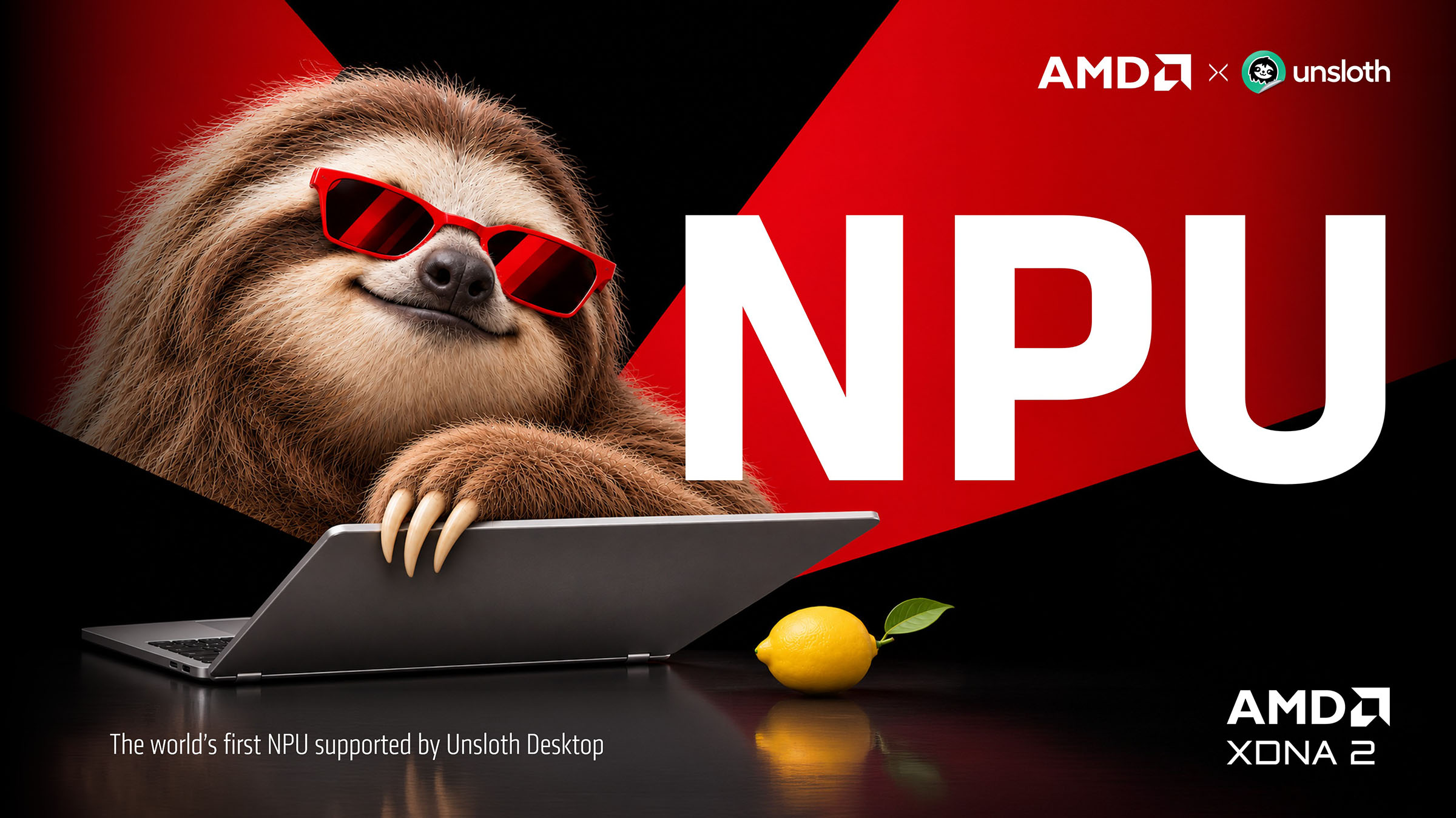
AMD and Unsloth have collaborated to bring NPU support to Unsloth Desktop, making AMD XDNA™ 2 architecture NPUs the world’s first NPUs supported by the application. Enabled through integration with Lemonade and FastFlowLM (FLM), this collaboration connects Unsloth’s user ecosystem with dedicated NPU acceleration.
It’s a new way to put the NPU to work: running agent inference locally, efficiently, and through familiar applications.
One AMD NPU. 100+ Agentic Apps
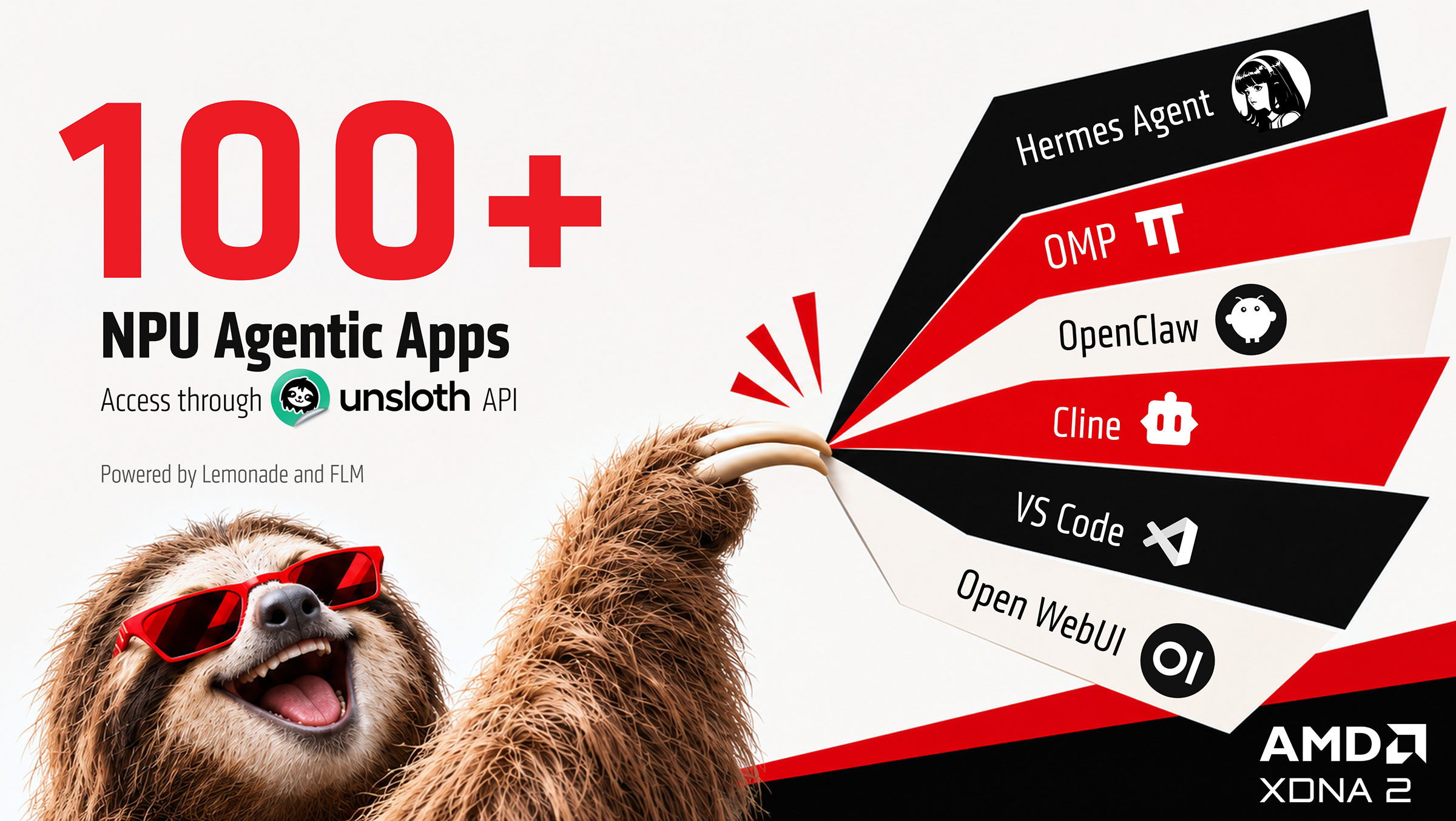
The impact reaches beyond a single application. Through the Unsloth Desktop API, which offers an OpenAI compliant endpoint for compatible apps, the integration opens the door to more than 100 agentic applications and workflows.
Tools including Hermes Agent, OpenClaw, Open WebUI, Cline, OMP, and VS Code illustrate the breadth of that ecosystem, from coding assistance to connected agent workflows. Applications access local model inference through the Unsloth Desktop API, while Lemonade and FLM handle the serving and inference path to AMD XDNA™ 2 NPUs.
Together, AMD and Unsloth are expanding where developers can deploy agent workloads and how users can experience local AI.
Unplug your Agents
As agents take on more work, power efficient execution becomes increasingly important.
AMD XDNA™ 2 NPUs are designed for power-efficient AI inference. Offloading supported inference workloads to this dedicated engine can help preserve battery life and leave CPU and GPU resources available for other applications (memory permitting).
For users, that means a foundation for agent experiences that fit the way they use their PCs, including when working unplugged and getting more out of their battery. For developers, it creates another execution option for bringing local AI into everyday workflows - enabling low power, persistent agents.
How to run Unsloth Desktop on the AMD XDNA™ 2 NPU
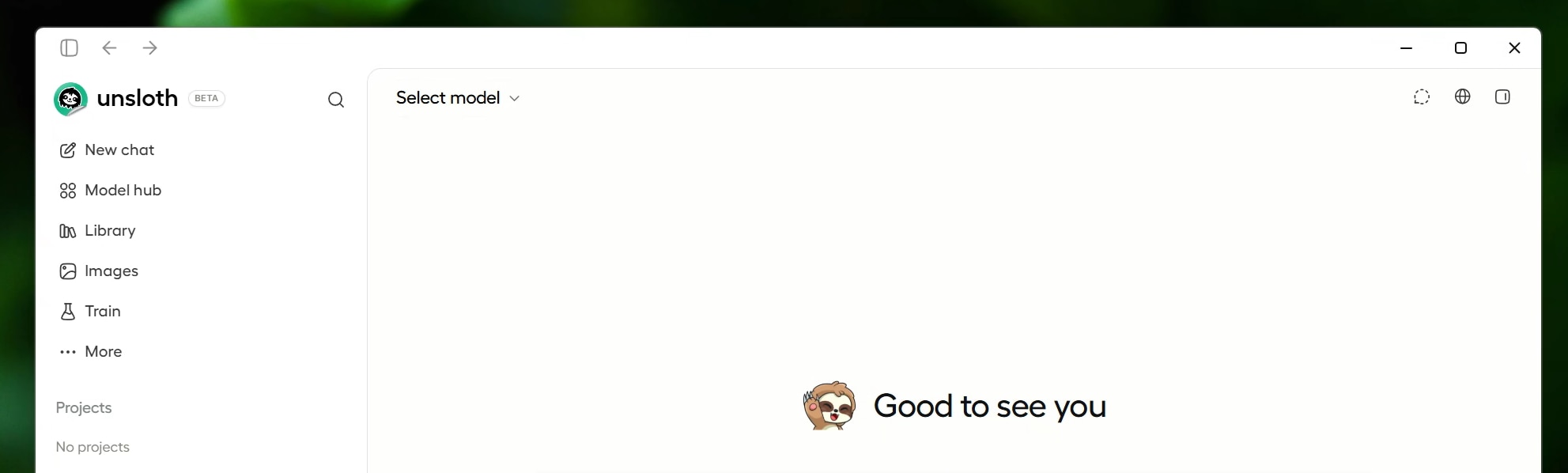
1. On an AMD device with an XDNA™ 2 NPU, download Unsloth Desktop for Windows and install.
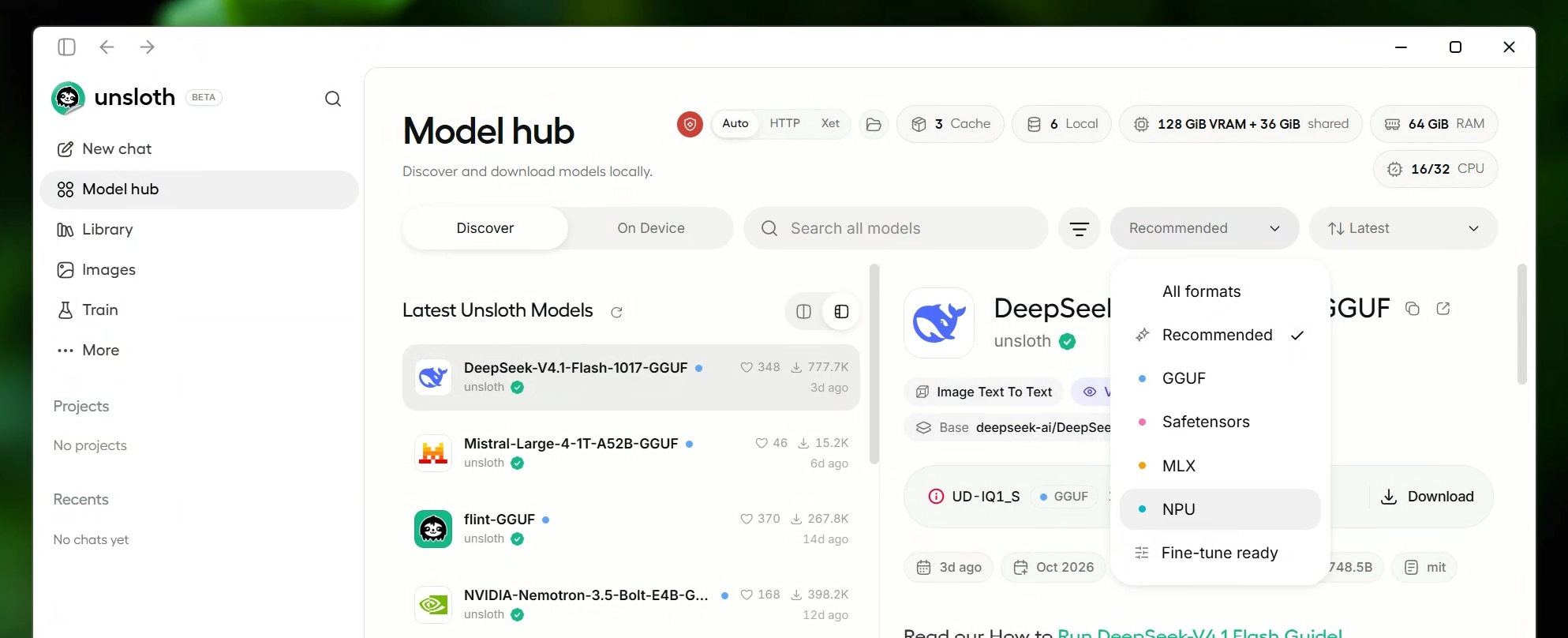
2. Go to the model hub page, click on the filter sign, select the NPU from the drown down list.
3. Click on Enable NPU
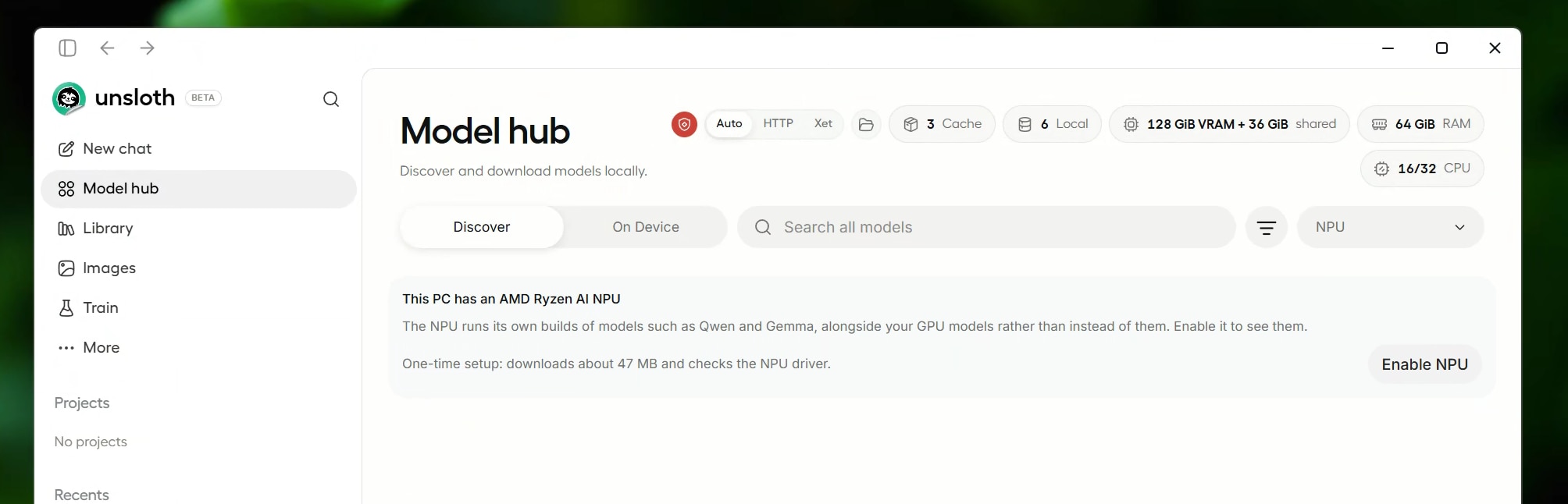
4. Download the NPU model you want to run. Note: different models have different memory requirements. For example the Qwen 3.6 35B A3B model with full context requires around 28GB of memory available to the NPU. Using windows default 50% shared allocation - this means your system needs to have 64GB of system ram.

5. Wait for the download to complete (if it seems stuck - it is not) then go back to New Chat, and from the drop down menu, scroll till you find the "NPU" section, load the model with the context you want and you are now inferencing on the NPU!
Realtime Demo: 35B MoE on the AMD XDNA™ 2 NPU
The demo shows this integration in action: a Qwen3.6 mixture-of-experts model with 35 billion total parameters running local inference through Unsloth Desktop and FLM on the AMD NPU.
It brings the collaboration into focus: Unsloth’s accessible software experience connected to AMD NPU.
By working across hardware, inference software, and the application ecosystem, AMD and Unsloth are making NPU acceleration useful to more developers and users.
More applications. Efficient local inference. New possibilities for agentic AI on the PC.

Related Blogs
-
Is Your Enterprise Data Infrastructure Ready for Agentic AI?
After consolidating data, the next test is whether enterprise data infrastructure is ready for a big increase in requests from at-scale agentic AI.
November 18, 2026
-
ROCm 10.2.0: Advancing Performance, Stability, and Developer Experience — ROCm Blogs
Explore ROCm 10.2.0, featuring refreshed frameworks, enhanced memory and library capabilities, and more as AMD advances the developer experience
November 17, 2026
-
More AI. More Control. AMD Instinct MI350P Comes to Windows Server.
AMD Instinct MI350P brings AI inference to Windows Server with simplified deployment, flexible GPU partitioning and control over enterprise data
November 17, 2026
-
Keep the Agent Warm: How ATOM Serves AgentX Workloads on AMD Instinct MI355X GPUs — ROCm Blogs
Learn how ATOM keeps AgentX coding sessions warm on AMD Instinct™ MI355X GPUs, from prefix and state reuse to prefill scheduling and fused decode kernels, using Kimi-K3.
November 16, 2026
-
An AITER Pin Keyed by Kernel Text: Faster Glue Than the Inductor Default — ROCm Blogs
Learn how an AITER pin keyed by kernel text beats Inductor's default glue config, and how it compares with open-list autotune.
November 16, 2026
-
AMD and Rancher Government Solutions Bring Security-Focused HPC and AI to Kubernetes
AMD and RGS simplify HPC and AI on Kubernetes with a hardened reference architecture for efficient GPU scheduling and utilization.
November 16, 2026
-
AMD Advances AI Training Across More Workloads in MLPerf® Training 6.1
See how AMD Instinct™ GPUs deliver faster training and broader coverage in MLPerf® Training 6.1, with generational and round-over-round gains.
November 16, 2026
-
Scaling Enterprise AI with AMD Compute and HiddenLayer Security
AMD and HiddenLayer combine high-performance compute and AI security to help enterprises protect data, manage risk and scale AI adoption
November 16, 2026