AMD Advances AI Training Across More Workloads in MLPerf® Training 6.1
Nov 16, 2026
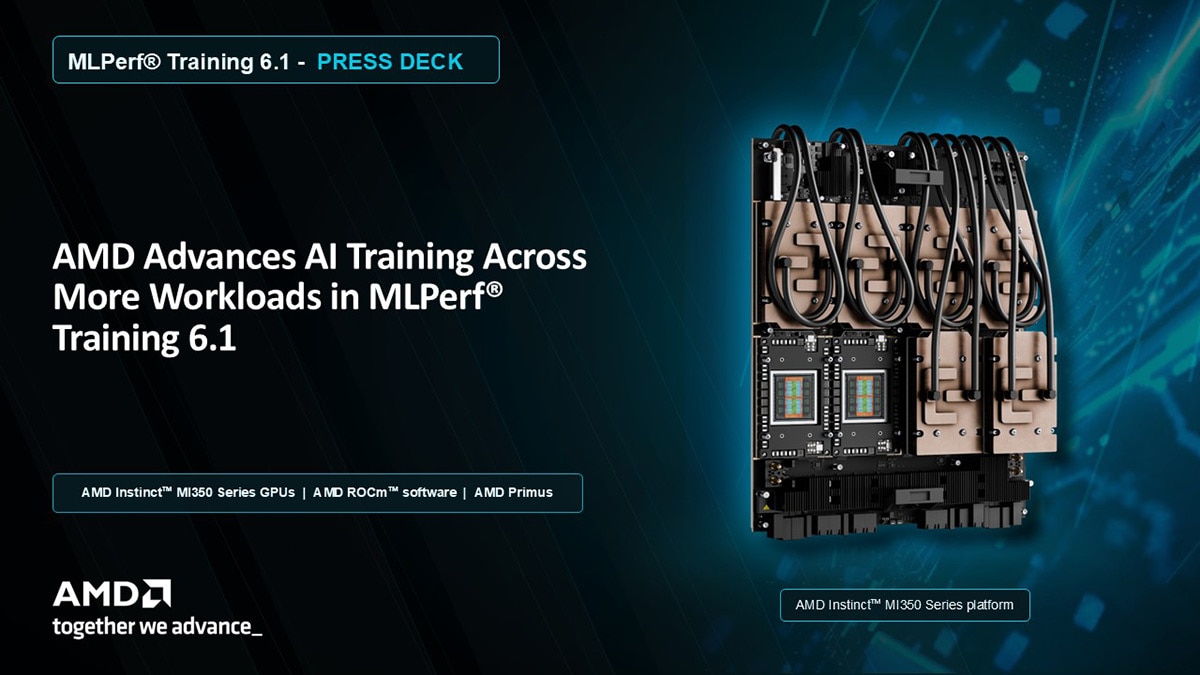
MLPerf® Training 6.1 brings shorter training cycles and broader workload coverage to AMD Instinct™ MI350 Series GPUs. Across four comparable eight-GPU Llama pre-training and fine-tuning configurations, training time fell approximately 16% on average versus Training 6.0 using the same GPU models.[1] That gives teams more room to iterate without changing GPU models.
The addition of GPT-OSS-20B and DLRMv4 expands the AMD submission from three to five benchmarks, its broadest training coverage to date.[2] The round also includes AMD’s first MLPerf mixture-of-experts (MoE) training submission and a major precision milestone: its first public, reproducible FP6 training demonstration with FLUX.1. These additions expand the model architectures and training precision options customers can evaluate.
Competitive comparisons show how AMD Instinct GPUs perform across these workloads, while partner submissions demonstrate how close reference performance can be reproduced across server and cloud systems. Together, these results help customers evaluate training infrastructure across workloads, precision choices and system providers.
Training Performance Advances Across Hardware and Software
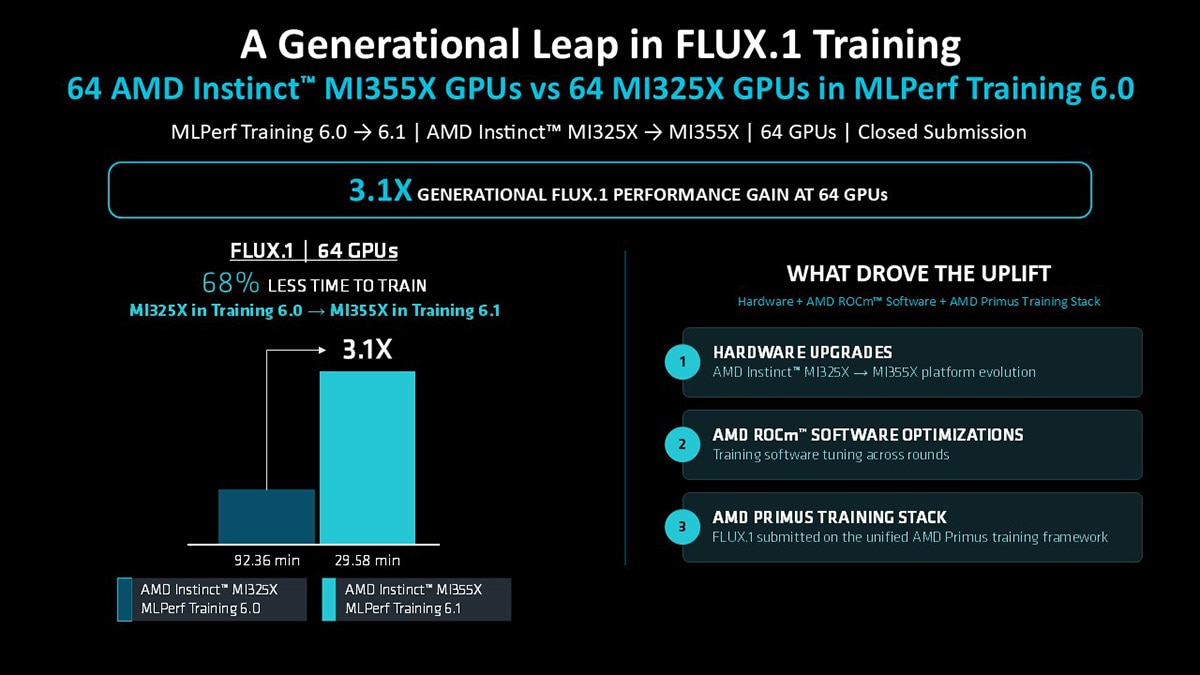
FLUX.1 illustrates how hardware and software advances combine. At 64 GPUs, AMD Instinct™ MI355X GPUs in Training 6.1 delivered 3.1× performance, equivalent to approximately 68% less training time, versus AMD Instinct™ MI325X GPUs in Training 6.0.[3] The gain combines a hardware-generation change with AMD ROCm™ software and AMD Primus training-stack advances, translating platform progress into a shorter time to the required benchmark quality target.
Training performance also improved on existing GPU models. Across Llama 2 70B low-rank adaptation (LoRA) fine-tuning and Llama 3.1 8B pre-training, AMD Instinct™ MI350X GPUs and AMD Instinct MI355X GPUs reduced training time by approximately 16% on average versus Training 6.0. All four comparisons used the same GPU models and eight-GPU counts.
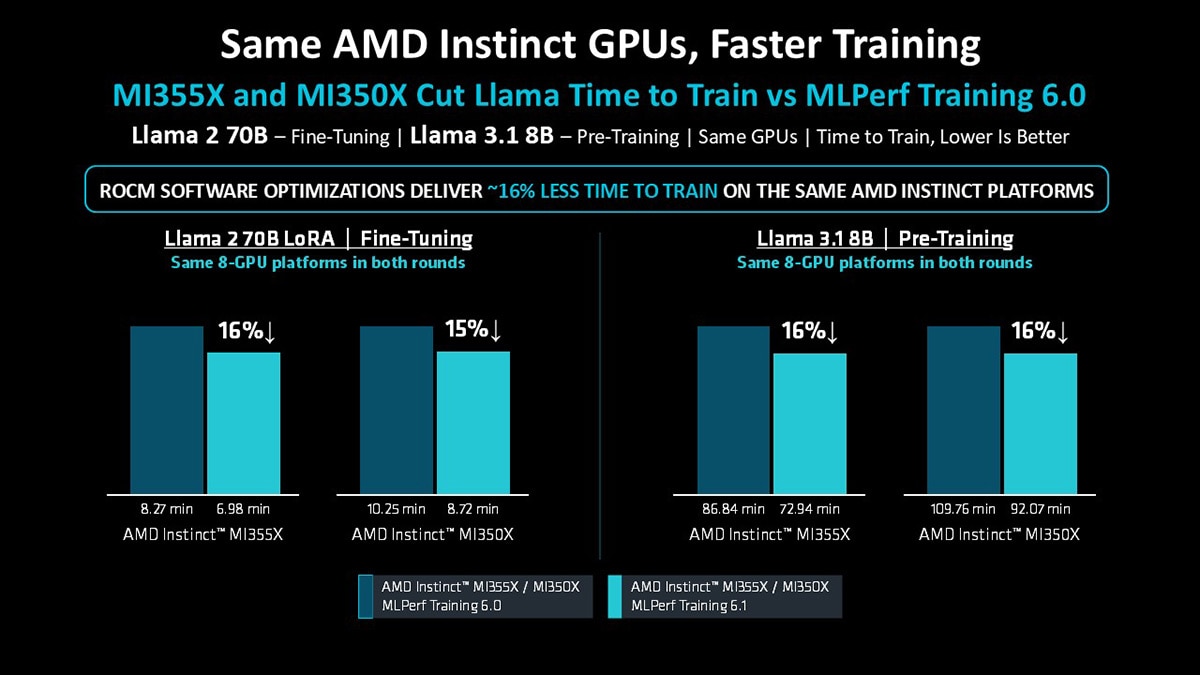
These Llama results show why current software belongs in an infrastructure evaluation alongside GPU specifications. The training stack continued to deliver progress on the tested GPU models between benchmark rounds.
Competitive Results Extend Across More Training Workloads
Building on these gains, AMD Instinct MI355X GPUs keep delivering competitive results across language models, image generation and recommendation, giving organizations more choice as their training needs evolve.
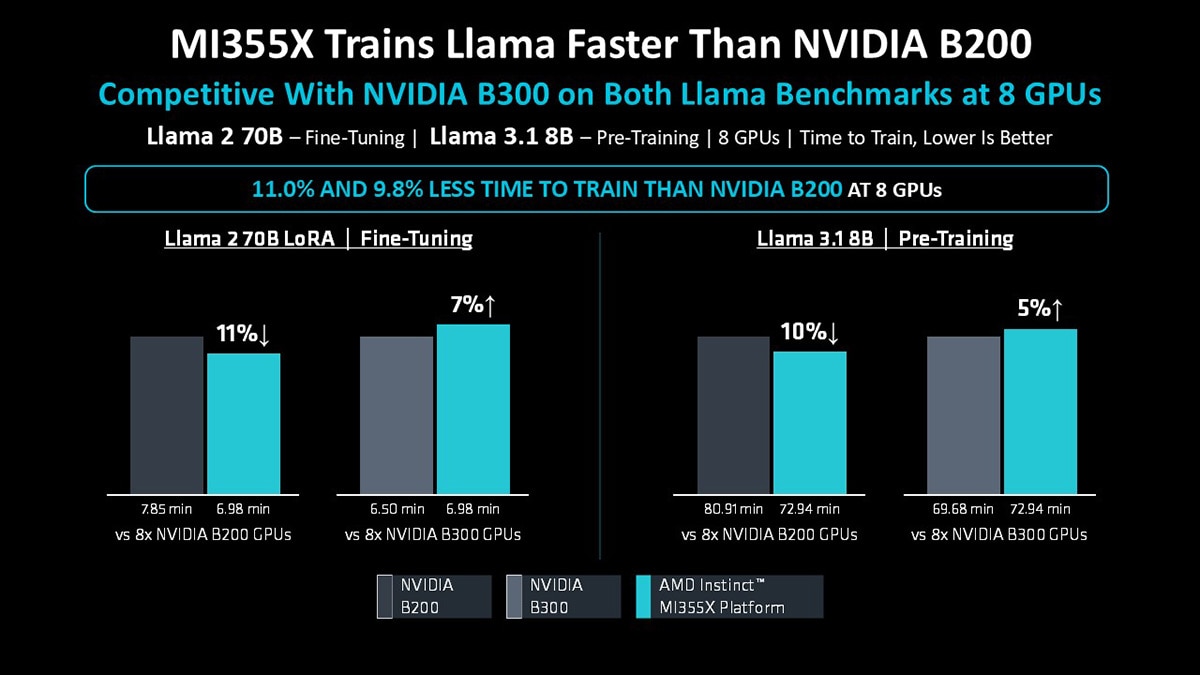
At eight GPUs, AMD Instinct MI355X GPUs took 11.0% less time on Llama 2 70B and 9.8% less time on Llama 3.1 8B than NVIDIA B200 GPUs. Training took 4.7% to 7.4% more time than NVIDIA B300 GPUs across the two workloads.[4] This gives customers a competitive single-node option across both pre-training and model adaptation, two distinct stages of language-model development.
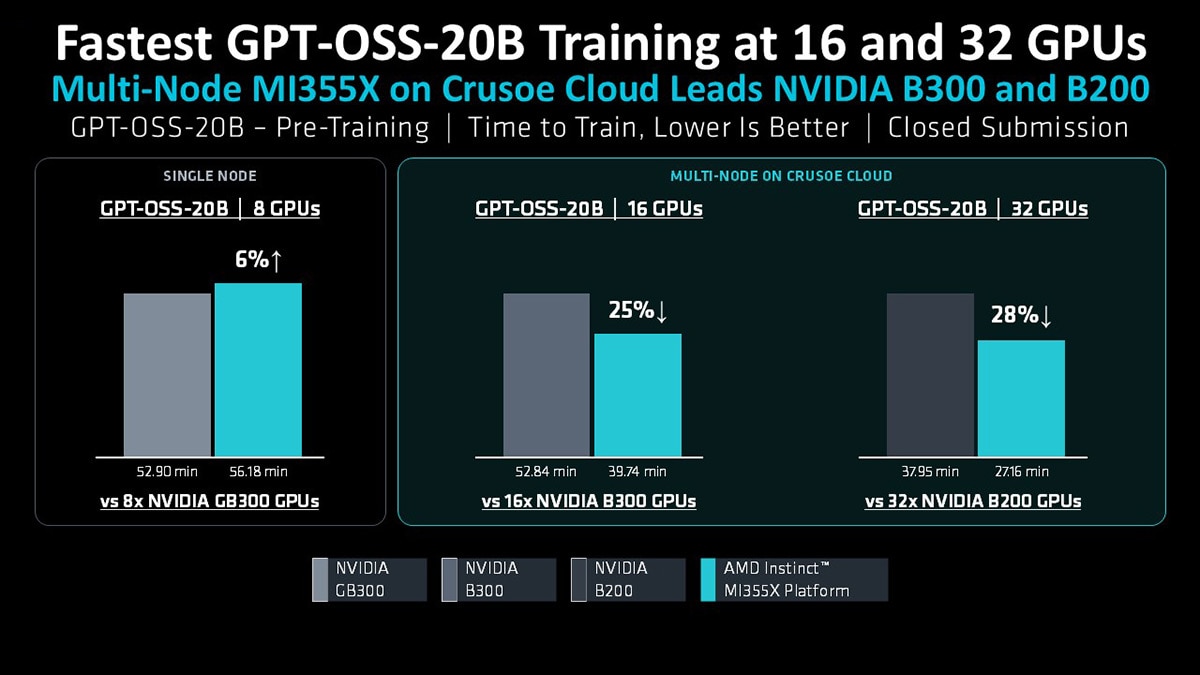
GPT-OSS-20B extends these results beyond dense language models. The first AMD MLPerf MoE-training entry took 24.8% less time than NVIDIA B300 GPUs at 16 GPUs and 28.4% less time than NVIDIA B200 GPUs at 32 GPUs.[5] For teams adding MoE to their model roadmap, the new coverage comes with competitive results at several cluster sizes, providing a starting point for single-node tests and multi-node training evaluations.
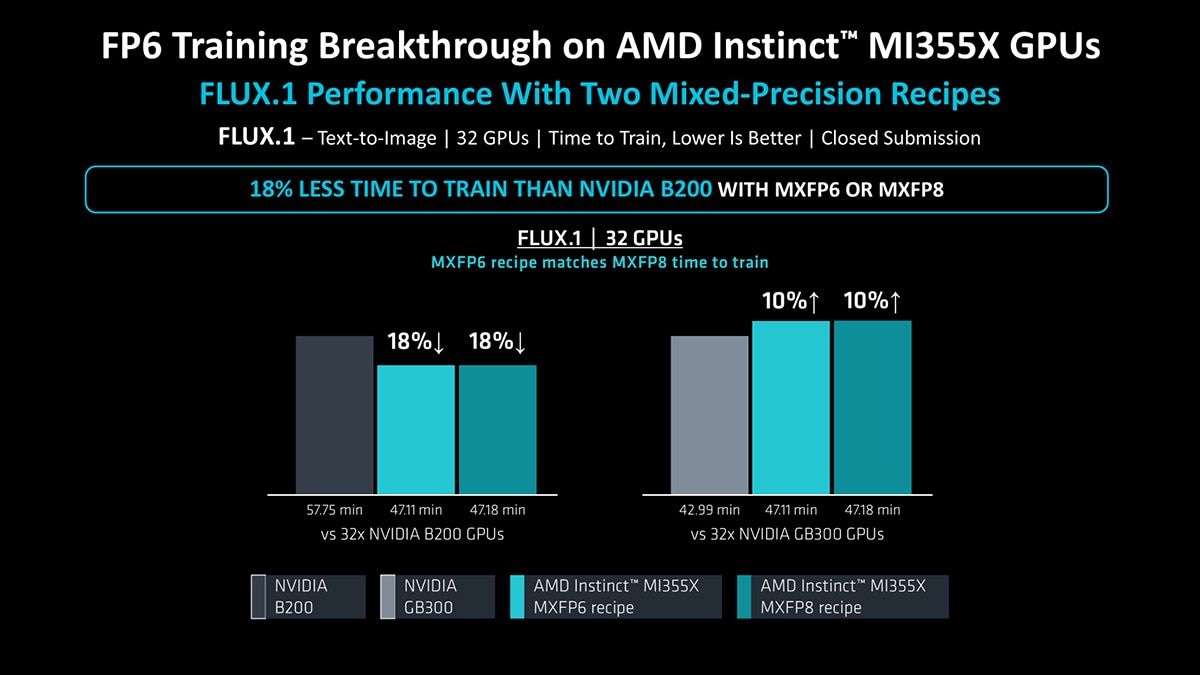
FLUX.1 marks a major technical milestone: the first public, reproducible demonstration of FP6 training, putting the FP6 capability already available in AMD Instinct™ MI350 Series GPUs into practice. With greater numerical precision than FP4, FP6 gives teams an intermediate option for balancing training accuracy and performance. On 32 AMD Instinct MI355X GPUs, mixed MXFP6/MXFP4 and MXFP8/MXFP4 recipes completed training in 47.11 and 47.18 minutes, respectively. Both recipes used approximately 18% less time than NVIDIA B200 GPUs and approximately 10% more time than NVIDIA GB300 GPUs.[6] These closely matched results demonstrate FP6 as a practical training option with competitive performance.
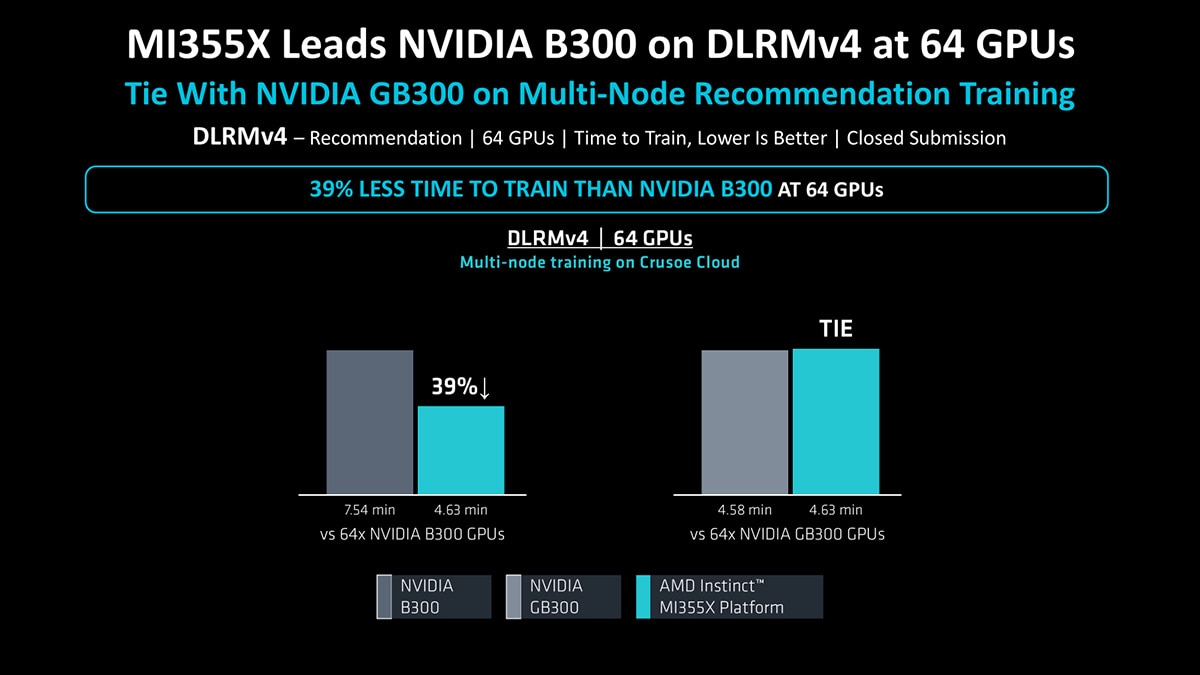
DLRMv4 takes the comparison into recommendation training. At 64 GPUs, AMD Instinct MI355X GPUs took 38.5% less time than NVIDIA B300 GPUs and approximately 1% more time than NVIDIA GB300 GPUs.[7] For organizations whose training portfolio includes recommendation alongside generative AI, that near-parity GB300 result broadens the case for assessing the same GPU family across both workload types.
The wider workload comparison becomes more useful when customers can see how closely the performance holds across systems from multiple providers.
Partner Results Connect Performance with System Choice
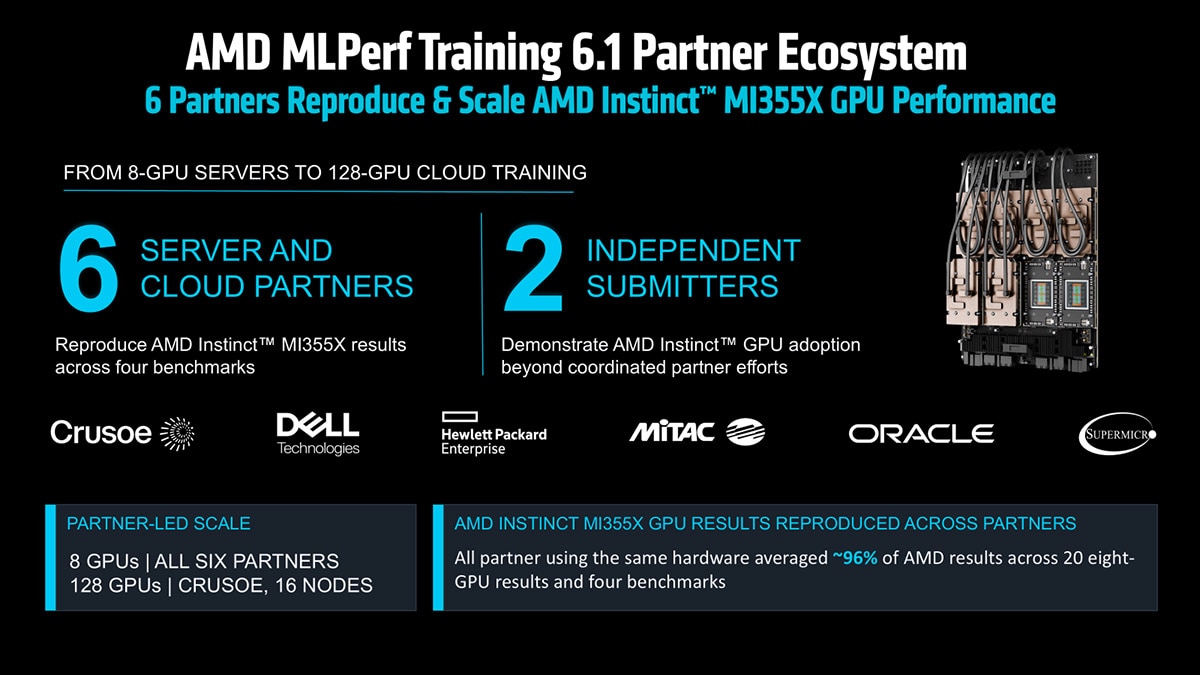
Partner submissions add that next layer. Crusoe, Dell, HPE, MiTAC, Oracle and Supermicro submitted results on AMD Instinct MI355X GPUs. All 20 matched eight-GPU results from these six partners, covering four benchmarks, averaged approximately 96% of AMD reference performance. Individual results ranged from approximately 91% to 101%.[8] This shows how close reference performance was reproduced across the tested systems, giving customers a basis for comparing provider configurations. These results give customers evidence that performance close to AMD’s reference results can be reproduced across multiple server and cloud providers, broadening their options when evaluating training infrastructure.
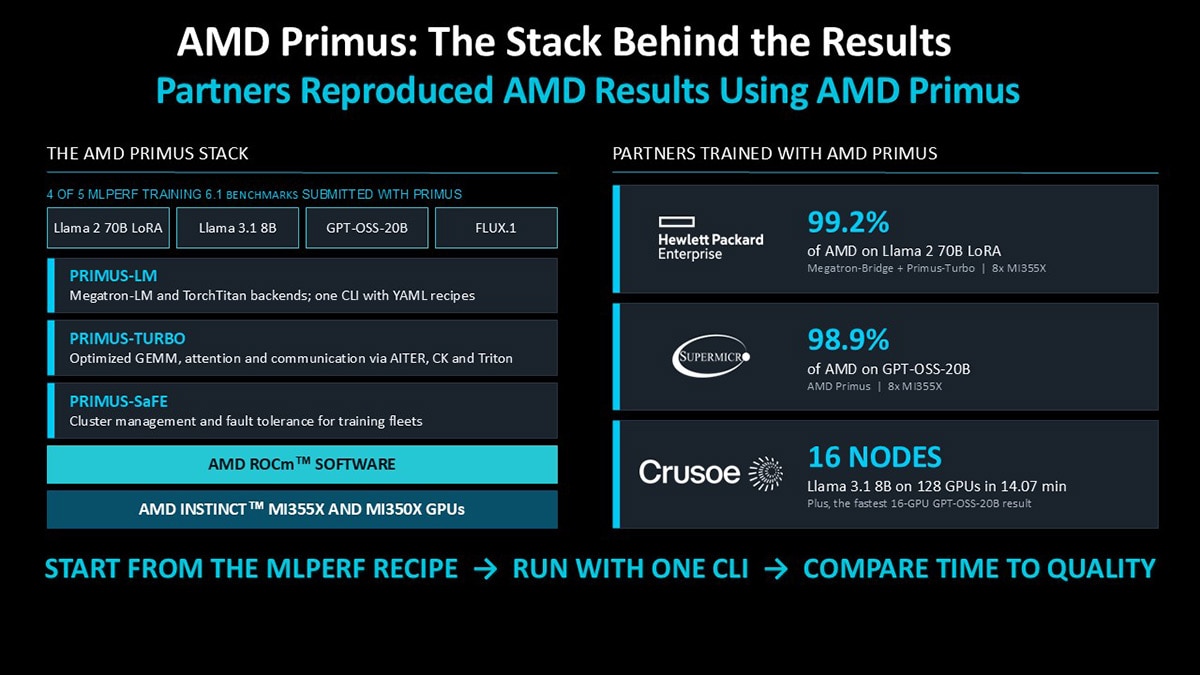
Crusoe also submitted Llama 3.1 8B cloud configurations spanning one to 16 nodes. Its 128-GPU configuration completed in 14.07 minutes and was the largest AMD Instinct GPU-based submission this round.[9]
AMD Primus links the broader workload coverage with the partner implementations. It supported four of the five AMD benchmarks, including the new GPT-OSS-20B workload and the mixed FP6/FP4 FLUX.1 recipe. HPE, Supermicro and Crusoe identified AMD Primus in their submission metadata.[10] These implementations show a shared training stack supporting different model architectures and precision approaches. DLRMv4 used a separate stack.
AMD is preparing the Training 6.1 reproduction guide, workload recipes and FP6 container for release. The intended next step is practical: start from matching benchmark conditions, then compare convergence and time to quality in your own environment.
Adapting a benchmark configuration to another training job also involves environment setup, diagnostics and profiling. AMD ROCm software, version 10, addresses these tasks through AMD Skills in AI coding assistants and a command-line interface, available as a technology preview, for installation, validation and diagnostics. Modular software, scalable communications and local profiling support teams investigating multi-node workloads. These version 10 capabilities are separate from the software used to produce the submitted results.
Looking Ahead to MLPerf Endpoints
As MLPerf data center inference benchmarking moves toward MLPerf® Endpoints, Microsoft’s first submission on AMD Instinct™ GPUs offers an early milestone. The collaboration with AMD and MangoBoost delivered the first Endpoints results for GPT-OSS-120B and DeepSeek-R1 on AMD Instinct GPUs, using Azure ND MI300X v5 virtual machines equipped with AMD Instinct MI300X GPUs and MangoBoost’s inference optimization software and recipes. For GPT-OSS-120B, this collaboration reports the highest published per-GPU MLPerf throughput on AMD Instinct MI300X GPUs, providing an early example of the results emerging through the new benchmark.[11]
Final Takeaway
MLPerf® Training 6.1 brings faster training and broader workload coverage to AMD Instinct™ GPUs. Competitive results across five benchmarks, the first AMD MLPerf mixture-of-experts training submission and a mixed FP6/FP4 FLUX.1 recipe give teams more options as their training requirements evolve.
These results reflect progress across hardware, software and the partner ecosystem. AMD ROCm™ software and AMD Primus help translate GPU capability into training performance, while partner submissions show how closely that performance can be reproduced across different systems. Together, they give customers a stronger basis for evaluating training infrastructure across workloads and providers.
For a closer look at the work behind these results, explore the MLPerf Training 6.1 technical deep dive for details on the software and optimizations behind the submission. The MLPerf Training 6.1 reproduction guide provides configurations and instructions for reproducing the benchmarks on AMD Instinct GPUs.
Footnotes
1. MLPerf® Training v6.0 and v6.1, Closed division, Llama 2 70B LoRA fine-tuning and Llama 3.1 8B pre-training. AMD submissions on eight AMD Instinct™ MI350X GPUs: v6.0 entry 6.0-0035 and v6.1 entry 6.1-0067. AMD submissions on eight AMD Instinct MI355X GPUs: v6.0 entry 6.0-0036 and v6.1 entry 6.1-0062. All are Available on-premise entries. Training times in minutes, v6.0 to v6.1: MI350X Llama 2, 10.251459 to 8.717791; MI350X Llama 3.1, 109.755894 to 92.074850; MI355X Llama 2, 8.271402 to 6.979886; MI355X Llama 3.1, 86.844700 to 72.942202. AMD calculated the arithmetic mean of four time reductions, each equal to 100 × (1 − v6.1 training time / v6.0 training time). The mean is 15.6732%, rounded to approximately 16%. This AMD-calculated aggregate is not an official MLPerf® score. Result not verified by MLCommons Association. This qualification applies to the aggregate, not to the underlying submissions. Calculations use unrounded source values. Source: MLCommons Training results.
2. MLPerf® Training v6.1, Closed division. The five AMD benchmarks are Llama 2 70B LoRA, Llama 3.1 8B, GPT-OSS-20B, FLUX.1 and DLRMv4. Representative AMD entries are 6.1-0062 for the three language-model benchmarks, 6.1-0001 for the mixed FP6/FP4 FLUX.1 recipe and 6.1-0061 for DLRMv4. The MLPerf® Training v6.0 AMD submission covered three benchmark types through entries 6.0-0035, 6.0-0036 and 6.0-0037. Source: MLCommons Training results.
3. MLPerf® Training v6.0 and v6.1, Closed division, FLUX.1. AMD submitted 92.360373 minutes on 64 AMD Instinct™ MI325X GPUs in v6.0 entry 6.0-0037 and 29.581063 minutes on 64 AMD Instinct MI355X GPUs in v6.1 entry 6.1-0066. Both are Available on-premise entries. AMD calculated 3.1223× performance as v6.0 training time / v6.1 training time and 67.9721% less training time as 100 × (1 − v6.1 training time / v6.0 training time), rounded to 3.1× and approximately 68%. The performance ratio is calculated from time to the required quality target. Hardware and software differ between rounds. Calculations use unrounded source values. Source: MLCommons Training results.
4. MLPerf® Training v6.1, Closed division, Llama 2 70B LoRA fine-tuning and Llama 3.1 8B pre-training. AMD entry 6.1-0062 on eight AMD Instinct™ MI355X GPUs is compared with Dell entry 6.1-0083 on eight NVIDIA B200 GPUs and GigaComputing entry 6.1-0096 on eight NVIDIA B300 GPUs. All are Available on-premise entries. Training times in minutes, respectively for Llama 2 and Llama 3.1: AMD, 6.979886 and 72.942202; Dell, 7.845400 and 80.906696; GigaComputing, 6.498847 and 69.679008. AMD calculated 11.0% and 9.8% less training time than B200 and 7.4% and 4.7% more training time than B300. Less time = 100 × (1 − AMD time / comparator time); more time = 100 × (AMD time / comparator time − 1). Calculations use unrounded source values. Source: MLCommons Training results.
5. MLPerf® Training v6.1, Closed division, GPT-OSS-20B. At 16 GPUs, Crusoe entry 6.1-0005 on AMD Instinct™ MI355X GPUs, Available cloud, achieved 39.738373 minutes versus HPE entry 6.1-0100 on NVIDIA B300 GPUs, Available on-premise, at 52.837264 minutes: 24.8% less training time. At 32 GPUs, Crusoe entry 6.1-0006 on AMD Instinct MI355X GPUs, Available cloud, achieved 27.156535 minutes versus University of Florida entry 6.1-0149 on NVIDIA B200 GPUs, Available on-premise, at 37.952615 minutes: 28.4% less training time. Percentages are AMD calculations. Less time = 100 × (1 − AMD GPU system time / comparator time). Calculations use unrounded source values. Source: MLCommons Training results.
6. MLPerf® Training v6.1, Closed division, FLUX.1, 32 GPUs. AMD entry 6.1-0001 on AMD Instinct™ MI355X GPUs, Available cloud, used a mixed MXFP6/MXFP4 recipe and achieved 47.108858 minutes. AMD entry 6.1-0064 on AMD Instinct MI355X GPUs, Available on-premise, used a mixed MXFP8/MXFP4 recipe and achieved 47.179163 minutes. University of Florida entry 6.1-0149 on NVIDIA B200 GPUs achieved 57.752417 minutes. Dell entry 6.1-0090 on NVIDIA GB300 GPUs achieved 42.989146 minutes. Both NVIDIA entries are Available on-premise. For the MXFP6/MXFP4 and MXFP8/MXFP4 recipes, respectively, AMD calculated 18.4% and 18.3% less training time than B200 and 9.6% and 9.7% more training time than GB300, summarized as approximately 18% less and approximately 10% more. Less time = 100 × (1 − AMD time / comparator time); more time = 100 × (AMD time / comparator time − 1). Calculations use unrounded source values. Hardware, software and deployment environments differ. Source: MLCommons Training results.
7. MLPerf® Training v6.1, Closed division, DLRMv4, 64 GPUs. Crusoe entry 6.1-0007 on AMD Instinct™ MI355X GPUs, Available cloud, achieved 4.631798 minutes. Cisco entry 6.1-0069 on NVIDIA B300 GPUs, Available on-premise, achieved 7.537431 minutes. Quanta Cloud Technology entry 6.1-0137 on NVIDIA GB300 GPUs, Available on-premise, achieved 4.584523 minutes. AMD calculated 38.5% less training time than B300 as 100 × (1 − AMD GPU system time / B300 time) and approximately 1% more training time than GB300 as 100 × (AMD GPU system time / GB300 time − 1). Calculations use unrounded source values. Source: MLCommons Training results.
8. MLPerf® Training v6.1, Closed division, matched eight-GPU AMD Instinct™ MI355X results for Llama 2 70B LoRA, Llama 3.1 8B, GPT-OSS-20B and DLRMv4. AMD reference entries are 6.1-0062 for the three language-model benchmarks and 6.1-0061 for DLRMv4. The 20 matched partner results comprise Crusoe 6.1-0004 for Llama 3.1 8B, GPT-OSS-20B and DLRMv4; Oracle 6.1-0057 for Llama 2 70B LoRA, GPT-OSS-20B and DLRMv4; Dell 6.1-0085 and 6.1-0086, each for all three language-model benchmarks; HPE 6.1-0102 for all three language-model benchmarks; MiTAC 6.1-0114 for Llama 2 70B LoRA; Supermicro 6.1-0141 for all three language-model benchmarks and 6.1-0142 for DLRMv4. Crusoe and Oracle are Available cloud entries; the AMD references and other partner entries are Available on-premise. AMD calculated each normalized performance percentage as 100 × AMD reference training time / partner training time. The arithmetic mean across the 20 matched results is 96.1452%, rounded to approximately 96%. The range is 90.6302% to 100.6346%, rounded to approximately 91% to 101%. Calculations use unrounded source values. This AMD-calculated aggregate is not an official MLPerf® score. Result not verified by MLCommons Association. This qualification applies to the aggregate, not to the underlying submissions. Source: MLCommons Training results.
9. MLPerf® Training v6.1, Closed division, Llama 3.1 8B pre-training, Crusoe submissions on AMD Instinct™ MI355X GPUs, Available cloud. Entry 6.1-0004 used one node and eight GPUs and achieved 78.339421 minutes; entry 6.1-0005 used two nodes and 16 GPUs and achieved 43.225950 minutes; entry 6.1-0003 used 16 nodes and 128 GPUs and achieved 14.073931 minutes, rounded to 14.07 minutes. The 128-GPU entry is the largest AMD Instinct GPU count in the Training v6.1 results set reviewed for this comparison. Source: MLCommons Training results.
10. MLPerf® Training v6.1, Closed division, submission framework and recipe metadata. AMD entry 6.1-0062 identifies AMD Primus for Llama 2 70B LoRA, Llama 3.1 8B and GPT-OSS-20B; AMD entry 6.1-0001 identifies AMD Primus for the mixed FP6/FP4 FLUX.1 recipe. These represent four of the five AMD benchmark types. HPE entry 6.1-0102, Supermicro entry 6.1-0141 and Crusoe entries 6.1-0003, 6.1-0004 and 6.1-0005 also identify AMD Primus in their metadata. DLRMv4 used a separate training stack. Source: MLCommons Training results.
11. MLPerf® Endpoints v1.0, Standardized division, DeepSeek-R1, Available category. Submitter: Azure. System: Azure ND MI300X v5, one node with eight accelerators. MLPerf Result ID: 1.0.1.deepseek-r1.legacy_mlperf_deepseek_r1.1p. The submission metadata identifies MangoBoost as providing the benchmark recipe and performance-tuning guidance. The report is provisional. Pending MLCommons Association verification, results are subject to change pending peer review. Source: MLCommons Endpoints submission report.
12. The MLPerf name and logo are registered and unregistered trademarks of MLCommons Association in the United States and other countries. All rights reserved. Unauthorized use strictly prohibited. See www.mlcommons.org for more information.
Footnotes
1. MLPerf® Training v6.0 and v6.1, Closed division, Llama 2 70B LoRA fine-tuning and Llama 3.1 8B pre-training. AMD submissions on eight AMD Instinct™ MI350X GPUs: v6.0 entry 6.0-0035 and v6.1 entry 6.1-0067. AMD submissions on eight AMD Instinct MI355X GPUs: v6.0 entry 6.0-0036 and v6.1 entry 6.1-0062. All are Available on-premise entries. Training times in minutes, v6.0 to v6.1: MI350X Llama 2, 10.251459 to 8.717791; MI350X Llama 3.1, 109.755894 to 92.074850; MI355X Llama 2, 8.271402 to 6.979886; MI355X Llama 3.1, 86.844700 to 72.942202. AMD calculated the arithmetic mean of four time reductions, each equal to 100 × (1 − v6.1 training time / v6.0 training time). The mean is 15.6732%, rounded to approximately 16%. This AMD-calculated aggregate is not an official MLPerf® score. Result not verified by MLCommons Association. This qualification applies to the aggregate, not to the underlying submissions. Calculations use unrounded source values. Source: MLCommons Training results.
2. MLPerf® Training v6.1, Closed division. The five AMD benchmarks are Llama 2 70B LoRA, Llama 3.1 8B, GPT-OSS-20B, FLUX.1 and DLRMv4. Representative AMD entries are 6.1-0062 for the three language-model benchmarks, 6.1-0001 for the mixed FP6/FP4 FLUX.1 recipe and 6.1-0061 for DLRMv4. The MLPerf® Training v6.0 AMD submission covered three benchmark types through entries 6.0-0035, 6.0-0036 and 6.0-0037. Source: MLCommons Training results.
3. MLPerf® Training v6.0 and v6.1, Closed division, FLUX.1. AMD submitted 92.360373 minutes on 64 AMD Instinct™ MI325X GPUs in v6.0 entry 6.0-0037 and 29.581063 minutes on 64 AMD Instinct MI355X GPUs in v6.1 entry 6.1-0066. Both are Available on-premise entries. AMD calculated 3.1223× performance as v6.0 training time / v6.1 training time and 67.9721% less training time as 100 × (1 − v6.1 training time / v6.0 training time), rounded to 3.1× and approximately 68%. The performance ratio is calculated from time to the required quality target. Hardware and software differ between rounds. Calculations use unrounded source values. Source: MLCommons Training results.
4. MLPerf® Training v6.1, Closed division, Llama 2 70B LoRA fine-tuning and Llama 3.1 8B pre-training. AMD entry 6.1-0062 on eight AMD Instinct™ MI355X GPUs is compared with Dell entry 6.1-0083 on eight NVIDIA B200 GPUs and GigaComputing entry 6.1-0096 on eight NVIDIA B300 GPUs. All are Available on-premise entries. Training times in minutes, respectively for Llama 2 and Llama 3.1: AMD, 6.979886 and 72.942202; Dell, 7.845400 and 80.906696; GigaComputing, 6.498847 and 69.679008. AMD calculated 11.0% and 9.8% less training time than B200 and 7.4% and 4.7% more training time than B300. Less time = 100 × (1 − AMD time / comparator time); more time = 100 × (AMD time / comparator time − 1). Calculations use unrounded source values. Source: MLCommons Training results.
5. MLPerf® Training v6.1, Closed division, GPT-OSS-20B. At 16 GPUs, Crusoe entry 6.1-0005 on AMD Instinct™ MI355X GPUs, Available cloud, achieved 39.738373 minutes versus HPE entry 6.1-0100 on NVIDIA B300 GPUs, Available on-premise, at 52.837264 minutes: 24.8% less training time. At 32 GPUs, Crusoe entry 6.1-0006 on AMD Instinct MI355X GPUs, Available cloud, achieved 27.156535 minutes versus University of Florida entry 6.1-0149 on NVIDIA B200 GPUs, Available on-premise, at 37.952615 minutes: 28.4% less training time. Percentages are AMD calculations. Less time = 100 × (1 − AMD GPU system time / comparator time). Calculations use unrounded source values. Source: MLCommons Training results.
6. MLPerf® Training v6.1, Closed division, FLUX.1, 32 GPUs. AMD entry 6.1-0001 on AMD Instinct™ MI355X GPUs, Available cloud, used a mixed MXFP6/MXFP4 recipe and achieved 47.108858 minutes. AMD entry 6.1-0064 on AMD Instinct MI355X GPUs, Available on-premise, used a mixed MXFP8/MXFP4 recipe and achieved 47.179163 minutes. University of Florida entry 6.1-0149 on NVIDIA B200 GPUs achieved 57.752417 minutes. Dell entry 6.1-0090 on NVIDIA GB300 GPUs achieved 42.989146 minutes. Both NVIDIA entries are Available on-premise. For the MXFP6/MXFP4 and MXFP8/MXFP4 recipes, respectively, AMD calculated 18.4% and 18.3% less training time than B200 and 9.6% and 9.7% more training time than GB300, summarized as approximately 18% less and approximately 10% more. Less time = 100 × (1 − AMD time / comparator time); more time = 100 × (AMD time / comparator time − 1). Calculations use unrounded source values. Hardware, software and deployment environments differ. Source: MLCommons Training results.
7. MLPerf® Training v6.1, Closed division, DLRMv4, 64 GPUs. Crusoe entry 6.1-0007 on AMD Instinct™ MI355X GPUs, Available cloud, achieved 4.631798 minutes. Cisco entry 6.1-0069 on NVIDIA B300 GPUs, Available on-premise, achieved 7.537431 minutes. Quanta Cloud Technology entry 6.1-0137 on NVIDIA GB300 GPUs, Available on-premise, achieved 4.584523 minutes. AMD calculated 38.5% less training time than B300 as 100 × (1 − AMD GPU system time / B300 time) and approximately 1% more training time than GB300 as 100 × (AMD GPU system time / GB300 time − 1). Calculations use unrounded source values. Source: MLCommons Training results.
8. MLPerf® Training v6.1, Closed division, matched eight-GPU AMD Instinct™ MI355X results for Llama 2 70B LoRA, Llama 3.1 8B, GPT-OSS-20B and DLRMv4. AMD reference entries are 6.1-0062 for the three language-model benchmarks and 6.1-0061 for DLRMv4. The 20 matched partner results comprise Crusoe 6.1-0004 for Llama 3.1 8B, GPT-OSS-20B and DLRMv4; Oracle 6.1-0057 for Llama 2 70B LoRA, GPT-OSS-20B and DLRMv4; Dell 6.1-0085 and 6.1-0086, each for all three language-model benchmarks; HPE 6.1-0102 for all three language-model benchmarks; MiTAC 6.1-0114 for Llama 2 70B LoRA; Supermicro 6.1-0141 for all three language-model benchmarks and 6.1-0142 for DLRMv4. Crusoe and Oracle are Available cloud entries; the AMD references and other partner entries are Available on-premise. AMD calculated each normalized performance percentage as 100 × AMD reference training time / partner training time. The arithmetic mean across the 20 matched results is 96.1452%, rounded to approximately 96%. The range is 90.6302% to 100.6346%, rounded to approximately 91% to 101%. Calculations use unrounded source values. This AMD-calculated aggregate is not an official MLPerf® score. Result not verified by MLCommons Association. This qualification applies to the aggregate, not to the underlying submissions. Source: MLCommons Training results.
9. MLPerf® Training v6.1, Closed division, Llama 3.1 8B pre-training, Crusoe submissions on AMD Instinct™ MI355X GPUs, Available cloud. Entry 6.1-0004 used one node and eight GPUs and achieved 78.339421 minutes; entry 6.1-0005 used two nodes and 16 GPUs and achieved 43.225950 minutes; entry 6.1-0003 used 16 nodes and 128 GPUs and achieved 14.073931 minutes, rounded to 14.07 minutes. The 128-GPU entry is the largest AMD Instinct GPU count in the Training v6.1 results set reviewed for this comparison. Source: MLCommons Training results.
10. MLPerf® Training v6.1, Closed division, submission framework and recipe metadata. AMD entry 6.1-0062 identifies AMD Primus for Llama 2 70B LoRA, Llama 3.1 8B and GPT-OSS-20B; AMD entry 6.1-0001 identifies AMD Primus for the mixed FP6/FP4 FLUX.1 recipe. These represent four of the five AMD benchmark types. HPE entry 6.1-0102, Supermicro entry 6.1-0141 and Crusoe entries 6.1-0003, 6.1-0004 and 6.1-0005 also identify AMD Primus in their metadata. DLRMv4 used a separate training stack. Source: MLCommons Training results.
11. MLPerf® Endpoints v1.0, Standardized division, DeepSeek-R1, Available category. Submitter: Azure. System: Azure ND MI300X v5, one node with eight accelerators. MLPerf Result ID: 1.0.1.deepseek-r1.legacy_mlperf_deepseek_r1.1p. The submission metadata identifies MangoBoost as providing the benchmark recipe and performance-tuning guidance. The report is provisional. Pending MLCommons Association verification, results are subject to change pending peer review. Source: MLCommons Endpoints submission report.
12. The MLPerf name and logo are registered and unregistered trademarks of MLCommons Association in the United States and other countries. All rights reserved. Unauthorized use strictly prohibited. See www.mlcommons.org for more information.

Contributors

Related Blogs
-
AMD and Rancher Government Solutions Bring Security-Focused HPC and AI to Kubernetes
AMD and RGS simplify HPC and AI on Kubernetes with a hardened reference architecture for efficient GPU scheduling and utilization.
November 16, 2026
-
Scaling Enterprise AI with AMD Compute and HiddenLayer Security
AMD and HiddenLayer combine high-performance compute and AI security to help enterprises protect data, manage risk and scale AI adoption
November 16, 2026
-
AMD and Fiddler: Enterprise AI Reliability in the Era of Autonomous Agents
AMD and Fiddler combine high-performance compute, open software, observability and governance to support reliable enterprise AI agents.
November 16, 2026
-
Exascale Was the Beginning: AMD Instinct™ MI430X GPUs
The AMD Instinct MI430X is the first GPU designed from the outset for the convergence of high-precision compute and AI for science.
November 12, 2026
-
Beyond Embedding Quantization: Quark UINT4 Qwen3.8-Flash-Next on Ryzen AI Halo — ROCm Blogs
Explore n-gram table choices for Qwen3.8-Flash-Next with AMD Quark UINT4, including accuracy and response-length tradeoffs.
November 11, 2026
-
AI Is the New Electricity. And the Meter Is Running.
AMD helps enterprises scale AI while managing costs with leadership compute, open platforms and ecosystem partnerships.
November 11, 2026
-
Parallelism for Long-Context Serving: GLM-5.3-Flash on MI300X — ROCm Blogs
Measured throughput of GLM-5.3-Flash on MI300X: how KV-cache capacity shapes TP8 and DP8+EP8 serving, with BF16 and FP8 KV cache.
November 10, 2026
-
Accelerating GLM-5.2 on AMD Instinct MI355X: EvalScope Benchmarks with Prefix Caching — ROCm Blogs
Learn how to optimize GLM-5.2 FP8 long-context inference on AMD Instinct MI355X GPUs using prefix caching and end-to-end inference stack tuning.
November 10, 2026