Where Genesis Meets Quantum Genesis: Scaling a Quantum CFD Workflow to 40 Qubits on Lux
Nov 24, 2026
From the exascale supercomputers powering discovery across the United States to Lux, the first Genesis Mission system for SI-driven science, AMD powers the world's leading scientific computing. With leadership CPUs, GPUs, FPGAs, networking and the ROCm™ software, AMD offers nations, laboratories and enterprises one open platform for high-performance computing, Super Intelligence (SI) for science, sovereign SI, agentic SI and the path to quantum computing.
This post is about the last item on that list. It covers a step along the path to quantum computing that Rolls-Royce, Xanadu and AMD took together on Lux, using a problem the U.S. Department of Energy has named a national priority.
The path to quantum starts on a supercomputer
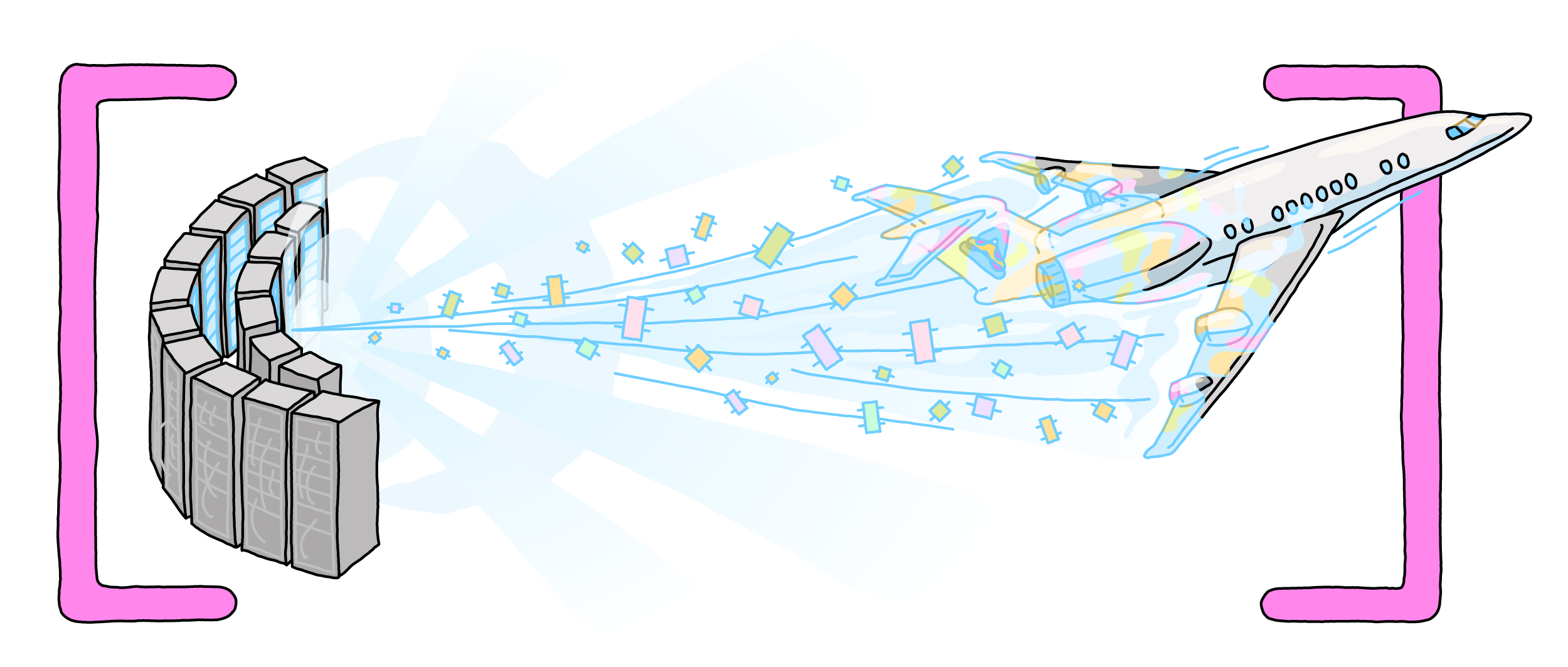
Useful quantum computing will not begin on the day a fault-tolerant quantum computer is switched on. It begins earlier, with the algorithms, software and infrastructure that machine will need. Fault-tolerant quantum computers will not stand alone, either. They will be built, tested and run next to supercomputers. Before an algorithm runs on quantum hardware, someone has to compile it, count what it costs and check that it is correct. A problem large enough to be useful is, by definition, beyond what any classical computer can simulate. A supercomputer can still check the algorithm at the largest sizes classical hardware can reach. That exposes cost and correctness problems that would otherwise only surface on the quantum computer itself.
The U.S. Department of Energy has now said where that work should point. Through Quantum Genesis, part of the broader Genesis Mission, DOE aims to deliver fault-tolerant, scientifically relevant quantum computers. Its Q Competition targets systems with logical qubits in the low hundreds in 2028. In October, DOE published the Quantum Genesis Priority Applications: eight problems that will be used to judge whether those machines are scientifically relevant.
In applied mathematics, Linear Systems and Partial Differential Equations focuses on problems such as turbulence, where the range of length and time scales "requires impractically dense meshes and small-time steps". DOE names the quantum singular value transform (QSVT) among the key algorithms and fluid dynamics among the applications a solution would unlock. DOE is also explicit about what progress takes: "a clear understanding of resource estimation and optimization, integration into the scientific workflow, and performance benchmarking against the best-known classical alternatives." Until fault-tolerant hardware exists, every one of those is a job for classical high-performance computing. That is the problem every organization preparing for quantum computing shares: get applications ready now, and find the algorithmic, software and infrastructure bottlenecks before the hardware arrives.
AMD co-developed Lux to power unified scientific workflows that bridge experimental instruments, classical simulation, and advanced modeling, creating a seamless computing foundation for next-generation architecture across CPUs, GPUs, and fault-tolerant quantum processors. DOE lists quantum among the national priorities Lux serves. The work below is an early example of that kind of workflow: a quantum algorithm developed, compiled and executed end to end on an SI-and-HPC system, so that it is ready for the quantum processors to come.
An industrial instance: Rolls-Royce and jet-engine CFD
Rolls-Royce designs the next generation of lower-emission aircraft engines with computational fluid dynamics (CFD). At its core, each simulation solves very large systems of linear equations, repeatedly. Simulating a complete engine at high-resolution, as desired by engineers, is still beyond today's supercomputers. That is the "impractically dense meshes" problem DOE describes, seen from industry.
In March, Rolls-Royce, Xanadu and AMD ran a QSVT solver for a 256 × 256-mesh lid-driven cavity, a standard CFD benchmark, on a single AMD Instinct™ MI300X GPU: 20 qubits, 35 million gates, under two hours. PennyLane’s resource estimation then showed where the cost was: almost all of it was in the block encoding. A block encoding is the circuit that loads the problem matrix into the quantum computer, which is exactly the "efficient quantum oracle" DOE's target asks for. Every QSVT step calls it, so every saving in the block encoding is multiplied across the whole solver.
This time the team set out to build that oracle for a mesh 64 times larger, 2048 × 2048, and to run it end to end. That took a supercomputer.
Lux: the first Genesis Mission platform
Lux was co-developed by Oak Ridge National Laboratory, AMD, Oracle Cloud Infrastructure and HPE as a public-private partnership, with AMD co-investing alongside DOE. It is the first U.S. SI factory for science and the first operational Genesis Mission platform. Its 504 nodes carry 4,032 AMD Instinct MI355X GPUs. Each node has:
- two 64-core AMD EPYC™ 9575F CPUs with 3 TB of DDR5;
- eight MI355X GPUs, each with 288 GB of HBM3E at 8 TB/s and 78.6 TFLOPS of FP64, linked by AMD Infinity Fabric™ system-wide interconnect;
- AMD Pensando™ Pollara 400 AI NICs;
- 25.6 TB of local NVMe.
40 qubits on one rack
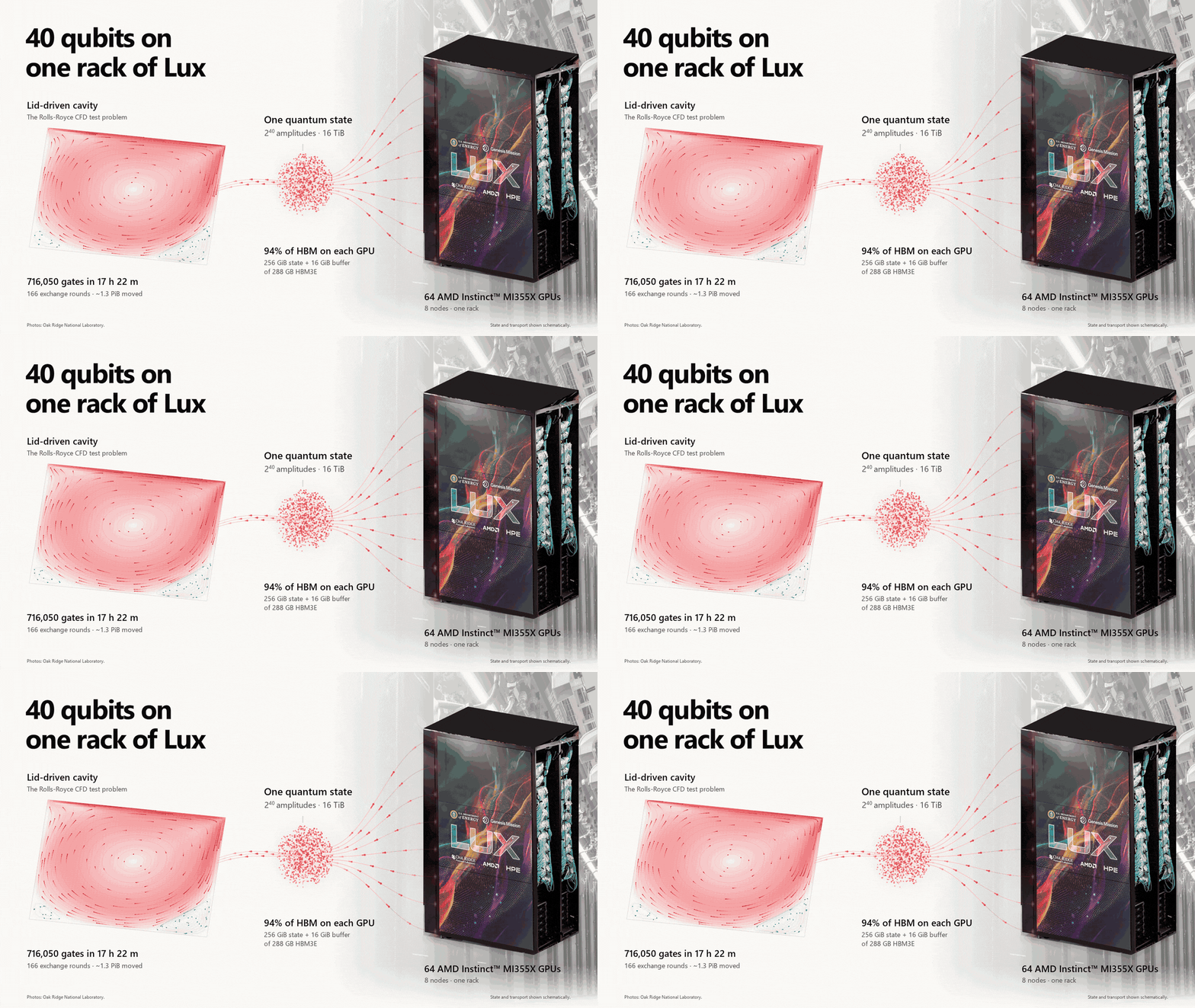
The memory problem. A classical simulator stores every amplitude of the quantum state. Each extra qubit doubles the memory. The 2048 × 2048 block encoding needs 40 qubits: 2⁴⁰ complex amplitudes, or 17.6 TB. March's 20-qubit run needed 17 MB, so the new problem is a million times larger in memory.
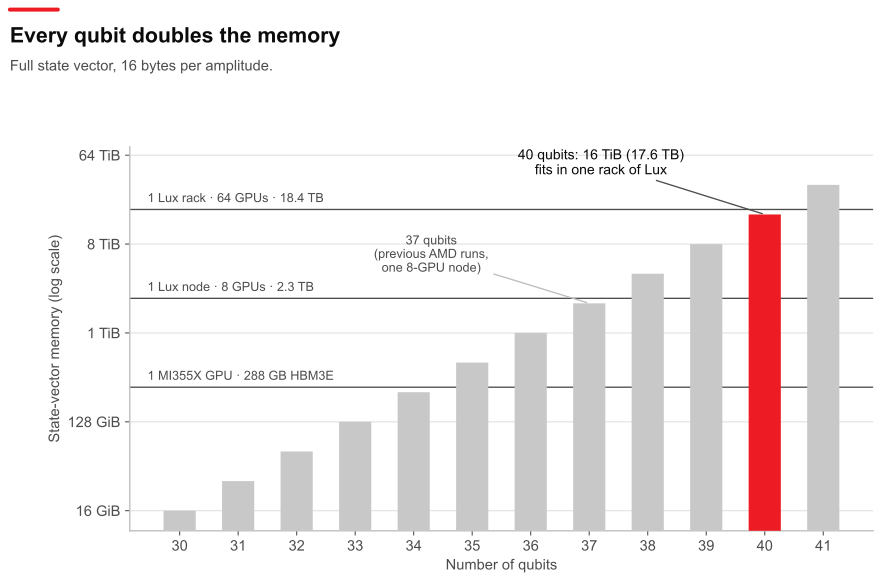
One rack of Lux, eight nodes and 64 GPUs, holds 18.4 TB of HBM3E, so the whole 40-qubit state fits in GPU memory on a single rack. Each GPU holds 2³⁴ amplitudes, a 256 GiB slice, plus a buffer for exchanging data with its peers. That uses about 94% of each GPU's 288 GB.
Memory per GPU sets the GPU count. The simulator needs a power-of-two number of GPUs. Here is where AMD’s larger memory GPUs shine. On a GPU with less memory, the same state needs twice as many GPUs. A larger share of every gate then has to cross the network, and the job no longer fits in one rack.
Bandwidth, not just capacity. Every gate sweeps a GPU's whole 256 GiB slice, about 16,000 times more data per gate than in March. That makes the workload bound by HBM bandwidth inside each GPU. Between GPUs, it is bound by the fabric: the simulator periodically swaps qubits between GPUs so that the next gates act on local data. In this run there were 166 exchange rounds, each moving on average half of every GPU's local state. In total, each GPU sent 21 TiB and received another 21 TiB, and about 1.3 PiB moved between GPUs over AMD Infinity Fabric and the AMD Pensando network.
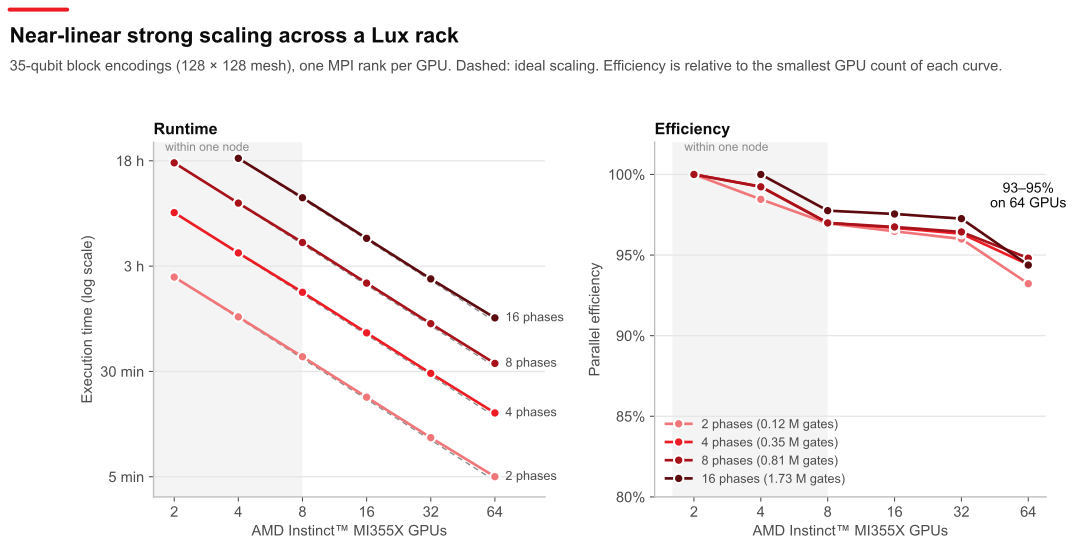
The result. The 40-qubit, 716,050-gate block encoding of the Rolls-Royce 2048 × 2048 matrix ran in 17 hours 22 minutes on 64 MI355X GPUs, with zero errors. Before the full run, we checked how the workflow scales on Lux using a smaller, 35-qubit version of the problem (128 × 128 mesh). Going from 2 to 64 MI355X GPUs, the circuits ran up to 29.8× faster. On 64 GPUs they reached 93–95% of ideal linear scaling, across GPUs within a node and across nodes within a rack, and this held for circuits from 0.1 to 1.7 million gates.
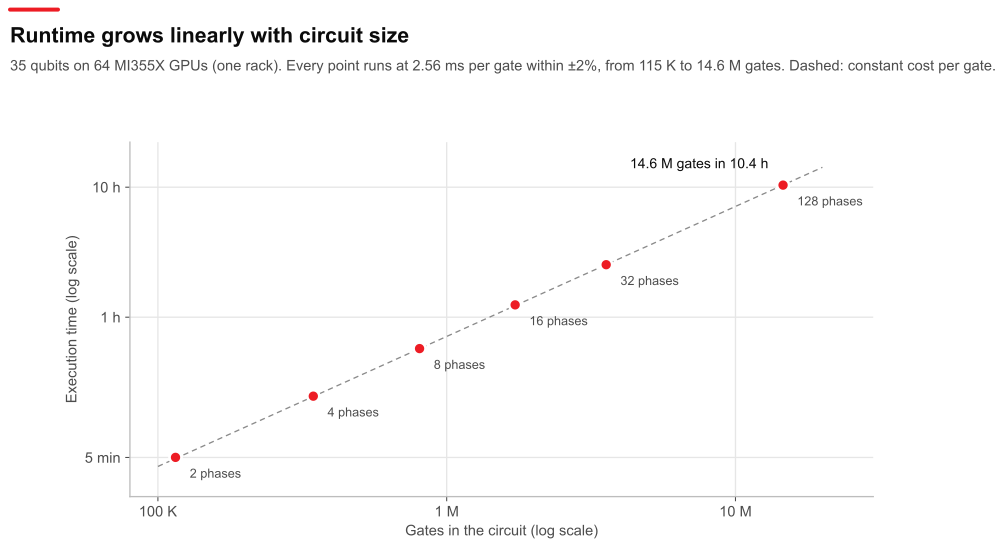
Cost also grows predictably with circuit size. On one rack, every 35-qubit QSVT circuit we ran, from 2 to 128 phase angles, cost the same 2.56 milliseconds per gate within ±2%. That includes a 128-phase circuit with 14.6 million gates, which completed in 10.4 hours. This predictability lets teams budget compute for deeper circuits before they submit them.
The open stack, from Python to silicon
The program is written in PennyLane, Xanadu's open-source quantum software. It is compiled with Catalyst, which turns the program into compact MLIR in under a minute on Lux's AMD EPYC CPUs, even for a circuit of this size. It then runs on PennyLane Lightning, a high-performance state-vector simulator. Lightning is built on Kokkos and HIP over the open AMD ROCm stack, and distributes the state across GPUs with GPU-aware MPI.
For this work the teams brought Lightning's multi-node, multi-GPU support to AMD Instinct MI355X GPU and integrated it with Catalyst. On the algorithm side, Xanadu cut the block encoding's non-Clifford gate count by more than 220× and reordered qubits so that cross-node traffic dropped by about 90%. The details are in Xanadu's companion technical post on PennyLane.
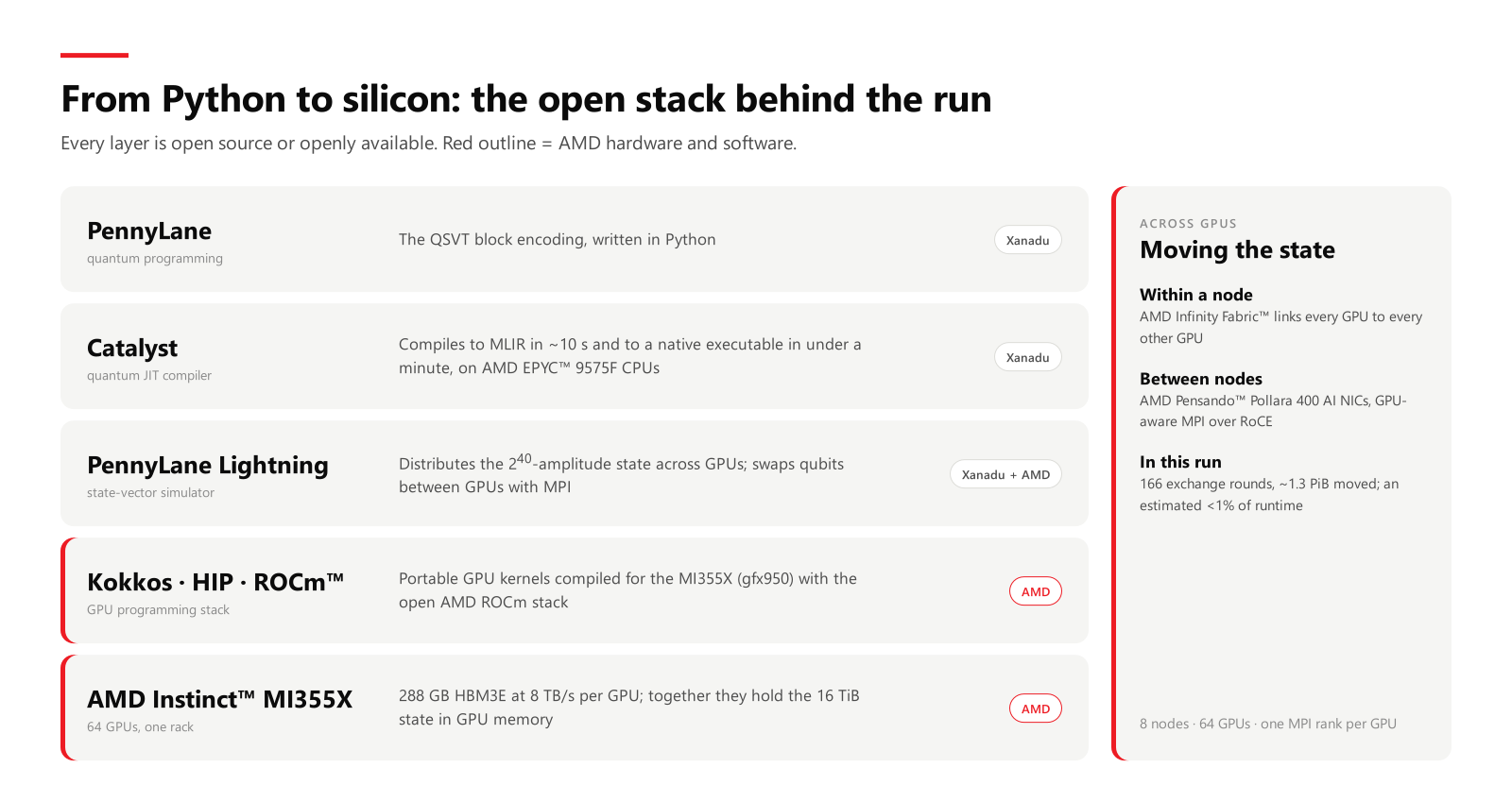
Every layer is open. Researchers can inspect, reproduce and extend the result, and customers can bring the same workflow to their own AMD systems.
Measuring the run against Quantum Genesis
DOE's priority applications come with a yardstick. Here is how this work lines up with it.
What DOE says progress requires | What this work did on Lux |
Resource estimation and optimization | Identified the block encoding as the dominant cost and reduced it by orders of magnitude. Multi-controlled gates went from over 99% of the block encoding to 13%. The circuit was then compiled and costed at full 40-qubit size. |
Integration into the scientific workflow | Used a real Rolls-Royce CFD matrix rather than a toy problem. Python, compiler and distributed simulator run end to end on the same system that runs classical simulation and SI. |
Benchmarking against classical | Block-encoding outputs checked against the classical result at 35 qubits (128 × 128 mesh), then executed at full 40-qubit scale on Lux. |
Target Application: "the problem matrix implemented efficiently as a quantum oracle" | The block encoding is that oracle, built for an engineering CFD matrix and executed at 40 qubits. |
The road ahead is still long. This work is the groundwork DOE describes: building the most expensive component of a quantum linear solver for a real engineering problem, counting its cost, and running it at a size that only a supercomputer can check.
The classical computing continuum behind quantum
Quantum Genesis calls for an integrated ecosystem of HPC, SI and quantum computing, and notes that "SI and HPC can also help improve quantum-system design, control, optimization, and error correction." AMD and Xanadu are working on both ends of that statement.
Lux provides classical computing at scale. It lets teams develop, compile, cost and verify quantum programs at full size before the hardware exists.
Backline provides classical computing at the qubit. It is the tight, real-time coupling between classical processors and quantum hardware needed for control and error-correction decoding.
Together they explore the classical side of a practical quantum computer, from large-scale algorithm development to low-latency quantum-classical execution.
What's next
AMD is building the open, high-performance classical foundation that connects today's most demanding workloads with tomorrow's quantum systems. Next steps for this work include evaluating realistic test cases featuring increasingly complex block-encodings. The objective is to identify encodings that trade additional qubits for reduced circuit depth—a critical trade-off on the path to quantum advantage. Crucially, without the scaling demonstrated in this work, researching and validating these advanced encodings would not be possible.
Organizations ready to move their quantum strategy from exploration to execution can work with AMD and Xanadu to identify priority applications, evaluate infrastructure requirements, and start scaling quantum-classical workflows today. Contact us at QuantumComputing@AMD.com, hello@xanadu.ai or start on AMD Instinct GPUs today with the AMD Developer Cloud.
Other resources
- DOE: Quantum Genesis Priority Applications
- Quantum Genesis
- Lux at OLCF and the Lux User Guide
- Propelling Aerospace Innovation (March 2026)
- PennyLane technical blog· Xanadu blog
- Bring your own decoder with Backline
- AMD Developer Cloud
Footnotes
SI stands for SuperIntelligence and relates to Artificial Intelligence (AI)



Related Blogs
-
AMD AI NIC Technology: AMD AI NICs Now Support HPC to Accelerate AI for Science
See how AMD AI NIC™ technology serves AI for Science, running AI training and MPI simulations on one Ethernet network with AMD Instinct™ MI355X GPUs.
November 16, 2026
-
AMD Brings Agentic AI to Supercomputing with Open-Source AMD HPC Assistant, Debuting on LUMI and Frontier
AMD HPC Assistant is an open-source, AI-powered guide that helps researchers move faster from code to discovery, debuting on the LUMI and Frontier supercomputers.
November 16, 2026
-
GPU-Initiated DMA Copy Engines in RCCL and rocSHMEM — ROCm Blogs
Learn how GPU-initiated SDMA engines in RCCL and rocSHMEM offload data transfers to free compute units and maximize scale-up bandwidth.
November 12, 2026
-
Exascale Was the Beginning: AMD Instinct™ MI430X GPUs
The AMD Instinct MI430X is the first GPU designed from the outset for the convergence of high-precision compute and AI for science.
November 12, 2026
-
Performance Profiling on AMD GPUs - Part 7: AI/PyTorch® Edition — ROCm Blogs
Profile and optimize a PyTorch Evoformer (TinyOpenFold) training workload on AMD Instinct GPUs using rocprofv3, rocprof-compute, and rocprof-sys.
November 03, 2026
-
Performance Profiling on AMD GPUs - Part 6: Advanced Thread Trace (ATT) - The Microscope for Your Application — ROCm Blogs
Explore rocprofv3 ATT and ROCprof Compute Viewer to trace GPU kernels and explain stalls, waits, and memory-bound performance.
September 21, 2026
-
Supercharging Genomics Alignment with AMD Instinct GPUs
How ROCm/HIP GPU acceleration brings long-read DNA alignment closer to real-time on AMD MI300X
July 30, 2026
-
Advancing Agentic Workflows With AMD EPYC™ 9006 Series Server CPUs
AMD EPYC™ 9006 Server CPUs power agentic AI with purpose-built CPUs for agent sandboxes, AI host nodes, and enterprise workloads at scale.
July 23, 2026