
The AI Landscape Is Changing Again
Your customers are likely still thinking about AI infrastructure through a narrow lens based on how they’ve used AI to date: call-and-response single outputs and questions like which GPUs to use, how much accelerator memory they need and which models they’d like to run.
All of these are important factors, but they’re no longer the whole picture. They made sense during the first wave of AI adoption when the priority was experimentation. With the advent of agentic AI, the infrastructure conversation has changed, and with it comes the opportunity for partners to help customers move beyond a GPU-only view of AI.
How AI Workloads Are Changing
AI is transforming from simple LLM call-and-response workloads to ongoing, independent workloads that enable customers to do much more with their infrastructure than before, running ongoing operations and workloads without human input.
Agentic AI systems can autonomously plan, retrieve information, call tools, interact with APIs, update states, query databases, trigger workflows and coordinate multiple services. As those systems move into production, customers need infrastructure that can support continuous, concurrent, service-heavy workloads, not just the previous isolated model inference.
While GPUs remain essential for large-scale AI training and inference and provide the accelerator performance required for model computation, they’re only one part of the system in agentic environments. Deploying agentic workflows depends on a combination of scaling agent sandboxes, maximizing AI host-node throughput and powering general-purpose workloads.
Much of that surrounding work is CPU-driven. If the CPU can’t keep pace, customers will run into bottlenecks, high latency, low GPU utilization or inefficient scaling, even after investing heavily in accelerators.
A balanced AI platform therefore needs both elements: accelerators for model computation and high-performance server CPUs for the service, orchestration and data layers that make agentic AI usable at scale.
With the introduction of AMD EPYC™ 9006 Series server CPUs, infrastructures can evolve to meet these new demands and continue to deliver cutting-edge performance as agentic AI is adopted.
The Best Server CPU Portfolio for the Agentic Era1
AMD EPYC 9006 Series server CPUs enable leadership performance when it comes to agentic AI, cloud, enterprise and high-performance computing workloads, offering up to 256 cores, 512 threads and clock speeds of up to 5GHz – with outstanding performance per core for a server processor. With industry-leading PCIe® Gen 6 I/O and up to 1.6TB/s per socket memory bandwidth, these processors lead the way for customers leaning into the most demanding agentic workflows.
For customers concerned about upgrading, AMD EPYC server CPUs already offer a standards-based x86 foundation for dense, efficient server infrastructure, and this next generation of CPUs extends that roadmap for future deployments, helping customers seamlessly upgrade without disrupting their existing production environments.
For partners, this new product range gives the agentic AI conversation with customers three clear entry points: scaling up, maximizing throughput and powering general purpose workloads that surround AI.
1. Scaling Up
For customers building sandbox environments, multi-agent experimentation or high-concurrency agentic services, dense compute is key. The more agents a customer can fit within their available power, rack and budget constraints, the easier it becomes for them to scale AI adoption without creating unsustainable infrastructure costs or complexity.
High-core-count AMD EPYC 9006 Series server CPUs are designed to meet this need, offering up to 33% higher core count over the previous generation,2 giving partners a direct way to tackle agentic capacity through a higher concentration of agents.
2. Maximizing Throughput
In accelerator-rich systems, server CPUs still play a critical role. They help feed the GPUs, coordinate data movement, support I/O, run host-side services and reduce friction between model execution and the broader application environment.
High-frequency AMD EPYC 9006 Series server CPUs feature industry-leading PCIe® Gen 6 I/O subsystems that offer twice the bandwidth per lane compared to previous-generation products3 and up to 1.6 TB/s of per-socket memory bandwidth, helping reduce host-side bottlenecks and support swift movement of data across the system.
For customers focused on maximizing GPU utilization and token generation, these CPUs help ensure the host platform can keep pace with the accelerator performance their AI workloads depend on.
3. General-Purpose AI Services
Many customer workloads won’t fit neatly into a single AI category. Their use cases will span databases, storage services, CPU inference, orchestration logic, analytics, middleware, security and much more. These are precisely the kinds of general-purpose workloads that make agentic AI such a powerful addition to managing modern business workloads.
The breadth of the AMD EPYC 9006 Series server CPU portfolio enables partners to map customer requirements to the right processor in the product family, delivering CPU inference for small and medium language models, orchestration for planning and tool use, or support for confidential AI environments through AMD security technologies like AMD SEV and trusted I/O capabilities.
For customers modernizing their existing enterprise infrastructure at the same time as they adopt AI, moving to AMD EPYC 9006 Series server CPUs maintains the x86 platform their software stack relies on helps to reduce migration issues and shortens the path from AI planning to deployment.
AMD Arena
Build expertise with training on AMD AI solutions, AMD EPYC™ server CPUs, AMD Instinct™ GPUs and more across the AMD portfolio.
Subscribe
Get monthly updates on the latest AMD products, training resources and Meet the Experts webinars.
Agentic AI Needs High-Performance Computing
CPUs aren’t replacing GPUs in the AI picture. The shift to agentic AI now requires infrastructure to provide both powerful CPUs and GPUs working in tandem. Use this shift to agentic AI as a reason to revisit your customers’ wider data center architecture and ask them:
Are they still treating AI as a standalone GPU project?
Are they planning for production-scale AI already?
Can their current server infrastructure support the level of compute that agentic systems require?
Are power, cooling or rack space restrictions already limiting their AI expansion?
Do they need a standards-based path that supports existing enterprise software and operational models?
There’s an opportunity here to move the conversation from “Which accelerator should I buy?” to “What infrastructure will let my business scale AI reliably, efficiently and economically?”
Introduce your customers to the power of AMD EPYC 9006 Series server CPUs and the shift to agentic AI they support.
To learn more, speak to your AMD representative or visit amd.com.

Related Articles
-
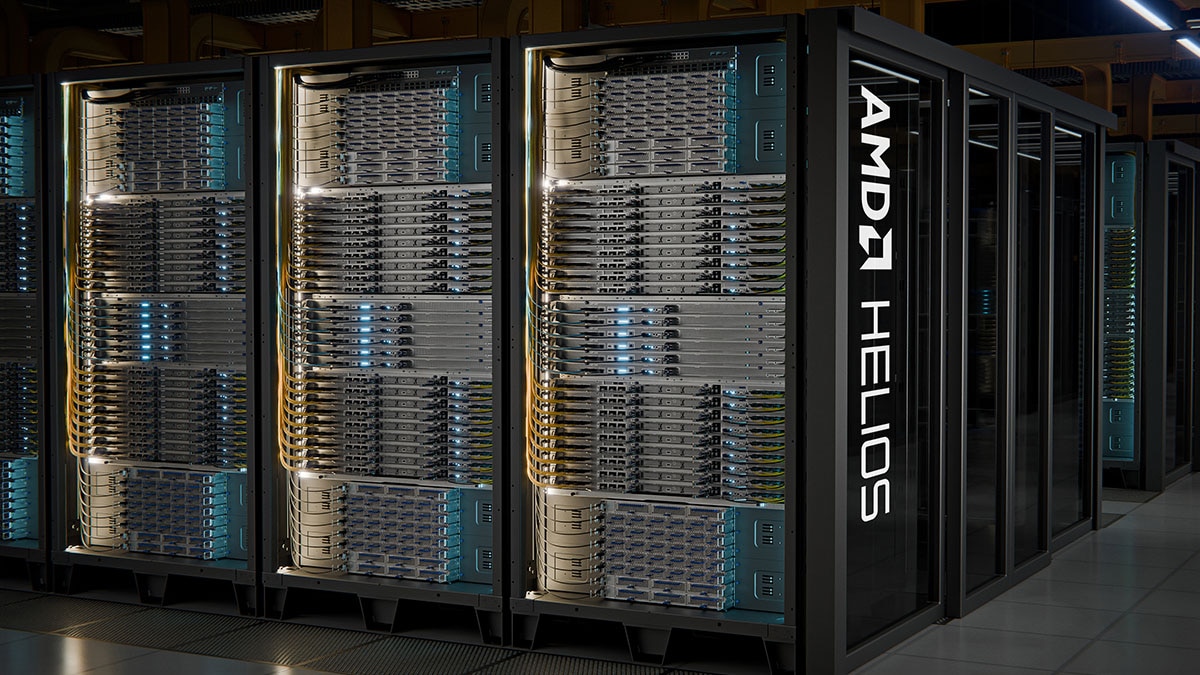
AMD Helios™ Rackscale Platform
AMD Helios™ rackscale platform unifies compute, networking, software, power and cooling for scalable inference, training and agentic AI infrastructure…
-
Optimize Data Center Infrastructure with AMD EPYC™
Help customers modernize data center infrastructure amid memory constraints by auditing workloads, right-sizing memory and using AMD EPYC™ server CPU …
-
Financial Data Security with AMD EPYC™
Learn how AMD EPYC™ server CPUs advance financial services workloads today and enable AI and HPC for future growth.
-
Accelerating Innovation in the Public Sector
Learn how AMD technologies support public sector needs across healthcare, education, infrastructure, defense, and more.



Related Training Courses
Related Webinars
Footnotes
- EPYC-067 - Based on AMD internal analysis and modeling of representative infrastructure workloads underlying agentic AI systems as of June, 2026. Performance comparisons reflect estimated rack‑scale throughput within a modeled 100kW deployment and include proxy workloads spanning web services, data infrastructure, and orchestration layers. Results are derived from a combination of AMD testing, third‑party data, and projections, and may vary based on system configuration, software stack, and workload mix. See AMD Agentic AI rack‑scale performance blog and AMD methodology description for details on assumptions, workloads, and measurement approach.
- 9xx6-005: vCPU support based on core count, comparing Top of Stack "Venice" CPU with 256 cores and 5th Gen EPYC 9965 with 192 cores.
- 9xx6-003: PCIe Gen comparison based on PCI-SIG published statements, https://pcisig.com/pci-express-6.0-specification. 2P 6th Gen EPYC CPU with 128 lanes of PCIe Gen 6 and 5th Gen EPYC with 128 lanes of PCIe Gen 5 as of 6/3/2025. PCIe is a registered trademark of PCI-SIG Corporation.
- EPYC-067 - Based on AMD internal analysis and modeling of representative infrastructure workloads underlying agentic AI systems as of June, 2026. Performance comparisons reflect estimated rack‑scale throughput within a modeled 100kW deployment and include proxy workloads spanning web services, data infrastructure, and orchestration layers. Results are derived from a combination of AMD testing, third‑party data, and projections, and may vary based on system configuration, software stack, and workload mix. See AMD Agentic AI rack‑scale performance blog and AMD methodology description for details on assumptions, workloads, and measurement approach.
- 9xx6-005: vCPU support based on core count, comparing Top of Stack "Venice" CPU with 256 cores and 5th Gen EPYC 9965 with 192 cores.
- 9xx6-003: PCIe Gen comparison based on PCI-SIG published statements, https://pcisig.com/pci-express-6.0-specification. 2P 6th Gen EPYC CPU with 128 lanes of PCIe Gen 6 and 5th Gen EPYC with 128 lanes of PCIe Gen 5 as of 6/3/2025. PCIe is a registered trademark of PCI-SIG Corporation.