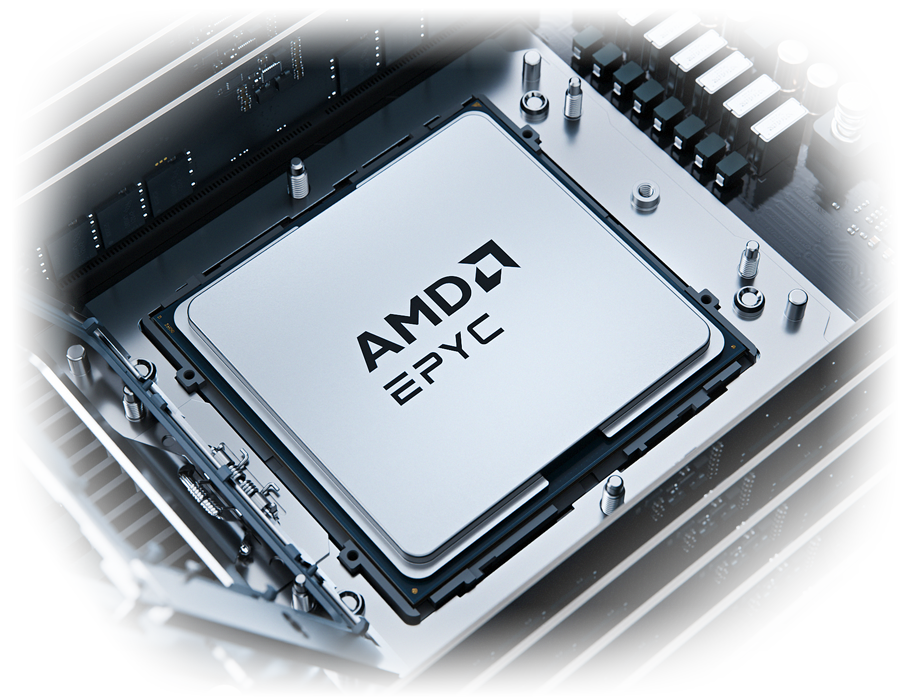
Modernize AI First Data Centers

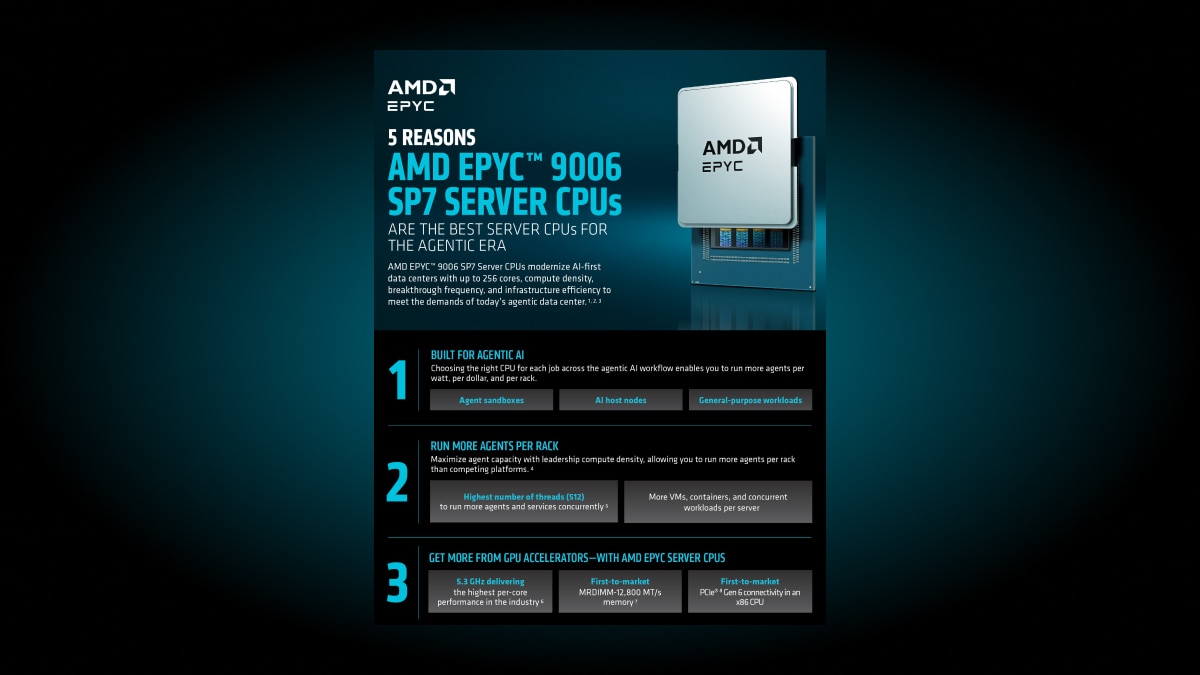
Agentic AI increases CPU demand across the data center. AMD EPYC™ 9006 SP7 Server CPUs help organizations scale agentic workflows, get more from GPU accelerators, complete more enterprise work, and achieve generationally faster time to insights for HPC simulations through three critical CPU roles.3

Agentic Sandbox CPU

Run More Agents. Per Watt. Per Dollar. Per Rack.4,5,6

Maximize agent capacity across racks and systems with the highest thread density and leadership performance per watt, enabling more agents within the same power envelope.7

AI Host Node CPU

Get More From GPU Accelerators.

Keep accelerators productive and AI workloads moving with highest frequency performance, fast CPU-to-GPU communication, and fastest memory bandwidth, maximizing GPU utilization and token throughput.8,9

General-Purpose CPU

More Jobs Done. Faster Insights. Fewer Servers.

Drive more workloads across general-purpose computing, complex HPC simulations, and agentic orchestration with the best performance, performance per watt, and density leadership.10,11,12


Close-up of a microchip on a circuit board with teal and amber indicator lights and shallow depth of field

AMD EPYC 9006 SP7 CPU-Based Platforms Are Shipping

For IT and infrastructure leaders planning next-generation deployments, that means the CPUs needed to run agents, keep GPUs productive, and support enterprise workloads are available today.

High Performance Across the Agentic Data Center

Designed to complete more work within data center power, cost, and space constraints from concurrent agent services and GPU-accelerated infrastructure to enterprise applications and HPC.

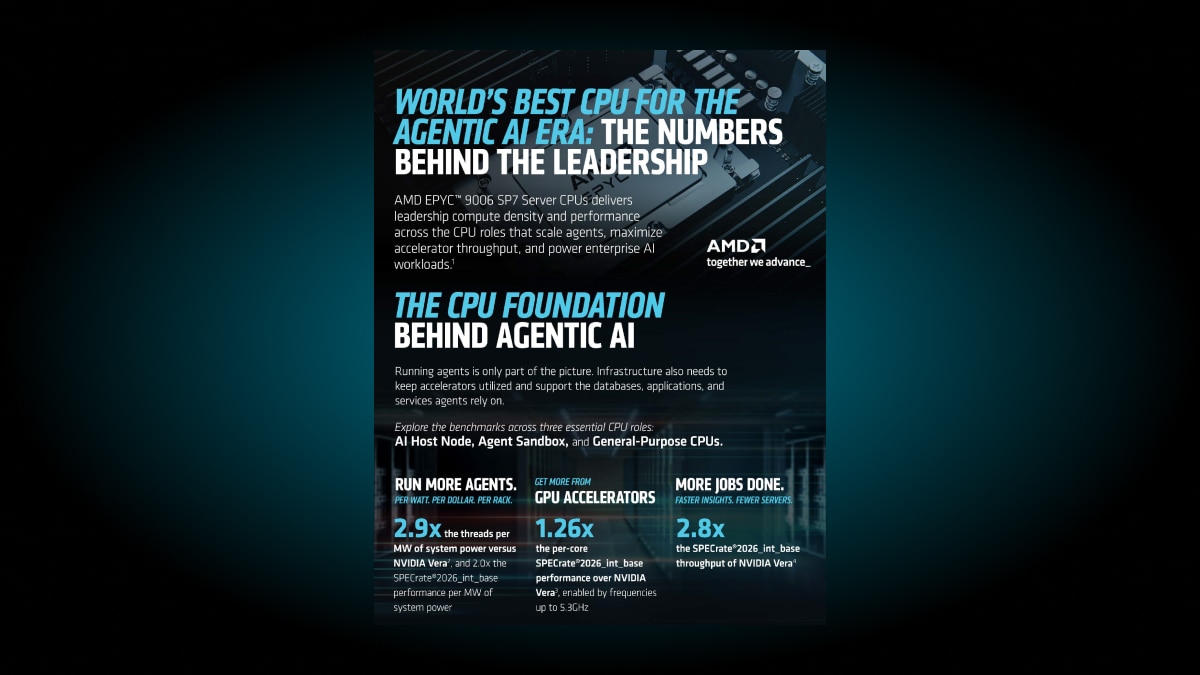
2.9X
cores/rack watt vs NVIDIA Vera13
Run More Agents
1.3X
per-core performance vs NVIDIA Vera14
Maximize GPU Utilization
~2.8X
throughput vs NVIDIA Vera15
Get Faster Insights

Demos

See AMD EPYC 9006 SP7 Server CPUs in Action

AMD EPYC 9006 Series

Architecture

Designed for Performance, Density, and Data Movement

AMD "Zen 6” delivers strong per-core performance for demanding enterprise and AI workloads, while AMD "Zen 6c” increases core and thread density for scale-out environments, all backed by a platform designed to keep compute, memory, and I/O working in balance.

Specifications

AMD EPYC 9006 SP7 Server CPU Specs

Compare AMD EPYC 9006 SP7 Server CPUs. Use the filters to find processors by core count, frequency, cache, and Default CPU Power. 

*Additional export control models are available for applicable markets. Refer to relevant product documentation for model availability and details.

Partners

Broad and Growing Ecosystem

AMD works with a variety of partners to build and develop optimized solutions featuring AMD EPYC 9006 SP7 Series Server CPUs.


Dell Technologies logo
Supermicro logo
Hewlett Packard Enterprise Logo
Lenovo logo

Frequently Asked Questions

AMD EPYC™ 9006 SP7 Server CPUs are designed for agentic AI, AI host-node infrastructure, cloud, enterprise, virtualization, general-purpose computing, HPC, and technical computing workloads.

AMD EPYC™ 9006 Series Server CPUs offer the broadest server CPU portfolio for agentic AI, with purpose-built processors that customers can match to each CPU role and the work it performs:

  • AMD EPYC 9006 SP7 Server CPUs: Support Agent Sandboxes, AI Host Nodes, and General-Purpose workloads, providing the highest multithreaded core count and highest performance in the portfolio.
  • AMD EPYC 9006 SP8 Server CPUs: Support the Agent Sandbox CPU and General-Purpose CPU roles, providing right-sized compute for enterprise and agent deployments.

AMD EPYC™ 9006 SP7 Server CPUs combine frequencies up to 5.3GHz, PCIe® Gen 6 I/O, and up to 1.6 TB/s per-socket memory bandwidth with MRDIMM-12800 to support data movement and CPU-to-GPU communication.

Choose performance-oriented “Zen 6” configurations for workloads that prioritize frequency, responsiveness, or per-core performance. Choose density-oriented “Zen 6c” configurations for highly parallel workloads that prioritize concurrency and aggregate throughput.

AMD EPYC™ processor OPNs (Ordering Part Numbers) that exceed the Total Processing Performance and Performance Density thresholds defined in the U.S. Export Administration Regulations (EAR) and are classified under ECCN 5A992.z.2 are identified as “Export Controlled.”For current requirements, see the BIS Export Administration Regulations.

Resources

Footnotes

*Models 9996, 9956, 9966, and 9846 are Export Controlled: These items are classified under Export Control Classification Number (ECCN) 5A992.z.2 pursuant to the U.S. Export Administration Regulations (EAR). For current export control requirements, please refer to the U.S. Department of Commerce, Bureau of Industry and Security (BIS) Export Administration Regulations. See https://www.bis.gov/regulations/ear
  1. 9xx6-005C: as of 11/5/2026, AMD EPYC CPUs can support up to 1.33x the vCPUs and threads vs 5th Gen AMD EPYC 9965. 6th Gen AMD EPYC 9996 has the highest thread density (thread count) and the highest multithreaded core density of server CPUs in production.
    vCPU support based on thread count, comparing Top of Stack 6th Gen EPYC 9996 CPU with 256 cores (512 threads) and 5th Gen EPYC 9965 with 192 cores (384 threads).
    In comparison, the highest thread count Intel® Xeon® processor is the Intel Xeon 6990E at 288 cores (288 threads).
    The highest multithreaded core count is the Intel Xeon 6980P at 128C (256 threads), and the highest thread count Nvidia CPU is the Nvidia Vera with 88 cores (176 threads).
    For reference, 6th Gen Intel Xeon CPUs support up to ~0.8x, ARM AGI with 136 cores (136 threads, 1 thread per core) is expected to support up to ~0.35x, and Nvidia Vera is expected to support ~0.5x the thread count of 5th Gen AMD EPYC CPUs.
    Intel specifications from ark.intel.com. ARM specifications from https://www.arm.com/products/cloud-datacenter/arm-agi-cpu#Specifications. Nvidia specifications from https://developer.nvidia.com/blog/nvidia-vera-cpu-delivers-high-performance-bandwidth-and-efficiency-for-ai-factories/.
  2. 9xx6-004C: SPECrate®2017_int_base comparison based on published scores from www.spec.org as of 11/05/2026 and AMD internal estimates for 2P NVIDIA Vera and 2P Arm AGI as of 10/10/2026. Highest performing 2P server CPU based on the highest published 2P SPECrate®2017_int_base score and the highest published score per CPU (per socket). Results and configurations below are in the format of: [processor], [cores], [Default CPU Power or TDP], [1Ku price in USD], [score], [score / CPU W], [score / 1Ku price in USD], [score / core], [Link to score]
    2P AMD EPYC 9996, 512C, 600W, $14904 USD, 5470, 9.117, 0.367, 10.68, https://www.spec.org/cpu2017/results/res2026q4/cpu2017-20261020-52013.html
    2P AMD EPYC 9965, 384C, 500W, $11988 USD, 3260, 6.520, 0.272, 8.49, https://www.spec.org/cpu2017/results/res2026q4/cpu2017-20261005-51950.html
    2P Intel Xeon 6990E+, 576C, 450W, $14995 USD, 3050, 6.778, 0.203, 5.30, https://www.spec.org/cpu2017/results/res2026q2/cpu2017-20260518-51499.html
    2P Intel Xeon 6980P, 256C, 500W, $13955 USD, 2510, 5.020, 0.180, 9.80, https://www.spec.org/cpu2017/results/res2025q4/cpu2017-20251126-50522.html
    2P NVIDIA Vera, 176C, 450W, pricing not published, AMD estimate 1459, 3.242, n/a, 8.29
    2P Arm AGI, 272C, 300W, pricing not published, AMD estimate 1944, 6.480, n/a, 7.15
    NVIDIA Vera and Arm AGI scores are AMD internal estimates based on AMD engineering projections and subject to change; NVIDIA Vera estimate based on published Phoronix testing, https://www.phoronix.com/review/nvidia-vera-benchmarks/. Pricing not published for NVIDIA Vera or Arm AGI. Intel CPU W and prices at https://ark.intel.com/ as of 11/05/2026.
    Starting with the 6th Gen AMD EPYC™ server processor family, AMD uses Default CPU Power to describe processor power consumption, succeeding AMD's historical TDP reference. Default CPU Power reflects total power consumed across the processor's compute and I/O dies for the stated performance target. Default CPU Power and TDP may both serve as processor power references for product comparison, platform planning, and performance-per-watt analysis.
    SPEC®, SPEC CPU®, SPECrate® and SPECint® are registered trademarks of the Standard Performance Evaluation Corporation. See www.spec.org for more information.
    AMD CPU prices as of 11/05/2026.
    Results may vary due to factors including system configurations, software versions and BIOS settings.
  3. 9xx6-117: SPEChpc™ 2021_tny_base comparison based on published 2P single-node results from www.spec.org as of 11/05/2026. The 2P AMD EPYC 9965 result is the highest published 5th Gen AMD EPYC result. Results and configurations below are in the format of: [processor], [cores], [Default CPU Power or TDP], [1Ku price in USD], [score], [score / CPU W], [score / 1Ku price in USD], [Link to score]
    2P AMD EPYC 9996, 512C, 600W, $14904 USD, 52.3, 0.0872, 0.00351, https://www.spec.org/hpc2021/results/res2026q4/hpc2021-20261013-00396.html
    2P Intel Xeon 6980P, 256C, 500W, $13955 USD, 22.4, 0.0448, 0.00161, https://www.spec.org/hpc2021/results/res2025q3/hpc2021-20250819-00384.html
    2P AMD EPYC 9965, 384C, 500W, $11988 USD, 22.9, 0.0458, 0.00191, https://www.spec.org/hpc2021/results/res2024q4/hpc2021-20240918-00307.html
    Starting with the 6th Gen AMD EPYC™ server processor family, AMD uses Default CPU Power to describe processor power consumption, succeeding AMD's historical TDP reference. Default CPU Power reflects total power consumed across the processor's compute and I/O dies for the stated performance target. Default CPU Power and TDP may both serve as processor power references for product comparison, platform planning, and performance-per-watt analysis.
    SPEC® is a registered trademark and SPEChpc™ is a trademark of the Standard Performance Evaluation Corporation. See www.spec.org for more information.
    AMD CPU prices as of 11/05/2026. Results may vary due to factors including system configurations, software versions and BIOS settings.
  4. 9xx6-014B: Comparison based on published Top-of-stack core counts and CPU W, Default CPU Power for 6th Gen EPYC, and TDPs for 5th Gen EPYC, Intel® Xeon®, and Nvidia Vera for estimated Highest Agents / CPU W across AMD EPYC™ 256C at 400W, AMD EPYC™ 9965 (500W TDP), Nvidia Vera (450W TDP), ARM AGI (300W TDP), Intel® Xeon® 6980P (500W TDP), and Intel Xeon 6990E+ (450W TDP) powered servers as of 7/22/2026. 2 threads per core (SMT). 1 thread per core for ARM AGI.
    Agent counts are estimates derived from available CPU thread resources used as a proxy under a consistent theoretical workload. Actual agent capacity and throughput will vary based on workload, model, memory, software, orchestration, and system configuration.
    Starting with the 6th Gen AMD EPYC™ server processor family, AMD uses Default CPU Power to describe processor power consumption, succeeding AMD's historical TDP reference. Default CPU Power reflects total power consumed across the processor's compute and I/O dies for the stated performance target. Default CPU Power and TDP may both serve as processor power references for product comparison, platform planning, and performance-per-watt analysis. Intel Xeon TDP from ark.intel.com. Nvidia Vera TDP from https://developer.nvidia.com/blog/nvidia-vera-cpu-sets-a-new-standard-for-agentic-workloads-in-ai-factories/. ARM AGI Specifications from https://www.arm.com/products/cloud-datacenter/arm-agi-cpu#Specifications.
  5. 9xx6-013: Comparison based on published Top-of-stack core counts and 1Ku pricing for estimated highest Agents / CPU $ and threads / CPU $ AMD EPYC™ 9006 (512 threads), AMD EPYC™ 9005 (384 threads), and Intel® Xeon® 6 (256 threads) SKUs as of 7/22/2026. Threads derived as 2 threads per core (SMT). Intel and Xeon are trademarks of Intel Corporation or its subsidiaries.
    Source: https://www.amd.com/content/dam/amd/en/documents/solutions/ai/methodology-description.pdf
    Agent counts are estimates derived from available CPU thread resources used as a proxy under a consistent theoretical workload. Actual agent capacity and throughput will vary based on workload, model, memory, software, orchestration, and system configuration.
  6. 9xx6-063A: Comparison based on AMD internal testing and estimates and published AMD and NVIDIA specifications as of 11/05/2026. AMD EPYC scores are estimates based on AMD internal testing. System power per CPU = CPU power / 85% voltage regulator efficiency + memory power at 65% load + NIC + storage + BMC + other.
    2P 6th Gen AMD EPYC 256C at 400W: 32x64GB DDR5-8000 RDIMM, GCC 16.1, estimated SPECrate®2026_int_base 1810, 1,417 W system power per 2P server (708 W per CPU).
    NVIDIA Vera: 88C, 450W TDP, ETL256 rack (8-CPU system), LPDDR5X-9600, GCC 15.2, estimated SPECrate®2026_int_base 925 (2P), 1,417 W system power per 2 CPUs (709 W per CPU).
    Within 1 MW of system power: 706 AMD EPYC 2P servers × 1,024 threads = 722,768 threads vs 706 NVIDIA Vera 2-CPU equivalents × 352 threads = 248,403 threads, 2.9x. Performance within 1 MW: 706 × 1810 = 1,277,550 vs 706 × 925 = 652,764 SPECrate®2026_int_base, 2.0x.
    Cores per rack: AMD Helion rack 32,768 cores, https://www.amd.com/en/products/rackscale-solutions/helion.html#configurations, vs NVIDIA Vera ETL256 rack 22,528 cores (256 CPUs × 88 cores), https://www.nvidia.com/en-us/data-center/products/vera-rack/. 32,768 / 22,528 = 1.45x.
    Agents per rack: AMD Helion rack 65,536 threads vs NVIDIA Vera ETL256 rack 45,056 threads, 2 threads per core (SMT) on both, ~1.45x.
    Agent counts are estimates derived from available CPU thread resources used as a proxy under a consistent theoretical workload. Actual agent capacity and throughput will vary based on workload, model, memory, software, orchestration, and system configuration.
    Nvidia Vera performance from: https://nvdam.widen.net/s/nmw5vblpqd/nvidia_vera_cpu_architecture_whitepaper?nvid=nv-tblg-543584. SPEC®, SPEC CPU® and SPECrate® are registered trademarks of the Standard Performance Evaluation Corporation. See www.spec.org for more information. Results may vary.
  7. 9xx6-005C: as of 11/5/2026, AMD EPYC CPUs can support up to 1.33x the vCPUs and threads vs 5th Gen AMD EPYC 9965. 6th Gen AMD EPYC 9996 has the highest thread density (thread count) and the highest multithreaded core density of server CPUs in production.
    vCPU support based on thread count, comparing Top of Stack 6th Gen EPYC 9996 CPU with 256 cores (512 threads) and 5th Gen EPYC 9965 with 192 cores (384 threads).
    In comparison, the highest thread count Intel® Xeon® processor is the Intel Xeon 6990E at 288 cores (288 threads).
    The highest multithreaded core count is the Intel Xeon 6980P at 128C (256 threads), and the highest thread count Nvidia CPU is the Nvidia Vera with 88 cores (176 threads).
    For reference, 6th Gen Intel Xeon CPUs support up to ~0.8x, ARM AGI with 136 cores (136 threads, 1 thread per core) is expected to support up to ~0.35x, and Nvidia Vera is expected to support ~0.5x the thread count of 5th Gen AMD EPYC CPUs.
    Intel specifications from ark.intel.com. ARM specifications from https://www.arm.com/products/cloud-datacenter/arm-agi-cpu#Specifications. Nvidia specifications from https://developer.nvidia.com/blog/nvidia-vera-cpu-delivers-high-performance-bandwidth-and-efficiency-for-ai-factories/.
  8. 9xx6-030A: Peak frequency comparison based on published specifications as of October 13, 2026.
    6th Gen AMD EPYC 9686F (96C, high-frequency): 5.3 GHz max boost frequency. Source: amd.com.
    Intel Xeon 6972P (96C): 3.9 GHz max turbo frequency. Source: https://ark.intel.com.
    5th Gen AMD EPYC 9575F (64C, high-frequency): 5.0 GHz max boost frequency. Source: amd.com.
    Intel Xeon 6960P (72C): 3.9 GHz max turbo frequency. Source: https://ark.intel.com.
    As of October 13, 2026, no other publicly available server processor with 96 or more cores offers a 5.3 GHz max frequency (Intel Xeon 6972P 96C: 3.9 GHz; NVIDIA Vera 88C: up to 3.2 GHz; Arm AGI 136C: up to 3.7 GHz; Intel Xeon 6776P with PCT: 4.6 GHz at 64C).
    Max boost for AMD EPYC processors is the maximum frequency achievable by any single core on the processor under normal operating conditions for server systems. Intel and Xeon are trademarks of Intel Corporation or its subsidiaries.
  9. 9xx6-006A: 6th Gen EPYC CPUs can support up to 2.6X memory bandwidth (up to 16 channels of 12,800MT/s DDR5 for 1.6TB/s of memory bandwidth/socket compared to 614GB/s memory bandwidth/socket of 5th Gen EPYC CPUs (9005) with 12 channels of 6,400MT/s DDR5). 6th Gen EPYC CPUs can support up to 2X the IO bandwidth (PCIe Gen 6 supported at 64GT/s per lane, EPYC 9005 platforms support PCIe Gen 5 at 32GT/s per lane)
    Competitor memory bandwidth/socket:
    Vera: ~1.2 TB/s
    ARM AGI: ~0.8 TB/s
    Intel Xeon 6980P: ~0.8 TB/s
    Intel specifications from ark.intel.com. ARM specifications from https://www.arm.com/products/cloud-datacenter/arm-agi-cpu#Specifications. Nvidia specifications from https://developer.nvidia.com/blog/nvidia-vera-cpu-delivers-high-performance-bandwidth-and-efficiency-for-ai-factories/.
  10. 9xx6-011C: SPECrate®2026_int_base comparison based on published scores from www.spec.org as of 11/05/2026. Highest performing server CPU based on the highest published SPECrate®2026_int_base score, overall and per CPU. Generational comparison based on the highest published 2P AMD EPYC 9996 score and the highest published 2P AMD EPYC 9965 scores compiled with AOCC 5.1.0 (2.0x the performance, ~1.7x the performance / CPU W and ~1.6x the performance / CPU $) and with AOCC 5.2.0 (1.8x, ~1.5x and ~1.4x). Intel Xeon 6980P comparison based on the highest published 2P Intel Xeon 6980P score (2.3x the performance).
    2P AMD EPYC 9996, 512C, 600W, $14904 USD, AOCC 6.0, 2560, 4.267, 0.172, https://www.spec.org/cpu2026/results/res2026q4/cpu2026-20261014-00694.html
    2P AMD EPYC 9965, 384C, 500W, $11988 USD, AOCC 5.1.0, 1270, 2.540, 0.106, https://spec.org/cpu2026/results/res2026q2/cpu2026-20260210-00037.html
    2P AMD EPYC 9965, 384C, 500W, $11988 USD, AOCC 5.2.0, 1430, 2.860, 0.119, https://spec.org/cpu2026/results/res2026q2/cpu2026-20260601-00269.html
    2P Intel Xeon 6980P, 256C, 500W, $13955 USD, Intel oneAPI 2026.0, 1120, 2.240, 0.080, https://spec.org/cpu2026/results/res2026q2/cpu2026-20260519-00255.html
    Next highest published SPECrate®2026_int_base score: 8P Intel Xeon Platinum 8490H, 1660. The 2P AMD EPYC 9996 score is also higher than the NVIDIA published estimate for 2P NVIDIA Vera (925).
    Starting with the 6th Gen AMD EPYC™ server processor family, AMD uses Default CPU Power to describe processor power consumption, succeeding AMD's historical TDP reference. Default CPU Power reflects total power consumed across the processor's compute and I/O dies for the stated performance target. Default CPU Power and TDP may both serve as processor power references for product comparison, platform planning, and performance-per-watt analysis.
    SPEC®, SPEC CPU® and SPECrate® are registered trademarks of the Standard Performance Evaluation Corporation. See www.spec.org for more information. AMD CPU prices as of 11/05/2026. Intel CPU W and prices at https://ark.intel.com/ as of 11/05/2026. Results may vary due to factors including system configurations, software versions and BIOS settings.
  11. 9xx6-004C: SPECrate®2017_int_base comparison based on published scores from www.spec.org as of 11/05/2026 and AMD internal estimates for 2P NVIDIA Vera and 2P Arm AGI as of 10/10/2026. Highest performing 2P server CPU based on the highest published 2P SPECrate®2017_int_base score and the highest published score per CPU (per socket). Results and configurations below are in the format of: [processor], [cores], [Default CPU Power or TDP], [1Ku price in USD], [score], [score / CPU W], [score / 1Ku price in USD], [score / core], [Link to score]
    2P AMD EPYC 9996, 512C, 600W, $14904 USD, 5470, 9.117, 0.367, 10.68, https://www.spec.org/cpu2017/results/res2026q4/cpu2017-20261020-52013.html
    2P AMD EPYC 9965, 384C, 500W, $11988 USD, 3260, 6.520, 0.272, 8.49, https://www.spec.org/cpu2017/results/res2026q4/cpu2017-20261005-51950.html
    2P Intel Xeon 6990E+, 576C, 450W, $14995 USD, 3050, 6.778, 0.203, 5.30, https://www.spec.org/cpu2017/results/res2026q2/cpu2017-20260518-51499.html
    2P Intel Xeon 6980P, 256C, 500W, $13955 USD, 2510, 5.020, 0.180, 9.80, https://www.spec.org/cpu2017/results/res2025q4/cpu2017-20251126-50522.html
    2P NVIDIA Vera, 176C, 450W, pricing not published, AMD estimate 1459, 3.242, n/a, 8.29
    2P Arm AGI, 272C, 300W, pricing not published, AMD estimate 1944, 6.480, n/a, 7.15
    NVIDIA Vera and Arm AGI scores are AMD internal estimates based on AMD engineering projections and subject to change; NVIDIA Vera estimate based on published Phoronix testing, https://www.phoronix.com/review/nvidia-vera-benchmarks/. Pricing not published for NVIDIA Vera or Arm AGI. Intel CPU W and prices at https://ark.intel.com/ as of 11/05/2026.
    Starting with the 6th Gen AMD EPYC™ server processor family, AMD uses Default CPU Power to describe processor power consumption, succeeding AMD's historical TDP reference. Default CPU Power reflects total power consumed across the processor's compute and I/O dies for the stated performance target. Default CPU Power and TDP may both serve as processor power references for product comparison, platform planning, and performance-per-watt analysis.
    SPEC®, SPEC CPU®, SPECrate® and SPECint® are registered trademarks of the Standard Performance Evaluation Corporation. See www.spec.org for more information.
    AMD CPU prices as of 11/05/2026.
    Results may vary due to factors including system configurations, software versions and BIOS settings.
  12. 9xx6-005C: as of 11/5/2026, AMD EPYC CPUs can support up to 1.33x the vCPUs and threads vs 5th Gen AMD EPYC 9965. 6th Gen AMD EPYC 9996 has the highest thread density (thread count) and the highest multithreaded core density of server CPUs in production.
    vCPU support based on thread count, comparing Top of Stack 6th Gen EPYC 9996 CPU with 256 cores (512 threads) and 5th Gen EPYC 9965 with 192 cores (384 threads).
    In comparison, the highest thread count Intel® Xeon® processor is the Intel Xeon 6990E at 288 cores (288 threads).
    The highest multithreaded core count is the Intel Xeon 6980P at 128C (256 threads), and the highest thread count Nvidia CPU is the Nvidia Vera with 88 cores (176 threads).
    For reference, 6th Gen Intel Xeon CPUs support up to ~0.8x, ARM AGI with 136 cores (136 threads, 1 thread per core) is expected to support up to ~0.35x, and Nvidia Vera is expected to support ~0.5x the thread count of 5th Gen AMD EPYC CPUs.
    Intel specifications from ark.intel.com. ARM specifications from https://www.arm.com/products/cloud-datacenter/arm-agi-cpu#Specifications. Nvidia specifications from https://developer.nvidia.com/blog/nvidia-vera-cpu-delivers-high-performance-bandwidth-and-efficiency-for-ai-factories/.
  13. 9xx6-063A: Comparison based on AMD internal testing and estimates and published AMD and NVIDIA specifications as of 11/05/2026. AMD EPYC scores are estimates based on AMD internal testing. System power per CPU = CPU power / 85% voltage regulator efficiency + memory power at 65% load + NIC + storage + BMC + other.
    2P 6th Gen AMD EPYC 256C at 400W: 32x64GB DDR5-8000 RDIMM, GCC 16.1, estimated SPECrate®2026_int_base 1810, 1,417 W system power per 2P server (708 W per CPU).
    NVIDIA Vera: 88C, 450W TDP, ETL256 rack (8-CPU system), LPDDR5X-9600, GCC 15.2, estimated SPECrate®2026_int_base 925 (2P), 1,417 W system power per 2 CPUs (709 W per CPU).
    Within 1 MW of system power: 706 AMD EPYC 2P servers × 1,024 threads = 722,768 threads vs 706 NVIDIA Vera 2-CPU equivalents × 352 threads = 248,403 threads, 2.9x. Performance within 1 MW: 706 × 1810 = 1,277,550 vs 706 × 925 = 652,764 SPECrate®2026_int_base, 2.0x.
    Cores per rack: AMD Helion rack 32,768 cores, https://www.amd.com/en/products/rackscale-solutions/helion.html#configurations, vs NVIDIA Vera ETL256 rack 22,528 cores (256 CPUs × 88 cores), https://www.nvidia.com/en-us/data-center/products/vera-rack/. 32,768 / 22,528 = 1.45x.
    Agents per rack: AMD Helion rack 65,536 threads vs NVIDIA Vera ETL256 rack 45,056 threads, 2 threads per core (SMT) on both, ~1.45x.
    Agent counts are estimates derived from available CPU thread resources used as a proxy under a consistent theoretical workload. Actual agent capacity and throughput will vary based on workload, model, memory, software, orchestration, and system configuration.
    Nvidia Vera performance from: https://nvdam.widen.net/s/nmw5vblpqd/nvidia_vera_cpu_architecture_whitepaper?nvid=nv-tblg-543584. SPEC®, SPEC CPU® and SPECrate® are registered trademarks of the Standard Performance Evaluation Corporation. See www.spec.org for more information. Results may vary.
  14. 9xx6-049C: SPECrate®2026_int_base per-core comparison based on the published 2P 6th Gen AMD EPYC 9686F result and the highest published 96-core Intel Xeon SPECrate®2026_int_base result from www.spec.org as of 11/05/2026, and NVIDIA published estimates for NVIDIA Vera. Per-core results use total processor cores (cores per socket x sockets).
    2P AMD EPYC 9686F (GCC 16.1) delivers 1.26x the per-core performance of 2P NVIDIA Vera (GCC 15.2) and 1.73x the per-core performance of 2P Intel Xeon 6952P (Intel oneAPI 2025.3).
    Configurations:
    • 2P AMD EPYC 9686F: 96 cores per socket (192 cores total), SMT on, 32x 64GB DDR5-8000 RDIMM, 500W Default CPU Power, power determinism mode, GCC 16.1, 384 copies, SPECrate®2026_int_base 1270
    • 2P NVIDIA Vera: 88 cores per socket (176 cores total), GCC 15.2, NVIDIA published estimate
    • 2P Intel Xeon 6952P: Dell PowerEdge R770AP, 96 cores per socket (192 cores total), SMT on, 400W TDP, 768GB DDR5-6400, Intel oneAPI 2025.3, 384 copieStarting with the 6th Gen AMD EPYC™ server processor family, AMD uses Default CPU Power to describe processor power consumption, succeeding AMD's historical TDP reference.
    SPEC®, SPEC CPU® and SPECrate® are registered trademarks of the Standard Performance Evaluation Corporation. See www.spec.org for more information.
    Results may vary due to factors including system configurations, software versions and BIOS settings.
  15. 9xx6-107: PECrate®2026_int_base comparison based on the highest published 2P AMD EPYC 9996 score and the published 2P AMD EPYC 9965 AOCC 5.1.0 score from www.spec.org as of 11/05/2026, and the NVIDIA published estimate for 2P NVIDIA Vera.
    2P AMD EPYC 9996, 512C, AOCC 6.0, SPECrate®2026_int_base 2560, https://www.spec.org/cpu2026/results/res2026q4/cpu2026-20261014-00694.html
    2P AMD EPYC 9965, 384C, AOCC 5.1.0, SPECrate®2026_int_base 1270, https://spec.org/cpu2026/results/res2026q2/cpu2026-20260210-00037.html
    2P NVIDIA Vera, 176C, GCC 15.2, NVIDIA published estimate SPECrate®2026_int_base 925, https://nvdam.widen.net/s/nmw5vblpqd/nvidia_vera_cpu_architecture_whitepaper?nvid=nv-tblg-543584
    SPEC®, SPEC CPU® and SPECrate® are registered trademarks of the Standard Performance Evaluation Corporation. See www.spec.org for more information.
    Results may vary due to factors including system configurations, software versions and BIOS settings.