Product Selector and Estimation Tools
Compare AMD EPYC Server CPUs with Intel Xeon, calculate potential greenhouse gas emissions, and estimate total cost of ownership.


Switch from Intel Xeon® to AMD EPYC™ Server CPUs for a fast time-to-value: save space and power, easy migration, a stable roadmap, and out-of-the-box on‑prem, cloud, and hybrid deployments.
A single AMD EPYC 9005 CPU-based server can do the work of eight 2nd Gen Intel Xeon Platinum servers3


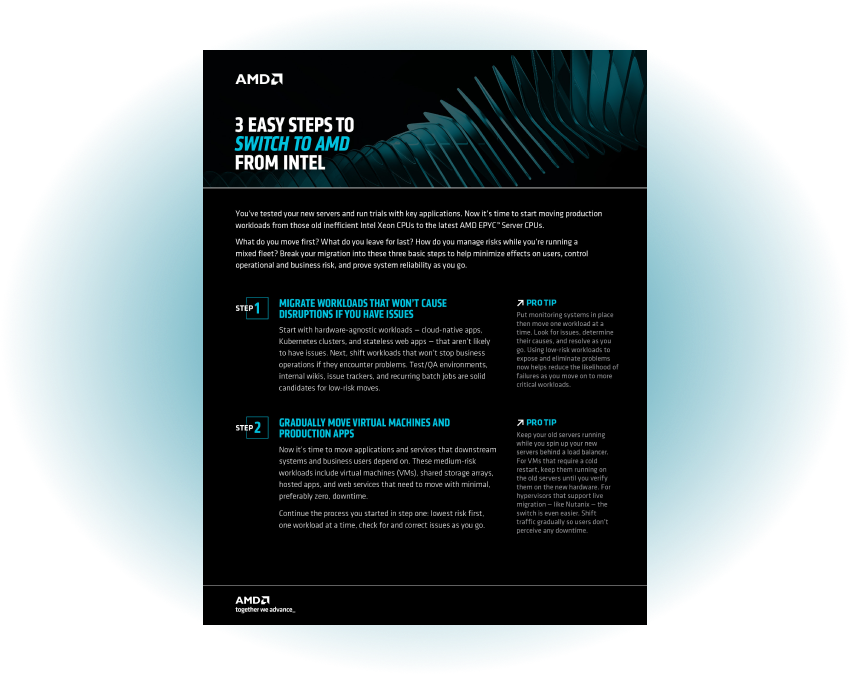
Break your migration into three basic steps to help minimize effects on users, control operational and business risk, and prove system reliability as you go.
Address migration myths, slash licensing costs, and execute a strategic refresh that pays for itself.
Migrate from Intel Xeon to AMD EPYC™ Server CPUs without modifications using x86 compatibility, VAMT tools, and modern hypervisors to maintain constant application availability.
AMD EPYC Server CPU is available in about 1600 cloud instances for leadership across workloads, with broad migration support from service providers.
Streamline migration with VAMT, enabling up to 8x consolidation when upgrading to AMD.3 See how VAMT can help break down the barriers when migrating between processor architectures.
Built-in at the silicon level, AMD Infinity Guard offers the advanced capabilities required to help defend against internal and external threats and keep your data safe.4 AMD helps protect your data with features like Secure Encrypted Virtualization (SEV), the most mature and widely deployed confidential computing technology in the industry.5
Build with an open-source software ecosystem that runs across both Server CPUs and GPUs, ensuring your AI development remains flexible and high-performing. This allows you to scale using the industry-standard tools you already use without proprietary lock-in.
Instantly see your personal consolidations and savings with AMD EPYC TCO Estimators.
Based on SPECrate®2017_int_base scores from spec.org as of December 11, 2025. Each core count features the highest-performing SKU in the processor series. See notes 6 and 7 for details.
Based on SPECrate®2017_int_base scores from spec.org as of December 11, 2025. Each core count features the highest-performing SKU in the processor series. See notes 6 and 7 for details.
Based on SPECrate®2017_int_base scores from spec.org as of December 11, 2025. Each core count features the highest-performing SKU in the processor series. See notes 6 and 7 for details.
Based on SPECrate®2017_int_base scores from spec.org as of December 11, 2025. Each core count features the highest-performing SKU in the processor series. See notes 6 and 7 for details.


When it comes to the x86 architecture, AMD sticks to what works. You can find the same, uncompromised set of instructions and features across all AMD EPYC Server CPU generations.
|
AMD EPYC™ 9005 Server CPUs Out of the Box x86 Performance, Seamless Integration |
Intel® Xeon 6 CPUs |
Architecture Strategy |
Single ISA Common Zen 5 cores on all EPYC 9005 platforms Cross-compatible CPUs |
Split architecture Must choose performance cores or efficiency cores Can’t mix architectures at the server level |
Portfolio |
8 cores to 192 cores |
8 cores to 144 cores* |
Feature Availability |
Unified feature set for leadership performance and efficiency |
More complexity: Broad model choices require compromise on features, performance, memory, efficiency, cost, and more |
AVX512 |
Yes, on all models |
Only on Performance core models |
Simultaneous Multithreading (SMT) |
Yes, on all models |
Only on Performance cores models |
| Deployment Strategy | Unified feature set simplifies deployment |
Mixed features require tuning, tweaking, and optimizing to run on a mix of “engines” and aligning deployment to unique per-system capabilities. |
*Intel Xeon product information as of Q425 https://www.intel.com/content/www/us/en/ark/products/series/240357/intel-xeon-6-processors.html

Standard 4th Generation AMD EPYC 9654 Server CPUs outperform 5th Gen Intel Xeon Platinum 8592+ on Llama 2 and Llama 3 inference workloads, even with Intel® AMX active.6

A MaxLinear Panther III accelerator paired with a 4th Generation AMD EPYC 9654 server outpaces two Intel Platinum 8472C servers with Intel™ QAT crypto and compression accelerators by up to 13X on L9 DEFLATE benchmarks.7

By switching its cloud to single-socket servers powered by 64-core 4th Gen AMD EPYC 9554P Server CPUs, Swisscom uses 55% fewer watts per vCPU than an Intel Xeon-powered server.8

*Forbes. ©2026 Forbes Media LLC. All rights reserved. Used under license.