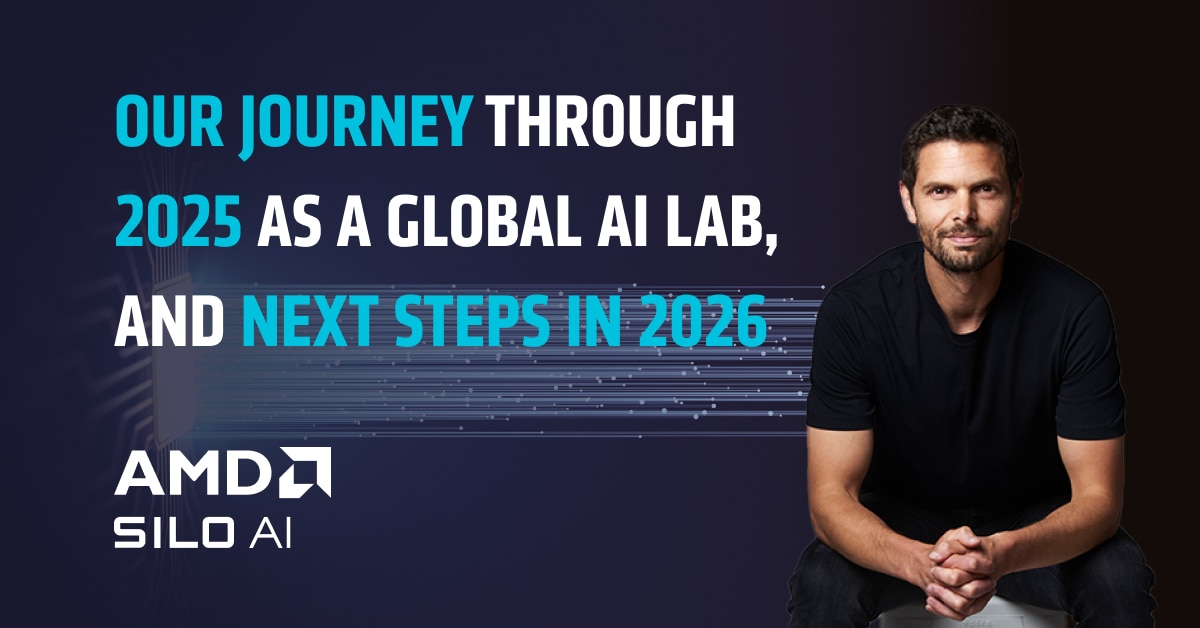
Our Journey Through 2025 as a Global AI Lab, and Next Steps in 2026
Dec 31, 2025
As we close out 2025, the AI landscape once again looks fundamentally different than it did 12 months ago. In my last end-of-year blog, I noted how open-source models had emerged as credible alternatives in 2024. That momentum accelerated further in 2025, with developments such as DeepSeek demonstrating that meaningful innovation does not depend solely on ever-larger scaling laws.
While AI continues to advance at speed and competition remains intense, one clear lesson from 2025 is that progress increasingly happens through collaboration. Across the globe, AI ecosystems are forming around openness - connecting startups, research institutions, governments, and established technology companies. Initiatives such as OpenEuroLLM, alongside relationships between companies including OpenAI, Google, Microsoft, Nvidia, and AMD, reflect a shift toward shared foundations and complementary strengths.
Alongside open collaboration, infrastructure investment stood out as a defining theme of the year. As AI adoption grows, so does demand for compute, prompting large-scale investments across the ecosystem. This was also evident in the 4th Nordic State of AI report, published in collaboration with AI Finland, which showed that Nordic-based companies most satisfied with their AI initiatives invest 14.6 times more in compute than those that are not.
At the same time, advances in foundational science continue to shape AI’s future. The most prestigious award in physics this year highlighted work in quantum physics, research that is directly informing the development of quantum computing, an area increasingly discussed in relation to AI’s long-term compute needs. Notably, this marks the second consecutive year in which the impact of AI has been visible at this level.
Fostering AI Ecosystems Across Europe
Aligned with the broader move toward open ecosystems, open-source technologies, and sovereign AI capabilities, AI-focused hubs are emerging across the world. In Europe, the Paris ecosystem stands out as a strong example of how research excellence, startups, and industry can reinforce one another. The ELLIS Institute in Tübingen, alongside the newly opened ELLIS Institute in Finland, further strengthen Europe’s research foundations.
What matters most is not individual projects, but integrated, long-term efforts spanning research, industry, and infrastructure. Sustaining this momentum requires clear ambition, world-class research to attract talent, long-term capital willing to support multi-year development, and the courage to innovate with AI rather than limiting its use to incremental efficiency gains.
Strong ecosystems are also essential for building sovereign AI capabilities. Open-source tools, modular architectures, and interoperable systems lower barriers to entry and enable organizations to evolve their AI stacks over time - reducing lock-in and accelerating adoption as new capabilities emerge.
AI Computing for Scientific Discovery
Interoperability and open-source approaches are not only enablers of adoption - they are cornerstones of scientific collaboration. Across fields such as drug discovery, materials science, quantum chemistry, energy systems, and climate research, AI combined with high-performance computing is accelerating progress on some of the world’s most complex challenges.
From the world’s fastest1 and most energy-efficient supercomputers2 - including El Capitan, Frontier, and LUMI - to newer systems such as Lux and Discovery in the US, and Alice Recoque and Herder in Europe, AMD continues to advance scientific computing through next-generation platforms and AI expertise.
I am particularly proud to see AMD Silo AI team members, under the leadership of Niko Vuokko, taking central roles in several of these projects, especially in life sciences and model development, where applied AI and scientific rigor meet at scale.
Solving the Last Mile of Customer AI at AMD
Alongside AI-for-Science efforts, AMD Silo AI teams led by Alex Finn and Jaakko Vainio have played a key role in advancing AMD’s AI software capabilities. From demonstrating throughput scaling on AMD GPUs in 2022 to supporting customers building on AMD compute platforms in 2025, our focus has remained on solving the last mile of AI - turning experimentation into production.
What began as SiloGen, a model-serving, development, and operations platform, has evolved into core components of the AMD Enterprise AI Suite. Today, it is a comprehensive open-source software stack designed to build, deploy, and operate AI models at scale. With full AMD ROCm™ software integration, the Suite is part of the open AMD AI software ecosystem, bringing foundational infrastructure and applied AI together.
Whether working with large enterprises or early-stage startups, AMD Silo AI teams have shown how to optimize models for AMD platforms, port workloads from other environments, and enable smooth transitions, often without changes to existing code. These efforts are steadily simplifying AI deployment, and we look forward to sharing more concrete customer stories in the months ahead.
Looking Ahead - AI in 2026
With AI evolving at its current pace, long-term predictions remain difficult. Still, several themes are likely to shape 2026.
AI adoption will continue to grow, increasing demand for compute across companies, nations, and regions. This will require sustained investment in both research and production-ready infrastructure. At the same time, questions around digital sovereignty are becoming more concrete as public services and critical systems increasingly rely on AI. Transparency, control, and trustworthiness are no longer abstract, and silicon diversity is likely to rise further on strategic agendas.
Quantum computing will remain an area of active research and long-term interest, particularly in relation to future compute constraints. In parallel, AI’s role in security and resilience will continue to expand, reinforcing the importance of robust, open, and reliable AI foundations.
Following the recent wave of generative AI breakthroughs, the next phase will be defined less by novelty and more by execution: AI moving from the lab into products, systems, and real-world use. Infrastructure, spanning compute, networks, data, and software, will remain the critical enabler. Built on open principles and supported by strong talent, it will determine who is able to translate AI capability into lasting impact.
Footnotes
EPYC-045E - Top500 list as of November 2025, https://top500.org/lists/top500/list/2025/11
EPYC-046E - GREEN500 list as of November 2025, https://top500.org/lists/green500/list/2025/11/.

Related Blogs
-
Meet the Next AMD Ryzen™ AI Halo
Meet the next AMD Ryzen™ AI Halo developer platform, powered by the AMD Ryzen™ AI Max+ PRO 495 processor. Run larger local LLMs, up to 300B parameters, thanks to the 192GB of unified memory that comes on the new platform.
October 12, 2026
-
AMD AI NIC™ Technology Driving AI-Ready Ethernet
Learn how AMD AI NIC™ technology helps organizations build AI-ready Ethernet networks with open standards, programmability, and transport innovation.
October 11, 2026
-
Kimi K3 on AMD Instinct GPUs with TokenSpeed
TokenSpeed delivers fast, agentic LLM inference on AMD Instinct™ MI355X GPUs, with optimized kernels and leading Kimi K3 performance.
October 09, 2026
-
scikit workloads with AOCL Data Analytics
Accelerate supported scikit-learn workloads with AOCL-Data Analytics while keeping your existing Python code and familiar scikit-learn APIs.
October 09, 2026
-
MangoBoost Delivers Open AI Models Powered by AMD
Mango Inference a serverless inference service providing production-ready access to open models powered by AMD Instinct™ GPUs and AMD ROCm™ software
October 09, 2026
-
MoRI UMBP Empowers AMD Instinct GPUs
See how UMBP, MoRI and SGLang optimize KV cache reuse to boost AMD Instinct™ MI355X GPU agentic AI performance and cost efficiency
October 09, 2026
-
Pre-Training Hybrid LLMs from Scratch in Primus on AMD Instinct™ GPUs — ROCm Blogs
Pre-train hybrid LLMs mixing MLA attention with Gated DeltaNet, Kimi Delta Attention and Mamba2 mixers on AMD Instinct MI355X GPUs, with open recipes.
October 07, 2026
-
DI Series: Serving Kimi-K3 MXFP4 Wide-EP Disaggregated on AMD Instinct MI300X and MI325X — ROCm Blogs
Learn how to serve a 1.4 TiB Kimi-K3 MXFP4 mixture-of-experts model disaggregated across AMD Instinct MI300X and MI325X GPUs.
October 07, 2026