Compute Defines Scale: How MediaKind and AMD Are Rethinking Video Infrastructure from On‑Prem to Cloud
Apr 17, 2026

Introduction
The broadcast and streaming industry is in the midst of a major infrastructure transition. Across pay‑TV, broadcast, and live sports workflows, operators are moving away from rigid, purpose‑built appliances toward software‑defined architectures that promise greater flexibility, faster service deployment, and cloud‑style operating models, all without sacrificing the deterministic performance live video requires.
Why the Processor Decision Matters More Than You Think
Live video processing sits at the extreme edge of enterprise networks and infrastructure. Every frame must be ingested, decoded, processed, encoded, packaged, and distributed in real time, often across multiple resolutions, codecs, and output formats simultaneously. Unlike batch workloads, live video pipelines tolerate no unpredictability: dropped or delayed frames translate directly into visible quality issues and viewer dissatisfaction.
As a result, processor selection becomes a first‑order architectural decision. CPU capability directly affects channel density per server, video quality consistency, power consumption, physical footprint, and long‑term total cost of ownership. For software‑defined media platforms, the CPU is not a commodity component; it defines whether the architecture scales efficiently or becomes constrained by fundamental processing limits and the operational overhead required to overcome them.
AMD EPYC™ Server CPUs: The Compute Foundation Behind MK.IO Beam
For highly parallel video workloads, where dozens or hundreds of channels must be processed concurrently, compute density and deterministic performance are critical.
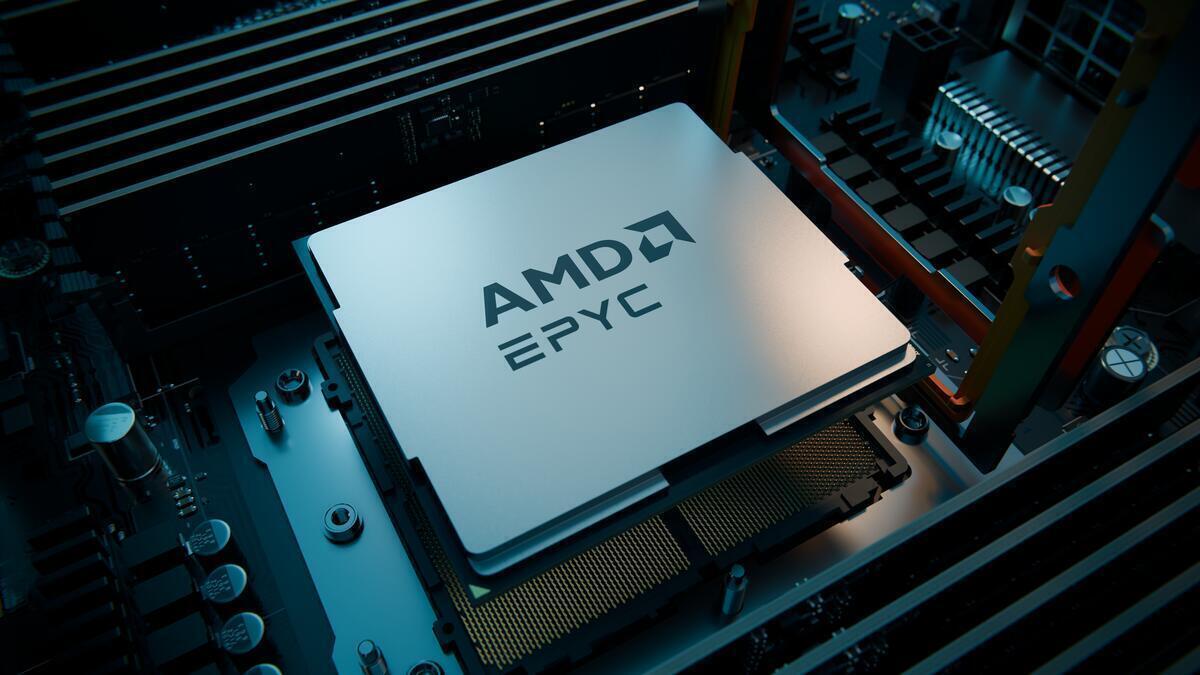
Fifth‑generation AMD EPYC™ server CPUs, built on the “Zen 5” and “Zen 5c” architectures, scale up to 192 cores per socket. This high core density makes AMD EPYC server CPUs particularly well‑suited for highly parallel video workloads, allowing far more channels to be processed concurrently on a single system.
MediaKind‑modeled deployment scenarios show that consolidating software‑defined video workloads on EPYC CPU‑based servers can substantially reduce physical headend footprint, depending on workload mix, redundancy requirements, and codec profiles. These reductions are achieved through the combination of MediaKind’s software‑defined architecture and consolidation onto general‑purpose infrastructure built on EPYC CPU‑based servers.
This consolidation extends beyond traditional headend encoding. With MediaKind MK.IO Beam, contribution workflows, which have historically required complex stacks of single‑purpose appliances, are transformed into software‑defined workloads that run on the same EPYC CPU-based infrastructure used for encoding and processing workflows. Contribution ingest, processing, and encoding can be dynamically configured on general‑purpose servers rather than fixed, specialized hardware, simplifying operations and enabling fast reconfiguration.
MediaKind evaluates compute platforms based on how much real streaming work can be completed per server, per rack, and per watt. AMD EPYC server CPUs provide ample per‑socket compute capacity for parallel, CPU‑intensive workloads, enabling operators to scale streaming channel density efficiently within a single system. In practice, these gains can translate directly into fewer servers to deploy, and lower operational cost per channel.
Energy efficiency represents another critical dimension of scale. Broadcast infrastructure operates continuously, making power consumption and cooling primary cost drivers over the lifetime of a deployment. AMD data‑center modernization studies show that migrations from legacy platforms to EPYC CPU‑based servers can deliver significant energy‑efficiency improvements in documented modernization scenarios.
When combined with MK.IO Beam’s ability to consolidate encoding, transcoding, multiplexing, contribution, and distribution into a single software stack, these efficiencies are amplified at the system level. Replacing fleets of single‑purpose appliances with consolidated, software‑defined workflows on general‑purpose servers can reduce rack space, cooling requirements, and operational complexity.
AMD EPYC platforms are also designed with video‑centric I/O requirements in mind. Each AMD EPYC 9004 and 9005 server CPU socket supports twelve channels of DDR5 memory and up to 128 lanes of PCIe® Gen 5 I/O; in dual‑socket system configurations, total available I/O can scale beyond a single socket, up to 160 lanes on supported platforms, and depends on system design while still enabling high‑bandwidth ingest and dense networking.
Seamless Scalability from On‑Prem to the Cloud
MK.IO Beam runs on commercial off‑the‑shelf (COTS) servers deployed in customer facilities, delivering software‑defined deployment, usage‑based licensing, and simplified lifecycle management¹. MediaKind’s broader MK.IO ecosystem adds a cloud‑based control plane that provides centralized fleet management, orchestration, and automation across distributed deployments.
Because MK.IO Beam is optimized for AMD EPYC server CPUs in customer‑controlled, on‑prem environments, and because AMD EPYC server CPUs are also widely used by major cloud providers, operators benefit from architectural continuity across hybrid deployments². This continuity reduces friction when integrating on‑prem processing with cloud‑based control and analytics, allowing workloads to move without requiring fundamental re‑architecture.
Edge Processing, Low Latency, and Data Sovereignty
Live sports and real‑time production demand ultra‑low latency that is best achieved close to the source. MK.IO Beam systems running on AMD EPYC server CPUs and deployed at the infrastructure edge enable local processing with efficient round‑trip latency and high operational resilience, capabilities that are critical for live contribution, in‑venue streaming, and real‑time decision‑making. For operators in regulated markets, on‑prem deployment also addresses data sovereignty requirements by keeping content and metadata within defined national or regional boundaries, while still enabling modern software‑defined workflows and centralized management.
MediaKind Use Cases Enabled by AMD EPYC Server CPUs
Dense headend consolidation is a highly visible example of how AMD EPYC server CPUs enable higher‑density and more consolidated deployment environments. Multi‑channel deployments can replace multiple racks of dedicated hardware with a single rack of EPYC CPU‑based COTS servers running the full MK.IO Beam software stack. High core density and memory bandwidth allow encoding, transcoding, multiplexing, and contribution to run concurrently on fewer systems, helping reduce footprint, power consumption, and operational complexity.
In live sports and event workflows, MK.IO Beam can be deployed at the venue or contribution edge to process multiple feeds on standard EPYC CPU‑based servers. Contribution, encoding, and processing operate in parallel on the same infrastructure and can be dynamically configured per event, helping minimize on‑site hardware while enhancing flexibility.
Alignment with the AMD Solutions‑Focused Strategy
The AMD solutions‑focused strategy emphasizes validated platforms that combine CPUs, accelerators, networking, and software ecosystems rather than standalone components. The MediaKind collaboration reflects this approach by pairing AMD EPYC server CPUs with a production‑proven media software platform, offering operators a clear upgrade path and long‑term architectural confidence.
Conclusion
The future of video infrastructure is software‑defined and simultaneously optimized for density, efficiency, and flexibility. MediaKind’s MK.IO Beam platform provides a software‑defined architecture built on AMD EPYC server CPUs, enabling broadcasters and streaming providers to modernize workflows while maintaining control over performance, cost, and quality.
Footnotes
¹ MediaKind product documentation for MK.IO Beam.
² Public disclosures from major cloud service providers regarding availability of AMD EPYC CPU‑based compute instances.
Footnotes
¹ MediaKind product documentation for MK.IO Beam.
² Public disclosures from major cloud service providers regarding availability of AMD EPYC CPU‑based compute instances.


Related Blogs
-
AIM: Unified User Experience from Profile Discovery to Deployment — ROCm Blogs
Learn how AIMs offer a unified user experience as you explore and deploy them across AMD Instinct, Radeon PRO, and EPYC.
September 29, 2026
-
Beyond TOPS: AMD Ryzen™ AI Embedded X100 at the Edge
Scale agentic AI at the edge with AMD Ryzen™ AI Embedded X100 Series: more concurrent agents, unified memory, x86 compatibility, and long life.
September 24, 2026
-
Advancing Gaming with AMD at G2E 2026
Discover how AMD Ryzen Embedded processors are powering next-generation casino gaming experiences at G2E 2026. Explore innovative platforms from ADLINK, Advantech, Axiomtek and Quixant, featuring high-performance computing, advanced graphics, AI capabilities, multi-display support and reliable, scalable designs built for demanding, always-on gaming environments worldwide and faster product development and deployment.
September 24, 2026
-
Advancing AI 2026: From Gigawatt Data Centers to Agentic PCs
Explore how AMD connects data center, cloud, and local AI to enable secure, cost-aware agentic workflows across enterprise PCs.
September 16, 2026
-
AMD Brings Local AI to Autodesk University 2026
See how AMD brings local AI and AI-ready workstations to Autodesk University 2026 for demanding design, engineering, and AEC workflows.
September 15, 2026
-
81% of Organizations Are Moving Toward AI PCs
Recent IDC research sponsored by AMD shows 81% of organizations are deploying, piloting, or planning near-term AI PC adoption.
September 14, 2026
-
Create, Connect, Control: AMD at IBC 2026
See how AMD and its partners are advancing practical AI, media workflows, high-resolution production, and security at IBC 2026.
September 11, 2026
-
AI Productivity at Scale: From Everyday Assistance to Autonomous Execution
How AMD scales AI productivity enterprise-wide with ACE, the Aria AI Suite, and autonomous systems that execute work instead of just assisting.
September 10, 2026