AMD™ Data Intelligence Platform and AI Researcher
May 15, 2026

Turning AMD IT Data into Actionable Questions
AMD IT teams work across large volumes of operational, observability, and financial data, but it can still be difficult to identify the right questions quickly and connect insights across systems. AIR (AI Researcher) is designed to help by surfacing role-relevant questions, connecting data across the AMD Data Intelligence Platform (DIP), and return explainable recommendations through a natural-language experience.
The goal is to help AMD teams move faster from signal to action with less manual effort. AIR transforms DIP data into clear, prioritized insights delivered through a conversational interface.
The Problem
AMD IT teams generate and manage large amounts of data across operational, observability, and financial processes. But turning that data into timely, cross-functional decisions remains challenging. Common pain points include:
- Data is distributed across IT, finance, service, and operational systems, making it harder to see connections across cause, impact, and cost.
- Specialized knowledge is often needed to formulate the right queries and interpret results across platforms.
- Investigating issues or opportunities can take significant time across multiple teams and tools.
- Standard dashboards are useful for monitoring known metrics, but they may not reveal unexpected relationships or next-best actions.
AIR is intended to help AMD IT reduce this friction by making insight discovery more accessible, connected, and actionable.
AIR is a conversational layer over the DIP ecosystem, powered by the Eureka Engine. It uses domain and user-profile metadata to generate high-value questions, map intent to the right DIP queries, and return results with provenance, confidence, and ranked recommendations. AIR provides explanations and suggested follow-ups so any role can act on trusted insights without needing SQL or deep database expertise.
How AIR Works
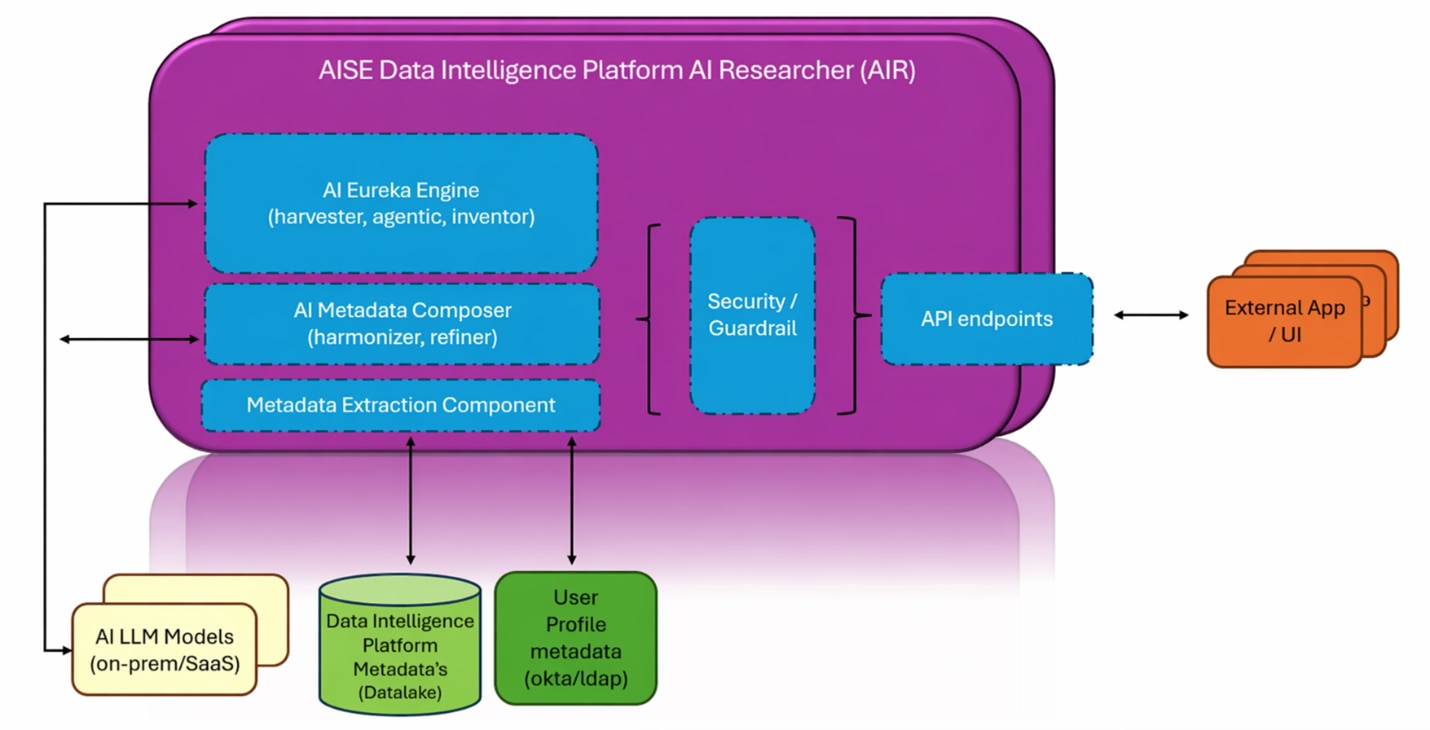
AIR provides enterprise-oriented APIs with authentication mechanisms and safety guardrails intended to support authorized access to aligned, explainable responses. It ingests and harmonizes metadata from multiple sources, and the Eureka Engine turns that context into the right data queries and AI-driven answers—personalized to each user’s profile and permissions.
Why This Capability Matters Inside AMD IT
- Unlock hidden opportunities: AIR surfaces questions and correlations teams may never have thought to ask (discover cost-drivers, hidden failure modes, or untapped optimizations).
- Move from reactive to proactive: AIR spots signals early and recommends prioritized actions so problems can get fixed before they escalate.
- Accelerate decisions: Turns discovery-to-action cycles from days or weeks into hours (faster triage, faster cost containment, faster roadmap prioritization).
- Break down silos: Combines IT, observability, and finance context in a single conversation—sees cause, impact, and cost together.
- Democratize insight: Non‑technical users get explainable, role-aware answers without SQL or reliance on analysts.
- Reduce risk and waste: Governed, auditable recommendations help enforce policy, can cut unnecessary spending, and lower incident impact.
- Scale expertise instantly: Captures and surfaces organizational know-how so every team benefits from best practices and past learnings.
Examples of AIR Questions and Why They Matter
Question |
Explanation |
What is the relationship between participant feedback following virtual meetings and the technical specifications of their devices and network environments, and how can these insights improve collaboration for R&D teams? |
This question links user feedback on call quality with device and network data. For systems engineers in R&D IT, analyzing these patterns can help identify causes of poor collaboration and guide targeted improvements that boost productivity. |
How does the location of storage resources affect responsiveness and throughput for project teams, especially at peak times? |
This question connects security with storage optimization, by identifying patterns that balance data protection with resource efficiency. It's especially relevant when both security and cost control are priorities. |
How can analysis of user logon and device usage patterns help identify the underlying causes of endpoints appearing offline, particularly when these trends are correlated with incident reports and support ticket histories? |
This inquiry combines device status, user behavior, and past support data to find patterns that may explain why endpoints become unresponsive. It is relevant for systems engineers who troubleshoot issues and build proactive monitoring strategies. |
Takeaway
AIR is designed to help AMD IT teams move beyond static reporting by surfacing relevant questions, connecting operational and financial context, and highlighting actions that may matter most. By combining explainability, governance, and role-aware access, AIR can help make insight discovery faster and more actionable inside AMD IT.

Related Blogs
-
AIM: Unified User Experience from Profile Discovery to Deployment — ROCm Blogs
Learn how AIMs offer a unified user experience as you explore and deploy them across AMD Instinct, Radeon PRO, and EPYC.
September 29, 2026
-
Beyond TOPS: AMD Ryzen™ AI Embedded X100 at the Edge
Scale agentic AI at the edge with AMD Ryzen™ AI Embedded X100 Series: more concurrent agents, unified memory, x86 compatibility, and long life.
September 24, 2026
-
Advancing Gaming with AMD at G2E 2026
Discover how AMD Ryzen Embedded processors are powering next-generation casino gaming experiences at G2E 2026. Explore innovative platforms from ADLINK, Advantech, Axiomtek and Quixant, featuring high-performance computing, advanced graphics, AI capabilities, multi-display support and reliable, scalable designs built for demanding, always-on gaming environments worldwide and faster product development and deployment.
September 24, 2026
-
Advancing AI 2026: From Gigawatt Data Centers to Agentic PCs
Explore how AMD connects data center, cloud, and local AI to enable secure, cost-aware agentic workflows across enterprise PCs.
September 16, 2026
-
AMD Brings Local AI to Autodesk University 2026
See how AMD brings local AI and AI-ready workstations to Autodesk University 2026 for demanding design, engineering, and AEC workflows.
September 15, 2026
-
81% of Organizations Are Moving Toward AI PCs
Recent IDC research sponsored by AMD shows 81% of organizations are deploying, piloting, or planning near-term AI PC adoption.
September 14, 2026
-
Create, Connect, Control: AMD at IBC 2026
See how AMD and its partners are advancing practical AI, media workflows, high-resolution production, and security at IBC 2026.
September 11, 2026
-
AI Productivity at Scale: From Everyday Assistance to Autonomous Execution
How AMD scales AI productivity enterprise-wide with ACE, the Aria AI Suite, and autonomous systems that execute work instead of just assisting.
September 10, 2026