Open Standards, Real Solutions: AMD at SIGGRAPH 2026
Jul 17, 2026

SIGGRAPH 2026 will run July 19–23 at the Los Angeles Convention Center. Now in its 53rd year, SIGGRAPH is the premier conference and exhibition for cutting-edge graphics research and the commercial advances that research enables. This fusion of deep technical expertise and creative expression sets SIGGRAPH apart; relatively few conferences draw such a wide cross-section of the people who research and create with computer graphics.
AMD will be active across SIGGRAPH and the related events that take place around the show. We're a proud platinum sponsor of DigiPro, aka the Digital Production Symposium, a July 18 event focused on how new and emerging VFX technologies move from research labs into production pipelines. On Sunday, we'll take part in the main program for the Academy Software Foundation's Open Source Days as an ASWF premier member and contributor. We're also sponsoring Pixar's annual RenderMan art competition that kicks off at its Art & Science Fair.

At SIGGRAPH itself, I'll join IO Interactive Technical Director Henrik Schlichter for "Forging the Glacier at IO Interactive" on Sunday at 2:30 PM in the 411 Theatre. Our fireside chat will discuss the development and evolution of IO Interactive's Glacier engine, the effects of emerging technologies like AI on game development, and how IO Interactive's decision to invest in a custom engine shaped recent games like 007 First Light.
If you're walking the show floor, you'll find workstations powered by AMD in multiple vendor booths, including Dell, Framework, Gigabyte, ICC, and Puget Systems. AMD researchers will present “Lightweight Attention-based Indirect Illumination,” a compact attention-based model for reconstructing complex indirect lighting on Sunday, 9:00 AM–5:30 PM in the West Hall Lobby. On Tuesday at 2:20 PM in Room 408A, AMD researcher Gurprit Singh and scientists from the Max Planck Institute for Informatics and Saarland University will discuss their technical paper on a new variance-reduction technique for Rao-Blackwellized Markov chain Monte Carlo light transport.
The Importance of Being Open
Our work within the open-source community and with our various ISV partners highlights the importance of open standards and the value of industry collaboration. Standards like OpenUSD (Universal Scene Description) provide a common framework for building complex 3D scenes from assets produced with different applications. Pixar developed the standard and open-sourced it in 2016; its standardization and continued development are now supported by the Alliance for OpenUSD (AOUSD), founded in 2023. AMD has long supported open-source development through organizations such as the Academy Software Foundation and through our work on AMD ROCm™ software and HIP. We recently joined AOUSD to help guide and improve the USD specification as adoption expands.
Our membership aligns with the needs of ISV partners that rely on OpenUSD to connect their own applications with larger production pipelines. Adobe has integrated OpenUSD throughout its Substance 3D ecosystem, where the format supports non-destructive interchange between applications.
"Adobe is delighted to welcome AMD to the Alliance for OpenUSD," said Guido Quaroni, Senior Director of Product and Engineering, 3D & Immersive, Adobe. "As OpenUSD expands beyond media and entertainment, AMD's expertise in hardware and high-performance computing will help us advance the standard and deliver the interoperability our Adobe Substance 3D customers depend on to create and scale 3D content."
Expanding Hardware Choice
Over the past year, support for AMD Radeon™ GPUs has increased across the M&E (media and entertainment) industry, while new CPU optimizations have improved performance in established applications. The June 24 release of RealityScan 2.2 added full AMD GPU support on Windows, enabling hardware-accelerated reconstruction on AMD Radeon™ and Radeon PRO, Ryzen™ AI Max processors, and Radeon AI PRO R9700 graphics. RealityScan 2.2 can also parallelize work across AMD and NVIDIA graphics hardware rather than leaving one GPU idle. This gives artists and technical teams more freedom to choose the vendor that best fits their needs instead of tying them to a single GPU ecosystem.
Our work with Chaos is another example of how open software can expand hardware choice within an established application.
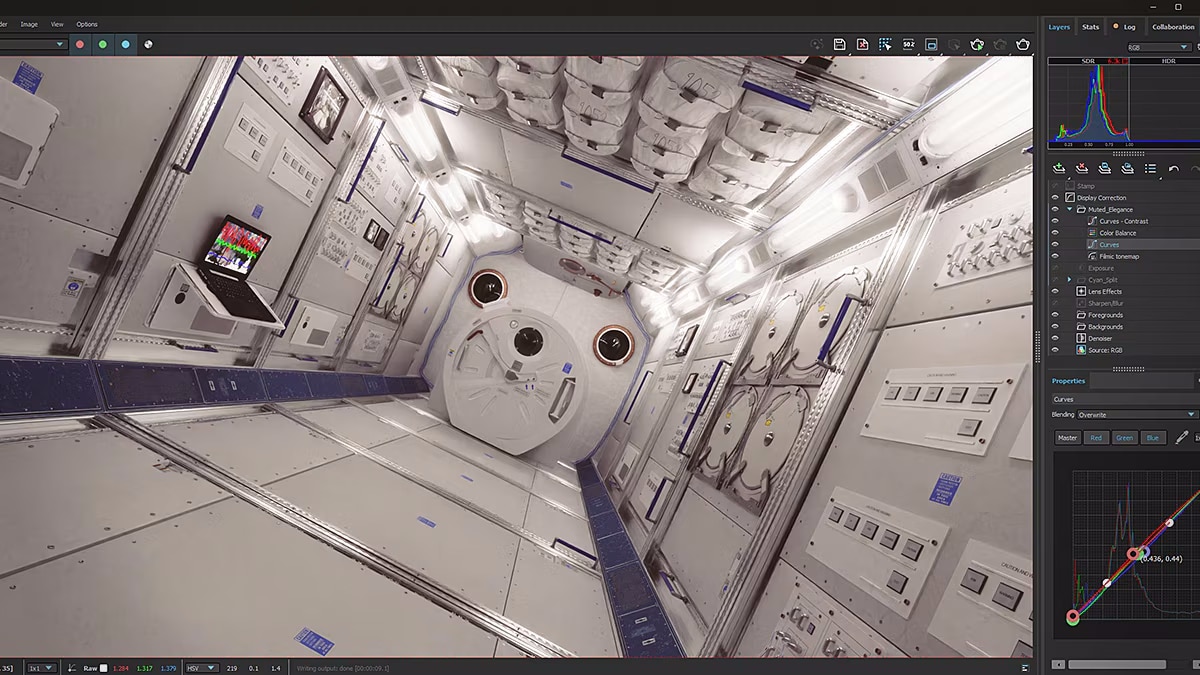
Chaos V-Ray GPU was originally built around CUDA and required artists to rely on an NVIDIA GPU. Chaos already supported AMD Ryzen™ Threadripper PRO processors for CPU rendering and the company has extended that support to AMD Radeon™ GPUs by using the AMD open-source HIP toolkit to compile its existing codebase natively for AMD hardware without needing to create and maintain a second, separate implementation.

3D Gaussian splatting (3DGS) is a newer technology you'll see discussed throughout SIGGRAPH 2026. 3DGS reconstructs scenes from multiple images, but it does so very differently from the textured polygonal meshes commonly used in photogrammetry. Instead, 3DGS uses many Gaussian primitives with position, shape, color, and opacity, allowing captured scenes to be rendered from novel viewpoints in real time. The method has attracted interest in digital twins, autonomous driving, immersive media, and reality capture because it can deliver high visual quality at substantially faster rendering speeds than neural radiance field (NeRF) implementations. AMD has published guides to training and rendering 3DGS models with GSplat on AMD ROCm™ software, along with additional work extending the technique to dynamic street scenes on AMD Instinct™ MI300X GPUs.
4DV.ai carries the concept of 3D Gaussian splatting into moving volumetric content. The company is developing browser-based tools for creating and editing 3D Gaussian splats; the "4D" refers to the company’s focus on time-varying volumetric video rather than static scenes. 4DV.ai has begun running its Gaussian-splat-based volumetric video workloads on AMD hardware as the companies work to improve support and performance.
Global Objects is applying photogrammetry, LiDAR, and Gaussian splatting to build digital twins from measured physical objects. Through its partnership with Independent Studio Services, the company has access to millions of objects across 13 locations and plans to capture 1.67 million unique licensed objects for a retrieval-grounded generative world model being developed with Microsoft on Azure. Global Objects is also evaluating AMD Ryzen™ AI Max Series processors and ROCm™ software for parts of its photogrammetry and Gaussian-splat workflow as it explores ways to train and render splats across a broader range of hardware.
OpenUSD is also evolving to better support 3DGS; OpenUSD v26.03 introduced a first-class schema for 3D Gaussian splats in March 2026, along with a reference renderer (hdParticleField). With these improvements, 3DGS can be incorporated into the same OpenUSD-based production pipeline as conventional geometry once participating applications implement the schema, rather than requiring a separate interchange pipeline.
Addressing the Memory Cost Curve
Open standards keep pipelines flexible, but they don't intrinsically solve the economic challenges of modern rendering. The memory footprint of high-resolution assets and physically accurate rendering can be considerable and sharply rising DRAM prices have made memory a large (and growing) percentage of workstation and render server costs. AMD recently acquired MEXT and its Predictive Memory™ Engine to address these concerns directly.
MEXT provides a software approach to memory tiering that identifies which memory pages are in use and which have gone cold. It offloads cold pages to NAND flash and uses an AI-based predictive engine to move them back into DRAM before an application requests them again.
AMD plans to integrate the technology across its data center portfolio, but earlier MEXT testing illustrates its potential value for content-creation workloads. A MEXT-authored evaluation of MoonRay -- the same open-source ASWF renderer DreamWorks is discussing in this year's keynote – speaks to the savings its predictive engine can deliver. MEXT reports nearly identical rendering performance between an AMD Ryzen™ Threadripper PRO processor configured with 512GB of DRAM versus an identical system with 256GB of DRAM backed by 256GB of NAND flash. The predictive engine correctly anticipated the next page MoonRay would need at 97.9% accuracy. This translated to a roughly 40% decrease in RAM-related costs and a 29% reduction in overall TCO.
See You on the Show Floor
The research presented each year at SIGGRAPH and DigiPro explores the future of VFX, but even the most promising ideas can reach production only when studios and production companies can afford to deploy them. AMD champions open standards, works with ISVs, OEMs, and creators to broaden hardware support, and invests in technologies that can bend cost curves back toward sanity, helping ensure that current and future innovations remain accessible.
Whether you're looking to optimize your rendering pipeline, explore new capture methods, or discuss the impact of open standards, drop by with your toughest pipeline questions in tow. You can find AMD workstation hardware at the Dell, Framework, Gigabyte, ICC, and Puget Systems booths, or catch our researchers and executives during their scheduled sessions. I look forward to seeing you in Los Angeles.

Related Blogs
-
Completing the GPU Performance Picture: Understanding TAF Alongside Peak FLOPs and MAF — ROCm Blogs
Learn how Typical Attained FLOPs complements Peak FLOPs and Max-Achievable FLOPs, including the methodology and MI325X results
October 05, 2026
-
How Agentic AI Is Expanding the Role of the DPU
As agentic AI drives more stateful workloads, DPUs are becoming critical for networking, storage, KV-cache management, and infrastructure efficiency.
October 05, 2026
-
ROCm 10.1: Breaking the Data-Movement Bottleneck — ROCm Blogs
ROCm 10.1 targets the data-movement bottleneck with AMD Infinity Storage, NUMA-aware memory, and a modernized stack.
October 04, 2026
-
MoRI UMBP Empowers AMD Instinct GPUs
See how UMBP, MoRI and SGLang optimize KV cache reuse to boost AMD Instinct™ MI355X GPU agentic AI performance and cost efficiency
October 01, 2026
-
Automating Performance Bottleneck Identification with the TraceLens Agent — ROCm Blogs
TraceLens Agent is an agentic workflow that examines GPU traces to deliver a prioritized optimization report, detailing root causes and fixes.
September 29, 2026
-
MORI CCO
MORI CCO enables compute-communication overlap on AMD Instinct™ GPUs. Build faster distributed inference and training kernels with device-side communication.
September 29, 2026
-
Unlocking Sim2Real for a Robotic Arm with RL Accelerated by AMD Instinct GPUs — ROCm Blogs
Train an XArm-6 pick-and-lift policy with PPO in MuJoCo Warp on AMD Instinct GPUs, then transfer it to the real robot.
September 28, 2026
-
How AMD Ryzen AI Max PRO 400 Series Processors Bring Local Agentic AI to Business Customers
See how AMD Ryzen AI Max PRO 400 Series processors bring local agentic AI to business with more memory, flexible deployment, and lower costs.
September 28, 2026