Chaos Empowers Artists with AMD GPU Rendering in V-Ray
Users of the award-winning renderer can now choose the hardware that best suits their production needs, thanks to AMD support in V-Ray’s GPU render engine
V-Ray is one of the most influential renderers in not one, but two, sectors of the CG industry. Chaos’s award-winning software has been used to create VFX for films and TV shows including Avengers: Endgame, Game of Thrones, and The Last of Us, and is routinely found to be the renderer most widely used for architectural visualization in surveys of architectural professionals.1
And now V-Ray supports a range of hardware that matches the diversity of its users. Its CPU render engine already benefited from highly multicore CPUs like the AMD Ryzen™ Threadripper™ processors. But now, Chaos has used the open-source HIP framework to update V-Ray’s formerly NVIDIA-only GPU render engine to support AMD GPUs. Thanks to HIP, artists of all types can now choose the hardware that suits their production needs—including both the powerful, affordable AMD Radeon™ PRO W7000 Series GPUs and its market-disrupting AMD Ryzen AI Max+ processors.

V-Ray: perfect performance on AMD CPUs
V-Ray’s CPU render engine, used for the most demanding tasks, like rendering ultra-high-resolution architectural stills and complex, final-quality visual effects, already performed beautifully on AMD hardware. As of May 2026, the 15 highest scores reported from Chaos’s publicly available V-Ray Benchmark are from AMD CPUs, like the 96-core Ryzen Threadripper™ PRO 9995WX processors.2
“Threadripper CPUs are awesome,” enthuses Chaos CTO and V-Ray co-creator Vladimir Koylazov. “If you want to use CPU rendering for professional visualization, there’s no other choice.”

V-Ray: pioneering new workflows on AMD GPUs
But V-Ray GPU, the software’s hybrid GPU/CPU render engine, presented more of a challenge. Previous versions of the engine—used for interactive visual previews as well as final-quality renders—relied on the proprietary CUDA API, meaning that Windows users were limited to NVIDIA graphics cards. Given the complexity of the code, it was hard for Chaos to justify creating and maintaining a separate code base to support other hardware.
The solution was HIP: the Heterogeneous-Compute Interface for Portability. Unlike frameworks such as OpenCL, the open-source HIP toolkit enables developers to port existing CUDA applications to run on AMD GPUs without the need to create and maintain a new code base.
Using HIP, Chaos was able to implement AMD GPU rendering in V-Ray, beginning with V-Ray for 3ds Max. V-Ray now supports recent generations of AMD GPUs, including the current AMD Radeon PRO W7000 Series GPUs for professional graphics workstations, and the AMD Radeon RX 9000 Series consumer GPUs.
Muhammed Hamed, Chaos’s Senior Product Manager for GPU rendering, describes AMD GPUs as providing “competitive performance” in V-Ray GPU, even in the initial release.
In Chaos’s tests, the AMD Radeon RX 9070 XT GPU was up to 2.4x faster than its NVIDIA equivalent, the GeForce RTX 5080, in scenes that required out-of-core rendering for textures: something often seen on very demanding projects like city-scale architectural visualizations.3
AMD: price/performance leadership for studios of all sizes
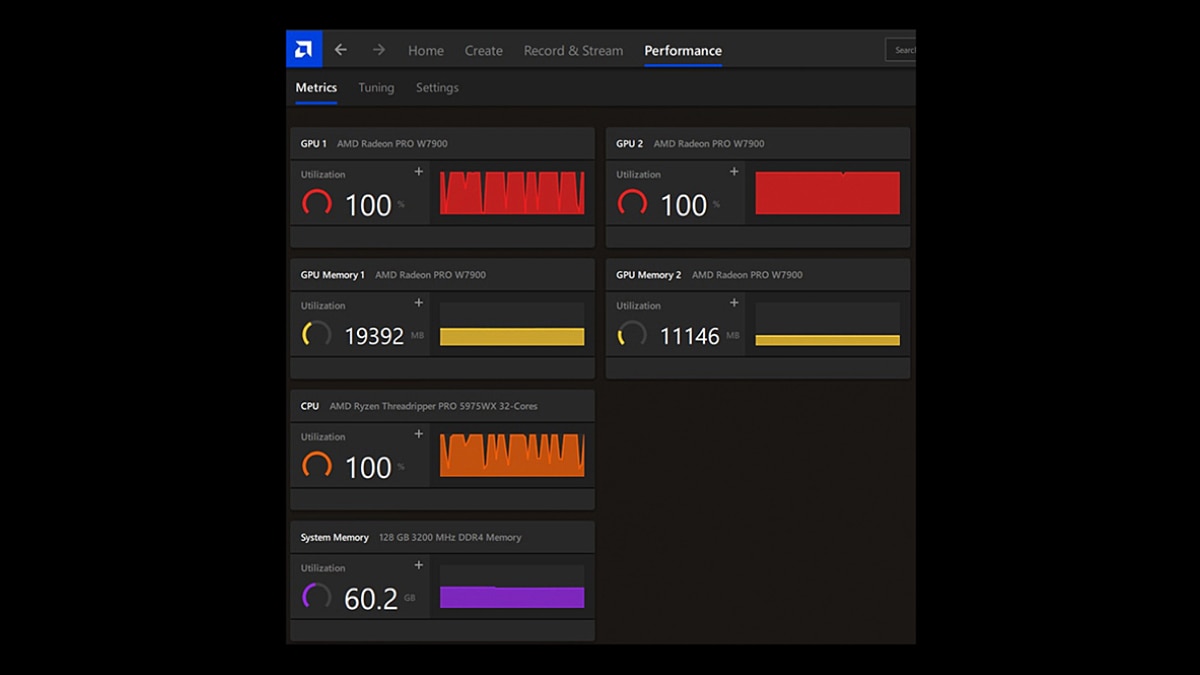
“V-Ray GPU on HIP is as efficient as it can be,” says Gary Davis, an award-winning multidisciplinary CG artist who has tested GPU rendering in V-Ray for 3ds Max. “When I enable it, both AMD graphics cards in my workstation are pegged at 100%.”
Davis has used both 3ds Max and V-Ray for over 20 years—nine of them spent working as a technical specialist for 3ds Max developer Autodesk, which had previously awarded him the title of 3ds Max Master. Now an independent artist and consultant, with clients including Dell, HP and Lenovo, Davis is currently using V-Ray in production on projects ranging from architectural visualizations to music videos for US electronic act Jennifer Place.
Davis’s main production machine is a Dell Precision 7865 workstation with an AMD Ryzen Threadripper™ PRO 5975WX CPU and two AMD Radeon PRO W7900 GPUs. The combined power of the three AMD compute engines—and the efficiency with which V-Ray GPU, running under HIP, can make use of them—has enabled him to dispense with an in-house render network.
“[Performance scaling in V-Ray GPU] is almost linear, and HIP supports both CPUs and GPUs, which allows me to add in the 32-core Threadripper,” he says. “Literally one machine has become the equivalent of a render farm.”
For working on the move, Davis uses a tablet with an AMD Ryzen AI Max+ 395 processor. Its market-disrupting architecture means that its 128GB of memory is shared dynamically between CPU and GPU, making it possible to render much larger projects on GPU.
“No other Windows platform allows me to work with up to 96GB of graphics memory while staying truly mobile,” says Davis. “It has the approximate performance of a single high-end GPU, so I can create 3D content on it easily, as well as doing compositing and editing work—then, for really heavy rendering tasks, move the projects over to the Threadripper workstation.”
One of Davis’s main reasons for choosing AMD hardware is that it outperforms equivalently priced processors from other manufacturers. “Being a one-man shop, I think about every dollar,” he says. “But end users of any size can benefit from AMD’s price/performance leadership, from indie outfits to the largest design firms and visual effects houses.”
V-Ray and AMD: the perfect partnership
By using HIP to implement support for AMD processors in V-Ray GPU, Chaos has given its artists the freedom to choose the hardware that best supports their own production needs — not just the hardware on which their software will run.
“Supporting AMD GPUs in V-Ray GPU is an important step forward for users who want more flexibility in how they build their rendering systems,” says Muhammed Hamed. “AMD GPU rendering in V-Ray GPU gives artists a credible, practical, and compelling new hardware path.”
Chaos now plans to extend support for AMD GPU rendering to the other editions of V-Ray, including Maya, Revit, and the V-Ray for Blender Community Edition, the new free edition of the software for users of the popular open-source 3D software.
Vladimir Koylazov says that enabling V-Ray users to choose more than one manufacturer’s hardware for GPU rendering will also benefit the computer graphics industry as a whole.
“I'm hoping that this leads to more affordable GPUs and more performant GPUs,” he says. “Having just one vendor to go to leads to all sorts of issues. Every time you have [hardware manufacturers] competing for performance, the results have been ultimately better products for users.”
About the Customer
Founded in 1997, Chaos provides world-class visualization and design solutions that empower creative minds to bring ideas to life. The company serves multiple industries, including architecture and design, media and entertainment, and product e-commerce, providing an ecosystem of accessible tools that support every stage of the design and creation process. Its innovative solutions help architects, designers, VFX artists/animators, and other creative professionals share ideas, optimize workflows and create immersive experiences. For more information, visit chaos.com.
Case Study Profile

- Industry:
Architecture, Engineering and Construction
Media and Entertainment - Challenges:
To promote customer choice by enabling V-Ray’s previously NVDIA-only GPU renderer to harness the power of AMD hardware, without the need to create a new code base - Solution:
Chaos used the HIP (Heterogeneous-Compute Interface for Portability) framework to update the existing V-Ray GPU CUDA code base to support AMD GPUs and processors - Results:
V-Ray GPU now supports both discrete AMD Radeon™ PRO GPUs and integrated Ryzen™ AI Max+ processors, with AMD GPUs outperforming their NVIDIA counterparts on some tasks - AMD Technology at a Glance:
HIP API and Kernel Language
AMD Radeon™ PRO W7000 Series GPUs
AMD Radeon™ AI PRO R9000 Series GPUs
AMD Radeon™ RX 9000 Series GPUs
AMD Ryzen™ AI Max+ Processors
- Technology Partners: