Rapid Validation on AMD Versal Silicon without Leaving MATLAB or Python
Oct 07, 2026
Introducing AMD Vitis™ Hardware in the Loop
Validate Faster. Deliver Sooner.
AMD Vitis™ Hardware in the Loop (Vitis HIL) bridges simulation and hardware bring-up by enabling system-level verification on evaluation hardware directly from existing MATLAB® or Python™ test environments. Teams can reuse familiar testbenches, stimulus generation, reference models, and result-analysis workflows instead of rebuilding them for hardware validation. Rather than replacing simulation, Vitis HIL extends verification to real silicon when greater speed, scale, or hardware fidelity is required.
Software-Only Simulation for Heterogeneous Systems Can Be Complicated
Consider a representative heterogeneous DSP design: a polyphase channelizer implemented across AI Engine kernels and HLS-compiled programmable logic (PL) fabric on an AMD Versal VC1902 adaptive SoC. The design operates at an 8.75 GHz input sample rate and produces 16 sub-channel outputs. End-to-end verification with the AI Engine simulator or cycle-accurate RTL simulation requires millions of input samples to confirm convergence, sub-channel separation, and spectral fidelity across operating conditions. Processing these realistic data sets in software can take a long time, whereas the same workload runs much faster on the target hardware. As a result, exploring parameters such as cascade length, SSR factor, and twiddle precision through simulation alone becomes impractical.
Software simulation must model every pipeline stage, memory access, and inter-kernel data transfer, while the AI Engine array executes these operations in parallel at 1.25 GHz with deterministic, cycle-accurate timing. For the 16-channel polyphase channelizer described above, the clearest way to verify sub-band separation and phase alignment at the target sample rate is to run the design on silicon and observe the output directly.
Vitis HIL runs the design on physical silicon rather than emulating it or relying on a behavioral model. AI Engine kernels execute on the physical AI Engine array at the programmed clock frequency (typically 1.25 GHz) on the VCK190, while the PL fabric runs at its synthesized clock rates. Memory accesses use the actual programmable NoC and block RAM hierarchy. As a result, host-side observations capture real pipeline latency, fixed-point rounding, saturation behavior, and timing-dependent edge cases that software simulation may not reveal.
For complex DSP applications, hardware-speed execution makes measured performance directly representative of deployment. A polyphase filter bank using 400 AI Engine tiles at 1.25 GHz processes test vectors at hardware speed, so the latency and throughput measured with Vitis HIL are the values the deployed system will exhibit, not estimates derived from simulation cycle counts.
How It Works in 10 Steps
The Vitis HIL workflow has two phases. Phase 1 is a one-time build and board setup process. Phase 2 is the iterative test loop used as the design evolves. Engineers repeat Phase 1 only when the hardware architecture changes, not during routine test iterations.
Phase 1: Set Up
- Configure a Vitis Subsystem with your AI Engine and programmable logic content
- Generate a bootable SD card image using a single build command
- Flash the image onto an SD card
- Insert the SD card and power on the development board
- Start the Vitis HIL server on the board
Phase 2: Test
Generate stimulus frames on the host using existing MATLAB® or Python™ scripts. Input data is wrapped in typed frame objects aligned to the Vitis HIL interface specification: no format conversion is needed.
- Call the Vitis HIL run function with the input frame list. The client marshals the data over TCP, initiates a DMA transfer to the AI Engine PLIO interfaces, and waits for the output.
- The AI Engine array and PL fabric execute the computation at the full silicon clock rate. Output data accumulates in DMA output buffers on the board.
- The run call returns with processed output frames. A drain loop at the end of a test sequence flushes any data remaining in the hardware pipeline.
Apply reference comparison, spectral analysis, BER calculation, or any existing verification methodology directly in MATLAB® or Python™: no output format translation required.
Key Idea:
Existing MATLAB® or Python™ verification scripts can typically retain their stimulus-generation and result-analysis logic when adapted to the Vitis HIL frame and run APIs.
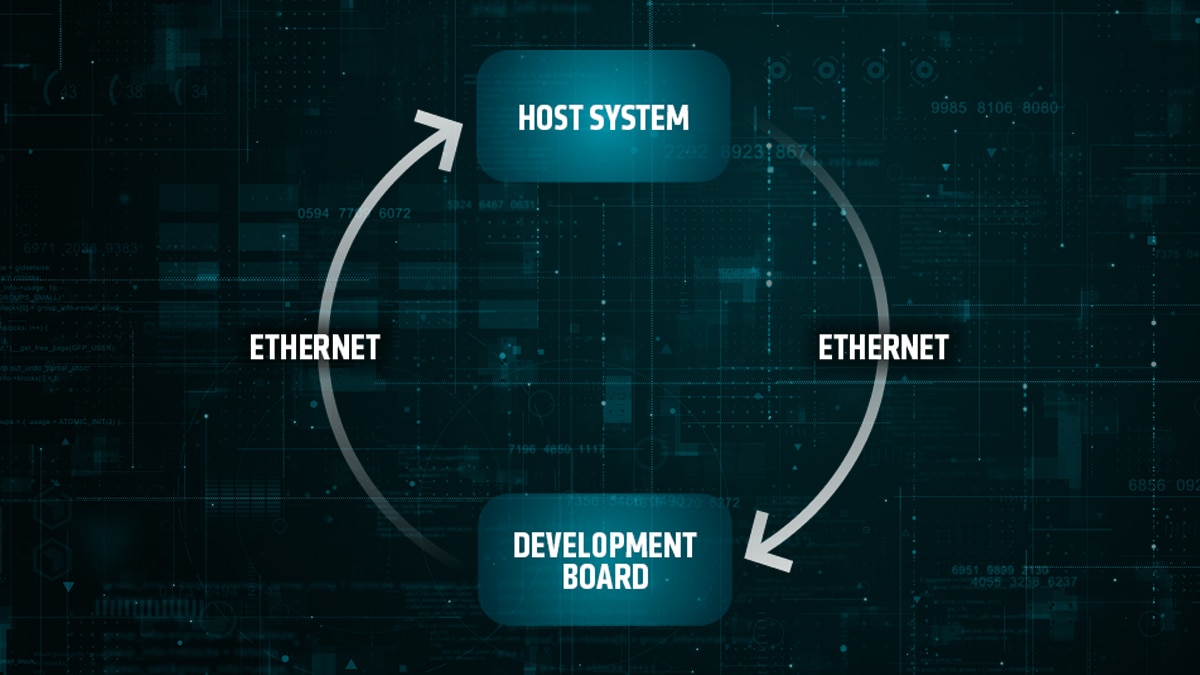
The round-trip path includes stimulus generation, Ethernet transmission, DMA transfer to the AI Engine PLIO interfaces, computation, DMA readback, Ethernet return, and result delivery. Total latency consists of kernel pipeline fill time plus approximately 2–5 µs of transport overhead. With large frames, four times the kernel frame size is a recommended starting point (DMA and TCP overhead becomes a negligible share of processing time, and sustained throughput approaches the memory bandwidth available to the Ethernet subsystem). After the test sequence, the getStats() API reports per-port DMA transfer counts and measured throughput for comparison with the design specification.
Designed for Both AI Engine and PL-Only Designs
Vitis HIL is built around the Vitis Subsystem (VSS), which packages AI Engine graphs and HLS PL kernels as a reusable IP block. Although the flow is designed primarily for heterogeneous systems, a VSS can also contain only HLS PL kernels. In that configuration, hil_gen generates a bitstream and the Vitis HIL server image that connect the PL kernels directly to the Ethernet-backed DMA infrastructure. The MATLAB® or Python™ APIs work the same way, allowing teams with traditional programmable logic DSP designs to use the same verification method and evaluation hardware without an AI Engine graph.
Vitis HIL provides a unified verification approach for designs ranging from PL-only fixed-point DSP implementations to full heterogeneous AI Engine and PL systems, with consistent tooling and host APIs across both.
The Hardware: Two Evaluation Kits, One Flow
Vitis HIL is fully supported on two AMD Versal™ evaluation kits. Both use the same 10-step workflow.
Supported Boards
VCK190 Evaluation Kit: Versal AI Core Series (VC1902). Purpose-built for aerospace & defense and low earth orbit (LEO) satellite DSP workloads where size, weight, and power (SWaP) constraints are critical: radar signal processing, sonar, SIGINT, and satellite payload applications.
VEK280 Evaluation Kit: Versal AI Edge Series (VE2802). Optimized for automotive and industrial edge applications: ADAS perception, sensor fusion, machine vision, and real-time signal processing before integration into a vehicle or industrial platform.
Both boards connect to the host through standard Ethernet and use the same MATLAB® or Python™ Vitis HIL APIs. Verification logic can therefore be reused across VCK190 and VEK280 targets, although the hardware design must be rebuilt for each selected device and board.
Who is Vitis HIL for?
Vitis HIL is designed for teams that need system-level validation beyond what software-only simulation can practically provide, including:
- Algorithm engineers validating throughput, latency, and numerical behavior before platform integration
- Signal processing engineers verifying waveform fidelity and deterministic latency for DSP workloads
- FPGA architects integrating AI Engine compute with PL-based routing, formatting, or protocol interfaces
- Verification engineers expanding test coverage with realistic data sets on real hardware
- System integrators validating end-to-end behavior across AI Engine and PL pipelines
Getting Started: Tools and Licensing
Vitis HIL is included with AMD Vitis 2026.1 and supports MATLAB® or Python™ host APIs for stimulus generation, result capture, and automated test execution. For detailed setup, supported data types, frame-size tuning, and optimization guidance, see the Vitis HIL User Guide (UG1865). For a practical walkthrough, Adam Taylor’s Hackster.io example demonstrates end-to-end verification of a polyphase channelizer using Vitis HIL on a VCK190 board.
Key Idea:
After the board is set up, routine test iterations can run from MATLAB® or Python™ without manual interaction with the hardware. When the design bitstream changes, the Vitis HIL workflow can script the update, restart the Vitis HIL server, and establish a new TCP connection, making the process suitable for automated and CI/CD environments.
Ready to validate on Real Silicon?
Learn more about Vitis HIL including a step-by-step walkthrough and how-to video.


Related Blogs
-
AMD and Advantech - Architecting the Next Generation of Regulated Casino Games
Discover how Advantech and AMD are redefining regulated casino gaming with Ryzen Embedded 8000 Series processors, integrated RDNA 3 graphics, XDNA AI acceleration, and purpose-built DPX platforms. The solution enables immersive multi-screen experiences, predictive maintenance, stronger security, lower power consumption, simplified designs, and long-term platform availability for gaming OEMs worldwide.
October 21, 2026
-
From AI That Answers to AI That Acts
Why physical AI requires a new definition of performance – one built around the whole system, not peak compute.
October 19, 2026
-
Running MolmoAct2 Robot Policy on an AMD Ryzen AI Max+ 395 Mini PC — ROCm Blogs
In this tutorial, users are introduced to a state of the art vision-language-action model and the steps to implement the model directly optimized for the AMD Ryzen AI Max+ 395 Computer.
September 29, 2026
-
AMD Expands Automotive-Grade FPGAs with Spartan UltraScale+ XA FPGAs for ADAS Applications
The Spartan™ UltraScale+™ XA device joins the AMD portfolio of automotive-grade, safe, and highly scalable FPGAs and adaptive SoCs.
September 29, 2026
-
From Sensor to Insight: Production-Ready Single-Chip Edge AI. Proven.
AMD Versal™ AI Edge Series Gen 2 and Vitis™ AI accelerate production-ready edge and physical AI. Learn how they speed up your deployment.
September 22, 2026
-
Enabling Physical AI Agents with Lemonade — ROCm Blogs
Learn to deploy local agents for interactive robot arm manipulation using the Lemonade framework.
August 24, 2026
-
IPMX Demystified: What We’ve Learned and How to Deploy
The Internet Protocol Media Experience (IPMX) has entered a new phase. Official IPMX testing and certification program is now live, and at ISE 2026 the industry unveiled its first wave of certified products. Manufacturers can now evaluate IPMX as a deployable standard rather than a promising framework. This article walks through what IPMX is, how the certification program works, what the first certified products tell us, what early deployments are showing, and how Adeas-Nextera FPGA IP cores running on AMD adaptive silicon can help manufacturers reach certifiable products faster.
August 03, 2026
-
Uniform x86 Cores for Real-Time AI: Reducing the Hybrid-Core Tax in Physical AI Systems
Build real-time physical AI systems with AMD Ryzen AI Embedded X100 processors, uniform x86 cores and reduced timing variability.
July 23, 2026